How to Bilateral Breathe in Freestyle

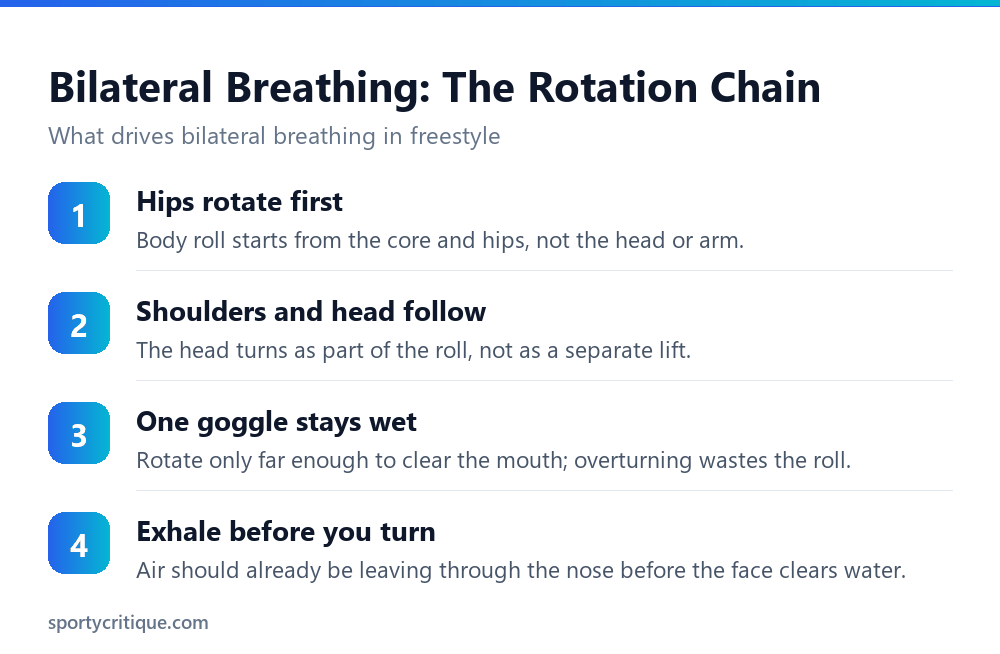
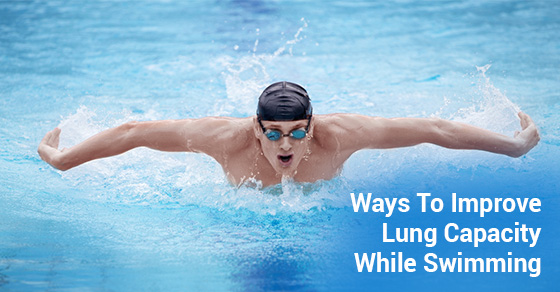
To bilateral breathe in freestyle, let the breath come from your body’s existing rotation instead of lifting or turning your head separately. As your hips and torso roll toward one side, your head rotates along with that roll just far enough to clear your mouth, usually on a three-stroke pattern that alternates sides every other breath. Exhale steadily underwater so you’re only inhaling when your face clears the surface, and keep one goggle in the water on every breath, both sides.
Most swimmers who struggle with bilateral breathing are trying to solve it as a head problem, consciously lifting or twisting the neck harder to reach air on the weaker side. That’s backward. Breathing to both sides works when the body’s rotation, which should already be happening every stroke regardless of whether you’re breathing, simply carries the head along with it. Fix the rotation and the breath on the weak side stops feeling like a separate, effortful action.
This guide covers the actual mechanics of executing bilateral breathing once you’ve already decided to work on it, not whether a beginner should start with it. If you’re still building basic air comfort in the water, breathing every stroke to one side first is the right call before adding a second side.
- →Bilateral breathing works when body rotation carries the head, not when the head lifts or turns on its own
- →A three-stroke pattern (breathing every third stroke, alternating sides) is the standard starting rhythm
- →Exhale underwater before the face clears the surface, so the breath in is quick and doesn’t delay the stroke
- →Keep one goggle in the water on every breath, to both sides, as a check that rotation isn’t excessive
- →The weak side almost always struggles because that side rotates less, not because the neck can’t reach as far
Table of Contents
Let Rotation Do the Work, Not the Neck
In an efficient freestyle stroke, the torso rotates roughly 30 to 45 degrees off horizontal on every stroke cycle, breathing or not. That rotation is what should carry the head to the surface on a breathing stroke. A swimmer whose stroke already rotates well on both sides has most of the work for bilateral breathing already done before adding the breath at all.
The problem shows up when a swimmer only rotates fully toward their strong breathing side and rotates less toward the other side, since that’s the side they’ve never needed to reach air from. Bilateral breathing then forces a choice: either the head lifts separately from an incomplete rotation, which strains the neck and throws off body position, or the rotation gets built out evenly on both sides, which fixes the root cause instead of working around it.
💡 Pro tip: A simple self-check: if the weak-side breath feels like a lift or a twist rather than a continuation of the roll already happening, the rotation on that side is incomplete. The fix is building symmetric rotation through drills, not trying to breathe harder or faster on that side.
Timing the Breath Within the Stroke
The breath begins as the recovering arm swings forward over the water and the opposite arm finishes its underwater pull. That’s the point where rotation naturally peaks toward the breathing side, giving the head the most clearance to reach air without any extra lifting motion. Breathing outside that window, too early or too late in the stroke cycle, forces the head to work against the rotation instead of riding it.
Exhalation should already be underway before the face clears the water, released steadily through the nose while the face is still submerged. Holding the breath underwater and then exhaling explosively at the surface wastes time that should go toward inhaling, and it’s one of the most common reasons a breath feels rushed or incomplete even when the rotation timing is otherwise correct.
⚠️ Watch out: Delaying the recovering arm’s forward swing to squeeze in a longer breath is a common compensation that breaks stroke rhythm. The breath should fit inside the existing stroke timing, not stretch the stroke to make room for the breath.
The Three-Stroke Pattern
The standard bilateral pattern breathes every third stroke, which alternates the breathing side automatically since each arm takes a turn as the “third” stroke in sequence. Some swimmers use a five-stroke pattern for longer, more aerobic swimming, trading total air intake for a more pronounced rotation and a longer stretch between breaths, though that trade-off makes less sense for anyone still building the base skill.
Drills That Build It
The side-kick breathing drill isolates head rotation from full-stroke timing, which makes it useful early on. Push off the wall on your side, bottom arm extended forward and top arm resting along your side, then kick while rotating only your head forward to breathe before returning face-down between breaths. Doing this on both sides separately shows clearly which side needs more work before combining it back into the full stroke.
A center-mount snorkel is useful earlier in the process, for a different reason: it removes breathing from the equation entirely so a swimmer can build even, symmetric rotation on both sides without needing to time a breath at all. A FINIS Original Center-Mount Swimmer’s Snorkel ($45.00) lets you feel whether your rotation is genuinely even side to side, since there’s no breath to mask a lazier roll on the weaker side. Once that symmetric rotation feels automatic, adding the bilateral breath back in tends to go faster than trying to fix rotation and breathing timing at the same time.
Counting strokes out loud or with a simple tap on each wall push-off keeps the three-stroke pattern honest, since it’s easy to unconsciously drift back to breathing only on the comfortable side once fatigue sets in during a longer set.
Common Bilateral Breathing Mistakes
- ✓Let hip and torso rotation carry the head to the surface
- ✓Exhale steadily underwater before the face clears
- ✓Keep one goggle in the water on every breath, both sides
- ✓Build symmetric rotation with drills before adding the breath
- ✕Lifting or twisting the head separately from the body’s roll
- ✕Holding the breath, then exhaling explosively at the surface
- ✕Over-rotating on the weak side to compensate for incomplete roll
- ✕Delaying the recovering arm to squeeze in extra breathing time
Why It Matters Beyond the Pool
Bilateral breathing has a practical use outside of stroke symmetry: it lets a swimmer check position and sight landmarks or other swimmers on either side without changing their breathing pattern to do it. A pool swimmer who only breathes to one side often never notices this limitation, since lane lines and walls provide enough reference. In open water, being able to breathe toward whichever side has useful information, a buoy, a kayak escort, another swimmer closing in, is a real tactical advantage, not just a technique exercise.
It also corrects a one-sided pull that single-side breathers tend to develop over time. Breathing consistently to one side encourages a slightly asymmetric stroke, since the body unconsciously favors the rotation pattern it uses most often. Bilateral breathing forces both sides to do equal work, which shows up as straighter, more efficient swimming even on lengths where no breath is taken at all.
Transitioning From One-Side Breathing
Most swimmers learning bilateral breathing aren’t starting from zero; they already breathe comfortably to one side and are adding a second. The most common approach is to keep the existing every-other-stroke pattern to the strong side for most of a set, then dedicate specific short intervals, a length or two at a time, entirely to bilateral breathing. Trying to switch the whole pattern over in a single session usually produces worse breathing on both sides rather than steady progress on the new one.
A useful progression is alternating full lengths: one length bilateral, one length back to the comfortable side, repeated through a set. That keeps total air intake manageable while still building real repetitions on the weak side, rather than abandoning bilateral breathing the moment a set gets hard and defaulting back to the easy side out of fatigue.
📊 Note: Fatigue is when old habits reassert themselves fastest. If bilateral breathing consistently falls apart specifically during the last quarter of a set, that’s normal early on and not a sign the technique work isn’t sticking; it just means endurance for the new pattern still needs to catch up to the technique itself.
Managing the Air-Shortage Feeling on the Weak Side
A mild sense of urgency when breathing to the weak side is common even after the rotation mechanics are technically correct, simply because the brain hasn’t logged as many repetitions of getting air from that side without issue. That feeling tends to fade with volume rather than with any specific technique fix, which is part of why drill repetition matters more here than in most other stroke corrections.
Swimmers who feel real panic rather than mild unfamiliarity on the weak side often benefit from backing up a step: return to the side-kick drill on that side alone, at an easy pace, without any pressure to hit a stroke count or pace target. Building comfort in isolation before reintroducing full-speed swimming keeps the weak side from becoming associated with stress, which otherwise makes the whole skill harder to learn than the mechanics alone would suggest.
Frequently Asked Questions
How long does it take to learn bilateral breathing?
It varies, but most swimmers who already have solid one-side breathing and decent rotation see real progress within a few weeks of consistent drill work. The weak side usually lags behind the strong side for a while even after the pattern feels generally comfortable.
Should I force bilateral breathing during a race or hard set?
Not necessarily. Many competitive swimmers default to bilateral breathing in training to build symmetry, then switch to breathing on their stronger side, sometimes every stroke, during an actual race or maximum-effort set where air intake matters more than symmetry in that moment.
Why does my weak side still feel harder even after practicing?
Incomplete rotation on that side is the most common cause, not a physical limitation. Isolating that side with a side-kick drill, without combining it into the full stroke yet, usually reveals whether the rotation itself is the bottleneck.
Is a three-stroke or five-stroke pattern better?
Neither is universally better; they serve different purposes. Three-stroke gives more air and works well as the default training pattern, while five-stroke suits longer aerobic swimming once the three-stroke pattern feels automatic and a swimmer wants a more pronounced rotation with less frequent breathing.
Does a snorkel actually help with learning to breathe on both sides?
Indirectly. A center-mount snorkel removes breathing from the drill entirely, which is useful for building the even, symmetric body rotation that bilateral breathing depends on. It doesn’t practice the breath itself, so it works best as a rotation-building step before or alongside actual bilateral breathing drills, not as a replacement for them.
As an Amazon Associate, we earn from qualifying purchases through links on this page.