Pool Cue Joint Types Explained: Wood-to-Wood, Metal, and Quick-Release


Pool cue joints come in three main types: wood-to-wood, where the shaft threads directly into wood with no metal collar for a softer, warmer hit; metal joints (stainless steel, brass, or phenolic), which play firmer and brighter; and quick-release systems like Uni-Loc, which use a precision pin-and-insert design that locks with a half-turn for fast assembly, common on travel and break/jump cues. None is objectively best; each trades hit feel against convenience and durability differently.
Joint type gets less attention than tip hardness or shaft taper when players shop for a cue, but it changes the feel of every single shot, not just the ones where it’s obviously relevant. The joint is the connection point where the shaft’s vibration either transfers cleanly into the butt or gets slightly absorbed and softened, and that difference is exactly what players mean when they describe one cue’s hit as “harder” or “softer” than another of similar weight and balance.
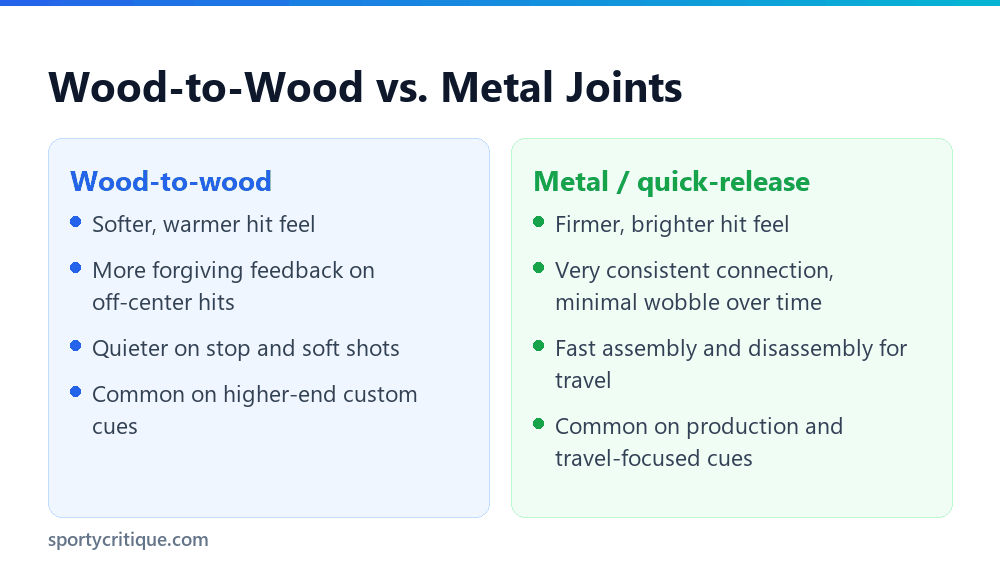
- →Wood-to-wood joints have no metal collar and produce a softer, warmer, more forgiving hit
- →Metal joints (stainless, brass, phenolic) play firmer and brighter, with a crisper feel on contact
- →Quick-release systems like Uni-Loc use a pin-and-insert design for fast, consistent assembly
- →Thread specs (5/16×18, 5/16×14, 3/8×10, radial) aren’t interchangeable between cues without matching hardware
- →Travel and break/jump cues favor metal and quick-release joints for durability and fast setup
Table of Contents
Wood-to-Wood Joints
A wood-to-wood joint threads the shaft’s tenon directly into the butt’s wood, with no metal collar sitting between the two pieces. That direct wood-on-wood contact is what produces the softer, rounder hit players associate with this joint style: less of the shot’s energy reflects sharply back through the cue, and more of it feels absorbed into a warmer, quieter response.
This joint style tends to show up on higher-end custom cues aimed at players who prioritize feel and touch over travel convenience or maximum durability. It’s also generally more forgiving on slightly off-center hits, giving more usable feedback through the cue rather than a sharp, punishing response to a mishit, which some players specifically value during long practice sessions focused on touch shots.
Metal Joints
Metal joints, made from stainless steel, brass, or phenolic resin, add a rigid collar between the shaft and butt. That rigidity is what produces the firmer, brighter hit these joints are known for, since less of the shot’s energy gets absorbed at the connection point compared to a wood-to-wood design.
Metal joints also hold up better to repeated hard use over time, resisting the wear that can eventually loosen a wood-to-wood connection. That durability is a big part of why metal joints are common on cues built for frequent breaking or heavy daily play, where consistent, unwavering connection matters more than the subtler feel advantages of wood-to-wood.
Quick-Release Systems
Quick-release joints, with Uni-Loc as the most widely recognized modern system, use a precision-engineered pin and insert rather than a fully threaded connection. A half-turn locks the pieces together with a tight, centered fit, dramatically speeding up assembly compared to a standard multi-turn thread, which matters most to players who break down and reassemble their cue frequently.
💡 Pro tip: Break and jump cues, which often need to be swapped in and out mid-match, lean heavily on quick-release joints for exactly this reason. A cue like the Players HXT-P1 Jump/Break Cue (Quick-Release Joints) ($363.17) uses interchangeable quick-release joints specifically so a player can switch shaft configurations fast during a match, something a standard threaded joint makes far more cumbersome.
Fit consistency on a quick-release system depends heavily on manufacturing precision, since the pin-and-insert tolerance is what determines whether the connection feels tight and centered or slightly loose over repeated use. A well-made quick-release joint holds its consistency for years; a poorly made one can develop play or wobble faster than either a wood-to-wood or standard metal-threaded joint would.
Radial Pin Joints
A radial pin joint is a variation that uses a short metal pin, typically stainless steel, set into a slightly recessed collar rather than a full-length threaded rod. It splits the difference between a standard metal-threaded joint and a wood-to-wood design: the metal pin adds durability and connection stability, while the shorter pin length and recessed design let more of the wood-to-wood contact area remain, softening the hit somewhat compared to a full-length metal joint.
This hybrid approach shows up on cues aimed at players who want some of wood-to-wood’s warmer feel without giving up all of metal’s durability advantage. It’s a middle-ground option rather than a strict upgrade over either pure design, and preference between a radial pin joint and a full wood-to-wood or full metal joint comes down to individual feel, the same way preference between the two original categories does.
How to Identify Which Joint Type You Have
Unscrewing the cue and looking directly at the joint face answers this quickly. A visible metal ring or collar where the shaft and butt meet indicates a metal joint; no metal ring, with wood visible all the way to the threads, indicates wood-to-wood. A quick-release system looks visually different from both, since it uses a short pin and a matching recessed insert rather than a fully threaded connection running the full depth of the joint.
Manufacturer documentation or the cue’s original product listing usually states the joint type and thread spec directly, which is the more reliable source than trying to identify it purely by eye, especially for a used cue purchased without documentation. When in doubt, a local cue shop or cuesmith can identify the exact joint type and spec in a few minutes, which is worth doing before ordering any replacement part sight unseen based on a guess.
Keeping a Joint in Good Condition
Threaded joints, whether wood-to-wood or metal, benefit from occasional light cleaning of the threads themselves, since dust and chalk residue can build up over time and make the connection feel gritty or slightly less secure than when the cue was new. A dry cloth or a small brush works for routine cleaning; avoid heavy lubricants unless the cue manufacturer specifically recommends one, since some lubricants attract more dust and debris than they prevent.
Quick-release systems generally need less routine maintenance, since there are no threads to clean, but the pin and insert should still be kept free of dust and grit for the connection to stay tight and centered. A joint that’s started to feel loose or develop play over time, regardless of type, is worth having checked by a cuesmith rather than continuing to play on it, since a worn joint changes how consistently the cue hits from shot to shot.
📊 Note: Never force a joint that doesn’t seem to thread or lock smoothly. Cross-threading a wood-to-wood or metal joint, or forcing a quick-release pin at the wrong angle, can damage the connection in a way that’s far more expensive to repair than the few seconds saved by rushing the assembly.
Storing a two-piece cue in a proper case, rather than leaving it assembled and leaning in a corner between sessions, also protects the joint indirectly by keeping dust and moisture away from the connection and reducing the chance of an accidental knock or drop damaging the threads or pin. A case is a small investment relative to the cue itself and pays off over the cue’s full lifespan, not just at the joint.
Thread Specs Aren’t Interchangeable
Common threaded pool cue joint specs include 5/16×18, 5/16×14, and 3/8×10, referring to the thread diameter and pitch of the connection. These aren’t universal; a shaft threaded for one spec physically won’t fit a butt threaded for another, which matters directly for anyone buying a replacement shaft separately from their existing butt rather than as a matched pair.
⚠️ Watch out: Always confirm the exact joint spec, not just “metal” or “wood-to-wood” in general terms, before buying a replacement shaft or a separate joint-compatible accessory. Two cues can share a joint category and still be physically incompatible if the thread spec doesn’t match.
Choosing a Joint Type for Your Game
- ✓Choose wood-to-wood if feel and touch matter more than travel convenience
- ✓Choose metal or quick-release for durability and frequent breakdown/reassembly
- ✓Confirm the exact thread spec before buying a separate replacement shaft
- ✓Match joint type to how the cue actually gets used, not just brand reputation
- ✕Assuming all metal joints feel and perform identically to each other
- ✕Buying a replacement shaft without confirming thread spec compatibility
- ✕Choosing a joint type purely on price without considering hit-feel preference
- ✕Expecting a cheap quick-release joint to match a precision system’s fit consistency
What This Looks Like on a Real Cue
A cue like the Action ACTBJZ Break/Jump Cue (Wood-to-Wood Joint) (price not returned by the API at time of writing; confirm the current listing) uses a wood-to-wood joint on a break/jump cue specifically, which is a less common pairing since break/jump cues more often favor metal or quick-release joints for durability under hard, repeated impact. It’s a useful example of how joint choice interacts with a cue’s intended purpose rather than being a fixed rule; the manufacturer prioritized a specific hit feel even on a cue category that typically leans toward maximum durability instead.
Frequently Asked Questions
Which joint type is best for a beginner?
There’s no wrong choice for a beginner specifically; joint type matters more to feel preference than to skill level. A standard metal-threaded joint on a mid-range production cue is a perfectly reasonable, durable starting point that doesn’t require thinking about joint type at all until preferences develop with experience.
Can I replace a wood-to-wood joint with a metal one?
Not without professional cue repair work, since it requires modifying the actual joint construction, not just swapping a part. This is a specialized cuesmith job, not a DIY project.
Do quick-release joints wear out faster than threaded joints?
Not inherently, though fit consistency depends heavily on manufacturing quality. A well-made quick-release system holds its tight fit for years; a poorly made one can develop play faster than a standard threaded joint would.
Does joint type affect how hard I can break with the cue?
Indirectly. Metal and quick-release joints generally hold up better to the repeated hard impact of breaking, which is why break-specific cues favor them, but joint type itself doesn’t directly add or subtract break power the way tip hardness or overall cue weight does.
What’s a radial pin joint compared to a standard metal joint?
A radial pin joint uses a shorter metal pin set into a recessed collar rather than a full threaded connection, blending some of wood-to-wood’s warmer feel with metal’s durability. It’s a middle-ground design, not a strict upgrade over either full wood-to-wood or full metal joints.
How do I know if my cue’s joint needs professional attention?
Any noticeable looseness, wobble, or grittiness in the connection that wasn’t there when the cue was newer is worth having checked by a cuesmith. Continuing to play on a worn joint changes how consistently the cue hits and can make the underlying problem worse over time.
None of these joint types is a universal upgrade over the others. The right choice depends on what a specific cue and player actually need: touch-focused practice, hard daily breaking, frequent travel, or some mix of all three, with the joint contributing its own small but real part to how the whole cue ultimately feels in a player’s hand shot after shot.
Handle the joint carefully, keep it clean, and it will outlast almost every other component on the cue.
As an Amazon Associate, we earn from qualifying purchases through links on this page.