Best Swim Fins for Technique Training


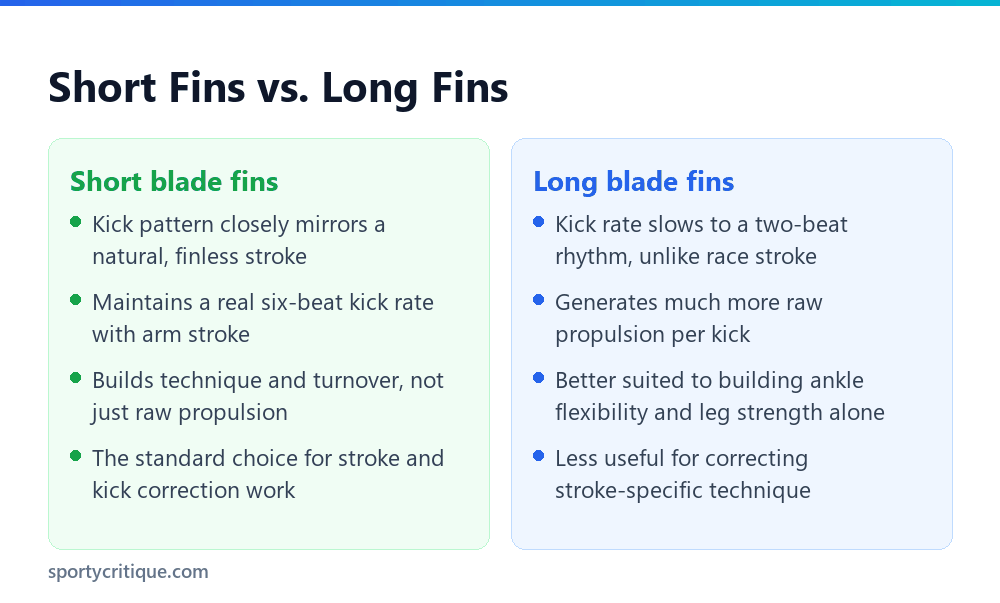
Short blade fins are the right choice for technique training specifically, since their kick pattern closely mirrors a swimmer’s natural, finless stroke, unlike long fins, which slow the kick rate down to a rhythm nothing like real swimming. Short fins reinforce a hip-driven kick, maintain a real six-beat kick rate alongside the arm stroke, and build the leg strength and turnover that actually transfers to unfinned swimming. Four real options from major swim brands are compared below.
Fins get bought for the wrong reason constantly: raw speed and the fun of moving fast through the water. That’s a real, legitimate use for long fins. But for a swimmer specifically working on stroke mechanics, kick timing, or body position, long fins actively work against the goal, since their slower kick rhythm doesn’t resemble anything a swimmer does without fins on.
- →Short blade fins mirror a natural, finless kick pattern; long fins slow the kick rate down to something unrealistic
- →Short fins maintain a real six-beat kick rhythm coordinated with the arm stroke, which long fins can’t do
- →The wedge-shaped sides on many short fins improve directional grip and control, not just speed
- →Short fins are more durable and compact than long fins, easier to pack and travel with
- →Higher kick tempo with short fins causes faster fatigue, which is expected, not a sign something’s wrong
Table of Contents
Why Short Fins Specifically, Not Just Any Fins
The core reason short fins work for technique correction comes down to kick rate. A short blade allows a swimmer to maintain something close to their normal six-beat kick, six kicks per arm-stroke cycle, coordinated the same way it would be without fins. Long fins, with their much larger surface area, generate enough propulsion per kick that the natural rhythm slows to a two-beat pattern that doesn’t resemble race-pace swimming at all.
That distinction matters directly for what fin training is supposed to accomplish. A swimmer using long fins to feel fast and build general leg strength is training something real, just not something that transfers cleanly back to an unfinned kick rhythm. A swimmer using short fins to reinforce a hip-driven kick and correct timing is training the actual pattern they’ll use in real swimming, just with a speed and propulsion boost layered on top of it.
What Short Fins Actually Fix
Short fins reinforce a kick that originates from the hips rather than the knees, since the added propulsion rewards the more efficient hip-driven motion and makes a knee-dominant kick feel noticeably less effective by comparison. Many short fin designs also include wedge-shaped sides that grip the water and improve directional control, giving a swimmer immediate feedback when their kick drifts off a straight, efficient line.
This combination, hip-driven power plus directional feedback, is exactly what makes short fins useful for isolated kick drills and technique-focused sets, not just general conditioning work. A swimmer drilling body position, rotation, or stroke timing with short fins gets real, immediate feedback on kick quality alongside whatever other technique element the drill targets.
4 Real Short-Blade Fins, Compared
📊 Note: All four are genuine short-blade technique fins from established swim brands, not general recreational or snorkeling fins mislabeled as training gear. Fit and foot pocket comfort vary more between these than actual performance, since the underlying short-blade principle is shared across all of them, which is why picking based on fit and available sizing is a reasonable way to break a tie between otherwise comparable options.
Who Actually Benefits From Short Fins
Short blade fins suit swimmers already comfortable with basic stroke mechanics who are working on refinement: kick timing, hip drive, body rotation, or race-pace tempo work. The higher kick rate and faster tempo engage muscles quickly and cause real fatigue faster than unfinned swimming, which means short fins reward a swimmer who already has reasonably solid technique to reinforce, rather than someone still learning the most basic mechanics from scratch.
A true beginner still building comfort and basic body position in the water often gets more benefit from a different tool, like a pull buoy or a kickboard used without fins at all, before adding the tempo and fatigue demands of short fin work. Short fins are a refinement tool, not typically a first tool for someone brand new to swimming technique.
Choosing the Right Fin
- ✓Choose short blade fins specifically for technique and kick-timing work
- ✓Expect faster fatigue at the higher kick tempo; that’s normal, not a problem
- ✓Check foot pocket sizing carefully, since fin fit varies more than performance between brands
- ✓Save long fins for pure speed, conditioning, or ankle-flexibility work
- ✕Buying long fins for technique correction and wondering why the kick rhythm feels off
- ✕Starting a true beginner directly on short fin technique work before basic comfort is built
- ✕Ignoring foot pocket fit and ending up with chafing or a loose, unstable fin
- ✕Assuming all short-blade fins perform identically regardless of brand or construction
Fit and Material Considerations
Silicone and rubber are the two dominant materials across short-blade training fins, with silicone generally offering a softer, more hypoallergenic fit and rubber offering strong durability at a typically lower price point. Neither material changes the fundamental short-blade training benefit; the choice mostly comes down to comfort preference and skin sensitivity.
A closed-heel foot pocket, common across most of these options, creates a more secure, chafe-resistant fit than an open-heel design, which matters more during longer technique sets where a fin that shifts or rubs becomes a real distraction from the actual drill. Trying a fin on with the actual swimwear and pool conditions in mind, rather than assuming one universal size fits every foot shape comfortably, avoids an uncomfortable surprise mid-set.
Drills That Actually Use Short Fins Well
Kick-only sets on the back or front, arms extended overhead in a streamlined position, isolate the leg drive short fins are meant to train without the arm stroke masking any kick inefficiency. Adding fins to this drill specifically, rather than swimming full stroke with them the whole session, keeps the training focused on the exact skill the fin is best suited to reinforce.
Fin-assisted sprint sets, short, fast repeats with full recovery between them, use the extra tempo and propulsion to let a swimmer feel a faster stroke rate than they can currently sustain unfinned, which can help build the neuromuscular pattern for eventually reaching that tempo without fins. This works specifically because short fins preserve a realistic kick rhythm; the same drill with long fins would teach a stroke rate and rhythm that doesn’t transfer back to real swimming.
💡 Pro tip: Removing fins partway through a set, finishing the same drill or distance without them immediately after a fin-assisted rep, helps a swimmer feel the direct contrast and consciously carry over whatever kick or tempo improvement the fins just reinforced. This on-off contrast is a common structure in competitive swim training specifically for that reason.
Building Up Fin Use Gradually
Introducing short fins gradually, starting with shorter kick sets before adding them to longer full-stroke work, lets the higher kick tempo and different muscle demand get introduced without overwhelming a swimmer who hasn’t trained at that intensity before. Jumping straight into long, fin-assisted full-stroke sets without this buildup often produces more fatigue and cramping than useful technique work.
Calf and foot cramping is a common early experience for swimmers new to fin work generally, since the fin changes the mechanical demand on those muscles in a way normal swimming doesn’t. This typically resolves within a few sessions as the relevant muscles adapt, and easing into fin volume gradually rather than starting with a long, intense session reduces how uncomfortable that adaptation period feels.
Basic Fin Care
Rinsing fins with fresh water after pool or open-water use removes chlorine or salt residue that otherwise degrades rubber and silicone materials over time, extending the usable life of a fin meaningfully with almost no effort. Drying fins out of direct sunlight before storage avoids the UV-driven material breakdown that direct sun exposure accelerates in most rubber and silicone sporting goods.
Checking foot pockets periodically for cracking or thinning, especially around the heel where flex stress concentrates most, catches a failing fin before it fails mid-set. A cracked foot pocket is a minor annoyance during a casual swim and a more serious problem during a structured, timed training set where equipment failure interrupts real training time.
Frequently Asked Questions
Are short fins or long fins better for beginners?
Neither is strictly better for a true beginner still building basic comfort in the water. Short fins suit swimmers refining technique they’ve already built some competence in, while a true beginner often benefits more from basic drills without fins at all before adding either type.
Why do my legs fatigue so fast with short fins?
This is expected, not a problem. Short fins maintain a higher kick tempo than unfinned swimming typically produces at the same effort level, which engages the muscles faster and leads to quicker fatigue during sustained sets.
Can I use short fins for actual racing, or just training?
Some short-blade fins, including several compared above, are explicitly built for both racing and training use. Fins aren’t legal in most competitive swim races themselves, so “racing” in this context usually refers to fin-assisted time trials or specific training formats rather than sanctioned competition.
Do I need a different fin for each swimming stroke?
Not typically. Short blade fins work across freestyle, backstroke, and butterfly kick technique work without needing a stroke-specific model, though breaststroke’s distinct kick generally isn’t trained with fins the same way the other strokes are.
Why do my calves cramp the first few times I use fins?
The fin changes the mechanical demand on the calf and foot muscles in a way unfinned swimming doesn’t, and this is a common adaptation response for swimmers new to fin work. It typically resolves within a few sessions; easing into fin volume gradually reduces how uncomfortable that adjustment period feels.
How long do swim fins typically last?
It varies with frequency of use and care, but rinsing fins after each use and storing them out of direct sunlight extends their usable life meaningfully. Checking the foot pocket periodically for cracking, especially around the heel, catches wear before it causes a failure mid-set.
The underlying choice is simple once the kick-rhythm difference is clear: pick short fins for technique work, save long fins for pure speed and strength sessions, and let the training goal of a given session decide which one comes out of the swim bag that day, rather than defaulting to whichever pair happens to be closest to hand.
That single decision does more for training quality than most of the other equipment choices combined.
As an Amazon Associate, we earn from qualifying purchases through links on this page.