Best Swim Paddles for Building Stroke Power


Among the best swim paddles for swimmers, the Speedo Nemesis Contour Paddles stand out for most people, since their contoured shape reduces wrist strain compared to a flat paddle design at a comparable size. Swimmers focused more on refining catch and pull technique than maximum resistance should look at the smaller TYR Catalyst paddles instead. Anyone newer to paddle training, or specifically working on catch-point feel rather than raw power, is better served starting with finger paddles like Speedo’s Swim Training Finger Paddles, which carry far less shoulder strain risk than full-hand designs.
Swim paddles add resistance and surface area to the hand, which builds pulling strength and can sharpen a swimmer’s feel for the water when used correctly. Used incorrectly, particularly with poor technique or excessive volume too soon, they’re also one of the more common causes of shoulder strain in competitive and serious recreational swimmers, which is exactly why choosing the right paddle type and using it with restraint matters as much as the paddle itself.
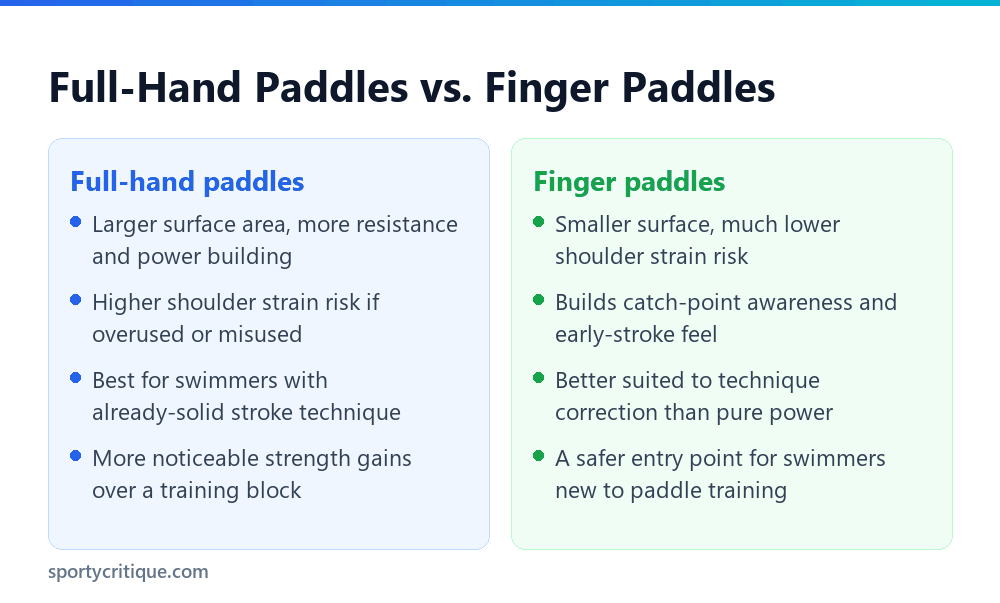
- →Full-hand paddles build more raw pulling power; finger paddles build catch-point feel with less strain
- →A contoured paddle shape reduces wrist strain compared to a flat paddle at a similar size
- →Paddles amplify existing technique, both good and bad, rather than fixing poor technique on their own
- →New paddle users should start with lower volume and smaller sizes to avoid shoulder strain
- →Finger paddles are a safer starting point than full-hand paddles for most swimmers new to paddle training
Table of Contents
How Paddles Actually Build Stroke Power
A paddle increases the surface area the hand presents to the water during the pull phase of a stroke, which increases resistance and forces the shoulder, back, and core muscles involved in pulling to work harder than they would swimming unassisted. Over a structured training block, this added resistance builds pulling strength that can translate into a more powerful stroke once the paddles come off.
⚠️ Watch out: Paddles amplify whatever technique a swimmer already has, including flaws. A swimmer with a dropped elbow or poor catch position doesn’t get that flaw corrected by paddle use; instead, the increased resistance can reinforce and even worsen the existing mechanical problem while adding real injury risk on top of it.
4 Real Options, Compared
📊 Note: The roughly $12 gap between the Sporti budget paddle and the Speedo Nemesis mainly reflects shape engineering aimed at wrist comfort, not a dramatic difference in raw resistance. Both are legitimate full-hand paddle options depending on budget.
Choosing Between Full-Hand and Finger Paddles
Full-hand paddles suit swimmers who already have solid stroke technique and are specifically looking to build additional pulling strength and power over a structured training block. The larger surface area does more work per stroke, which is exactly why it also carries more injury risk if technique breaks down under the added resistance, especially toward the end of a fatiguing set.
Finger paddles, covering only the fingers rather than the whole hand, add a smaller amount of resistance while sharpening a swimmer’s awareness of exactly where and how the hand first catches the water at the start of the pull. This makes them a better tool for technique correction and feel development than for pure strength building, and a meaningfully safer starting point for anyone new to paddle training generally.
Choosing the Right Paddle
- ✓Start with finger paddles or a smaller full-hand size if new to paddle training
- ✓Build up paddle volume gradually rather than jumping straight into full sets
- ✓Prioritize maintaining clean technique over maximum resistance
- ✓Stop immediately if shoulder discomfort develops during a paddle set
- ✕Jumping straight into large full-hand paddles without any prior paddle experience
- ✕Using paddles as a substitute for fixing underlying technique problems
- ✕Doing high-volume paddle sets before shoulder strength has adapted to the added load
- ✕Ignoring shoulder discomfort and pushing through a paddle set anyway
Avoiding Shoulder Strain From Paddle Use
Swimmer’s shoulder, a broad term covering several overuse injuries common in the sport, is specifically associated with excessive or poorly managed paddle use in a meaningful share of cases, since the added resistance increases load on the same rotator cuff and shoulder structures already under repetitive stress from normal swimming volume.
Limiting paddle volume, especially when first introducing them into a training routine, and paying close attention to any shoulder discomfort during or after a paddle set, are the two most practical ways to reduce this risk. A gradual increase in both paddle size and total volume over weeks, rather than an aggressive jump to maximum resistance and volume immediately, gives shoulder tissue time to adapt.
💡 Pro tip: Pairing paddle sets with a consistent shoulder-focused strength and mobility routine outside the pool, rather than relying purely on swimming volume to build shoulder resilience, is a commonly recommended practice among swim coaches and sports physical therapists specifically for reducing paddle-related injury risk.
Combining Paddles With Other Training Equipment
Pairing paddles with a pull buoy, which floats the legs and isolates the upper body pulling motion, is a common combination for swimmers specifically targeting arm and shoulder strength development separate from kicking. This combination concentrates the paddle’s added resistance entirely on the pulling motion rather than diluting the training stimulus across the whole stroke.
Using paddles alongside fins is less common and generally not recommended for beginners, since combining two pieces of resistance and assistance equipment at once makes it harder to isolate and correct any single technical issue that might emerge. Most coaches introduce paddles and fins as separate training tools initially, only combining them deliberately for more advanced, specific training goals later on.
Getting the Right Paddle Size
A paddle that’s too large for a swimmer’s hand and current strength level increases both injury risk and the tendency to compensate with poor technique, since the swimmer has to work harder than their current mechanics can properly support. Most manufacturers offer multiple sizes specifically to match paddle surface area to a swimmer’s hand size and experience level rather than a single one-size-fits-all option.
Younger or smaller-handed swimmers, and anyone brand new to paddle training regardless of hand size, generally do better starting with a small or medium size and moving up only once the current size feels comfortably manageable through a full training set without technique breakdown or shoulder discomfort.
Using Paddles for Specific Strokes
Freestyle and backstroke are the strokes most commonly trained with paddles, since their continuous, alternating arm pull pattern suits the added resistance naturally and gives clear, repeatable feedback on catch position stroke after stroke. Butterfly and breaststroke can also use paddles, but the simultaneous, symmetrical arm motion in both strokes makes any technique asymmetry between the left and right arm more immediately obvious, and sometimes more uncomfortable, than in the alternating strokes.
Coaches sometimes use paddle work specifically to diagnose this kind of left-right asymmetry in butterfly and breaststroke, since a swimmer favoring one arm’s catch position over the other shows up more clearly under the added resistance than it would swimming unassisted. This diagnostic use is somewhat different from the pure power-building goal most swimmers associate with paddle training.
Age and Development Considerations
Younger, still-developing swimmers generally benefit less from full-hand paddle training than older, more physically mature swimmers, since their smaller joints and still-developing shoulder structures carry a higher relative injury risk from the added resistance load. Many age-group swim programs delay meaningful paddle use until a swimmer reaches a certain age or technical level specifically for this reason.
Finger paddles are generally considered a safer option across a wider age range than full-hand paddles, given their significantly lower resistance and correspondingly lower joint stress, which is part of why many youth programs introduce finger paddles well before allowing younger swimmers to progress to full-hand designs.
Caring for Swim Paddles
Rinsing paddles with fresh water after use, particularly after swimming in chlorinated or salt water, prevents the straps and buckles from degrading prematurely, since both chlorine and salt residue can weaken rubber and plastic components over repeated exposure without regular rinsing. Letting paddles air dry fully before storing them in a swim bag also helps prevent the straps from developing an unpleasant odor over time.
Checking strap elasticity and buckle function periodically matters specifically because a strap that fails mid-set can release the paddle unexpectedly, creating a minor but genuinely disruptive safety issue during a fast-paced training set. Replacing a paddle once its straps show clear signs of wear is a low-cost fix compared to a mid-set failure during serious training.
Frequently Asked Questions
Are swim paddles safe for beginners to use?
With caution, yes, starting with a smaller size or finger paddles and limited volume. Jumping straight into large full-hand paddles as a beginner increases both injury risk and the chance of reinforcing poor technique.
Do paddles fix bad stroke technique?
No. Paddles amplify existing technique, including flaws, rather than correcting them. Technique issues need to be addressed directly through coaching and drills, not solved by adding resistance equipment.
What’s the difference between finger paddles and full-hand paddles?
Finger paddles cover only the fingers and build catch-point feel with less resistance and strain; full-hand paddles cover the whole hand and build more raw pulling power at higher injury risk if misused.
How often should I use paddles in training?
This varies by swimmer and coach, but starting with limited, occasional use and increasing gradually as shoulder strength adapts is safer than jumping into frequent, high-volume paddle sets immediately.
Can paddle use cause shoulder injuries?
Yes, excessive or poorly managed paddle use is a recognized contributing factor in swimmer’s shoulder and related overuse injuries, due to the added load on the rotator cuff and shoulder structures.
Should I combine paddles with a pull buoy?
Many swimmers do, since a pull buoy isolates the upper-body pulling motion the paddle is meant to target. Combining paddles with fins as well is less common and generally not recommended for beginners.
Swim paddles are a genuinely useful training tool when matched to a swimmer’s actual technique level and used with sensible volume progression, but they reward patience and restraint far more than aggressive, immediate maximum effort. Starting smaller, whether with finger paddles or a modest full-hand size, and building up deliberately protects both technique quality and shoulder health over a full training season.
Talking through a paddle plan with a coach before adding them into a regular routine, rather than picking a pair independently and guessing at appropriate volume, remains the safest path for any swimmer serious about using them well.
Whichever pair ends up in a swim bag, the same underlying principle applies: paddles reward a swimmer who already respects technique and pacing, and they punish one who treats them as a shortcut to instant power without the patience to build up to it properly.
As an Amazon Associate, we earn from qualifying purchases through links on this page.