Volleyball Substitution Rules Explained: Libero Swaps vs. Regular Subs

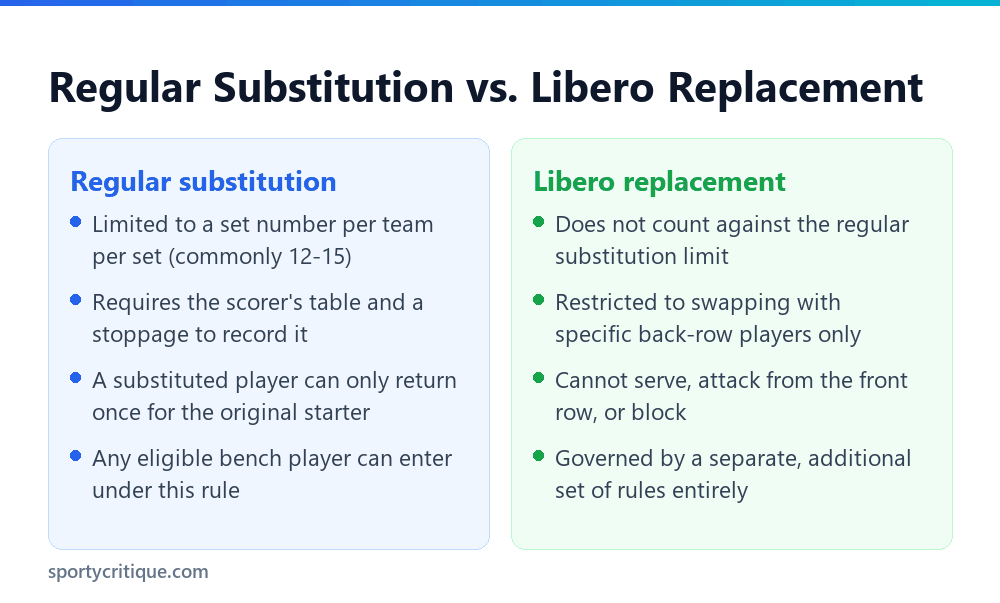
Volleyball substitution rules separate regular substitutions from libero replacements as two genuinely distinct systems. Regular substitutions are limited to a set number per team per set, commonly 12 in many leagues, and a substituted starter can only return to replace the same player who came in for them. Libero replacements operate under a completely separate rule set: they don’t count against the regular substitution limit at all, but they’re restricted to specific back-row swaps and the libero can never serve in most rule sets, attack from in front of the 10-foot line, or block.
Confusing these two systems is one of the most common rules misunderstandings among newer players, coaches, and even spectators, since both involve a player entering and leaving the game, but they operate under entirely different limits, restrictions, and procedures. Understanding the distinction matters practically for anyone tracking a team’s remaining substitutions during a close, late-set situation.
- →Regular substitutions are capped at a set number per team per set, commonly 12 in many leagues
- →Libero replacements do not count against the regular substitution limit at all
- →A libero can only swap with specific back-row players, never a front-row player
- →The libero cannot serve in most rule sets, attack in front of the 10-foot line, or block
- →A regularly substituted starter can only return to swap back in for the same replacement player
Table of Contents
Regular Substitution Limits
Most competitive volleyball rule sets cap regular substitutions at a specific number per team per set, commonly 12 under many standard rules, though this number can vary somewhat by league and level of play. Each substitution must be recorded at the scorer’s table during a stoppage in play, and exceeding the allowed limit results in a penalty or the substitution being disallowed entirely.
A specific restriction applies to how a substituted starter can return: they can only re-enter the set to replace the exact same player who substituted in for them originally, not any other player on the roster. This one-for-one return rule prevents teams from cycling through unlimited player combinations under the guise of legitimate substitutions.
⚠️ Watch out: Losing track of a team’s remaining substitution count in a long, close set is a real, practical risk, since a coach who wants to make a strategic change late in a set may find they’ve already used their full allotment without realizing it. Many coaching staffs assign a specific person purely to track this number throughout a match.
Libero Replacement Rules
The libero, a defensive specialist wearing a visually distinct jersey, operates under an entirely separate replacement system that exists specifically to let a team use a specialized defensive player without burning through their limited pool of regular substitutions. Libero replacements can happen an unlimited number of times within a set, since they don’t count against the regular substitution limit at all.
This freedom comes with real restrictions in exchange. A libero can only swap with a player in a back-row position, never a front-row player, and many rule sets require the libero replacement to happen only when the player they’re replacing is in a specific back-row position, most commonly a swap that happens as a player rotates into or out of the back row rather than at any arbitrary moment.
💡 Pro tip: Watching for the libero’s distinctly colored jersey makes it far easier for spectators and new players to track this separate substitution system during a live match, since the visual difference is deliberately built into the rules for exactly this recognition purpose.
What the Libero Can’t Do
The libero faces specific playing restrictions that don’t apply to any other position on the court. In most rule sets, the libero cannot serve at all, though some leagues and levels have modified this rule to allow limited libero serving in specific rotational positions, so checking the exact rules for a given league matters rather than assuming a uniform standard everywhere.
The libero also cannot attack the ball while it’s entirely above the height of the net when positioned in front of the 10-foot attack line, and cannot block or attempt to block at any point, regardless of court position. These restrictions exist specifically because the libero role was created to strengthen back-row defense and passing, not to add another attacking or blocking threat to the lineup.
Common Substitution Rule Confusions
- ✓Track regular substitution count separately from libero replacements
- ✓Confirm the current league’s exact substitution limit rather than assuming a universal number
- ✓Recognize the libero by their distinctly colored jersey during a match
- ✓Remember a substituted starter can only return for the same replacement player
- ✕Assuming libero replacements count against the regular substitution limit
- ✕Assuming every league uses an identical substitution limit and libero serving rule
- ✕Confusing a libero replacement with an ordinary player substitution
- ✕Losing track of remaining substitutions in a long, close set
How Substitutions Get Recorded
A regular substitution requires the incoming player to check in at the scorer’s table, where officials record the change and confirm the team hasn’t exceeded its allotted substitution count for the set. This procedural step, while sometimes viewed as a minor administrative formality, is what actually enforces the substitution limit and return restrictions discussed throughout this guide.
Libero replacements typically follow a lighter procedural requirement, sometimes not requiring the same formal check-in as a regular substitution in every league, since the position’s frequent, unlimited swapping within a set would create excessive stoppages if it required the same administrative process every single time. Specific procedural requirements still vary by league, so checking local rules avoids confusion at an actual match.
Why the Libero Rule Exists in the First Place
The libero position was introduced specifically to raise the overall standard of back-row defense and passing without forcing teams to sacrifice a regular substitution slot every time they wanted a specialized defensive presence on the court. Before the rule’s introduction, teams had to choose between a stronger all-around attacking lineup or dedicating scarce regular substitutions purely to defensive specialization.
This rule change is widely credited with raising the overall quality and rally length of competitive volleyball, since teams could now field a genuinely specialized defensive player without the substitution-limit tradeoff that previously discouraged this kind of positional specialization. Understanding this history helps explain why the libero rules are structured so differently from every other substitution on the court.
Exceptional Substitutions: Injury and Expulsion
Most rule sets include a provision for an exceptional substitution beyond the normal limit when a player is injured and physically unable to continue, or in the rarer case of a player being expelled or disqualified from the match by an official. This exceptional substitution doesn’t require the incoming player to be a like-for-like replacement in position or role, unlike a standard substitution’s stricter return requirements.
Officials typically require documented confirmation of the injury or the specific disciplinary action before granting this exception, since it exists specifically for genuine emergencies rather than as a loophole to circumvent the normal substitution limit. A team can’t claim an exceptional substitution simply because they’ve already used their full regular allotment and want to make another strategic change.
The Captain’s Role in Substitutions
In most competitive settings, only the team captain or head coach can formally request a substitution from the officiating crew, rather than any player deciding independently to swap themselves out mid-rally. This formal request-and-approval process, however brief in practice, keeps substitutions properly recorded and prevents disputes later in the match about whether a specific substitution was actually authorized.
Coaches typically communicate a planned substitution to the captain or directly to the second referee during a timeout or a natural break in play, rather than attempting to make the request while the ball is live. Understanding this communication chain helps new players and spectators follow why a substitution sometimes appears to happen instantly and other times seems to involve a brief delay while officials confirm the details.
Youth and Recreational League Variations
Youth and recreational leagues frequently modify standard substitution rules to prioritize playing time and development over strict competitive structure, sometimes requiring every rostered player to see a minimum amount of court time regardless of the coach’s strategic preferences. These modified rules can look quite different from the standard system described throughout this guide, so parents and new coaches should specifically check their league’s own rulebook rather than assuming standard competitive rules apply.
Some youth leagues also simplify or entirely omit the libero position and its associated replacement rules, given the added complexity for younger, less experienced players and officials still learning the sport’s broader rule set. This simplification is a deliberate teaching choice in many programs, with the full libero system typically introduced only once players move into more competitive, older age divisions.
Using Substitutions Strategically
Coaches often reserve a portion of their regular substitution allotment specifically for late-set situations, bringing in a stronger server for a critical point or a more experienced blocker against a specific opposing hitter, rather than spending substitutions early in a set on less critical moments. This kind of substitution budgeting becomes a real strategic skill at higher levels of competitive play.
Libero replacements, since they don’t draw from this same limited budget, get used far more liberally throughout a set, often on every single rotation cycle as the libero swaps in and out with the specific back-row player they’re paired with. This difference in usage frequency is itself a clear, practical illustration of why the two systems exist separately rather than as one unified substitution rule.
Frequently Asked Questions
Do libero replacements count against my team’s substitution limit?
No. Libero replacements are governed by a completely separate rule system and do not count against the regular substitution limit for the set.
How many regular substitutions are teams typically allowed per set?
Commonly 12 under many standard rule sets, though this number can vary by league and level of play, so checking the specific rules for a given competition matters.
Can the libero ever serve?
In most standard rule sets, no. Some leagues and levels have modified this to allow limited libero serving in specific rotational positions, so it varies by the exact rules in use.
Can a substituted starter come back into the set?
Yes, but only to replace the exact same player who substituted in for them originally, not any other player on the roster.
Why does the libero wear a different colored jersey?
To make the position easily identifiable to officials, players, and spectators, since the libero operates under a separate set of rules and restrictions that need clear visual recognition during play.
Can the libero attack or block?
The libero cannot block at any point and cannot attack the ball while it’s entirely above the net height when positioned in front of the 10-foot attack line.
Reading a scoreboard or a broadcast graphic that tracks substitutions makes considerably more sense once a viewer understands why the libero’s swaps never seem to reduce the team’s visible substitution count the way an ordinary player change does.
Keeping regular substitutions and libero replacements mentally separate, two different systems with two different sets of rules, clears up the large majority of substitution confusion that trips up newer players, coaches, and spectators alike. Once that distinction is clear, the specific numeric limits and positional restrictions are easy details to look up for any given league.
New players and parents following a match don’t need to memorize every procedural detail covered here to enjoy or understand the game, but knowing that these are two separate systems, with two separate purposes, clears up the single most common source of substitution confusion at every level from youth recreation leagues up through elite competitive play.
As an Amazon Associate, we earn from qualifying purchases through links on this page.