Badminton Doubles Serving Rules: Who Serves, Court Order, and Faults

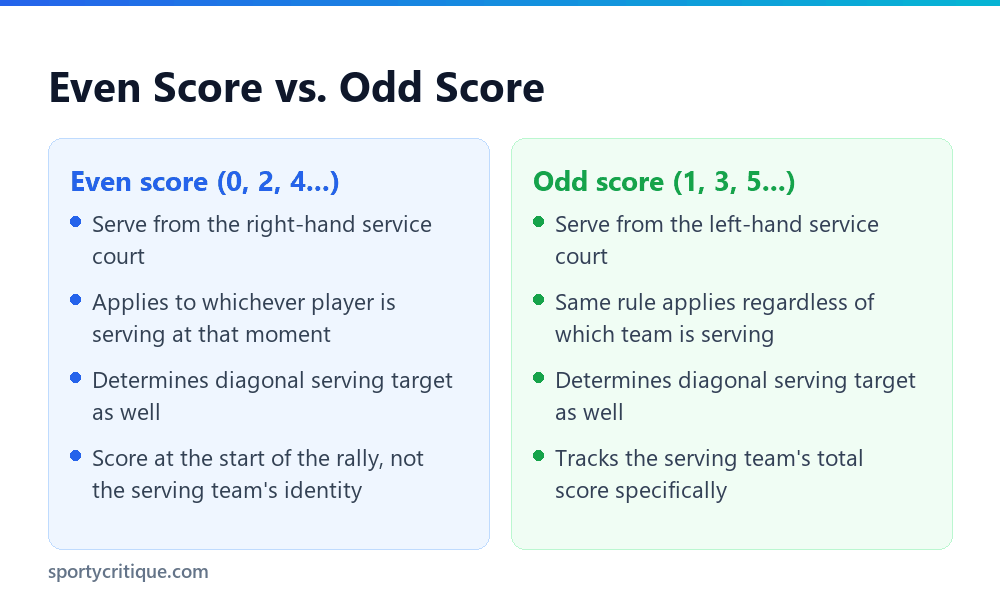
Badminton doubles serving rules are governed primarily by the serving team’s score: an even score means serving from the right-hand service court, an odd score means serving from the left. Within a team, whichever player is positioned in the correct service court for the current score is the one who serves, so you never need to memorize an order. Only the receiving player standing diagonally across from the server receives that serve, and a shuttle hit by the receiver’s partner is a fault (Laws 11 and 13).
Doubles serving has more moving parts than singles serving, because it combines score-based court positioning, rally-point scoring, and specific serve faults. Breaking the system down piece by piece removes most of the confusion. The rules below follow the BWF Laws of Badminton (Statutes Section 4.1), mainly Laws 9, 11, 12 and 13.
- →Even score means serve from the right court; odd score means serve from the left
- →Whichever player is standing in the correct court for the score serves, so you never need to memorize an order
- →Only the diagonally positioned receiver can legally return the serve, not their partner
- →Under rally-point scoring, the serve passes to the opposing side whenever the serving side loses a rally
- →Common errors include serving from the wrong court and the receiver’s partner returning the serve
Table of Contents
Court Position Determined by Score
The serving team’s score, not the game’s total point count or either team’s identity, determines which service court the serve comes from: an even score, 0, 2, 4, and so on, means serving from the right-hand court, while an odd score, 1, 3, 5, means serving from the left.
⚠️ Watch out: A common beginner mistake is tracking the total combined score of both teams rather than specifically the serving team’s own score when determining which court to serve from. Only the serving team’s current score matters for this specific rule.
This same even-right, odd-left logic determines where the serve must land diagonally as well, since a serve always travels diagonally across the court to the opposite service box, keeping the geometric relationship between server position and target consistent throughout a match.
Which Partner Serves
The Laws do set a sequence of serving (Law 11.4), but you do not need to memorize it. Because the serving side’s score decides the service court, whichever partner is standing in the correct court for that score is the one who serves that rally.
When the serving side wins a rally, the same player serves again, now from the other service court, and the two partners swap courts. The serve only passes to the opponents when the serving side loses a rally, and it is the score that decides the court every time.
💡 Pro tip: Thinking of court position, not a person, as what determines who serves removes much of the confusion new players have around this rule. Whoever is standing correctly positioned serves; it’s not about remembering whose “turn” it supposedly is.
Who Can Legally Receive the Serve
Only the receiving player standing diagonally across the court from the server, in the corresponding service box, is eligible to return that specific serve. If the shuttle is hit by the receiver’s partner instead, it is a fault under Law 13, even if the partner is better positioned to reach it.
The serve always goes diagonally, so the diagonal receiver is the only player who can return it without a fault.
Serve Changes Under Rally-Point Scoring
Modern badminton uses rally-point scoring, meaning a point is scored on every single rally regardless of which team served, and the serve passes to the opposing team immediately whenever the serving team loses a rally, a simpler system than older scoring formats that only awarded points to the serving team specifically.
When the serve passes to the opposing team, that team’s own even-or-odd score at that moment determines their serving court, following the exact same logic already covered, just applied to whichever team has newly gained serving rights rather than the team that just lost the rally.
Common Doubles Serving Mistakes
- ✓Track your own team’s score specifically, not the combined total, for court positioning
- ✓Remember that court position, set by the score, determines which partner serves
- ✓Confirm only the diagonal receiver can legally return the serve
- ✓Recheck serving court position immediately after any change of serve
- ✕Confusing the combined score of both teams with your own team’s specific score
- ✕Trying to memorize a serving order instead of checking the score
- ✕Letting the receiver’s partner hit a serve meant for the diagonal receiver
- ✕Forgetting to reposition correctly when the serve changes teams mid-game
Common Serve Faults and Errors
📊 Note: Some of these faults, like the serve height rule, have been adjusted over the years by international badminton’s governing rules, so double-checking the exact current standard for a specific league or competition avoids relying on an outdated version of a specific serve rule.
A Practical Example Walkthrough
Consider a doubles game starting 0-0: the serving team’s score is even, so their server starts in the right court, serving diagonally to the right court of the receiving team. If the serving team wins the rally, their score becomes 1, an odd number, so the same server now moves to the left court to serve the next point.
If the serving team instead loses that first rally, the other team scores a point and the score becomes 0-1 in their favor. They gain the serve, and because their score is now 1, an odd number, whichever of their players is positioned in their left court serves next. This example illustrates how the rule applies consistently regardless of which team is currently serving.
How Doubles Serving Differs From Singles
Singles serving uses the same even-right, odd-left court logic based on score, but without the added complexity of partner positioning, since a singles player always serves and receives personally rather than sharing that responsibility with a teammate positioned elsewhere on the court.
This shared responsibility in doubles is exactly what creates the additional rules around which partner serves and which partner can legally receive, rules that simply don’t exist in singles play since there’s only one player per side to consider at any given moment.
Where the Non-Serving Partner Stands
The server’s partner can stand anywhere within their own team’s court, as long as they don’t unsight the opposing server or receiver (Law 9.5).
Similarly, the receiving player’s partner may stand anywhere in their court as long as they do not unsight the server, and the shuttle must be returned by the designated receiver, reinforcing the same principle that only the designated server and receiver actively participate in that specific serve, with both partners positioned to avoid disrupting the process.
Service Order at the Start of a Match
At the very start of a match, the team winning the pre-match toss or coin flip typically chooses whether to serve first, receive first, or pick a specific side of the court, with the remaining choice going to the opposing team. The team serving first always starts serving from the right court, since the game begins at 0-0, an even score.
Lets During a Serve
A let, a rally that’s stopped and replayed without penalty, can occur around a serve for several reasons, including a server serving before the receiver was ready, or both server and receiver committing a fault on the serve at the same time. A shuttle that is caught in the net during the serve itself is a service fault under the Laws of Badminton, and it only becomes a let if it happens after the serve has been returned. Our upcoming guide to badminton let vs fault covers the difference in detail.
Understanding the difference between a let, which simply replays the point with no change to score or serving position, and a fault, which does end the rally and often changes serving rights, clarifies why some serve-related stoppages don’t actually affect the score or serving situation at all.
Checking Specific Format Rule Variations
While the core even-right, odd-left logic remains consistent across nearly all standard badminton formats, some recreational or simplified formats used in casual play or certain school programs occasionally modify serving rules for simplicity, particularly for younger or newer players still learning the sport’s broader rule set.
Confirming the specific serving rules in use for a given league, tournament, or casual game before relying entirely on the standard rules covered in this guide avoids confusion in a setting that’s deliberately using a modified or simplified format for its own specific reasons.
A Quick Worked Example
Say your pair serves first at 0-0. The server stands in the right service court and serves diagonally. If your side wins the rally, the score is 1-0, so the same server moves to the left court and serves again. If your side wins again, it is 2-0, and the server moves back to the right court.
Now suppose the opponents win the next rally. They gain the serve, and whoever stands in the correct court for their own score, even on the right and odd on the left, serves. Following the score this way means nobody needs to remember who served last, only what the score is.
If a team is unsure whether they are in the right court during a casual game, the simplest check is to say the serving side’s score out loud before the serve. An even score means the right court, and an odd score means the left. That one habit prevents most court mix-ups.
Frequently Asked Questions
How do I know which court to serve from in doubles?
Check your own team’s current score specifically: an even score means serve from the right court, an odd score means serve from the left.
Do I have to memorize who serves next in doubles?
No. The Laws set a serving sequence, but the score drives it. Whichever partner is standing in the correct service court for the serving side’s score serves that point.
Can my partner return a serve meant for me?
Not without a fault. Only the receiving player standing diagonally across from the server should return that serve, and a shuttle hit by the receiver’s partner is a fault.
What happens to serving position when the serve changes teams?
The newly serving team’s own current score determines their serving court, following the same even-right, odd-left rule applied to whichever team has just gained serving rights.
Do all badminton serve faults still apply the same way today?
Some specifics, like exact serve height rules, have been adjusted over time by international governing bodies, so checking current rules for a specific league avoids relying on outdated standards.
What counts as a fault if the receiver’s partner hits the serve?
Under Law 13, a shuttle hit by the receiver’s partner during the serve is a fault, and the serving side wins the point.
Once the underlying logic, score determines court, court position determines server, and only the diagonal receiver can return, clicks into place, doubles serving stops feeling like an arbitrary set of rules to memorize and becomes a straightforward, consistent system to apply in any match.
New doubles players who take a few minutes to internalize this system, rather than trying to memorize each individual rule as an isolated fact, find that the whole structure makes intuitive sense once the score-to-court relationship becomes second nature during actual, live match play rather than a rule that has to be looked up or debated separately for each and every single point of a full match.