Best Pull Buoys and Kickboards for Swim Training


The best pull buoy kickboard set for most swimmers is a dedicated pair, a Speedo pull buoy for isolating upper-body pulling technique and an Aquapella kickboard for isolating kick work, bought either separately or as a matched budget set like the Motionchic combo. Swimmers wanting a single, more compact piece of equipment that handles both jobs should consider the Arena Pull Kick II, a genuine 2-in-1 tool that functions as both a pull buoy and a kickboard depending on how it’s held.
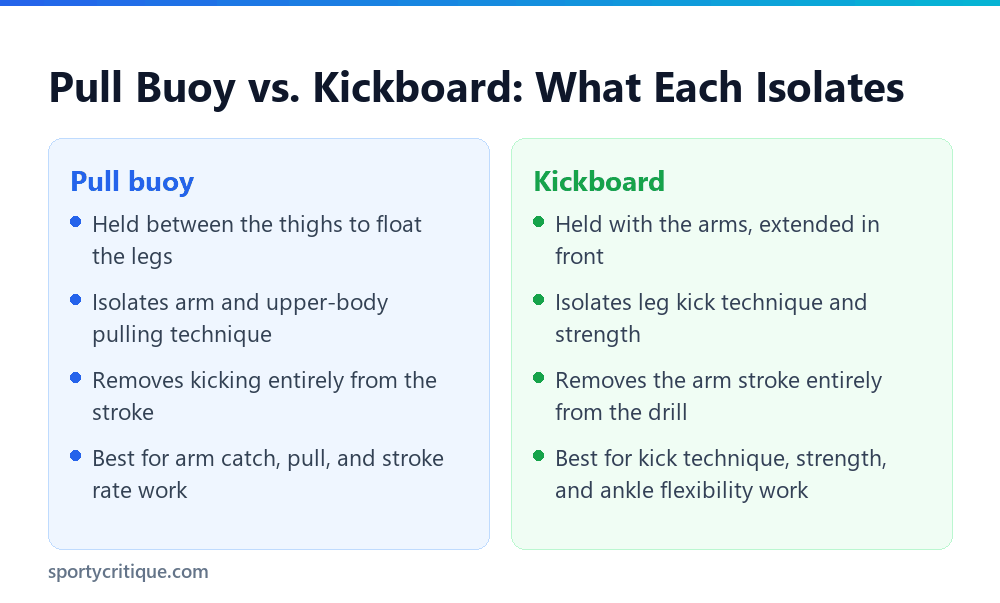
Pull buoys and kickboards serve opposite but complementary purposes: a pull buoy removes the kick entirely to isolate arm and pulling technique, while a kickboard removes the arm stroke entirely to isolate kick technique. Most structured swim training programs use both tools regularly, which is why owning at least one of each, whether separately or in a 2-in-1 design, covers the most common technique-isolation drills a swimmer will actually use.
- →A pull buoy isolates arm and pulling technique by removing the kick from the stroke entirely
- →A kickboard isolates kick technique by removing the arm stroke entirely
- →A 2-in-1 tool like the Arena Pull Kick II handles both jobs in a single, more compact product
- →Buying a matched set is often more cost-effective than two completely separate purchases
- →Both tools work best paired with actual technique drills, not just casual, unstructured use
Table of Contents
How a Pull Buoy Actually Helps Training
A pull buoy, held between the thighs, floats the legs and hips without any kicking effort, which isolates the arm stroke and lets a swimmer focus entirely on catch position, pull path, and stroke rate without the kick contributing to or masking any technique issues in the upper body.
This isolation is particularly useful for identifying and correcting a specific arm-stroke flaw that might otherwise be compensated for or hidden by a strong kick during normal, full-stroke swimming. Removing the kick entirely forces the arm stroke to do all the propulsive work, making any weakness immediately obvious.
How a Kickboard Actually Helps Training
A kickboard, held with the arms extended in front while the legs do all the propulsive work, isolates kick technique the same way a pull buoy isolates the arm stroke, letting a swimmer focus specifically on kick mechanics, ankle flexibility, and leg strength without the arms contributing to forward movement.
⚠️ Watch out: Using a kickboard with poor body position, letting the hips and legs sink too low in the water rather than maintaining a horizontal, streamlined position, reinforces bad habits rather than building good kick technique. Body position matters as much as leg movement itself during kickboard drills.
4 Real Options, Compared
📊 Note: The Arena Pull Kick II costs more than either individual Speedo or Aquapella product alone, but less than buying both separately at their combined price, making it a reasonable middle-ground choice for swimmers wanting to minimize the total number of separate items in their swim bag.
2-in-1 Tool vs. Two Separate Products
A 2-in-1 tool like the Arena Pull Kick II saves space in a swim bag and reduces the total number of items to keep track of, a genuine convenience for swimmers who travel to different pools or training locations regularly and want to minimize equipment they need to carry and manage.
Two separate, dedicated products, a purpose-built pull buoy and a purpose-built kickboard, sometimes perform each specific job slightly better than a combined design that has to compromise somewhat between two different functions. This difference is usually subtle enough that it shouldn’t be the deciding factor for most recreational or moderately competitive swimmers.
Choosing the Right Setup
- ✓Choose a 2-in-1 tool if minimizing swim bag clutter and cost matters most
- ✓Choose separate dedicated products if maximizing each tool’s specific performance matters more
- ✓Maintain proper body position during kickboard drills, not just leg movement alone
- ✓Use both tools as part of structured technique drills, not just casual pool time
- ✕Assuming any pull buoy or kickboard automatically fixes technique without deliberate drill focus
- ✕Letting hips sink during kickboard work, reinforcing poor body position habits
- ✕Buying premium versions of either tool before confirming basic need and use frequency
- ✕Using only one tool exclusively when both isolation types offer real, complementary training value
Sizing and Fit Considerations
Most pull buoys and kickboards for adults come in a single, general size that fits a wide range of body types reasonably well, though swimmers with notably smaller or larger builds, particularly younger swimmers, may find a youth-specific kickboard, sized smaller than a standard adult board, more comfortable and easier to control.
A pull buoy that’s too large can feel awkward and unstable between the thighs, while one that’s too small may not provide enough flotation to fully remove kicking effort from the drill. Most standard one-size buoys work fine for the large majority of adult swimmers, but checking specific product dimensions matters more for younger or smaller-framed swimmers.
Combining With Paddles and Fins
Pairing a pull buoy with swim paddles, discussed in more detail in other swim equipment content on this site, concentrates resistance entirely on the arm-pulling motion the pull buoy already isolates, a common combination for swimmers specifically targeting upper-body strength development.
Fins paired with a kickboard similarly concentrate added propulsion and resistance on kick technique work, though beginners should introduce this combination gradually rather than immediately, since fins change kick mechanics enough that a beginner benefits from first developing basic kickboard technique without the added assistance fins provide.
Material and Buoyancy Differences
Pull buoys and kickboards are typically made from closed-cell foam, chosen specifically for its buoyancy and resistance to water absorption over repeated use, though foam density varies between products and affects how much flotation a specific piece of equipment actually provides.
A pull buoy or kickboard that’s absorbed water over time, common with lower-quality foam or after years of heavy use, provides noticeably less flotation than a newer, fully buoyant product, which is worth checking for periodically if a piece of equipment that used to feel effective starts feeling less supportive than it once did.
Specific Drills Worth Trying
A simple pull buoy drill, swimming freestyle with the buoy between the thighs while focusing purely on catch position and pull path for a set distance, builds direct awareness of arm technique that’s harder to isolate during normal, full-stroke swimming where the kick contributes to overall propulsion.
A kickboard drill focusing specifically on ankle flexibility, pointing the toes and keeping the kick compact and originating from the hips rather than the knees, addresses a common technical flaw that’s much easier to isolate and correct with the arms out of the equation entirely during dedicated kickboard work.
💡 Pro tip: Combining short pull buoy sets and short kickboard sets within the same practice session, rather than using only one tool per session, keeps both isolation types in regular rotation without requiring separate, dedicated practice days for each specific drill type.
When These Tools Aren’t the Right Choice
Relying too heavily on pull buoy and kickboard drills at the expense of full-stroke swimming practice can leave a gap between isolated technique work and how that technique actually integrates into normal, coordinated swimming, since full-stroke swimming requires arms and legs to work together in a way neither isolation tool practices directly.
Most coaches recommend using these tools as a meaningful but limited portion of overall training volume, not the majority of practice time, ensuring a swimmer spends adequate time practicing the full, integrated stroke alongside the isolated technique work these tools specifically provide.
Using These Tools With Youth and Beginner Swimmers
Younger and beginner swimmers benefit from these isolation tools just as much as more advanced swimmers, though instruction and supervision matter more at this stage to ensure the isolated practice actually reinforces correct technique rather than allowing poor habits to develop unsupervised during independent tool-assisted practice.
A youth-sized kickboard specifically, smaller and more proportional to a younger swimmer’s body than a standard adult board, helps a beginner maintain better body position and control during kickboard drills than an oversized adult board would allow for a smaller-framed young swimmer.
Caring for Foam Training Equipment
Rinsing pull buoys and kickboards with fresh water after use in chlorinated or salt water extends the foam’s usable life and prevents chemical residue buildup that can gradually degrade the material’s surface and buoyancy properties over repeated exposure without regular rinsing.
Storing this equipment out of direct, prolonged sunlight when not in use also helps prevent the foam from becoming brittle or discolored faster than normal use alone would cause, a small habit that meaningfully extends the useful life of what’s otherwise a relatively inexpensive but regularly used piece of training equipment.
Frequently Asked Questions
Do I need both a pull buoy and a kickboard?
For well-rounded technique work, yes. Each isolates a different part of the stroke, arm pulling versus leg kicking, and most structured training programs use both regularly.
Is a 2-in-1 tool as good as two separate products?
It’s a reasonable compromise that saves space and cost, though dedicated separate products sometimes perform each specific job slightly better. The difference is usually subtle for recreational swimmers.
Why do my hips sink when I use a kickboard?
Poor body position during kickboard drills is common and reinforces bad habits rather than good kick technique. Focusing on maintaining a horizontal, streamlined position matters as much as the kick itself.
What size pull buoy or kickboard should I buy?
Most adults do fine with standard one-size products. Younger or smaller-framed swimmers often benefit from youth-specific sizing rather than a standard adult-sized product.
Should beginners use fins with a kickboard right away?
It’s generally better to develop basic kickboard technique first before adding fins, since fins change kick mechanics enough that beginners benefit from a more gradual introduction.
Can I use a pull buoy for every stroke, not just freestyle?
Yes, pull buoys work for isolating arm technique across multiple strokes, though freestyle and backstroke are the most common strokes practiced this way.
Whether choosing dedicated separate products or a combined 2-in-1 tool, having both types of isolation available in a swim bag covers the most common technique-focused drills a swimmer will actually use across a typical training season, at a total cost that remains modest regardless of which specific combination gets chosen.
None of this equipment does the actual technique work on its own. A pull buoy or kickboard creates the isolated conditions where a specific flaw becomes visible and correctable, but turning that opportunity into real improvement still depends on deliberate attention during each drill rather than passive repetition alone without any real focus on what’s actually changing stroke to stroke.
A coach or training partner watching specifically for the technique element a given drill is meant to isolate provides feedback that self-assessment alone often misses, which is why the most effective use of either tool usually happens within a structured practice, not solo, unguided pool time.
As an Amazon Associate, we earn from qualifying purchases through links on this page.