How to Convert a Pool Table Into a Shuffleboard Combo Table


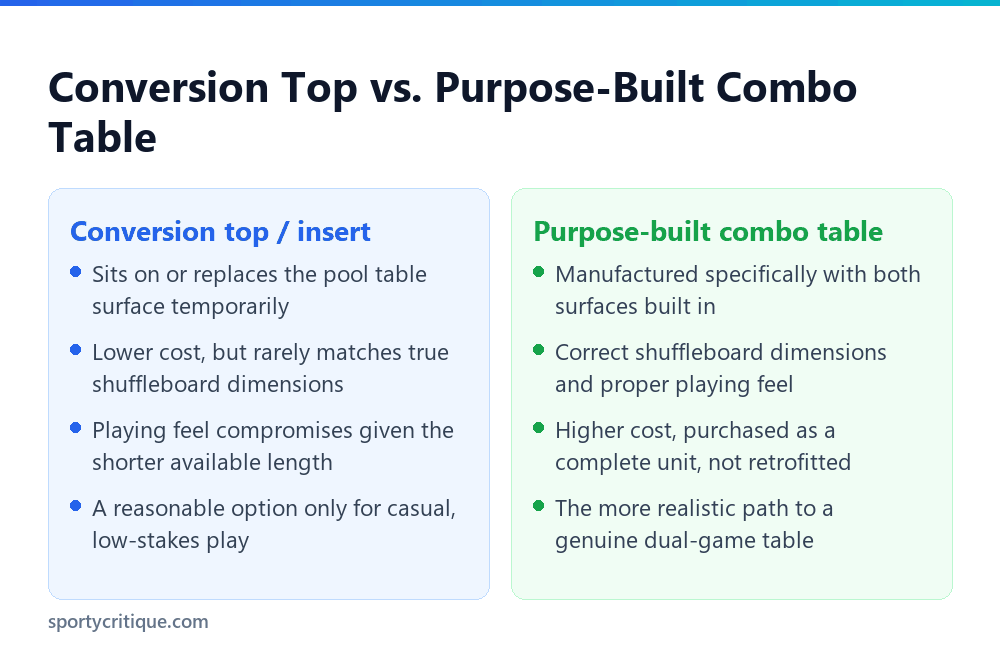
A true pool table shuffleboard combo isn’t a realistic DIY project for most owners, since a real shuffleboard playing surface needs 9 to 22 feet of length, far longer than any standard pool table’s dimensions. The honest options are a purpose-built combo table, manufactured specifically with both games in mind, or a compact conversion top that sits over the pool table for occasional, casual shuffleboard-style play at a shortened, compromised length. Neither delivers true shuffleboard proportions from an actual pool table’s existing frame.
The idea of converting an existing pool table into a shuffleboard table is appealing specifically because it sounds like an efficient way to get two games from one piece of furniture, but the actual dimensional mismatch between the two games makes a true conversion far less practical than it initially sounds. Understanding this constraint upfront saves time and expectations before attempting a project that reality doesn’t fully support.
Table of Contents
Game Room & Table Clearance Calculator
Calculate required cue clearance, table dimensions, and walking perimeter for combo game rooms.
- →A real shuffleboard surface needs 9-22 feet of length, longer than any standard pool table
- →A true DIY conversion from an existing pool table can’t achieve proper shuffleboard dimensions
- →Purpose-built combo tables, manufactured with both games in mind, are the realistic dual-game path
- →A compact conversion top offers casual play at a compromised, shortened length
- →Setting realistic expectations before starting avoids a disappointing, wasted DIY effort
The Core Dimensional Problem
Standard pool tables run 7, 8, or 9 feet in total length, while a genuine shuffleboard playing surface needs 9 to 22 feet depending on the specific table size, meaning even the largest common pool table falls short of the shortest reasonable shuffleboard length, before even considering the different surface material and finish shuffleboard actually requires.
⚠️ Watch out: Attempting to build or install a full-length shuffleboard surface directly onto an existing pool table frame isn’t structurally realistic for most home DIY builders, given the frame dimensions and structural support a pool table base was actually engineered for, not the different length and load requirements a genuine shuffleboard surface demands.
What a Conversion Top Actually Offers
A shuffleboard-style conversion top or insert, similar in concept to a ping pong conversion top some pool table owners already use, sits over the existing pool table surface, offering a compact, shuffleboard-style playing experience at the pool table’s own shorter length rather than true shuffleboard dimensions.
This shortened playing length changes the game meaningfully compared to real shuffleboard, since weight and speed control feel very different across a compressed 7 to 9-foot surface than across the 12 to 22-foot length most dedicated shuffleboard tables actually use. It’s a casual, party-game level compromise, not an equivalent substitute for genuine shuffleboard play.
Purpose-Built Combo Tables: The Realistic Option
Some manufacturers build genuine multi-game combo tables from the ground up, engineering the frame, surface, and dimensions specifically to accommodate pool, and sometimes other games like table tennis or air hockey, as interchangeable playing surfaces on one shared base structure.
These purpose-built combo tables represent a fundamentally different approach than converting an existing pool table after the fact, since the entire structure is designed from the start to support multiple game types properly, rather than retrofitting a single-purpose pool table frame never intended for a completely different game’s dimensional and structural requirements.
💡 Pro tip: Searching specifically for “multi-game combo table” or “game table combo” through specialty game table dealers, rather than searching for a pool-to-shuffleboard conversion specifically, surfaces the genuine, purpose-built products this comparison actually recommends over a compromised DIY approach.
Choosing the Right Approach
- ✓Accept that a true, full-length shuffleboard surface can’t fit an existing pool table frame
- ✓Consider a purpose-built combo table if genuine dual-game capability matters
- ✓Use a compact conversion top only for casual, low-stakes party-style play
- ✓Search for “multi-game combo table” specifically rather than a pool-to-shuffleboard conversion
- ✕Attempting to build a full-length shuffleboard surface onto an existing pool table frame
- ✕Expecting a compact conversion top to feel equivalent to genuine shuffleboard play
- ✕Assuming any pool table can be structurally retrofitted for a completely different game
- ✕Searching purely for “pool table shuffleboard combo” and missing the realistic combo-table category
Two Separate Tables: The Other Realistic Path
For households with enough available space, owning a standard pool table and a separate, genuine shuffleboard table delivers authentic playing quality in both games, avoiding the dimensional compromise any single-table conversion or combo approach inevitably introduces for at least one of the two games.
This path requires more total floor space than a single combo solution, but it’s worth considering seriously for any household where genuine playing quality in both games matters more than the space and cost savings a combined single-table approach might otherwise offer.
Maintaining a Combo or Conversion Surface
A conversion top used for shuffleboard-style play still benefits from a light wax application, similar to a genuine shuffleboard surface, since the same basic wood-and-wax mechanics apply even at a shortened, non-standard playing length.
A light application of Sun-Glo Speed #3 Shuffleboard Powder Wax (Pack of 3, 16 oz Shaker Cans) keeps a conversion top’s surface playable, though owners should expect the compact length to still feel noticeably different from genuine shuffleboard regardless of how well the surface itself is maintained and cared for.
Cost Comparison Across Approaches
A compact conversion top typically costs meaningfully less than either a purpose-built combo table or a genuine standalone shuffleboard table, reflecting its role as a casual, budget-conscious compromise rather than an equivalent alternative to the other two more capable options.
Purpose-built combo tables and genuine standalone shuffleboard tables both represent a larger investment, generally running into the thousands of dollars, a cost difference worth weighing seriously against how much genuine playing quality actually matters for a specific household’s actual use case and budget.
Why Online Searches Can Be Misleading
Searching for a pool table shuffleboard combo often turns up ping pong conversion tops mislabeled or miscategorized, small tabletop novelty products, or generic multi-game furniture listings that don’t actually deliver genuine shuffleboard dimensions, making it easy for a buyer to end up disappointed by a product that doesn’t match what the search term implied.
Reading product descriptions carefully for actual playing surface length, rather than relying on a listing’s title or general marketing language alone, helps separate a genuine, usable product from one that technically fits the search term but doesn’t deliver the real shuffleboard experience a buyer is actually hoping to find.
Space Planning for a Purpose-Built Combo Table
Even a purpose-built combo table still needs adequate clearance space for whichever game surface is currently in use, since shuffleboard specifically requires extra room at each end for a player’s shooting stance, a requirement that doesn’t disappear just because the table also supports pool as an alternate configuration.
Measuring available room against the combo table’s actual footprint in each specific game configuration, not just its general overall dimensions, avoids the same kind of space-planning mistake that affects buyers of standalone tables covered in more detail elsewhere in game-table content on this site.
How Switching Between Game Modes Actually Works
Purpose-built combo tables typically use a removable or interchangeable top system, requiring some physical effort and often a second person to safely lift and swap surfaces between games rather than an instant, effortless transition a buyer might assume from marketing images alone.
Checking a specific combo table’s exact swap mechanism and estimated changeover time before purchasing sets realistic expectations for how much effort switching between games actually requires in daily use, information that’s sometimes underemphasized in a product’s promotional material compared to its more prominently featured dual-game capability.
Storing the Unused Surface
A combo table’s currently unused game surface, whichever top isn’t installed at a given time, still needs a storage location somewhere in the home, an often-overlooked practical detail that affects a buyer’s total space requirements beyond just the table’s own footprint during active use.
Protecting a stored, unused surface from dust and incidental damage, similar to protection principles covered in other table-care content on this site, keeps that alternate surface ready for its next use rather than degrading in storage between the periods it’s actually installed and played on.
Who Each Option Actually Suits
A household hosting occasional casual parties, where a shuffleboard-style game adds variety without needing tournament-level authenticity, is well served by a simple conversion top layered onto an existing pool table, accepting the compromised length as a reasonable tradeoff for low cost and no additional floor space required.
A household genuinely serious about both games, wanting authentic shuffleboard feel alongside real pool play, is better served either by a purpose-built combo table with proper dimensions for each game or by two entirely separate, dedicated tables if space realistically allows for that larger footprint.
Frequently Asked Questions
Can I really convert my pool table into a full shuffleboard table?
Not into a true, full-length shuffleboard table. Standard pool tables are far shorter than genuine shuffleboard dimensions require, making a full conversion structurally unrealistic.
What’s the best realistic option for wanting both games?
A purpose-built combo table, manufactured specifically to support multiple games properly, or owning two separate, dedicated tables if space allows for genuine quality in both games.
Is a conversion top worth buying?
For casual, low-stakes party play, yes, it’s a reasonable, affordable option. It won’t replicate genuine shuffleboard’s playing feel given the compressed length involved.
Do conversion tops need the same maintenance as real shuffleboard tables?
Similar basic principles apply, including light wax application, though the compact length means the playing experience remains different regardless of maintenance quality.
How much does a purpose-built combo table cost compared to a conversion top?
Purpose-built combo tables generally cost significantly more, often in the thousands of dollars, compared to a conversion top’s much lower price point.
Should I search for “pool table shuffleboard combo” when shopping?
Also try “multi-game combo table” specifically, since this broader search term surfaces the genuine, purpose-built products better suited to real dual-game use than a conversion-specific search alone.
Talking to a specialty game table dealer directly about actual available space and realistic budget, rather than searching purely online for a specific product name, often surfaces options and configurations a general search wouldn’t necessarily turn up, particularly for a buyer with a genuinely unusual room shape or size to work around.
The honest picture here matters more than a convenient answer: a true pool-to-shuffleboard conversion isn’t realistic given the dimensional mismatch between the two games, but purpose-built combo tables and compact conversion tops both offer genuine, if different, paths toward enjoying both games without requiring an unrealistic DIY project.
None of this means the idea behind wanting a combined game table is unreasonable; the appeal of getting more use out of one piece of furniture, or fitting more variety into a limited space, is entirely understandable. It simply means the actual solution looks different from a straightforward surface conversion once the real dimensional constraints of shuffleboard are taken seriously.
Approaching this decision with accurate expectations from the start, rather than after an already-purchased conversion top disappoints, saves both money and frustration compared to discovering the dimensional mismatch only after committing to a specific product.
Whichever path a household eventually chooses, entering the decision with an accurate picture of what’s physically possible sets up a far more satisfying outcome than chasing a search term that, as it turns out, describes something the general market doesn’t actually sell in quite the way the phrase itself seems to strongly imply at first glance to any shopper searching for it online in the first place.
As an Amazon Associate, we earn from qualifying purchases through links on this page.