Badminton Let vs Fault: When a Rally Gets Replayed

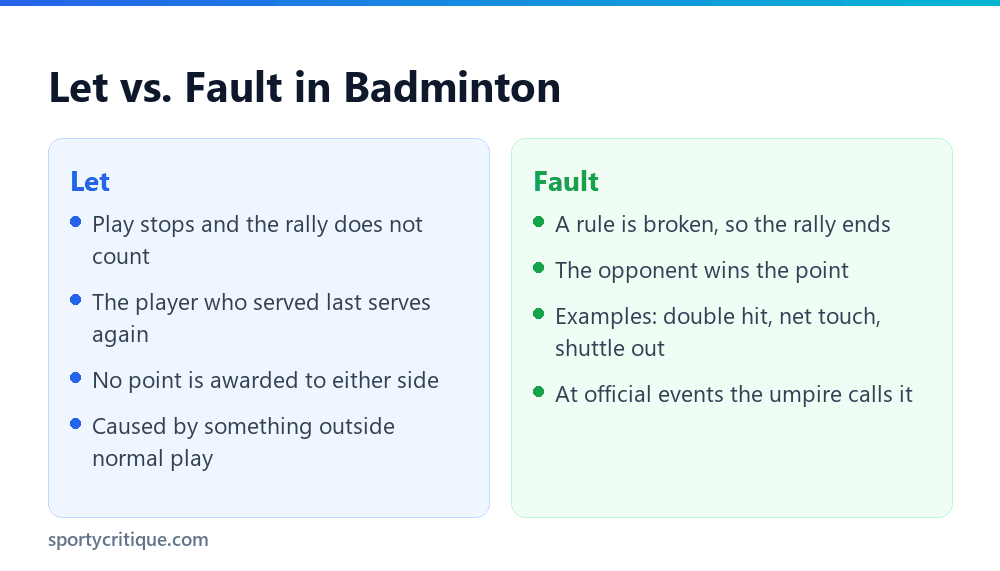
The badminton let vs fault difference is simple, because they are opposites. A let stops play and replays the rally, with no point for either side, and the player who served last serves again. A fault means a rule was broken, so the rally ends and the opponent wins the point. Common lets include the server serving before the receiver is ready, both sides faulting at once on the serve, and a shuttle breaking apart. Common faults include hitting the shuttle twice, touching the net, and the shuttle landing out.
Few moments in a club match cause more arguments than a disputed let or fault. Was the shuttle caught on the net, or did it never clear it? Was the receiver ready, or was the server too quick? Knowing the difference settles most of these arguments before they start, and it protects your own points when you are the one who is wrong.
- →A let replays the rally, and a fault ends it with a point to the opponent
- →After a let, play since the last service does not count and the same server serves again
- →A let can be called by the umpire, or by a player when there is no umpire
- →A shuttle caught in the net on the serve is a fault, but after the serve is returned it can be a let
- →Check your league’s rules, since local rules and umpire judgment matter
Table of Contents
What Is a Let in Badminton?
A let is a pause. The rally is cancelled as if it had not happened, and it is replayed. The Laws of Badminton, as summarized by badminton equipment makers and coaching sites, state that when a let occurs, play since the last service shall not count and the player who served last shall serve again.
The point of a let is fairness. If something happens that neither player could reasonably control, such as a shuttle breaking apart mid-rally, neither player should lose a point for it.
Situations That Count as a Let
Summaries of the Laws of Badminton list several situations. The most common are these:
What Is a Fault?
A fault means someone broke a rule, and the other side wins the point. Published summaries of the Laws of Badminton list many faults, including the shuttle landing outside the court, passing through or under the net, failing to pass over the net, touching a player’s body or clothing, or touching the ceiling or side walls.
Other faults involve how the shuttle is hit: carrying or slinging it on the racket, hitting it twice in two strokes, or a player and their partner hitting it one after the other. Touching the net with your racket or body, reaching over the net to strike the shuttle, and obstructing an opponent are also listed as faults.
Service has its own faults, such as serving above the permitted height or stepping on a service line. Our guides on the badminton service height rule and on doubles serving rules cover those in detail.
The Net Cases That Confuse Everyone
Net calls cause most disagreements, because they depend on when the shuttle touches the net and whether it is the serve.
On the serve, a shuttle caught on top of the net, or one that passes over and is then caught in the net, is a fault. After the serve has been returned, the same event is a let, according to published summaries of Law 14. Think of it as the receiver having a fair chance: once the shuttle is in the rally, the player who hit it should not be penalized for the net catching it.
A shuttle that never gets over the net is different. If a player hits it and it does not clear the net, it is a fault against that player. The let applies when the shuttle gets over and is caught, or sits on top of the net, as described in the laws.
⚠️ Watch out: Summaries of the laws are not a substitute for the official text. If you play in a league or tournament, ask the umpire or read the current Laws of Badminton, since details and local rules can change.
Who Can Call a Let?
At an officiated match, the umpire calls a let. In casual play without an umpire, the Laws of Badminton allow a player to call it to halt play. Call it immediately, because a late let call is hard to justify once the rally has ended.
A receiver who is not ready should show it, for example by raising a hand, before the serve begins. A server who serves anyway risks a let, and a repeated pattern of quick serves can lead to disagreements in club play.
What Happens to the Score After a Let
Nothing changes. The score stays where it was, and the server who served last serves again to the same receiver. In doubles, the same player serves from the same court as before.
A let is not counted against either player, and the rally is simply replayed. If the same problem keeps recurring, such as a receiver who is repeatedly not ready, an umpire may step in.
Five Quick Examples
Example one: the server swings before the receiver has lifted their racket or set their feet, and the receiver is clearly not ready. That is a let, and the same server serves again with the score unchanged.
Example two: during a rally, a player hits the shuttle, it clears the net, and it sticks in the tape on the opponent’s side after the serve has already been returned. Under the let rule as summarized above, that is a let, not a point for either side.
Example three: a player reaches across the net and strikes the shuttle on the opponent’s side of the court. That is a fault, and the opponent wins the point.
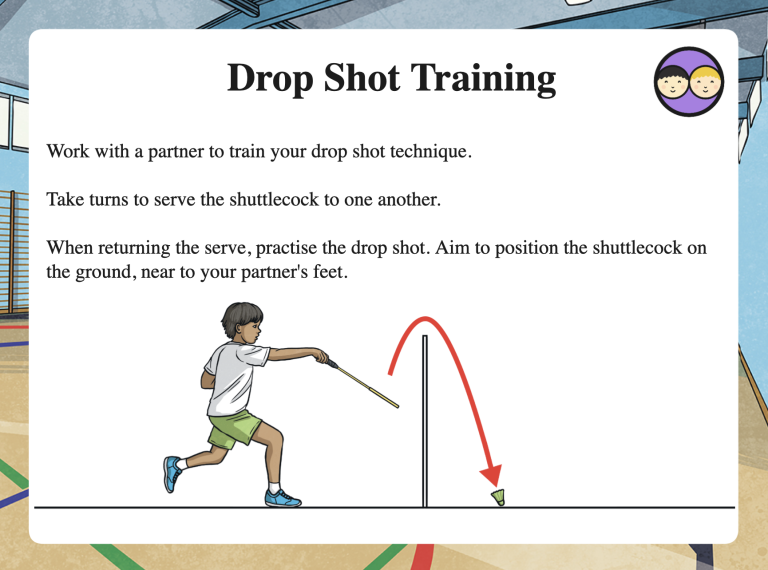
Example four: a player lunges for a drop shot and their racket brushes the net tape as they hit. Touching the net with the racket or body is a fault, even if the shot was good.
Example five: the shuttle’s skirt tears away from the cork base in the middle of a rally. That is a let, the rally is replayed, and both players use a new shuttle.
Lets and Faults in Doubles
The rules are the same in doubles, with a few extra wrinkles. A shuttle hit first by one player and then by their partner is a fault. When a let is called, the player who served last serves again, from the same service court, so the order of service does not change.
Communication matters in doubles. Partners should agree in advance who calls the line and who raises a hand for a let, so a pair does not stop play at different moments and cause confusion.
Umpired Matches Compared With Casual Play
At a tournament or league match with an umpire, the umpire makes the call, and players are expected to accept it. Some events also have service judges and line judges, who focus on specific calls and report to the umpire.
In casual play, you are the umpire. That works well when both players are honest and agree on the rules, and it works badly when they do not. A short chat before the first serve, or a shared reading of the let and fault rules, prevents most disputes.
Broken Shuttles and Equipment
A shuttle that comes apart during a rally, with the base separating from the skirt, is a let, and you replay the rally with a fresh shuttle. Nylon shuttles are more durable than feathers, but they can still break, and manufacturers note that cold temperatures make the skirt harder and more prone to breaking.
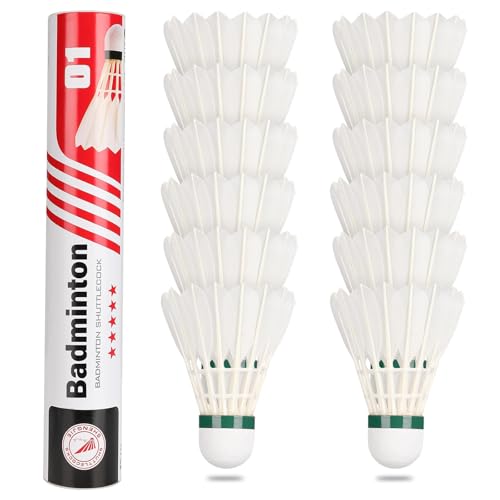
Keeping a spare tube nearby makes a broken shuttle a ten second pause instead of a search. A six-pack of Yonex Mavis 350 nylon shuttlecocks ($17.99, checked October 7, 2026) is a typical club-night supply, and the listing notes that Yonex sells Mavis shuttles in different temperature ranges, so choose the one that matches your hall.
Calling Lets and Faults Fairly
- ✓Call a let straight away, before the next shot
- ✓Replay the rally with the same server and score
- ✓Be honest about your own faults, such as net touches
- ✓Agree on how to handle lets before a casual match starts
- ✕Call a let after losing the point because you disagreed
- ✕Treat a fault as a let to avoid giving a point
- ✕Serve while the receiver is clearly not ready
- ✕Argue calls without checking the actual rule
Why Players Get These Calls Wrong
Most confusion comes from mixing up the cause with the outcome. A shuttle that sticks in the net looks the same whether it is a serve or a rally, but the rules treat the two differently, so players apply the wrong rule from habit. Reading the serve and the rally cases side by side, as in the table above, is the quickest cure.
A second source of error is emotion. A player who has just lost a long rally is more likely to claim a let than one who has just won it. Deciding on the rule first, and the point second, keeps the call honest and keeps the match friendly.
Finally, many players learned the game informally and never saw the written laws. Reading the official Laws of Badminton once, even just the let and fault sections, fills in most of the gaps.
Practical Tips for Club Play
Agree on a few ground rules before you play. Decide whether a raised hand means not ready, and who calls disputed shuttles that land near a line. Most arguments come from players assuming different rules, not from real disagreement.
If a call is truly unclear, replaying the rally is often the friendliest solution, and it is consistent with the spirit of a let. Save strict rulings for matches that have an umpire.
Frequently Asked Questions
What is the difference between a let and a fault in badminton?
A let replays the rally with no point for either side. A fault means a rule was broken, so the rally ends and the opponent wins the point.
Who serves after a let?
The player who served last serves again.
Is the shuttle hitting the net a let?
Not usually. If it clears the net, play continues. A let applies in specific cases, such as the shuttle becoming caught in the net after the serve is returned.
Is a shuttle caught on the net during the serve a let?
No. According to published summaries of the laws, it is a fault on the serve.
Can a player call a let in casual play?
Yes. The laws let a player call a let to halt play when there is no umpire.
What if the shuttle breaks during a rally?
That is a let. Replay the rally with a new shuttle.
A let replays the rally and a fault ends it. Learn the common lets, remember that the serve and the net follow special rules, call lets immediately and honestly, and most disputes at your club will disappear.
As an Amazon Associate, we earn from qualifying purchases through links on this page.