Best Golf Hitting Mats for Indoor Simulators: Turf Pile Density, Shock-Absorbing Substrates, and Joint Injury Prevention

Constructing an indoor home golf simulator or garage practice bay allows golfers to maintain swing mechanics, groove ball striking, and play virtual rounds year-round regardless of weather conditions. However, the most critical component in any simulator enclosure is not the high-definition projector or the optical launch monitor; it is the hitting mat resting on the floor. In outdoor golf, a properly struck iron shot strikes the ball first with a descending angle of attack before the leading edge carves a divot into the natural earth. On concrete garage slabs or basement subfloors, an artificial mat must absorb this violent downward deceleration force. Striking thousands of practice balls off a substandard, unpadded driving range mat sends repetitive high-frequency shockwaves through the club shaft into the golfer’s wrists, elbows, and shoulders, frequently resulting in chronic medial epicondylitis (golfer’s elbow) and wrist tendonitis.
Beyond orthopedic safety, hitting mat architecture directly dictates data accuracy on photometric and Doppler launch monitors. Low-cost synthetic turf mats utilize thin rubber backings that act like trampolines: on slightly fat strikes, the club’s heavy steel sole bounces off the unyielding rubber into the back of the ball, artificially creating clean contact and producing falsely inflated launch monitor numbers that crumble on real turf. Elite simulator hitting surfaces utilize advanced shock-absorbing substrates, such as multi-layer viscoelastic foam, liquid silicone gel bladders, or flexible synthetic bristle pods that allow the clubhead to pass through the strike zone without bouncing or jarring human joints. This comprehensive technical guide analyzes five premier golf hitting mats on the market, evaluating pile density, shock attenuation, divot action, and real wooden tee compatibility.
Table of Contents
Impact Biomechanics: Clubhead Deceleration, Turf Bounce, and Golfer’s Elbow
To understand the orthopedic and diagnostic importance of hitting mat construction, sports biomechanists study the deceleration curve of an iron strike. A standard seven-iron swing delivered by a low-handicap golfer travels at roughly eighty-five miles per hour with a downward angle of attack between negative three and negative five degrees. Upon contacting the turf immediately after ball impact, the clubhead experiences peak deceleration forces exceeding three hundred gravitational units (G-force) within less than ten milliseconds.
On natural bentgrass or bermuda turf, the soil shears easily, dissipating kinetic energy as the clubhead displaces earth into a divot. However, when an artificial hitting mat consists of simple nylon carpet glued to a five-millimeter EVA foam pad over hard concrete, the substrate cannot compress. The unyielding concrete reflects strike shockwaves directly back up the steel shaft into the flexor tendons of the golfer’s lead forearm. Over hundreds of repetitive practice balls, this mechanical trauma creates micro-tears in the tendon anchor at the medial epicondyle bone, leading to debilitating joint inflammation.
Additionally, turf bounce distorts launch monitor swing diagnosis. If the mat surface is too rigid, a clubhead striking the turf one inch behind the ball will not dig; instead, it bounces upward off the surface, catching the ball squarely on the lower sweet spot. The launch monitor records an authentic-looking shot with 1.40 smash factor, masking an error that would result in a twenty-yard chunk into a water hazard on an actual golf course. High-end hitting mats prevent clubhead bounce by allowing the club’s leading edge to travel through the turf layer, rewarding pure ball-first contact while providing authentic deceleration feedback on fat shots.
Top 5 Golf Simulator Hitting Mats: Technical Performance Matrix
The comparative data matrix below details turf fiber types, pile density, shock-absorbing substrate architectures, real tee capabilities, and orthopedic ratings across the five leading hitting mats on the market.
| Model | Turf Fiber & Pile Height | Shock-Absorbing Substrate | Divot Simulation Action | Tee Compatibility | Orthopedic Joint Safety |
|---|---|---|---|---|---|
| Fiberbuilt Grass Series Studio | Knitted crimp nylon bristles (1.0 inch) | Molded modular rubber EPS base | Pure through-strike (zero turf bounce) | Adjustable friction rubber tee cups | Exceptional (Maximum elbow & wrist protection) |
| Carl’s Place HotShot Commercial | Dense 0.75-inch nylon carpet face | Heavy anti-fatigue closed-cell foam | Moderate downward compression | Accepts real wooden tees anywhere | Very High (Balanced stability & cushioning) |
| Country Club Elite Real Feel | 130-oz high-density knitted nylon | 0.625-inch vulcanized urethane back | True downward divot drag feedback | Accepts real wooden tees at any depth | High (Penalizes fat shots with authentic drag) |
| TrueStrike Dual Hitting Mat | Woven strike turf over sub-layer | Proprietary silicone gel bladder | Realistic subterranean divot compression | Custom silicone tee holders | Exceptional (Mimics soft natural earth divots) |
| GoSports Elite Commercial Mat | 15mm woven synthetic turf | 10mm high-density EVA foam base | Standard surface rebound | Includes 3 rubber tees + tee holder slots | Moderate (Best for budget utility practice) |
1. Fiberbuilt Grass Series Studio Mat: The Ultimate in Joint Protection and Ball Flight Truth
The Fiberbuilt Grass Series Studio Mat is widely celebrated across PGA Tour instruction studios, commercial fitting bays, and high-end residential simulators as the gold standard in injury prevention and ball-striking fidelity. Unlike carpet-based mats, Fiberbuilt utilizes a patented hitting strip composed of thousands of flexible, densely packed nylon bristles standing one inch tall, mounted over a molded rubber modular foundation.
This bristle architecture fundamentally solves the turf bounce dilemma. When an iron descends into the Fiberbuilt strip, the individual bristles bend downward and outward under the clubhead’s sole, allowing the leading edge to pass through the ball and travel below the nominal surface level with zero upward rebound. This reproduces the true kinetic deceleration of soft fairway turf. The golfer experiences zero jarring vibration in their wrists or elbows, making it possible to practice daily without joint inflammation. Independent launch monitor testing confirms that fat shots lose clubhead speed authentically, providing truthful diagnostic feedback that translates directly to on-course performance.
Technical Specifications: Hitting Surface: Patented Fiberbuilt nylon bristle technology | Pile Height: 1.0 inch | Foundation: Heavy-duty molded modular rubber base | Dimensions: 4 ft x 5 ft (Single hitting station) | Weight: 65 lbs (stays anchored on concrete) | Durability Rating: 300,000 recorded club strikes without bald patches | Joint Safety: Maximum possible orthopedic protection rating.
View Fiberbuilt Grass Studio Mat on Amazon
2. Carl’s Place HotShot Commercial Mat: Built for High-Volume Simulator Centers
As one of the world’s premier indoor simulator enclosure manufacturers, Carl’s Place engineered the HotShot Commercial Golf Mat to endure the punishing demands of commercial golf centers and dedicated home simulator bays. Featuring an expansive five-by-five-foot single-station footprint, the HotShot provides ample room for both right- and left-handed golfers without repositioning the mat.
The HotShot features a high-density, three-quarter-inch knitted nylon turf face bonded to a heavy, anti-fatigue closed-cell foam base. This combination absorbs downward shock effectively while providing comfortable underfoot cushioning during multi-hour practice rounds. One of its standout features is universal tee acceptance: players can push real wooden tees directly into the dense nylon fibers at any location, allowing custom ball heights for low-lofted drivers, fairway woods, or hybrid punch shots without needing clumsy rubber tee tubes.
Technical Specifications: Turf Face: 0.75-inch high-density knitted nylon | Substrate: 0.625-inch high-rebound closed-cell anti-fatigue foam | Dimensions: 5 ft x 5 ft (Ambidextrous layout) | Weight: 42 lbs | Tee Compatibility: Accepts real wooden and plastic tees anywhere | Pre-Drilled Holes: 4 pre-drilled rubber tee locations | Edge Profile: Precision-beveled clean perimeter edges.
View Carl’s Place HotShot Mat on Amazon
3. Country Club Elite Real Feel Golf Mat: Dense 130-Ounce Fiber Drag
The Country Club Elite (CCE) Real Feel Golf Mat, developed by J.R. Mats, earned a prestigious reputation among collegiate golf coaches for providing the most authentic feedback on swing path and strike quality. Constructed using an astonishingly dense 130-ounce nylon fiber face, the CCE mat resists tearing, melting, and premature thinning under relentless high-velocity swings.
The primary advantage of the CCE design is its ability to penalize fat strikes truthfully. When a golfer strikes behind the ball, the densely packed, heat-set vertical nylon fibers grip the clubhead’s sole, causing authentic rotational drag that slows clubhead speed and drops ball launch velocity just as a thick turf divot would. Because of this high fiber resistance, pure ball-first contact is rewarded with explosive distance, while steep digging strikes provide immediate acoustic and sensory feedback. However, because the vulcanized urethane base is relatively firm, golfers with pre-existing joint issues should pair it with an aftermarket foam underlayment.
Technical Specifications: Turf Construction: 130-ounce spring-crimped heat-set nylon yarn | Backing: 0.625-inch vulcanized urethane closed-cell foam | Dimensions: 5 ft x 5 ft | Weight: 48 lbs | Divot Feedback: Realistic downward resistance on fat shots | Tee Capability: Holds standard wooden tees securely at any depth | Origin: Made in the USA.
View Country Club Elite Mat on Amazon
4. TrueStrike Dual Golf Hitting Mat: Subterranean Silicone Gel Innovation
TrueStrike re-engineered the golf hitting surface by introducing fluid dynamics to artificial turf. Beneath a durable woven polypropylene turf striking sheet lies a proprietary silicone gel sub-surface bladder. This gel layer behaves mechanically like damp, compacted organic topsoil.
When an iron blade strikes the TrueStrike gel layer, the viscous silicone fluid displaces laterally beneath the point of impact, allowing the clubhead to move downward through the ball in a natural downward trajectory. This completely neutralizes the upward rebound shock that triggers tendonitis in the golfer’s lead arm. As the club exits the strike zone, the silicone gel returns to its original flat resting state instantly. For players seeking the softest, most joint-friendly divot compression outside of natural outdoor turf, TrueStrike represents an extraordinary mechanical achievement.
Technical Specifications: Core Technology: Proprietary pressurized silicone gel sub-surface bladder | Turf Layer: Replaceable high-durability woven strike skin | Foundation: Interlocking heavy-gauge polymer base tray | Dimensions: 4.3 ft x 6.5 ft (Modular station) | Weight: 85 lbs | Joint Health: Clinically demonstrated reduction in impact vibration | Modular Design: Replaceable center gel section.
View TrueStrike Dual Mat on Amazon
5. GoSports Elite Commercial Golf Mat: Value-Driven Practice Reliability
For golfers assembling an entry-level garage simulator on a budget, the GoSports Elite Commercial Golf Mat offers dependable utility without the high price tag of gel-filled modular systems. Featuring a fifteen-millimeter woven synthetic turf layer bonded to a ten-millimeter high-density EVA foam backing, this mat provides a stable, flat hitting platform for irons, hybrids, and drivers.
Measuring five by four feet, the GoSports Elite provides ample stance width for adult golfers. It includes three rubber tee holders designed for different ball heights and features pre-cut hole positions on both sides of the mat to accommodate right- and left-handed players. While it does not offer the deep divot displacement of Fiberbuilt or TrueStrike, placing this mat over an extra half-inch interlocking foam gym tile layer creates an affordable, joint-safe indoor practice setup for casual winter training.
Technical Specifications: Turf Pile: 15 mm high-density synthetic grass | Base: 10 mm anti-tear closed-cell EVA foam | Dimensions: 5 ft x 4 ft | Weight: 26 lbs | Included Accessories: 3 rubber tees (various heights) + 1 plastic tee holder | Stance Layout: Ambidextrous dual-side tee holes | Portability: Rolls up cleanly for compact storage.
View GoSports Elite Mat on Amazon
Substrate Mechanics: Evaluating EVA Foam, Gel Bladders, and Nylon Bristles
Understanding the physics of what lies beneath the green turf face dictates how the mat manages impact energy and protects human joints:
- EVA Foam Substrates (Standard Utility): Ethylene-vinyl acetate provides basic cushioning by compressing closed air cells under foot. However, under high-velocity downward iron strikes, thin EVA foam bottoms out rapidly, transferring remaining strike energy into the concrete slab beneath. EVA foam is cost-effective but requires adequate thickness (at least 15 mm to 20 mm) to prevent joint soreness during daily use.
- Silicone Gel Bladders (Hydrodynamic Displacement): Viscous silicone fluids redistribute pressure omni-directionally. When compressed by a golf club’s leading edge, the gel flows outward within a sealed elastomer bladder, mirroring the subterranean shear of natural damp topsoil. This eliminates peak impact spikes completely, making gel mats the premier choice for golfers recovering from tendonitis or wrist injuries.
- Nylon Bristle Pods (Frictional Shear): Rather than relying on compressive cushioning, vertical bristle systems like Fiberbuilt allow the club to slice between thousands of flexible nylon fingers. The energy converts into lateral mechanical displacement rather than compressive bottoming, ensuring identical clubhead deceleration whether you hit one millimeter or twenty millimeters into the surface.
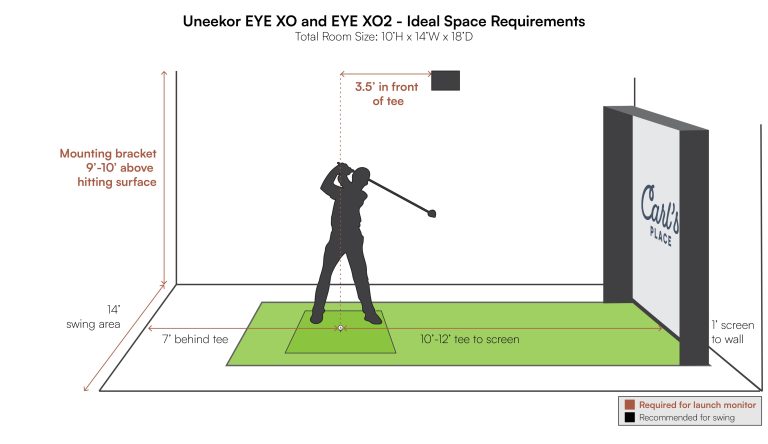
Simulator Integration: Mat Thickness and Floor Level Alignment
When installing a hitting mat inside a simulator bay, players must account for the vertical height difference between the hitting surface and surrounding turf floors:
1. Stance Level Parity: A premium hitting mat often stands 1.5 to 2.0 inches thick from the base of its rubber tray to the top of its turf fibers. If a golfer stands on bare concrete or thin putting turf while hitting off a thick raised mat, the ball sits 1.5 inches above their feet. This unnatural sidehill-lie geometry forces an upright swing plane and promotes errant hook shots. Always ensure your stance area rests on the exact same vertical plane as the hitting strip.
2. Launch Monitor Radar Horizon: Radar launch monitors (such as the FlightScope Mevo+ or Garmin Approach R10) sit several feet behind the tee on the floor. If a thick mat sits directly in the radar’s line-of-sight without the monitor being raised on a matching leveling stand, the front edge of the mat creates radar clutter and occludes low launch angle tracking. Raise your launch monitor to the exact surface elevation of your hitting turf.
Frequently Asked Questions About Golf Hitting Mats
Here are clear, definitive answers to common inquiries regarding golf hitting mats, injury prevention, and simulator integration.
Can hitting off a golf mat cause golfer’s elbow?
Yes, hitting off thin or rigid golf mats on top of concrete garage floors reflects violent deceleration shockwaves up the club shaft into the wrist and elbow joints, frequently causing chronic medial epicondylitis (golfer’s elbow). Mats with deep nylon bristles or silicone gel substrates prevent this injury.
Why do cheap golf mats give false launch monitor numbers?
Cheap mats have unyielding rubber backings that cause the clubhead to bounce off the surface into the ball on fat strikes. This produces clean contact and high smash factors on poor strikes that would have resulted in heavy chunked shots on real grass.
Can you use real wooden tees in golf hitting mats?
High-density knitted nylon mats like Country Club Elite and Carl’s Place HotShot hold standard wooden tees securely anywhere in the turf. Other systems like Fiberbuilt use rubber tee cups that accept custom tees at adjustable heights.
How long do commercial golf hitting mats last?
Premium commercial hitting mats like Fiberbuilt and Country Club Elite are rated for over 300,000 strikes and easily last 3 to 7 years in heavy home simulator use before needing replacement hitting strips.
How thick should a golf simulator hitting mat be?
A quality hitting mat should have a total thickness between 1.25 and 2.0 inches, combining dense turf fibers with a thick shock-absorbing foam, gel, or modular rubber base to protect joints from concrete subfloors.
Investing in a premier golf hitting mat like the joint-protective Fiberbuilt Studio Mat or the divot-simulating TrueStrike Dual protects your body from debilitating repetitive strain injuries while ensuring that your simulator launch numbers reflect genuine ball-striking skill. With shock-absorbing substrates, dense nylon turf fibers, and authentic turf deceleration, you can practice with total confidence all year round.