How to Play Baseball: The Rules, the Count & Why the Defense Has the Ball

Baseball is played by two teams of nine. One team bats and tries to send runners around four bases to score; the other team takes the field holding the ball and tries to record three outs. When three outs are made, the teams swap. Do that twice and you’ve played one inning. Do it nine times and the game is over, and whoever has more runs wins.
⚾ Baseball Hub: Explore all 24 glove break-in tutorials, bat guides, and strategic breakdowns in our Complete Baseball Resource Hub.
Table of Contents
Start here: the defense has the ball
Almost every sport you already understand works the same way — whoever has the ball is attacking. Football, basketball, soccer, hockey, rugby: possession means offense. Baseball inverts that completely, and this is the single reason it feels alien to newcomers.
In baseball the defense holds the ball. The pitcher, standing in the middle of the field with the ball in his hand, is on the defending team. The offense sends out one player at a time, armed with a bat, and that player’s job is to hit the ball away from the people who own it and then run.
The team with the ball is the team trying to stop you. Once that clicks, the rest of the rulebook stops being arbitrary.
This is why baseball has no clock, no possession arrow and no field position in the way other sports do. The defense controls the pace because the defense decides when the next pitch is thrown. The offense can’t take the ball; it can only wait for it to be thrown and try to do something with it. Everything else — the count, the outs, the strange base-running rules — is machinery built on top of that one inversion.
The shape of a game
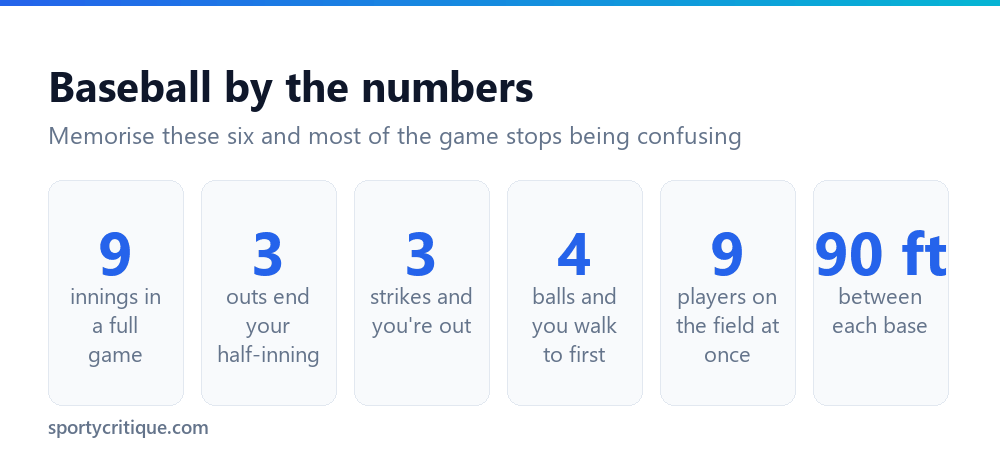
A game is nine innings. Each inning has two halves. In the top half the away team bats and the home team fields; in the bottom half they switch. A half-inning ends when the fielding team records three outs — not after a set time, not after a set number of batters. Three outs, and everyone changes places.
That’s why a half-inning can last four minutes or forty. If the defense gets three quick outs, it’s over almost immediately. If the offense keeps reaching base, the half-inning keeps going and the runs keep coming. There is no way to run out the clock, because there is no clock. A team down by ten runs in the ninth still has to be got out three times before it loses.
The home team bats second, which matters more than it sounds. If the home team is already ahead after the top of the ninth, the game just ends — they don’t bother batting again. And if the home team scores the go-ahead run in the bottom of the ninth, the game ends the instant that run crosses the plate.
📊 Note: Tied after nine innings? You play extra innings — complete innings, one at a time, until one team is ahead at the end of one. Baseball has no draws in most leagues.
The count: the engine of every single pitch
Every at-bat is scored by two running totals, always said in the same order: balls first, then strikes. A 2-1 count means two balls, one strike. Get to four balls and the batter walks to first base for free. Get to three strikes and the batter is out.
A pitch is a strike if it passes through the strike zone — roughly over the width of home plate, between the batter’s knees and the midpoint of their torso — or if the batter swings and misses at it, or if the batter hits it foul. A pitch is a ball if it misses the zone and the batter doesn’t swing. The umpire behind the catcher decides, pitch by pitch.
This is the part that turns baseball from watching into following. A hitter ahead in the count can afford to be picky and wait for a pitch they can drive. A hitter behind in the count has to protect the plate — swinging at anything close, just to stay alive. Same two players, same distance apart, completely different contest depending on two small numbers.
The four ways you get out
Almost every out in baseball is one of these four. Learn them and you’ll be able to explain nearly any play you see.
- The batter never put the ball in play
- Swinging and missing counts; so does a called strike in the zone
- Written as K in a scorebook — backwards K if the batter didn’t swing
- Fair or foul makes no difference — a catch is a catch
- Runners must return and tag up before advancing
- The most common out in the outfield
- Batter hits it on the ground, fielder throws to first
- This is a force out — no tag needed
- The bread-and-butter infield play
- Used when the runner is not forced to advance
- Stealing, overrunning, or caught between bases
- The fielder must touch the runner, not the base
There are stranger ways to make an out — interference, running out of the baseline, being hit by your own batted ball — but they’re rare enough that you can ignore them until you see one. The four above will cover almost every out in almost every game.
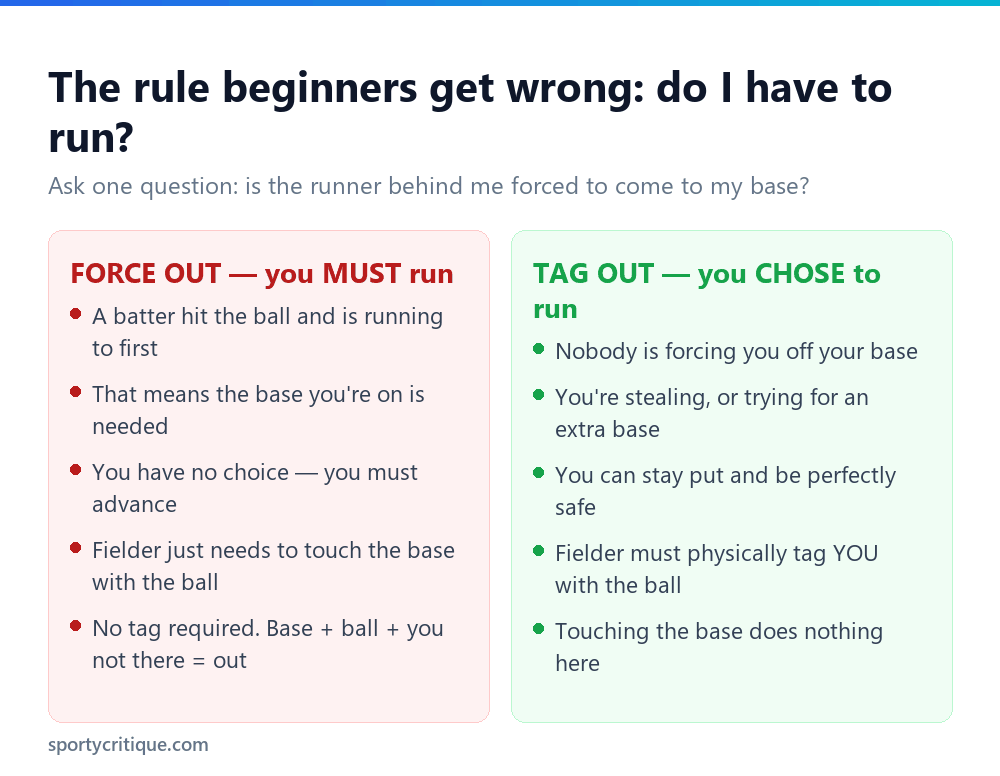
Force out or tag out? Ask one question
This is the rule newcomers get wrong most often, and it’s worth slowing down for, because it explains a huge number of plays that otherwise look like the fielders are choosing at random whether to touch the base or chase the runner.
Here’s the question: is somebody being forced into the base I’m standing on?
A runner on first base has a problem the moment the batter hits a ground ball. The batter must run to first — that’s not optional. But two runners can’t occupy one base, so the runner already on first is forced to vacate and head for second. He has no choice in the matter. And because he has no choice, the defense doesn’t need to tag him. They just need to get the ball to second base before he gets there. Base, ball, runner not there yet: out.
Now change one thing. Put a runner on second base with first base empty. The batter hits a ground ball and runs to first. Is the runner on second forced anywhere? No — nobody is coming to second, so he can stand there all day and be perfectly safe. If the defense wants him out, someone has to physically tag him with the ball while he’s off the base.
This also explains the double play, the most satisfying sequence in the sport. Runner on first, ground ball to the shortstop: he throws to second (force out on the runner coming from first), and the second baseman immediately throws to first (force out on the batter). Two outs, one batted ball, about four seconds.
The nine positions — and the number code nobody explains
Every defensive position has a permanent number, and those numbers are how baseball writes itself down. Almost no beginner guide mentions this, and it’s the thing that makes scoreboards, box scores and commentary suddenly readable.
Now the payoff. When you see 6-4-3 written next to a double play, that’s not a score — it’s a route. Shortstop (6) to second baseman (4) to first baseman (3). A 4-6-3 is the mirror image. A fly ball caught by the centre fielder is just 8. Once you can read those, you can reconstruct an entire game from a box score you weren’t at.
💡 Pro tip: The shortstop is number 6, not 5, which looks like a mistake and isn’t. The numbering was set when the shortstop was considered a roving extra outfielder rather than an infielder, and it simply never got renumbered.
The three rules that confuse everybody
Foul balls, and why the count can stall forever
A foul ball counts as a strike — but it can’t be your third strike. Hit a foul with two strikes already and nothing happens; the count stays 0-2 or 1-2 and you go again. This is why you’ll occasionally see an at-bat run to fourteen pitches with a batter fouling off everything close. The one exception: a bunt attempt fouled off with two strikes is strike three, and the batter is out.
Tagging up
If a fly ball is caught, every runner must return and touch their original base before advancing. They can then run at their own risk — this is ‘tagging up’, and it’s how a deep fly ball to the outfield can still score a runner from third. If a runner takes off early and the ball is caught, the defense can throw to that base and have them called out for leaving too soon.
The infield fly rule
The one everyone jokes about. With runners on first and second (or bases loaded) and fewer than two outs, if the batter pops the ball up in the infield, the umpire calls the batter out immediately — whether or not anyone catches it.
It sounds bizarre until you see the problem it solves. Without it, a fielder could deliberately let an easy pop-up drop, then start a force-out chain and turn one lazy fly ball into a double or triple play, because the runners were stuck near their bases waiting to see if it was caught. The rule removes the incentive by calling the batter out regardless. Runners may still advance at their own risk, but nobody can be forced.
Actually playing: what to do when it’s you out there
Reading rules and standing on a field are different problems. If you’re about to play your first game rather than watch one, here’s what actually matters in the first hour.
When you’re batting
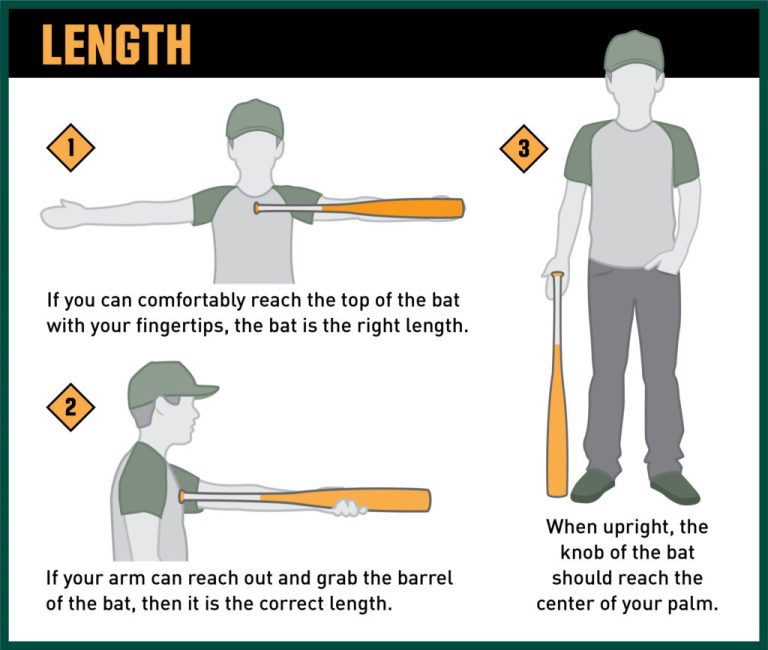
Stand so that your front shoulder points at the pitcher and you can comfortably reach the far edge of the plate with the barrel of the bat. Keep your hands back and your weight balanced. Watch the ball out of the pitcher’s hand, not the pitcher’s body — beginners track the wind-up and pick the ball up far too late. And swing level rather than trying to lift the ball; the home runs come later, and they come from timing, not from uppercutting. Getting a bat that actually fits you matters more at this stage than any swing tip, because a bat that’s too heavy turns every swing into a lunge.
When you’re in the field
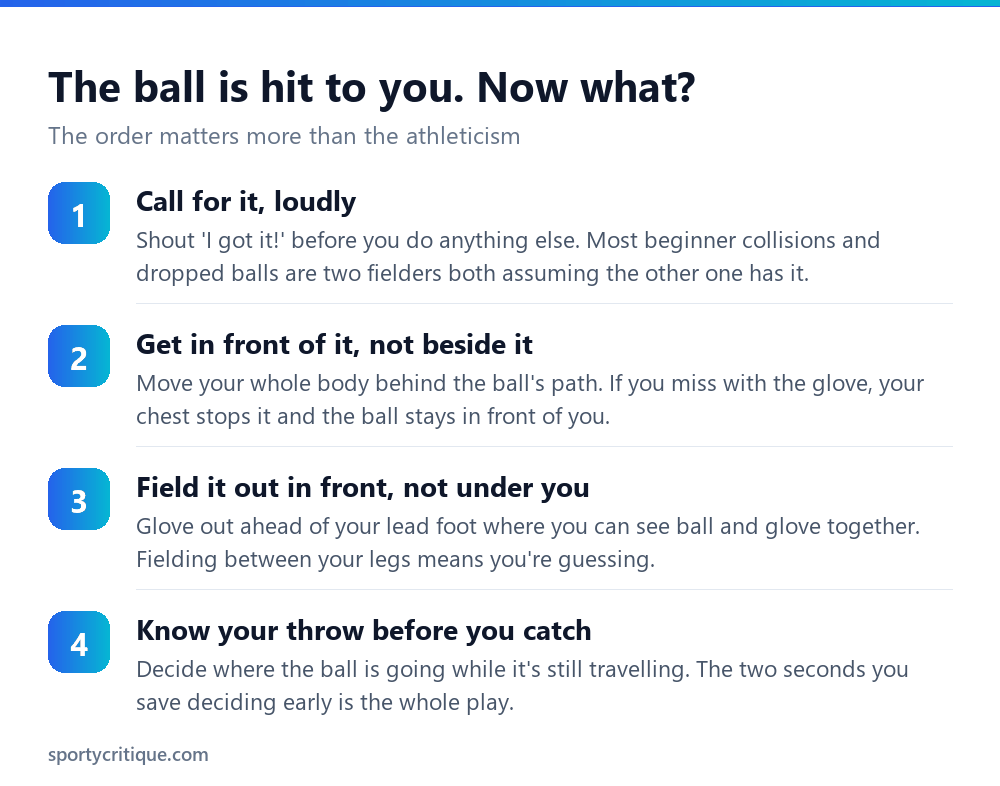
Before every pitch, ask yourself one question: if the ball comes to me, where am I throwing it? Answer it before the pitch, not after. Fielders who look composed aren’t reacting faster than you — they decided earlier. With nobody on base the answer is almost always first. With a runner on first and fewer than two outs, it’s usually second, to start the double play.
Stay on the balls of your feet with your glove down as the pitch is thrown. It’s far quicker to come up to a ball than to drop down to one, and most missed grounders are missed underneath. A glove that’s properly broken in closes when you want it to; a stiff new one will pop the ball straight back out.
When you’re running
Run through first base — don’t slow down to stop on it, and don’t slide. You’re allowed to overrun first and come back safely, and slowing down to land on the bag is how people get thrown out by half a step. On every other base you have to actually stop there, which is why sliding exists. And always know how many outs there are before the pitch, because it changes whether you run on contact or wait to see if a fly ball is caught.
What beginners get wrong
- ✓Watch the ball leave the pitcher’s hand, not the wind-up
- ✓Decide where you’re throwing before the pitch arrives
- ✓Call loudly for any ball in the air near you
- ✓Run hard through first base every single time
- ✓Count the outs out loud between pitches until it’s automatic
- ✕Swinging at the first pitch every at-bat because it feels aggressive
- ✕Fielding a ground ball from the side to protect yourself — get in front of it
- ✕Sliding into first base — it’s slower and it’s how wrists get hurt
- ✕Assuming a fielder touching a base is always an out — check if it’s a force
- ✕Leaving your base early on a fly ball with fewer than two outs
Frequently asked questions
How long does a baseball game take?
Around two and a half to three hours for nine innings at professional level. Youth and amateur games are usually shorter — often six or seven innings, and many leagues add a time limit or a run-difference rule to stop games running away.
Why do they say ‘balls’ before ‘strikes’?
Pure convention, but it’s universal — 3-1 always means three balls and one strike, never the reverse. Getting the order backwards is the fastest way to reveal you’re new to the sport.
What’s the difference between a walk and a hit?
A walk is four balls: the batter is awarded first base without swinging, and it does not count as a hit in the statistics. A hit means the batter put the ball in play and reached base safely because of it. Both put a runner on first; only one counts toward a batting average.
Do I need special equipment to start?
A glove and a bat, and that’s genuinely it for a casual game. Batting helmets are required in organised leagues. Cleats help but trainers work fine on grass. Everything else can wait until you know you like it.
How far is the pitcher from the batter?
Sixty feet six inches at adult level, measured from the pitching rubber to the back point of home plate. Youth leagues use shorter distances that step up with age — we break the distances down by level in our pitching distance guide.
What does it mean to ‘steal’ a base?
A runner takes off for the next base while the pitcher is delivering, without waiting for the batter to hit anything. There’s no force involved, so the catcher must throw down and the fielder must tag the runner. It’s a straight race between the runner’s legs and the catcher’s arm.
- →Work on the throw first — how to throw a baseball properly, including the four-seam grip that keeps the ball straight
- →Understand the pitching distances by age level in how many feet you pitch from
- →Get the gear right: sizing a baseball bat and breaking in a glove
- →Then think about strategy — how to actually win a game of baseball