How to Play Rugby: The Rules, the Offside Line & Why It Looks Like Chaos

Quick Answer: Rugby union: 15 players a side, 80 minutes, and one rule that explains everything else — the ball can never be passed forward. Ground it over the opponent’s try line for 5 points, or kick it through the posts. Play barely stops: tackles flow into rucks, rucks release the ball, and it starts again. The thing that makes it look like chaos is the offside line — an invisible boundary that moves every few seconds, and we explain it properly below.
🏉 Rugby Hub: Explore all 35 boot reviews, rules breakdowns, and tackling guides in our Complete Rugby Resource Hub.
Watch rugby for the first time and you see thirty people, a lot of shouting, and a referee blowing a whistle for reasons known only to him. Watch it once knowing where the offside line is and it becomes one of the most legible sports there is. That’s the gap this guide closes — not just the rules, but why the game looks the way it looks.
Table of Contents
The one rule that explains rugby
The ball may never travel forward out of a player’s hands. Pass it sideways or backwards, run forward with it, or kick it ahead. Those are your three options, forever.
Every strange thing about rugby comes from this. Why do players run diagonally? Because they must stay behind the ball carrier to receive a pass. Why do teams kick away perfectly good possession? Because kicking is the only legal way to move the ball forward twenty metres at once. Why does a team of fifteen bunch up in the middle? Because the support has to arrive from behind.
Drop the ball forward or knock it forward off your hands — the knock-on you’ll hear called every few minutes — and the other team gets a scrum. It’s the most common infringement in the sport, and it’s why rugby players are obsessive about catching with two hands and ‘presenting’ the ball backward as they hit the ground.
The offside line: rugby’s invisible geometry
This is the law that separates people who ‘don’t get’ rugby from people who love it. Master it and 80% of the referee’s whistles suddenly make sense.
The principle in one sentence: you may not gain an advantage from being in front of the ball. In open play, if you’re ahead of the teammate who last played the ball, you’re offside and must not interfere — no tackling, no chasing, no standing in the way. You have to retreat behind the ball before you can rejoin.
Where the line actually sits
| Situation | Where the offside line is | In plain English |
|---|---|---|
| Open play | Through the ball itself / the teammate who last played it | Stay behind your own ball carrier |
| Ruck | Through the hindmost foot of the hindmost player of your team in the ruck | The back foot of the last body in the pile |
| Maul | Same — hindmost foot, parallel to the try line | Same, but the ball’s still off the ground |
| Scrum | The hindmost foot of the last player in the scrum (backs must be 5m back) | Backs stand well off |
| Lineout | 10 metres back from the line of touch (for players not in it) | The huge gap you see behind a lineout |
⚠️ The nuance almost nobody explains: if you were offside at a ruck, maul, scrum or lineout, you stay offside even after it ends — until you retreat behind the line or are put onside by a teammate’s action. This is why you’ll see a player who was caught on the wrong side jog backwards for five seconds while play continues without them. They’re not sulking; they’re legally frozen.
And crucially: being offside isn’t automatically a penalty. An offside player is only penalised if they take part in play, contest the ball, or obstruct an opponent. Stand still in an offside position and do nothing and the referee will usually let it go — which is exactly what you’ll see players do when they can’t retreat in time. They freeze, hands up, making themselves visibly irrelevant.
💡 Watching tip that transforms the sport: next match, stop following the ball and watch the defensive line instead. You’ll see fifteen players moving forward in a rough horizontal line that reforms after every single tackle. That line is the offside line, made visible by bodies. Once you see it, you can’t unsee it — and every penalty for ‘offside’ becomes obvious.
The breakdown: what the pile of bodies actually is
When a tackle happens, a very specific sequence of legal obligations kicks in, and getting them wrong is the most penalised thing in rugby:
- The tackler must release the ball carrier immediately and roll away.
- The tackled player must release the ball — usually by placing it backward toward their own team.
- Arriving players must come through the ‘gate’ — entering from behind their own hindmost teammate, not from the side.
- Once bodies bind over the ball, it’s a ruck — and now nobody may use their hands. Feet only.
That last rule is why a ruck looks like a shoving match: the ball is on the ground and the only legal way to move it is to drive opponents off it and hook it back with your feet. The first player to arrive and stay on their feet over the ball, though, can use hands — this is the ‘jackal’, and it’s how openside flankers win turnovers.
| Phase | What it is | Ball position | Hands allowed? |
|---|---|---|---|
| Tackle | Carrier brought to ground | Being placed | Release, then compete |
| Ruck | Players bound over the ball on the ground | On the ground | No — feet only |
| Maul | Carrier held up, still standing, teammates bound on | In hands, off the ground | Yes |
| Scrum | 8 forwards a side, ball fed in | Fed under the pack | Hooked with feet |
| Lineout | Restart from touch, jumpers lifted | Thrown in | Yes |
The maul has a quirk worth knowing: if a maul stops moving forward, the referee calls ‘use it’ and the team must play the ball within about five seconds, or lose it. A maul that collapses or is deliberately pulled down is penalised — which is why you’ll see a driving maul rumble twenty metres toward the line while the defence looks like it’s trying not to touch it. They mostly can’t.
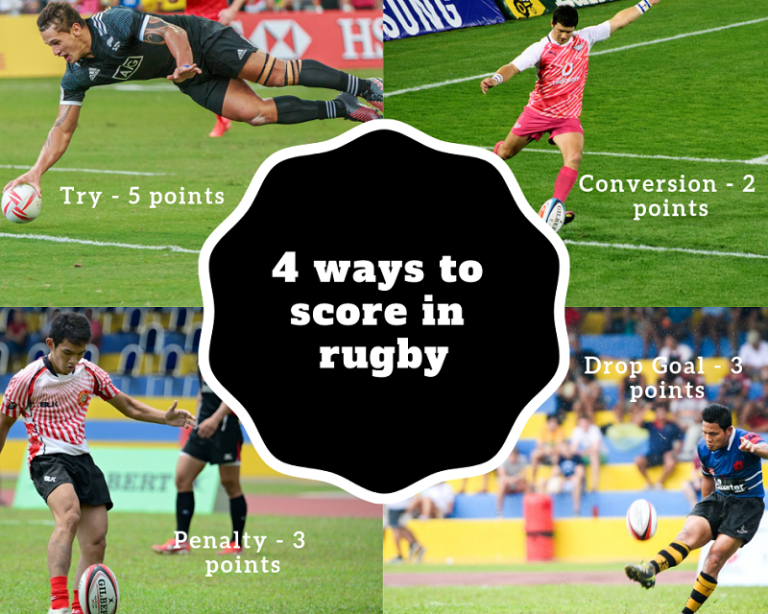
Scoring, briefly
| Method | Points |
|---|---|
| Try (grounding the ball in the in-goal area) | 5 |
| Conversion (kick after a try) | 2 |
| Penalty goal | 3 |
| Drop goal | 3 |
| Penalty try (awarded when foul play stops a certain try) | 7 — no kick taken |
The strategic wrinkle: a try scored under the posts makes the conversion trivial, while one in the corner leaves a brutal angle. That’s why you’ll see a player who has already crossed the line keep running sideways toward the middle — they’re buying their kicker two easy points. Full details, including the union-vs-league differences and bonus points, are in our rugby scoring guide.
All 15 positions, and how to tell who’s who
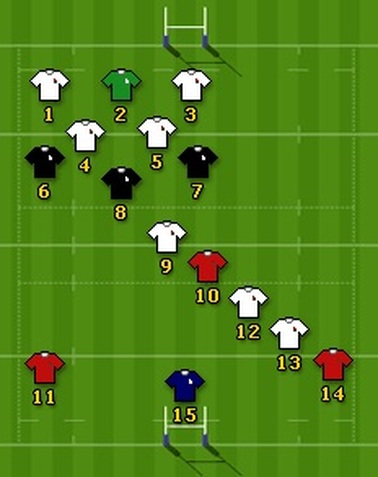
Rugby numbers aren’t decorative — they tell you exactly what a player does. 1 to 8 are the forwards (the ball-winners), 9 to 15 the backs (the ball-users).
| # | Position | The job | Typical build |
|---|---|---|---|
| 1 | Loosehead prop | Anchor the scrum’s left side; lift in lineouts | Immovable |
| 2 | Hooker | Hook the ball back in scrums; throw into lineouts | Powerful, accurate |
| 3 | Tighthead prop | The hardest scrummaging job in the sport | Immovable, angrier |
| 4 | Lock | Lineout jumping, scrum drive | Very tall |
| 5 | Lock | Same, plus the engine-room work nobody sees | Very tall |
| 6 | Blindside flanker | The big hitter — tackles, carries | Big, mobile |
| 7 | Openside flanker | The ‘fetcher’ — jackals for turnovers, first to every breakdown | Fast, relentless |
| 8 | Number 8 | Picks from the scrum base; links forwards to backs | Big and skilful |
| 9 | Scrum-half | Delivers the ball from every breakdown; the pack’s voice | Small, quick, loud |
| 10 | Fly-half | The decision-maker — runs the attack, kicks for territory | The brain |
| 11 | Wing | Finish tries; chase kicks | Fast |
| 12 | Inside centre | Crash ball or second playmaker, depending on the system | Strong |
| 13 | Outside centre | The hardest defensive read on the field | Fast and smart |
| 14 | Wing | Finish tries; field kicks | Fast |
| 15 | Fullback | Last line of defence; catches bombs; counter-attacks | Brave, good under high balls |
One quirk for the quiz: South Africa numbers its flankers the other way round — their openside wears 6 and blindside wears 7, opposite to most of the world. If you’re wondering why a commentator called a No. 6 ‘the fetcher’, that’s why.
💡 New to the sport and wondering where you’d play? The honest sorting: if you enjoy contact and physical work, you’re a forward; if you’d rather run into space, you’re a back. Very tall → lock. Small and bossy → scrum-half. Fast → wing. Nobody stays where they start, so don’t overthink the first assignment.
Why teams kick away the ball they just fought for
This baffles every newcomer, and the answer is simple once you accept the forward-pass law: territory is worth more than possession in a sport where you can only advance the ball twenty metres at a time by carrying it into people who are trying to stop you.
A fly-half who kicks from his own 22 to the opponent’s 10-metre line has moved the entire contest 50 metres up the pitch in two seconds. Yes, the other team now has the ball — but they have it deep in their own half, under pressure, with your chasers arriving. Statistically, that’s a better position than having possession pinned on your own line. It’s not throwing the ball away; it’s trading a bad asset for good real estate.
Union, league, sevens: which rugby are you watching?
| Code | Players | The defining difference | Feel |
|---|---|---|---|
| Rugby union | 15 | Rucks and mauls; possession is contested at every breakdown | Structured chaos, 80 min |
| Rugby league | 13 | Six tackles then hand the ball over; no contest at the breakdown | Faster, more repetitive, more space |
| Rugby sevens | 7 | Full-size pitch, 7-minute halves, absurd fitness | Track meet with tackling — see our sevens guide |
If a match you’re watching looks oddly tidy and the same team keeps the ball for five plays in a row, you’re watching league. If everything is a wrestling match for possession, that’s union. The scoring differs too, which trips people up — a league try is 4 points, a union try is 5.
Your first training session (what actually happens)
- You will not be crunched on day one. Clubs teach tackle technique progressively — pads, then controlled contact, then live. Any club that throws a beginner into full contact immediately is a bad club; leave.
- Fitness is the shock, not the contact. Rugby is repeated sprints with wrestling in between. Arriving with a running base makes the first month dramatically less miserable.
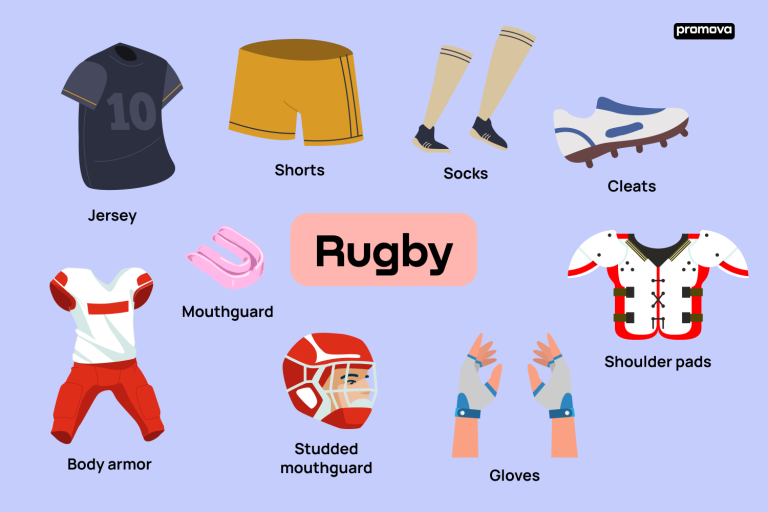
- Gear: boots (football/soccer cleats work to start), a mouthguard — non-negotiable, get one moulded — and a fitted shirt so opponents can’t grab loose fabric. That’s genuinely it. Head guards and padding are optional and don’t do what people think they do.
- Learn to pass first. The spiral pass makes everything else in the sport possible; being unable to pass off your weak hand is the thing that will hold you back longest.
- You’ll be knackered and sore. Everyone is, for about three weeks. Then you’re not, and you’re addicted.
⚠️ Tackle technique is a safety issue, not a style choice. Head up, cheek to the ball-carrier’s hip, wrap the arms, drive with the legs. Contact above the shoulder line draws cards and causes injuries. If you take nothing else from your first sessions, take this: never tackle with your head down, and never lead with the shoulder without wrapping.
Watching rugby: decoding the whistle
Most whistles in a match are one of five things. Learn these and you’ll follow any game:
| What you see | What was probably called | Result |
|---|---|---|
| Ball goes forward off hands | Knock-on | Scrum to the other team |
| Ref points across the pitch, arm horizontal | Offside | Penalty |
| Ref makes a ‘rolling’ motion at a tackled player | Not releasing / not rolling away | Penalty |
| Hands in the ruck | Handling in the ruck | Penalty |
| Ref arm straight up, then down | Penalty awarded | Kick at goal, touch, or tap |
| Arm at 45° pointing to a team | Scrum feed / advantage | Play may continue |
Referees also play advantage: after an infringement they’ll shout ‘advantage’ and let play continue if the non-offending team is doing well from it. If the advantage doesn’t materialise, they bring it back to the penalty. That’s why play sometimes rewinds thirty seconds — nothing has gone wrong; the referee is simply refusing to reward the offending side.
Frequently asked questions
Is rugby more dangerous than American football?
Different, and the answer isn’t what people assume. No pads means players tackle with technique rather than as projectiles, and high contact draws red cards immediately. The injury profile skews toward soft tissue and joints rather than the repeated high-speed collisions padding enables. Concussion is taken seriously — head contact protocols are strict and enforced.
Why do players keep kicking possession away?
Territory beats possession when you can only pass backwards. A 50-metre kick moves the contest further than five phases of carrying, and the receiving team gets the ball in a bad spot under pressure.
What’s the difference between a ruck and a maul?
The ball. If it’s on the ground with players bound over it, that’s a ruck (no hands). If the carrier is still on their feet with teammates bound on, that’s a maul (hands allowed).
How long is a rugby match?
Two 40-minute halves plus stoppages — around 100 minutes of real time. The clock runs continuously and stops only for injuries and specific referee decisions.
Do I need to be big to play rugby?
No — and this is genuinely the sport’s best feature. Rugby has a position for every body type: 100kg props, 60kg scrum-halves, tall locks, fast wings. It’s one of the few team sports where being unusually built is an advantage rather than a problem.
Can you pass forward if the ball goes backwards out of the hands?
The test is the direction the ball travels from the hands, not the direction the player is running. A pass thrown backwards relative to the passer can drift forward relative to the ground and still be legal — which is why some passes look forward on TV and aren’t.