
An Ankle Brace for Gymnastics Has to Allow a Pointed Toe


An ankle brace for gymnastics has to do something most ankle braces were never designed for: allow a fully pointed toe while still protecting against a lateral roll. Here’s how four real options handle that tradeoff, and when a brace isn’t the right answer at all.
The right ankle brace for gymnastics has to balance two things that work against each other: lateral (side-to-side) support to protect against a rolled ankle, and enough range of motion to still point the toe fully for landings, leaps, and tumbling. A low-profile, lace-free brace like the McDavid Phantom allows more plantarflexion (toe point) than a rigid stabilizer like an ASO, which trades some of that range for firmer side support. Neither is wrong; they solve different problems, and a brace alone is not a substitute for seeing a doctor or athletic trainer after an actual injury.
Most ankle braces on the market were designed with basketball, soccer, or general athletic use in mind, where the ankle mostly needs to stay at a neutral or slightly flexed angle. Gymnastics asks for the opposite extreme regularly: a fully pointed toe on every landing, leap, and tumbling pass. A brace that locks the ankle at a safer, more neutral angle can genuinely protect against a sprain and still work against a gymnast by limiting the exact motion the sport requires.
⚠️ Watch out: This guide covers general support and preventive options, not treatment for an existing injury. If an ankle is currently sprained, swollen, or painful to bear weight on, see a doctor or licensed athletic trainer before returning to training. A brace can support a healing or healthy ankle; it cannot diagnose or heal one, and training through real pain risks a worse injury.
- →The core tension in any gymnastics ankle brace is support versus range of motion, especially plantarflexion (toe point)
- →Low-profile, lace-free braces generally preserve more toe point but offer less lateral (side-to-side) stability
- →Rigid or semi-rigid braces like the ASO give more lateral support but can restrict the full point needed for landings
- →Compression sleeves offer the least support but the most flexibility, better suited to prevention than recovery
- →A brace supports an ankle; it does not replace medical evaluation for an actual sprain or repeated instability
Table of Contents
The real design tension, explained
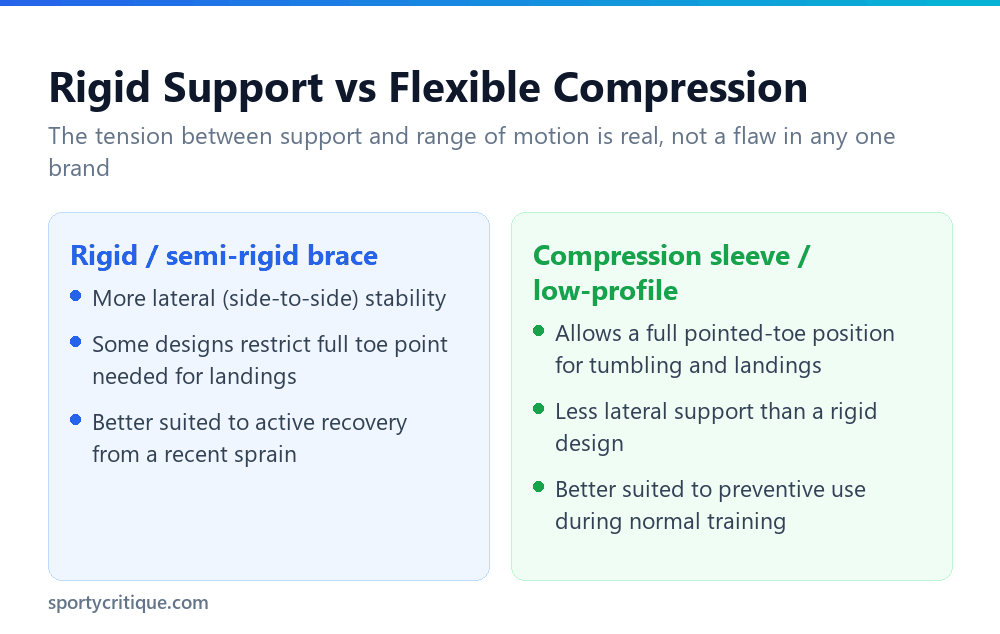
Lateral ankle sprains happen when the foot rolls outward or inward beyond its normal range, usually landing awkwardly off a beam, bar release, or vault. A brace that limits that side-to-side roll reduces sprain risk in exactly the direction most injuries occur. But limiting motion at the ankle joint rarely limits only the dangerous direction; most rigid designs also restrict plantarflexion, the pointed-toe position, to some degree, because the same structures that resist sideways roll also resist the ankle folding forward and down.
That is the actual engineering problem, not a defect specific to one brand. A brace built with hard plastic stays or a stiff lace-up shell will generally give more lateral protection at some cost to toe point. A soft compression sleeve preserves nearly full range of motion but does much less to stop a genuine lateral roll. Every product in this guide sits somewhere on that spectrum, and picking one means deciding which end of the tradeoff matters more for a specific gymnast.
Four real options across that spectrum
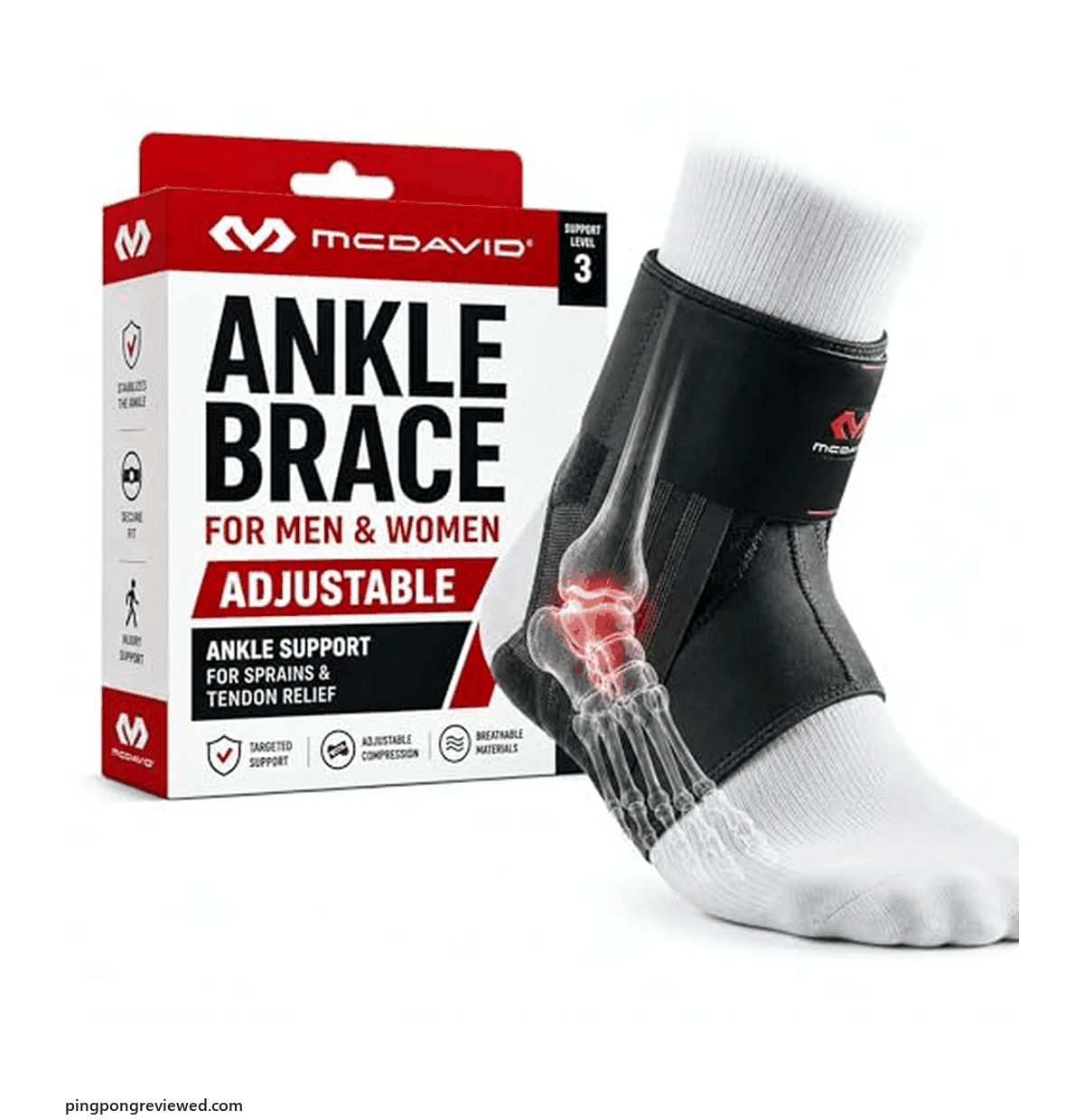
The McDavid Ankle Brace, Low Profile Lace-Free Phantom Ankle Braces for Men Basketball and more. Lightweight Design, Advanced Strapping & Flex-Support sits toward the flexible end. It is lace-free, low profile enough to fit inside a gymnastics slipper or bare shoe, and uses flex-support stays rather than a rigid shell, which preserves more of the toe-point range a gymnast needs. Current price: $36.00.
The McDavid Stealth Lace-Free Ankle Brace, Lightweight Support and Stability with Flex-Support Stays for Cleats, Men and Women steps up the support level while staying lace-free, using a more structured strapping system for extra stability. It gives more lateral protection than the Phantom above at some further cost to full range of motion, making it a middle option on this list. Current price: $46.99.
The ASO EVO Ankle Brace sits at the firm end of this group. Its figure-8 strapping and semi-rigid design are widely used across sports for genuine instability and post-injury support, and that same rigidity is what limits it as an everyday gymnastics brace: it is built to resist the ankle folding in most directions, which includes some of the plantarflexion tumbling and landings require. Current price: $41.99.
The Mueller Adjustable Ankle Support, Black, One Size is a soft, adjustable neoprene sleeve at the flexible end of the spectrum. It gives light compression and a mild reminder of joint position (proprioception) without meaningfully restricting toe point, which makes it a reasonable everyday preventive option for a gymnast with no current instability, but a poor choice for someone who has actually rolled an ankle recently and needs real lateral support. Current price: $16.97.
📊 Note: Live pricing for some of these listings was not returned by Amazon’s data feed at the time this was written. Where you see “price not listed in our data feed right now,” check the current price and stock status directly on the product page.
When a brace is not the right tool
A brace is preventive or supportive equipment, not treatment. Real warning signs, swelling that doesn’t go down within a day or two, pain on bearing weight, a visible deformity, or an ankle that has rolled more than once in a short period, call for evaluation by a doctor or licensed athletic trainer before any brace gets involved. Training through those signs with a brace as the only intervention risks turning a manageable sprain into a chronic instability problem that follows a gymnast for years.
Why gymnastics ankles are injured differently than other sports
Most ankle brace marketing is written for basketball and soccer, where the classic injury is a lateral roll landing off another player’s foot or an uneven patch of turf. Gymnastics adds a second common mechanism: landing short or long on a dismount or tumbling pass, which loads the ankle at an extreme plantarflexed angle rather than a neutral one. A brace tested and marketed against the first mechanism doesn’t automatically perform the same way against the second, which is part of why generic sports braces sometimes fit gymnastics training awkwardly even when they’re well made for their intended sport.
Repetitive impact is the other piece. A gymnast lands from height dozens of times in a single practice, which is a different stress pattern than the occasional hard cut or jump landing in field sports. That repetition is one reason chronic, low-grade ankle instability shows up often in gymnasts even without one dramatic sprain, and it’s worth mentioning to a doctor or athletic trainer as a pattern, not just reporting the most recent single incident.
A quick sizing note
Ankle brace sizing is usually based on shoe size or ankle circumference, and it varies by brand rather than following one universal chart. A brace sized too large will shift during a landing, which defeats its purpose regardless of how rigid or flexible the design is; one sized too small will dig into the achilles or the front of the ankle during a full toe point. Measure against the specific manufacturer’s chart rather than assuming a size that fit a different brand will transfer directly.
Fitting a brace around gymnastics footwear
Most competitive and recreational gymnastics happens barefoot or in thin slippers, not shoes, which rules out any brace bulky enough to need extra shoe room. Every option above is low-profile enough to sit under a slipper or against bare skin, but actual fit still varies by foot shape. Trying a brace through a full range of motion, pointing the toe as far as possible, rolling the ankle gently side to side, before committing to it for practice is worth the extra few minutes compared to discovering a restriction mid-routine.
- ✓Match brace rigidity to actual injury history, not to whichever product looks most protective
- ✓Test full toe point and side-to-side motion before wearing any new brace in practice
- ✓See a doctor or athletic trainer for an actual sprain rather than relying on a brace alone
- ✓Replace a compression sleeve once elastic support noticeably loosens
- ✕Assume a rigid brace is automatically the safer pick for a young or beginner gymnast
- ✕Train on a fresh, painful sprain because a brace is on
- ✕Buy a shoe-style basketball or soccer ankle brace that won’t fit under a gymnastics slipper
- ✕Ignore persistent instability after several rolled ankles; that pattern needs medical evaluation
💡 Pro tip: If you’re recovering from a recent sprain and returning to light training with a doctor’s clearance, a moderate-support option like the McDavid Stealth is often a more practical middle ground than jumping straight from a rigid recovery brace to no support at all.
Cost also tracks roughly with support level in this group, though not perfectly. The Mueller sleeve costs a fraction of the rigid ASO brace, which makes it a reasonable low-risk starting point for a family unsure whether their gymnast needs a brace at all. Spending more on a rigid brace before establishing that an actual instability exists is money that would often be better spent on a coach’s or trainer’s assessment first.
Bottom line
There is no single best ankle brace for gymnastics, because the sport asks for two things a brace can’t fully deliver at once: strong lateral support and a full pointed-toe range of motion. Pick based on actual injury history rather than which product markets itself as strongest, and treat any brace as support for a healthy or healing ankle, not as a substitute for seeing a professional about a real injury.
Will an ankle brace restrict my pointed toe?
It depends on the design. Low-profile, lace-free braces with flexible stays preserve most of the toe-point range gymnastics requires; rigid or semi-rigid braces built for genuine instability restrict more of that motion in exchange for stronger lateral support. Test the full range of motion before wearing any brace in practice.
Can I wear an ankle brace during competition?
Rules vary by governing body and level, so check with your gym or meet organizers before competing in a brace. Many programs allow low-profile supports but restrict bulkier rigid braces; this article is not a substitute for checking your specific competition’s equipment rules.
Should I see a doctor before buying an ankle brace?
If you’re buying for prevention with no current injury, a brace alone is a reasonable choice. If you’ve actually sprained or rolled an ankle recently, or have swelling or pain bearing weight, see a doctor or licensed athletic trainer first. A brace supports an ankle; it doesn’t diagnose or treat an existing injury.
How long do compression-style ankle sleeves last?
Typically a season or two of regular use before the elastic loosens enough to reduce the support and proprioceptive feedback they’re meant to provide. Once a sleeve feels noticeably looser than when new, it’s worth replacing rather than assuming it still offers the same support.
As an Amazon Associate, we earn from qualifying purchases through links on this page.


