Best Ankle Brace for Soccer: 4 Verified Options and Honest Limits


No ankle brace reliably prevents a sprain, but a properly fitted one can add real resistance to the rolling motion behind most soccer ankle injuries. Here’s what four verified, currently sold options actually do, and where a compression sleeve stops being enough.
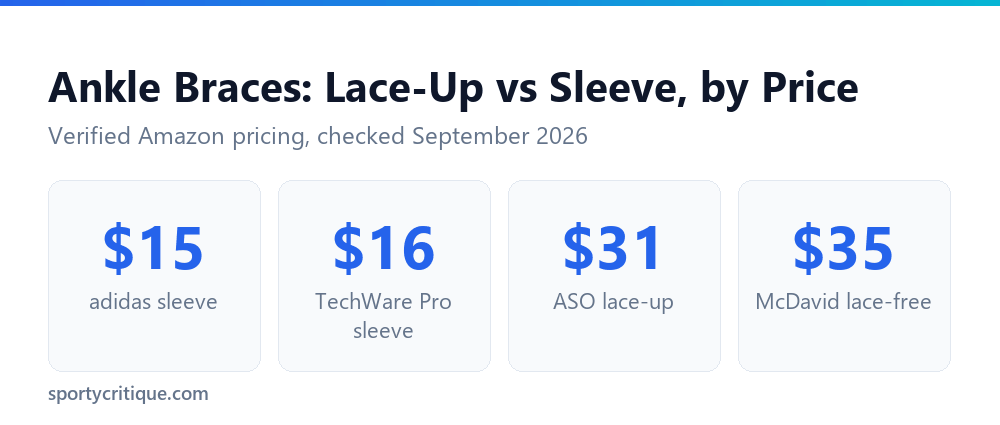
There is no ankle brace, cheap or expensive, that reliably prevents a bad ankle sprain in soccer. What a properly fitted brace can do is add mechanical resistance to the rolling motion that causes most sprains, and that resistance measurably helps some players, especially those recovering from a previous sprain. We checked pricing and stock on four widely sold ankle supports on Amazon: two lace-up or strapped braces built for real restriction, and two compression sleeves that offer support and warmth without the same mechanical limiting. If you have an active injury or ongoing ankle pain, see a doctor or physical therapist before choosing a brace off a review page, this one included.
We want to be direct about what this post can and can’t tell you. An ankle brace is a piece of medical-adjacent equipment, and claims about injury prevention deserve more caution than claims about, say, which soccer ball feels nicer to strike. We checked that the four products below are real, currently sold, and priced as stated, verified against Amazon’s own product data in September 2026. We did not run a clinical study, and neither did most of the marketing copy you’ll see on similar listings elsewhere, so treat any specific injury-rate percentage you see on a sock or brace listing with real skepticism.
- →No brace reliably prevents a sprain; a snug, strapped design adds resistance to rolling, it doesn’t eliminate the risk
- →Lace-up or strapped braces (McDavid, ASO) restrict motion more than slip-on compression sleeves (adidas, TechWare Pro)
- →Compression sleeves add warmth and mild support but shouldn’t be relied on for an unstable ankle after a real injury
- →If you have a current sprain, swelling, or recurring instability, see a doctor before choosing a brace from any review
- →A brace that doesn’t fit inside your actual cleat is useless during a match, check compatibility before buying
Table of Contents
What an ankle brace can and can’t do
A strapped or lace-up ankle brace works by physically limiting how far the ankle joint can roll inward or outward, the motion behind most soccer ankle sprains. That mechanical limit is real and measurable in lab settings, and it’s part of why athletic trainers commonly tape or brace ankles for players returning from a previous sprain. What it is not is a guarantee. A hard enough impact or an awkward enough plant can still injure a braced ankle, and no listing that claims otherwise is being honest with you.
A compression sleeve is a different category of product entirely. It applies even pressure around the joint, which some players find reduces swelling and adds a subjective sense of stability, but it does not restrict the rolling motion the way a strapped brace does. If your goal is genuine mechanical support after a previous sprain, a lace-up or strapped design is the more appropriate category, not a compression sleeve.
⚠️ Watch out: If you currently have swelling, sharp pain, or a joint that feels unstable walking on flat ground, that’s an active injury, not something to brace through with a product from a shopping guide. See a doctor or physical therapist first. A brace bought online cannot diagnose whether a ligament is torn versus strained, and that distinction changes what kind of support, if any, you should be wearing.
Four verified options, lace-up braces and compression sleeves
We split these into the two real categories rather than pretending they compete on the same axis. The first two below are strapped or lace-up designs meant to genuinely restrict motion; the second two are compression sleeves meant for mild support and warmth.
McDavid Lace-Free Ankle Brace

The McDavid Lace-Free Ankle Brace was listed at $34.99 at last check, verified in stock. Type: Lace-free, low profile. It fits inside a cleat’s low-cut collar more easily than a bulkier lace-up model, which matters for players who find rigid braces don’t fit inside a snug soccer boot at all.
ASO (Med Spec) Lace-Up Ankle Stabilizer
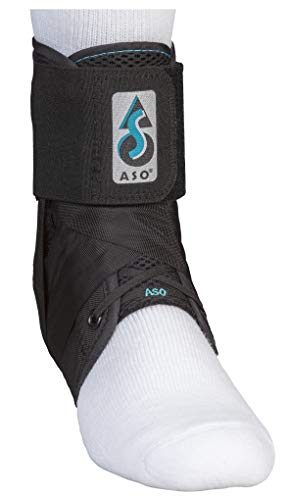
The ASO (Med Spec) Lace-Up Ankle Stabilizer was listed at $31.23 at last check, verified in stock. Type: Lace-up with figure-eight straps. It’s one of the more established lace-up designs used in athletic training rooms, built around a figure-eight strap pattern that limits inward and outward rolling more than a plain compression sleeve can.
adidas Ankle Support Compression Sleeve

The adidas Ankle Support Compression Sleeve was listed at $14.99 at last check, verified in stock. Type: Compression sleeve. It’s a slip-on compression sleeve rather than a rigid brace, meaning it adds mild support and warmth but nothing close to the mechanical restriction a strapped brace provides.
TechWare Pro Compression Sleeve

The TechWare Pro Compression Sleeve was listed at $15.99 at last check, verified in stock. Type: Compression sleeve with arch support. Like the adidas sleeve, this is a compression product rather than a strapped brace; it’s built more around everyday arch and Achilles discomfort than acute ankle-roll prevention during a match.
Fitting a brace inside an actual soccer cleat
This is where a lot of ankle brace purchases go wrong. Soccer cleats run lower-cut than basketball or football shoes, and a bulky lace-up brace built with basketball players in mind may simply not fit inside your boot’s collar. Before buying, check whether the listing mentions soccer or football cleat compatibility specifically, and if it doesn’t, measure the brace’s bulk around the ankle against your boot’s actual collar height. A brace you can’t fit inside your cleat is not a brace you’ll wear during a match, no matter how good it looks on paper.
💡 Pro tip: Try the brace with your actual cleats on, laced the way you normally play, before match day. Some players find a slightly smaller size than their shoe size works better under a tight-fitting boot, since the brace itself adds bulk that a loose everyday shoe would absorb but a snug cleat won’t.
Who a brace actually makes sense for
- ✓Players returning to soccer after a previous sprain who’ve been cleared to play by a doctor or physio
- ✓Players who feel occasional mild instability but have no current swelling or sharp pain
- ✓Anyone choosing a strapped or lace-up design specifically for its motion-limiting straps, not just because it’s labeled a brace
- ✓Checking that the brace fits inside your actual cleat before buying, not after
- ✕Wearing any brace as a substitute for seeing a doctor about a current injury
- ✕Assuming a compression sleeve gives the same restriction as a strapped or lace-up brace
- ✕Buying based on marketing claims about exact injury-prevention percentages
- ✕Ignoring cleat compatibility and discovering the brace doesn’t fit on game day
Common myths about ankle braces
When to see a professional instead of shopping
If you have current swelling, bruising, sharp pain when bearing weight, or a joint that gives way on flat ground, those are signs that need a medical evaluation before you buy anything. A doctor or physical therapist can tell you whether you’re dealing with a mild sprain that a brace can support during recovery, or something more serious like a ligament tear that needs a different treatment plan entirely. No review page, including this one, is a substitute for that evaluation, and choosing the wrong support for an undiagnosed injury can slow your recovery or make things worse.
📊 Note: We are not medical professionals and this page is not medical advice. If you’re unsure whether your ankle needs a brace, taping, physical therapy, or imaging, ask a doctor rather than guessing from a shopping guide.
Caring for a brace so it keeps its support
Straps and hook-and-loop closures wear out faster than most people expect, especially on a brace worn for every training session and match over a season. Hand washing in cold water and air drying preserves the elastic and the strap material far better than a hot washer and dryer cycle, which can loosen the stitching and weaken the very straps doing the restricting. Check the hook-and-loop closure periodically too; once it stops gripping firmly, the brace loses much of its function even if the fabric itself still looks fine.
If you rotate between two braces, one for training and one kept fresh for matches, both will last longer than a single brace worn daily for months straight. That’s a minor cost tradeoff worth considering if you play often enough that a single brace wears out within a season.
Bottom line
If you want real restriction after a previous sprain and you’ve been cleared to play, a lace-up or strapped brace like the ASO or McDavid options above is the appropriate category, not a compression sleeve. If you just want mild support and warmth for general use, a sleeve like the adidas or TechWare Pro option is cheaper and less bulky, but don’t expect it to do the job of a strapped brace. Either way, check that whatever you buy actually fits inside your cleats before match day, and see a doctor first if there’s any sign of a current injury.
Can an ankle brace prevent a soccer injury?
No brace can reliably prevent a sprain. A strapped or lace-up brace adds mechanical resistance to the ankle-rolling motion behind most sprains, which measurably helps in some cases, especially for players returning from a previous injury, but it doesn’t eliminate the risk of a hard enough impact or an awkward plant causing a new injury.
What’s the difference between a compression sleeve and a lace-up ankle brace?
A compression sleeve applies even pressure and adds warmth but doesn’t meaningfully restrict joint motion. A lace-up or strapped brace uses straps, often in a figure-eight pattern, to physically limit how far the ankle can roll inward or outward. They serve different purposes and aren’t interchangeable if you need real restriction after an injury.
Will an ankle brace fit inside soccer cleats?
It depends on the brace and the cleat. Soccer cleats run lower-cut than basketball shoes, so a bulky lace-up brace may not fit under a tight-fitting boot collar. Check the listing for cleat compatibility and try the brace with your actual boots before match day.
Should I see a doctor before buying an ankle brace?
Yes, if you have current swelling, sharp pain, bruising, or a joint that feels unstable on flat ground. Those are signs of an active injury that a shopping guide can’t diagnose. A doctor or physical therapist can tell you whether a brace is appropriate or whether you need a different treatment first.
Are expensive ankle braces always better than cheap ones?
Not automatically. Price differences among the options here mostly reflect the type of product, strapped braces built for real restriction cost more than simple compression sleeves, rather than one specific brand being universally superior. Match the type of brace to what you actually need rather than assuming price alone tells you the answer.
As an Amazon Associate, we earn from qualifying purchases through links on this page.