
Gymnastics Grips for CrossFit Are Not the Same as Competition Grips


Gymnastics grips for CrossFit look like the same product a competitive gymnast wears, and structurally they are. The hole style that actually works best is usually different, and here’s why.
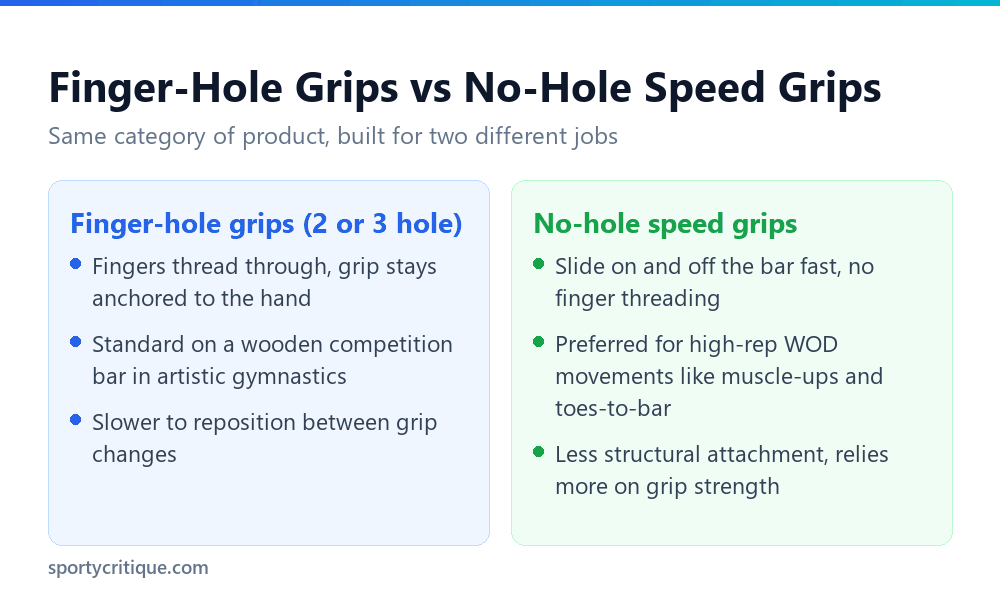
Gymnastics grips for CrossFit are the same basic product as artistic gymnastics grips, leather or synthetic palm protection with a wrist strap, but CrossFit athletes usually want a different hole style. Competitive gymnasts almost always use 2 or 3 finger-hole leather grips on a wooden bar. Many CrossFit athletes prefer a no-hole or fewer-hole “speed grip” instead, because CrossFit workouts demand fast transitions between grip positions that finger holes slow down.
Walk into a CrossFit box and you will see people wearing what look like gymnastics grips, and in a technical sense, that is exactly what they are wearing. But ask a competitive artistic gymnast and a CrossFit regular to each pick their ideal pair, and they will often land on different products. The crossover is real. The preferences inside that crossover are not identical, and the difference matters more than the marketing copy on most listings admits.
- →Finger-hole grips (2 or 3 holes) anchor to the hand and are standard for competitive artistic gymnastics on a wooden bar
- →No-hole “speed grips” slide on and off fast, which is why many CrossFit athletes prefer them for high-rep WOD movements
- →Steel and aluminum pull-up rigs behave differently under a grip than a chalked wooden competition bar does
- →Leather grips last longer and feel more secure; synthetic grips are cheaper, grip better without chalk, and wear faster
- →A grip that feels perfect on rings can feel wrong on a straight bar, and vice versa; the surface changes the fit
Table of Contents
Why the same product splits into two different preferences
Artistic gymnastics grips were designed for one job: protecting the palm during repeated giant swings and releases on a wooden high bar or uneven bars, where the hand stays in roughly the same position for extended sequences. Finger holes exist to keep the grip locked onto the hand through that motion, so it doesn’t shift or spin mid-swing.
CrossFit asks something different of the same equipment. A workout might move an athlete from pull-ups to muscle-ups to toes-to-bar in the same set, each requiring a slightly different hand position on a bar that is usually steel or aluminum, not wood, and might not be chalked consistently. Speed between movements counts. A grip built to lock onto the hand for one sustained motion is not always the fastest choice when the hand needs to reposition constantly.

Four real grips, and where each one actually fits
The Bear KompleX 3 Hole Leather Hand Grips for Workouts, Pull-ups, Weightlifting, WOD Gymnastics, Crosstraining Palm Grips with Wrist Wraps, Hand Protection from Rips and Blisters,1 Pair is the traditional choice: full-grain leather, 3 finger holes, adjustable wrist wrap. This is closest to what a competitive gymnast trains with, and it holds up well over months of use because leather resists abrasion better than synthetic material. It is also the slowest of the four to put on and take off between movements. Current price: $44.98.
The Bear KompleX No Hole Hand Grips – Non-Slip Fingerless Gymnastics Grips for Weight Lifting, Pull-ups & Cross Training | Lightweight, Padded Wrists & Foldable Grip. drops the finger holes entirely. It stays on the hand through a wrist strap alone, which means no threading fingers through holes between movements. That is exactly the tradeoff a lot of CrossFit athletes want during a workout with mixed bar movements, at some cost to how locked-in it feels compared to a finger-hole design. Current price: $49.98.
The Bear KompleX 2-3 Hole Carbon Hand Grips for Weight Lifting, Cross Training and Gymnastics, Durable Workout Grips with Wrist Wraps, Comfortable Lifting Straps & Workout for Gymnastic Bars splits the difference: a carbon fiber-reinforced synthetic material with a 2-or-3-hole option depending on hand size and preference, giving some of the security of finger holes with a lighter, faster-drying material than leather. Current price: $49.98.
The JerkFit WODies Gymnastics & Weightlifting Grips with Wrist Wraps – 3 Hole Versatile Gym Gloves for Pull Ups, Gym Training & Cross Training – Hand Grips Palm Protector for Men & Women is the budget classic in this category, a 3-hole elastic and synthetic grip with wrist support, originally built specifically with CrossFit training in mind rather than adapted from a gymnastics product. It won’t outlast full-grain leather under heavy use, but it costs less and works fine for someone still figuring out which hole style they prefer. Current price: price not listed in our data feed right now.
📊 Note: Live pricing for some of these listings was not returned by Amazon’s data feed at the time this was written. Where you see “price not listed in our data feed right now,” check the current price and stock status directly on the product page.
Chalk, bar material, and why they change the calculation
A wooden competition bar holds chalk consistently and offers a fairly predictable amount of friction. A steel or powder-coated pull-up rig at a typical gym does not behave the same way, and chalk rules vary by gym, some allow it freely, some restrict it near certain equipment. Synthetic and carbon-blend grips tend to hold their friction better on a clean, unchalked steel bar than leather does, which is part of why they show up more often in CrossFit gyms specifically.
Rings add another variable. A grip that feels stable on a straight bar can feel wrong on gymnastics rings, where the hand wraps around a rounded surface rather than gripping a fixed cylinder. Anyone doing ring work regularly is better off trying a grip on rings specifically before assuming a bar-tested favorite will translate.
Leather versus synthetic: the real tradeoff
- ✓Choose leather if you train the same bar movements for months and want durability
- ✓Choose synthetic or carbon blends if you switch between rings, bars, and rigs often
- ✓Break in a new leather grip gradually; stiff leather can chafe before it softens
- ✓Check the wrist strap length against your own wrist size, not just hand size
- ✕Assume a grip marketed for gymnastics will suit high-rep WOD transitions without trying it
- ✕Buy a finger-hole grip sized for a child gymnast and expect it to fit an adult CrossFit athlete
- ✕Skip checking hole spacing if you have unusually short or long fingers
- ✕Ignore how a grip performs on an unchalked steel bar if that’s what your gym actually has
Breaking in a new leather grip without wrecking a workout
New leather grips arrive stiff, and using them at full intensity on day one is a common way to end up with a blister in a spot the grip is supposed to protect. A better approach is wearing them for short, lighter sets over the first week, gripping a bar without full bodyweight load, so the leather flexes at the fold points before it has to handle real volume. Some athletes soften new leather further with a small amount of leather conditioner, though that is optional and has no effect on the grip’s actual holding power.
Synthetic and carbon-blend grips skip most of this problem. They arrive closer to their final flexibility and generally need only a session or two to mold to an individual hand, which is one more reason they show up often as a first grip purchase for someone new to either sport.
Sizing: where most first-time buyers get it wrong
Grip sizing runs by hand width, not by shoe size or general body size, and it is brand-specific rather than standardized across the category. Measure straight across the widest part of the palm, just below the fingers, and compare that number against the actual chart for the specific product, not a general size guess based on a different brand worn previously. A grip sized too small will bunch the fingers and cut into the palm during a hard set; one sized too large will slide during a swing, which is a bigger safety concern on rings or a high bar than on a fixed pull-up bar closer to the ground.
Who should skip grips entirely
Not everyone doing pull-ups or muscle-ups needs grips at all. Someone training a handful of reps a week, without high-volume bar or ring work, often does fine with plain chalk and no grip. Grips earn their place once volume climbs, callus tears become a recurring problem, or a specific movement, like high-rep toes-to-bar, starts wearing through skin faster than it can recover between sessions.
💡 Pro tip: If you’re not sure whether you want holes at all, start with a 2-hole or 3-hole design rather than jumping straight to no-hole speed grips. It’s easier to learn to move fast with holes and later drop to no-hole grips than to learn security first on a fingerless design.
Wrist wraps deserve a mention on their own. Nearly every grip in this category ships with an integrated wrap, but the length and stiffness vary between brands. A longer wrap gives more adjustable wrist support during heavy pulling and pressing work, which matters for weightlifting movements CrossFit programming often pairs with gymnastics skills in the same workout. A shorter, thinner wrap is lighter and less bulky under a watch or heart rate strap, at the cost of some of that extra wrist stability.
Bottom line
Gymnastics grips for CrossFit share their basic design with the grips competitive gymnasts use, but the hole style that works best usually differs. Finger-hole leather grips suit sustained bar work on a consistent surface; no-hole or fewer-hole synthetic grips suit the fast movement changes and mixed equipment that define most CrossFit workouts. Try both styles before committing to one, since hand size and personal preference decide the final answer more than any spec sheet.
Can I use regular gymnastics grips for CrossFit?
Yes, and many people do. Finger-hole leather grips built for artistic gymnastics work fine for CrossFit bar work, they’re just slower to reposition between different movements than a no-hole speed grip, which matters more in a timed WOD with mixed exercises than in sustained single-movement bar work.
What’s the difference between 2-hole and 3-hole grips?
Hole count changes how many fingers thread through the grip and how securely it anchors to the hand. 3-hole grips are the traditional gymnastics standard and feel more locked in; 2-hole designs free up one finger for a faster, slightly less secure grip, which some CrossFit athletes prefer for quicker transitions.
Do I need chalk with these grips?
It depends on the material. Leather grips generally perform better with chalk underneath, since leather alone can get slick with sweat. Synthetic and carbon-blend grips are often designed to grip well with or without chalk, which is one reason they’re common in gyms that restrict chalk use.
How do I know what size grip to buy?
Measure across your palm at its widest point and check that measurement against the specific brand’s size chart, since sizing varies between manufacturers even at the same labeled size. A grip that’s too small will restrict finger movement; one that’s too large will shift during use, which defeats the point of wearing it.
As an Amazon Associate, we earn from qualifying purchases through links on this page.


