Billiards Glossary: Rail, Kitchen, Scratch, and Other Terms Explained


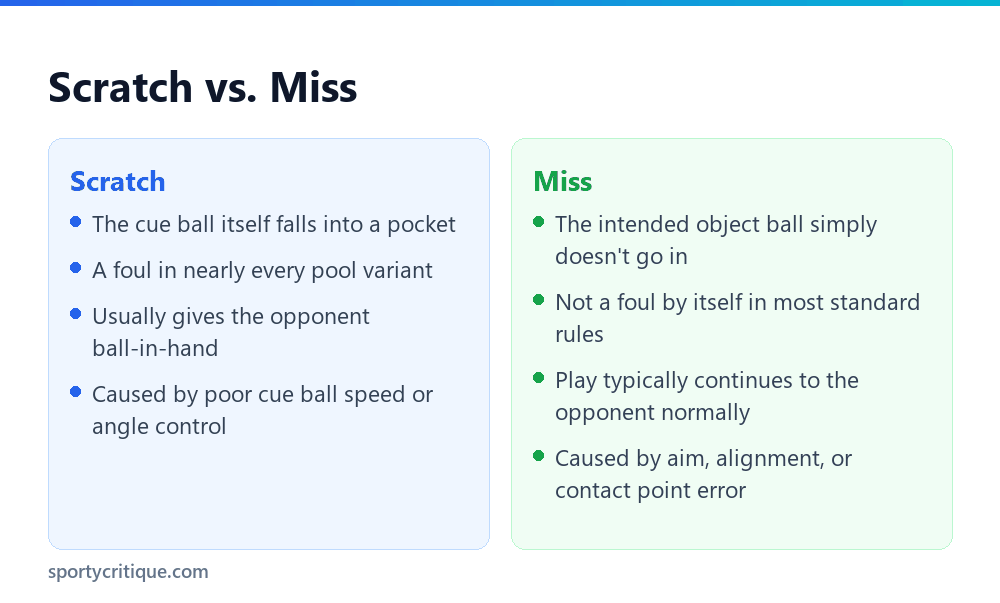
A billiards terms glossary covers the vocabulary that rules and technique articles usually assume a reader already knows. A rail is the cushioned edge of the table; the kitchen is the area behind the head string where the cue ball is placed on a re-rack in some games; a scratch is when the cue ball itself falls into a pocket, a foul in nearly every pool variant. Dozens of other terms, English, safety, break, and more, are defined below in plain language.
Billiards and pool carry a dense vocabulary built up over more than a century of organized play, and most rules or technique content assumes a reader already knows terms like “kitchen” or “safety” without ever defining them directly. This glossary exists specifically to fill that gap for newer players working through the sport’s other, more detailed articles.
- →A rail is the cushioned edge of the table; a cushion is the rubber strip inside the rail itself
- →The kitchen is the area behind the head string, relevant mainly for re-spotting the cue ball
- →A scratch means the cue ball fell into a pocket, a foul in nearly every pool variant
- →English refers to sidespin applied to the cue ball, distinct from top or bottom spin
- →A safety is a defensive shot meant to leave the opponent without a good next shot, not to pocket a ball
Table of Contents
Table Terms
Ball and Cue Terms
Shot and Rule Terms
Position and Strategy Terms
Position play, deliberately controlling where the cue ball ends up after pocketing an object ball, sits at the center of skilled pool and separates a beginner simply trying to sink each ball from a more advanced player planning several shots ahead. Several specific terms describe this layer of the game.
📊 Note: A player described as having “good shape” isn’t being praised for their form or stance; it specifically means their cue ball ended up in a favorable position for the next shot in their planned pattern.
Terms Beginners Commonly Mix Up
- ✓Rail refers to the cushioned edge structure; cushion is the rubber strip specifically
- ✓English is sidespin; draw and follow are backspin and topspin, a separate axis entirely
- ✓A safety is intentionally defensive; a missed shot attempting to pocket a ball is not the same thing
- ✓A scratch means the cue ball fell in a pocket, not simply missing the intended object ball
- ✕Using “rail” and “cushion” interchangeably in a way that confuses new players
- ✕Assuming English refers to any spin rather than specifically sidespin
- ✕Calling a missed shot a “safety” after the fact when it wasn’t an intentional defensive play
- ✕Confusing a scratch (cue ball in the pocket) with simply missing the object ball
Terms Specific to Certain Games
Some vocabulary applies only to specific pool variants rather than the sport broadly. Eight-ball uses “stripes and solids” to describe the two ball groups players are assigned during a game, while nine-ball uses “the nine on the snap,” referring to legally pocketing the nine ball directly off the break for an outright win in some rule sets.
Straight pool, also called 14.1 continuous, introduces terms like “break shot” in a different sense than the opening break of a rack, referring instead to the specific shot that both pockets the last object ball of a rack and re-breaks the newly racked 14 balls in the same stroke. Snooker, a related but distinct game played on a larger table, has its own separate vocabulary largely outside the scope of standard pool terminology.
Equipment Terms Worth Knowing
💡 Pro tip: Using a dedicated break cue rather than a primary playing cue for the opening break shot protects the more expensive cue’s tip, ferrule, and joint from the repeated high-impact stress that breaking puts on equipment over time.
Fouls and Penalty Terms
Most of these foul terms exist to keep matches fair and prevent a player from gaining an unearned advantage through an illegal or borderline shot. Understanding them matters particularly for anyone entering their first league or tournament setting, where fouls get called and enforced far more strictly than in casual, informal home games.
Common Slang and Informal Terms
Beyond official rulebook vocabulary, pool rooms and casual play carry their own informal slang that varies somewhat by region and community but shows up often enough to be worth knowing. A “hustler” describes a player who deliberately conceals their actual skill level to win money off an unsuspecting opponent, related to but distinct from sandbagging in a handicapped league context specifically.
“Slop” or a “lucky shot” describes a ball going in a pocket the shooter wasn’t specifically aiming for, which counts in most casual and bar-table games but is explicitly disallowed in “call shot” formats common in more serious competitive play, where a player must announce which ball and pocket they’re aiming for before each shot.
📊 Note: Call-shot rules matter more in competitive settings specifically because they remove the ambiguity around whether a shot was intentional, which affects how disputes over close or unclear pocketed balls actually get resolved during a match.
Frequently Asked Questions
What’s the difference between a rail and a cushion?
The rail is the overall cushioned edge structure around the table; the cushion specifically refers to the rubber strip inside the rail that balls actually bounce off.
Is a scratch the same as missing a shot?
No. A scratch specifically means the cue ball itself fell into a pocket, which is a foul in nearly every pool variant. Simply missing the intended object ball is a miss, not a scratch.
What does English mean in pool?
English refers to sidespin, applied by striking the cue ball off-center to the left or right of its vertical axis. It’s distinct from draw (backspin) and follow (topspin).
What is the kitchen in pool?
The area behind the head string near one end of the table. It matters mainly for re-spotting the cue ball after certain fouls, depending on the specific game’s rules.
Why is a defensive shot called a safety?
Because its purpose is to protect a player’s position by leaving the opponent without a good next shot, rather than attempting to pocket a ball outright.
Are pool and billiards terms interchangeable with snooker terms?
Not entirely. Snooker is a related but distinct game played on a larger table with its own separate vocabulary, though some general terms like rail and cushion carry over.
Bookmarking a glossary like this one and returning to it while reading other billiards content is often more effective than trying to memorize every term in one sitting before it’s needed in context. The vocabulary sticks far better once it’s tied to an actual shot, rule dispute, or piece of match commentary a reader has personally encountered.
Knowing this vocabulary doesn’t improve a player’s stroke or position play directly, but it makes every other piece of pool instruction, rules explanation, or match commentary far easier to actually follow and apply. A player fluent in this terminology gets more value out of every other resource they read afterward.
New terms occasionally enter common use as the sport evolves, and regional variation means not every player uses identical slang even within the same country. Treating this glossary as a solid working foundation rather than an exhaustive, unchanging final list keeps expectations realistic while still covering the vocabulary that matters for the vast majority of everyday conversations, rules discussions, and instructional content a newer player will encounter.
As an Amazon Associate, we earn from qualifying purchases through links on this page.