Best Tennis Racquets for Tennis Elbow: Arm-Friendly Flex, Weight & Dampening

Tennis elbow (lateral epicondylitis) is the most devastating and prevalent injury in racquet sports. The sharp, searing ache along the outside of the elbow joint makes gripping a racquet, hitting backhands, or even turning a doorknob agonizing. While poor stroke mechanics and overplaying contribute, the primary culprit is often modern equipment: ultra-stiff 70+ RA racquets paired with dead polyester strings strung at 58 pounds. Fortunately, cutting-edge racquet engineering allows players to heal and stay on the court by combining ultra-flexible carbon layups, active micro-bearing dampening, and expanded sweet spots.
Table of Contents
Biomechanical Causes of Tennis Elbow: Shockwaves and Torsional Twist
When a tennis ball strikes your racquet bed at 50 to 80 mph, the impact lasts approximately 4 milliseconds. During this tiny fraction of a second, three distinct physical forces travel up the handle into your arm:
Initial Impact Shock: The raw kinetic collision force of the heavy ball decelerating and reversing direction. If your racquet is light and stiff, the frame cannot absorb this energy, transmitting the shockwave directly into the wrist joint and the common extensor tendon origin at the lateral epicondyle.
Frame Resonance and High-Frequency Vibration: After the ball leaves the string bed, the racquet frame oscillates back and forth at frequencies between 100Hz and 200Hz for several tenths of a second. High-frequency vibrations travel through the grip into the tendon micro-fibers, causing inflammation and microscopic tears.
Off-Center Torsional Twisting: Hitting the ball outside the sweet spot twists the racquet violently in your hand. Your forearm muscles instinctively contract with maximum force to keep the frame stable, subjecting the extensor carpi radialis brevis tendon to extreme eccentric tension.
Arm-Friendly Tennis Racquet Comparison: RA Stiffness, Mass & Dampening Matrix
| Racquet Model | Babolat RDC Stiffness (RA) | Unstrung Weight & Balance | Vibration Dampening Technology | String Pattern & Sweet Spot | Amazon Price & Recommendation |
|---|---|---|---|---|---|
| Wilson Clash 100 V2 | 57 RA (Ultra-Flexible) | 295g (10.4 oz) / 7 pts HL | FORTYFIVE° Carbon Mapping | 16×19 (Expanded Sweet Spot) | Check Amazon Price (Top Overall Arm-Friendly Pick) |
| ProKennex Ki Q+ 5 Pro (315g) | 63 RA (Plush Response) | 315g (11.1 oz) / 7 pts HL | Kinetic System (Micro-Bearings) | 16×20 (Pinpoint Control) | Check Amazon Price (Medical Grade Shock Absorption) |
| Yonex EZONE 100 (2024) | 67 RA (Comfortable Power) | 300g (10.6 oz) / 4 pts HL | VDM (Vibration Dampening Mesh) | 16×19 (Isometric Sweet Spot) | Check Amazon Price (Best Arm-Safe Offensive Power) |
| Head Gravity MP (2023) | 59 RA (Low-Impact Flex) | 295g (10.4 oz) / 3 pts HL | Auxetic 2.0 Carbon Structure | 16×20 (Massive Teardrop Face) | Check Amazon Price (Best Forgiveness on Mishits) |
| Prince Phantom 100X (305g) | 58 RA (Butter-Soft Touch) | 305g (10.8 oz) / 6 pts HL | TeXtreme Spread Tow + Twaron | 16×18 (Open Spin Pattern) | Check Amazon Price (Traditional Thin Beam Precision) |
In-Depth Reviews: The Best Arm-Friendly Tennis Racquets
1. Wilson Clash 100 V2: The Arm-Friendly Phenomenon
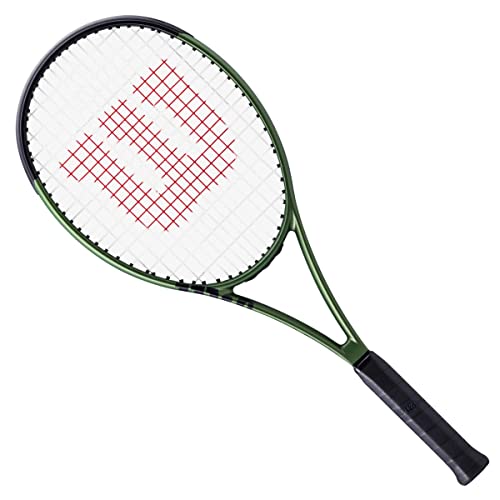
The Wilson Clash 100 V2 Tennis Racquet revolutionized tennis racquet design. Historically, flexible racquets with low RA ratings were thin, heavy, and demanded elite tour-level strength to generate pace. The Clash 100 shattered this rule by pairing a thick, modern aerodynamic beam with a mind-bogglingly flexible 57 RA stiffness rating.
Wilson accomplished this through patented FORTYFIVE° carbon mapping, which allows the frame to bend with extraordinary compliance in both horizontal and vertical swing planes while maintaining torsional stability. When you strike the ball, the frame flexes gently like a cushion, holding the ball for extended dwell time before springing forward. Tennis players plagued by chronic elbow pain universally report instantaneous pain relief when switching to the Clash 100 V2.
2. ProKennex Ki Q+ 5 Pro: Medical-Grade Kinetic Shock Absorption
If you have severe, chronic lateral epicondylitis and require the absolute safest racquet engineered, the ProKennex Ki Q+ 5 Pro Racquet is the gold standard. ProKennex holds exclusive medical patents on Kinetic System technology, integrating thousands of microscopic kinetic micro-bearings sealed inside dampening chambers distributed around the frame perimeter.
As you swing forward, the micro-bearings load toward the rear of the chambers. At the exact millisecond of ball impact, the bearings shift forward at the speed of sound, detonating kinetic energy against the incoming ball and absorbing 43% of frame shock and 50% of harmful vibrations before they can exit the handle. Weighing a solid 315g unstrung with a plush 63 RA flex, the Ki Q+ 5 Pro acts like a biological shock absorber for your arm.
3. Yonex EZONE 100 (2024): Arm-Safe Offensive Power
Players often worry that switching to an arm-friendly racquet means surrendering modern baseline power and topspin. The Yonex EZONE 100 Tennis Racquet proves otherwise. While its 67 RA rating appears moderately firm on paper, Yonex eliminates harsh vibrations through VDM (Vibration Dampening Mesh) woven directly into the graphite within the handle.
Furthermore, Yonex’s iconic square Isometric head shape expands the sweet spot by 7% compared to traditional oval racquets. By enlarging the hitting zone toward the upper hoop, off-center mishits produce significantly less torsional twisting, shielding your elbow from harsh twisting strain. It is the premier choice for aggressive baseliners who want effortless ball speed without elbow tenderness.
4. Head Gravity MP: Massive Teardrop Sweet Spot
Endorsed on the ATP tour by Alexander Zverev and Andrey Rublev, the Head Gravity MP Racquet is engineered around a distinct teardrop head shape that widens significantly toward the 3 and 9 o’clock positions. This moves the effective sweet spot higher on the string bed where modern topspin players naturally make contact.
Featuring a butter-soft 59 RA flex rating and Head’s Auxetic 2.0 carbon fiber construction, the Gravity MP provides exquisite sensory feedback without jarring your joints. Its 16×20 string pattern offers the ideal compromise between spin generation and directional control, allowing you to swing aggressively with complete arm comfort.
5. Prince Phantom 100X: Classic Thin-Beam Finesse
For traditionalists who grew up playing with flexible thin-beam graphite racquets, the Prince Phantom 100X (305g) is pure bliss. With a constant thin beam measuring only 20.5mm and an ultra-low 58 RA stiffness, the Phantom 100X flexes gracefully through ball contact.
Prince infuses TeXtreme Spread Tow carbon and Twaron aramid fibers into the layup, dampening unwanted frame flutter while preserving crystal-clear touch on drop shots and delicate touch volleys. Strung with soft multifilament strings, the Phantom 100X delivers an arm-safe, cloud-like hitting sensation unmatched by modern hollow power frames.
The Golden String Rules for Arm Health
Pairing an arm-friendly racquet with the wrong strings will completely negate the racquet’s therapeutic benefits. Follow these non-negotiable string guidelines:
1. Ditch Full Polyester Immediately: Stiff co-poly monofilaments lose their elasticity after 8 to 10 hours of play, going ‘dead’ and transmitting pure shockwaves directly into your joints. Cut out dead poly strings immediately.
2. Embrace Premium Multifilament or Natural Gut: Switch to high-elasticity multifilament strings (such as Tecnifibre X-One Biphase, Wilson NXT, or Babolat Xcel) or genuine Natural Gut. Natural gut and multifilaments absorb impact shock, pocket the ball deeply, and protect tendon fibers.
3. Lower Your String Tension: If you currently string at 55 to 58 pounds, drop your tension down to 48 to 52 pounds. Lower string tensions soften the string bed trampoline, dramatically reducing impact G-forces on your arm.
Biomechanics of Groundstroke Deceleration and Muscle Load
While the moment of ball collision creates the initial shockwave, research at sports medicine biomechanics laboratories reveals that over 50% of tendon strain occurs during the deceleration phase of the tennis stroke. When executing a full topspin forehand or backhand, the racquet must be decelerated from 70 mph to zero within a fraction of a second after ball release.
If your racquet is too light (under 280g) or possesses a stiff, hollow frame, the forearm extensor muscles must contract violently to absorb the racquet’s momentum. A flexible, headlight racquet (such as the Wilson Clash 100 or ProKennex Ki Q+ 5) features an organic flex profile that bends gently on follow-through, dissipating angular momentum and allowing your shoulder and core muscles to decelerate the swing smoothly without straining elbow tendons.
Lead Tape Customization for Torsional Stability
If you already own a comfortable tennis racquet but experience joint twinges on off-center balls, adding high-density adhesive lead or tungsten tape around the frame hoop provides an instant stability upgrade:
The 3 and 9 O’Clock Hoop Placement: Apply 2 to 3 grams of lead tape on the inside of the frame at the 3 o’clock and 9 o’clock positions (directly across from the center of the string bed). Adding perimeter mass at these lateral points raises the frame’s torsional twist weight significantly, preventing the racquet from twisting in your hand when you hit outside the sweet spot.
Handle Counter-Weighting: To keep the racquet maneuverable after adding hoop tape, add 4 to 6 grams of silicone putty or lead tape inside the trapdoor of the butt cap. Counter-weighting maintains a head-light balance (6 to 8 points head-light), allowing rapid wrist acceleration without feeling sluggish at the net.
Therapeutic Rehabilitation Protocols for Active Players
Upgrading your racquet and strings provides immediate mechanical protection, but restoring tendon health requires active rehabilitation:
The Tyler Twist with a Resistance Bar: The single most clinically proven exercise for lateral epicondylitis is the Tyler Twist using a flexible rubber resistance bar (such as a TheraBand FlexBar). Performing three sets of 15 eccentric wrist extension repetitions daily strengthens the tendon micro-fibers, promoting collagen repair and eliminating chronic inflammation within 6 to 8 weeks.
Grip Size Verification: Playing with a grip that is too small forces your fingers into a claw-like death grip. When holding your racquet in an Eastern forehand grip, there should be enough space between your fingertips and the palm of your hand to slide the index finger of your other hand comfortably. If the gap is too narrow, apply a thick cushioned replacement grip to widen the handle bevels.
String Gauge Selection: 16-Gauge vs. 17-Gauge for Shock Reduction
Beyond string material, string thickness (gauge) plays a profound role in arm comfort. Thick 15L or 16-gauge strings (1.30mm) are engineered for maximum durability, but their stiff cross-sectional density transmits harsh impact shocks into the frame.
Switching to thinner 17-gauge (1.25mm) or 18-gauge (1.20mm) multifilament strings increases string bed elasticity and ball pocketing dwell time. Thinner strings stretch more upon ball collision, acting like a soft trampoline that dissipates kinetic G-forces before they reach the racquet handle. Even if thinner strings require restringing slightly more frequently, the immense protection they provide to your elbow tendons makes the upgrade essential.
Vibration Dampeners: Myths vs. Reality
Many tennis players believe clipping a small rubber dampener onto the bottom string prevents tennis elbow. In laboratory testing, string dampeners only mute the acoustic ping of the strings; they absorb virtually zero frame shock or low-frequency torsional twist. To protect your arm, rely on flexible racquet frames, soft multifilament strings, and proper kinetic chain mechanics rather than cosmetic rubber dampeners.
Swingweight vs. Static Weight: Why Head-Light Balances Protect Tendons
Many recreational players confuse static weight (what the racquet weighs on a kitchen scale) with swingweight (how heavy the racquet feels when swinging through the air). A light 270g racquet with a head-heavy balance point actually possesses a high swingweight, making it sluggish through the contact zone while offering zero mass in the handle to absorb shock. Conversely, a 305g racquet with a 6 to 8-point head-light balance accelerates effortlessly while placing mass right in your hand to dampen vibrations. Always choose head-light balance specifications when recovering from tendonitis.
Restringing Frequency Guidelines for Injured Players
Strings lose elasticity and resilience even when racquets sit idle in a tennis bag. As strings notch and lose tension, they deaden, forcing your arm to generate extra swing speed to clear the net. As a golden rule, restringe your racquet as many times per year as you play per week (e.g., if you play three times weekly, restringe every four months minimum), and always replace strings immediately if you detect fraying or dead acoustic feedback.