Strength Training for Tennis: A Player’s Workout Guide


Strength training for tennis isn’t the same as generic gym fitness. The sport’s rotational groundstrokes, repetitive overhead serves, and constant one-leg-at-a-time movement call for a specific mix of core, shoulder, and leg work, and building that mix, rather than just lifting more in general, is what actually shows up in your game.
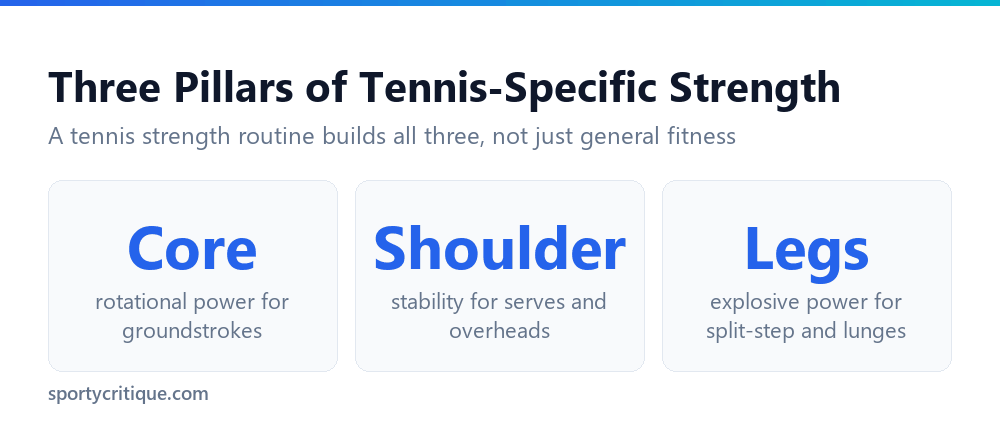
Strength training for tennis works best when it targets three areas the sport actually demands: rotational core strength for groundstroke power, shoulder stability for serving and overheads without injury, and explosive leg strength for the split-step, lunges, and quick direction changes. General gym strength helps, but a routine built around these three areas carries over to on-court performance more directly than generic full-body lifting alone.
Tennis is a rotational, start-stop sport played mostly on one leg at a time, whether you’re lunging for a wide ball or loading up for a serve. That’s a very different demand profile from a straight-ahead sport like running, and it’s why a tennis-specific strength routine looks different from a generic gym program, even though both build real, useful strength.
- →Rotational core strength (not just standard sit-ups) is the engine behind groundstroke and serve power for most recreational and competitive players
- →Shoulder stability work matters as much as shoulder strength for tennis, since the serve and overhead motions put the joint through a large, fast range of motion repeatedly
- →Single-leg and lateral leg strength carries over to the split-step, lunges, and direction changes more directly than straight-line leg exercises like a standard squat alone
- →Two to three dedicated strength sessions a week, separate from on-court practice, is a reasonable starting volume for most recreational players
- →This is a general strength and conditioning framework, not medical advice; anyone with an existing injury should get individual guidance from a physical therapist or doctor first
Table of Contents
Why tennis needs its own strength approach
A tennis groundstroke doesn’t get its power mainly from the arm. The stroke starts with a rotation through the hips and torso, transfers through the shoulder, and finishes at the racket, a kinetic chain where a weak link anywhere along the way limits how much power actually reaches the ball. That’s why a player with a strong arm but a weak core often struggles to generate real pace, while a player with strong rotational core strength can hit hard even with a relatively simple technique.
The same logic applies to movement around the court. Tennis rarely asks for straight-line sprinting; it asks for short, explosive bursts in every direction, sudden stops, and recovery steps back to center, almost always loading one leg at a time. General straight-ahead leg strength helps, but single-leg and lateral strength work targets the specific movement patterns tennis actually uses far more directly.
Rotational core work
Rotational core strength, the ability to generate and control force through a twisting motion, is different from the flexion-focused core strength built by standard sit-ups or crunches. Exercises like the medicine ball rotational throw, the cable or band wood chop, and the Russian twist all train the torso to rotate under load and then decelerate that rotation under control, which mirrors what actually happens during a groundstroke or serve.
A simple way to start is with band-resisted rotations: anchor a resistance band at roughly waist height, stand sideways to the anchor point, and rotate your torso away from it while keeping your arms relatively straight, then return under control. Two to three sets of 10-12 controlled reps per side, done a couple of times a week, is a reasonable starting volume without needing any specialized gym equipment.
A set of resistance loop bands is a genuinely useful, low-cost piece of equipment for this kind of rotational and stability work, since the bands provide adjustable resistance for rotational, lateral, and shoulder-stability exercises without needing a full home gym setup.
Shoulder stability, not just shoulder strength
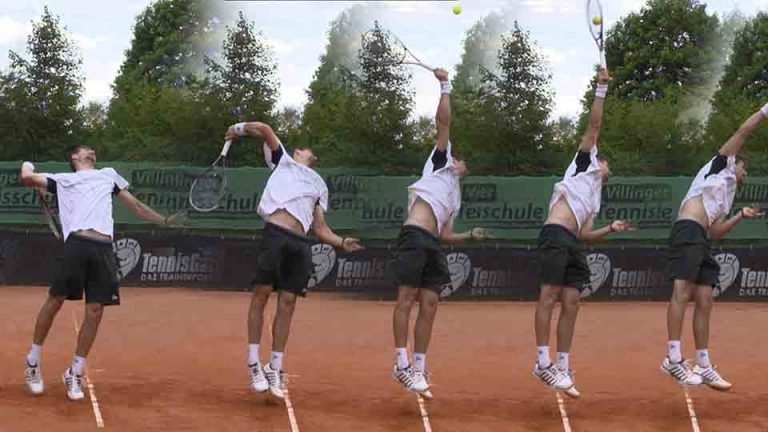
The serve and overhead are among the fastest, most repetitive overhead motions in any racket sport, and the shoulder joint takes on a lot of that stress. Building raw shoulder strength with exercises like overhead presses is useful, but stability work, training the smaller rotator cuff and scapular muscles that keep the joint properly positioned through that fast range of motion, matters just as much for staying healthy enough to keep playing.
Common stability exercises include external rotation with a light band or dumbbell (rotating the forearm outward while keeping the elbow tucked at your side), band pull-aparts for the upper back and rear shoulder, and scapular wall slides to reinforce good shoulder blade positioning. These are typically done with light resistance and higher reps, since the goal is control and endurance in the joint, not maximum strength.
⚠️ Watch out: Shoulder pain that’s sharp, persistent, or gets worse with serving is not something to train through. If you experience that kind of pain, see a doctor or physical therapist before continuing any shoulder-focused strength work, since pushing through joint pain can turn a minor issue into a more serious one.
Leg power: single-leg and lateral movement
Split step timing, lateral lunges to a wide ball, and quick recovery steps back to center all load one leg at a time, often while changing direction. Bulgarian split squats, lateral lunges, and single-leg Romanian deadlifts all train strength in that same single-leg, multi-directional pattern, which tends to carry over to on-court movement more directly than a standard bilateral squat alone, even though standard squats still have a place in a broader leg-strength program.
Explosive elements help too. Lateral bounds (jumping sideways from one leg to the other) and split-step timing drills build the fast-twitch power tennis actually uses in short, repeated bursts rather than the sustained effort a distance run trains. A reasonable structure is to pair a strength exercise (like a split squat) with an explosive exercise (like a lateral bound) in the same session, since both matter for on-court movement.
A simple weekly structure
💡 Pro tip: If you’re new to structured strength training, start with two sessions a week rather than three, and prioritize learning correct movement patterns with lighter resistance before adding load. Rotational and single-leg exercises in particular are easy to do with poor form if you rush the weight up too quickly.
Do you need a gym membership for this?
- ✓Use resistance bands for rotational and shoulder-stability work; they’re inexpensive and cover most of what a tennis-specific routine needs
- ✓Add bodyweight single-leg exercises (split squats, lateral lunges) that need no equipment
- ✓Progress gradually, adding resistance or reps only once form is consistent
- ✓Warm up with light rotational and dynamic movement before any strength session
- ✕Assume you need a full gym setup before starting; bands and bodyweight cover a lot of ground
- ✕Skip the warm-up and jump straight into rotational or explosive exercises cold
- ✕Copy an advanced tour player’s off-season program without adjusting for your own level
- ✕Ignore joint pain during an exercise; stopping and reassessing form is the right call
Fitting strength work around court time
For most recreational and club players, strength training should support on-court practice, not compete with it for time and recovery. Scheduling strength sessions on days you’re not also hitting hard, or at least several hours apart from an intense practice, gives your body more room to recover and adapt. During a heavier match schedule, such as tournament weeks, it’s reasonable to scale back strength volume rather than trying to maintain full intensity on both fronts at once.
Progressing the routine over time
A strength routine that never changes eventually stops producing improvement, since the body adapts to a consistent load and stimulus over a matter of weeks. For rotational and single-leg exercises, progression usually means adding resistance gradually, whether that’s a heavier resistance band, a dumbbell added to a split squat, or simply more controlled reps before fatigue changes your form. A general approach many strength coaches use is to increase load or reps only once the current level feels clearly manageable with good form, rather than on a fixed weekly schedule regardless of how the previous session felt.
It’s also worth building in lighter recovery weeks periodically, especially around a busy match or tournament schedule, rather than pushing progressively heavier loads year-round without a break. Persistent fatigue, declining performance in sessions that used to feel manageable, or nagging joint soreness that doesn’t fully resolve between sessions are all signs it’s time to scale back intensity for a week or two rather than pushing through.
Warming up before a strength or on-court session
A short dynamic warm-up before strength training, or before hitting on court, reduces injury risk and generally improves performance in the session that follows. A reasonable warm-up includes five to ten minutes of light cardio to raise body temperature, followed by dynamic movements like leg swings, walking lunges, arm circles, and a few light rotational trunk twists that mimic the movements you’re about to train. This matters as much before a strength session focused on rotational or explosive work as it does before stepping on court, since cold muscles and joints are more vulnerable to strain during fast, forceful movements.
Bottom line
A tennis-specific strength routine built around rotational core work, shoulder stability, and single-leg or lateral leg power carries over to on-court performance more directly than generic full-body lifting alone. Two to three sessions a week, built from simple exercises and inexpensive equipment like resistance bands, is enough to see a real difference in both power and injury resilience over time.
What kind of strength training is best for tennis players?
A routine focused on rotational core strength, shoulder stability, and single-leg or lateral leg power carries over to tennis-specific movements like groundstrokes, serves, and court movement more directly than generic full-body lifting alone.
How many days a week should a tennis player strength train?
Two to three dedicated sessions a week is a reasonable starting point for most recreational players, scheduled apart from intense on-court practice to allow for recovery.
Do I need gym equipment to start tennis-specific strength training?
Not necessarily. Resistance bands and bodyweight exercises cover most of the rotational, shoulder-stability, and single-leg work a tennis-specific routine needs, without requiring a full gym setup.
Will lifting weights make me slower or less flexible on court?
Generally no. Strength training, including with moderate to heavy loads, typically improves explosive power and joint stability for tennis, as long as it’s paired with normal mobility work and doesn’t replace on-court practice.
Should I strength train during tournament weeks?
It’s generally reasonable to scale back volume and intensity during a heavy match schedule rather than maintaining a full strength routine on top of competitive matches, since recovery demands are already elevated. Light maintenance work is usually fine; adding new heavy loads during a tournament week typically isn’t the best timing.
As an Amazon Associate, we earn from qualifying purchases through links on this page.