Tennis Scoring Explained: Love, 15-30-40, Deuce, Tiebreaks & 2026 Rules

Quick Answer: Tennis games go love (0), 15, 30, 40, game — win by two points. Tied at 40-40 is ‘deuce’, where you must win two straight points (advantage, then game). Six games with a two-game lead wins a set; 6-6 goes to a tiebreak. Matches are best of three sets (best of five in men’s Grand Slams). The server’s score is always called first.
Tennis scoring looks like it was designed by someone with a grudge. Zero is called ‘love’, the third point is worth 40 rather than 45, and a tied game gets its own French noun. There’s a reason for all of it — mostly medieval — and once you’ve read this page it will never confuse you again. We’ll cover the system, a worked game point by point, tiebreaks (including the part that confuses everyone: who serves when), and the 2022 rule change that made half the internet’s tennis explanations obsolete.
Table of Contents
The points inside a game
| Points won | Called | Where it comes from |
|---|---|---|
| 0 | Love | Almost certainly French l’œuf — ‘the egg’, for the shape of a zero |
| 1 | 15 | Likely a medieval clock face: quarter past |
| 2 | 30 | Half past |
| 3 | 40 | Shortened from 45 — ‘quarante-cinq’ appears in a 1435 ballad |
| 4 | Game | Provided you lead by two |
The clock-face theory is the popular explanation and it has a hole in it: if 15/30/45 marked quarter hours, the fourth point should be 60, and it isn’t — 40 exists because ‘forty-five’ got shortened in speech, and deuce needed room before the hour. Historians argue about this. What’s solid: the numbers are French, they’re medieval, and the earliest written reference to quarante cinq dates to around 1435. Nobody redesigned it because tennis, more than any sport, is fond of its own furniture.
How to say the score out loud
The server’s score always comes first. ’30–love’ means the server has two points and the receiver none. Tied scores use ‘all’: 15-all, 30-all. Three points each is not ’40-all’ — it’s deuce. Get this wrong and everyone knows it’s your first week; get it right and you sound like you’ve played for years.
Deuce and advantage: the two-point rule
At 40–40, you can’t win the game with a single point. You must win two in a row:
- Win the first point after deuce and you have advantage (‘ad-in’ if you’re serving, ‘ad-out’ if receiving).
- Win the next and the game is yours.
- Lose it and it’s back to deuce — and it can go around forever.
This loop is why a single tennis game can last ten minutes and why ‘holding serve’ is a genuine achievement rather than a formality. The longest recorded games have run past 30 points. It’s also why club and league play often adopts no-ad scoring (below) — courts get booked in one-hour blocks and deuce respects no schedule.
A worked game, point by point
Abstractions don’t stick. Here’s a real game, called correctly, with the server listed first throughout:
| Rally winner | Score | What just happened |
|---|---|---|
| Server | 15–love | Server on the board |
| Receiver | 15–15 | Called ’15-all’ |
| Server | 30–15 | Server ahead |
| Receiver | 30–30 | ’30-all’ |
| Receiver | 30–40 | Break point — receiver one point from winning the game |
| Server | Deuce | Saved. Not ’40-all’ |
| Server | Advantage in | Server one point from the game |
| Receiver | Deuce | Back to square one |
| Receiver | Advantage out | Break point again |
| Receiver | Game, receiver | A ‘break of serve’ — the pivot of most sets |
Note what happened there: the receiver had break point three times and the server saved two. That’s the drama the scoring system is built to manufacture, and it’s why tennis commentary obsesses over break points — they’re the moments where a set actually turns.
Games into sets, sets into matches
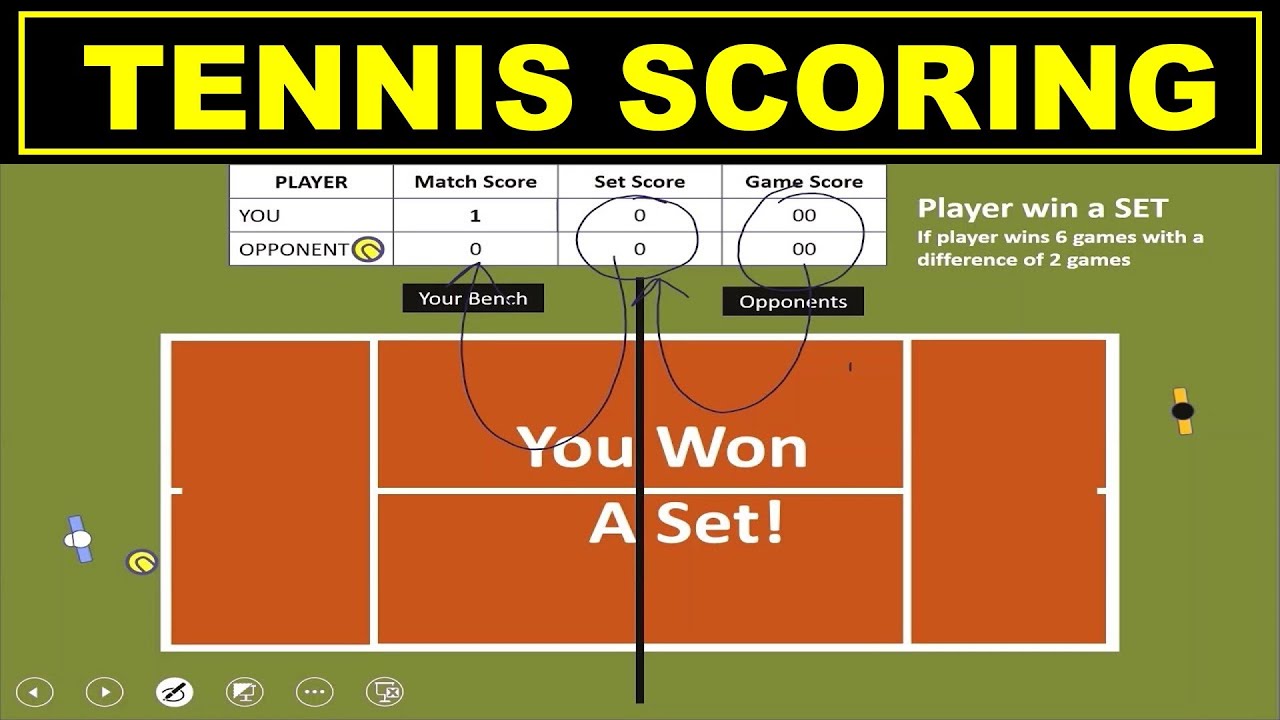
- A set is won by the first to 6 games with a two-game margin. 6–4 wins it. 6–5 does not — you play on to 7–5.
- At 6–6, a tiebreak decides the set, which then reads 7–6.
- A match is best of 3 sets almost everywhere — best of 5 in men’s Grand Slam singles.
- Serve alternates every game.
- Ends change after the 1st game and then every two games (i.e. after odd-numbered game totals), and every 6 points in a tiebreak.
💡 Reading a scoreline: ‘6–4, 3–6, 7–6(4)’ means the player won the first set 6-4, lost the second 3-6, and won the third in a tiebreak that finished 7 points to 4. The number in brackets is always the loser’s tiebreak score — if it’s 7-6(4), the tiebreak went 7-4.
Tiebreaks: the part everyone finds confusing
The scoring itself is easy — first to 7 points, win by two, counted normally (1, 2, 3…). What confuses people is the serving order, which is genuinely unusual:
| Points | Who serves | Why |
|---|---|---|
| Point 1 | Player A (whoever’s turn it was) | A single serve to start |
| Points 2–3 | Player B | Then it alternates in pairs |
| Points 4–5 | Player A | — |
| Points 6–7 | Player B | Change ends after every 6 points total |
| Points 8–9 | Player A | And so on, in twos |
| … | … | First to 7 with a 2-point lead wins the set |
The one-then-twos structure exists for fairness: it means both players serve an equal number of points from each end regardless of when the tiebreak ends. And there’s a follow-on rule people forget — whoever served first in the tiebreak receives first in the next set, so the serving rotation stays honest across the match.
⚠️ If a tiebreak reaches 6–6, it does not stop at 7. You keep going until someone leads by two: 8–6, 12–10, 20–18. The record books contain tiebreaks past 25 points a side. ‘First to 7’ is only true if nobody’s stubborn.
Final-set rules: the 2022 change most explanations missed
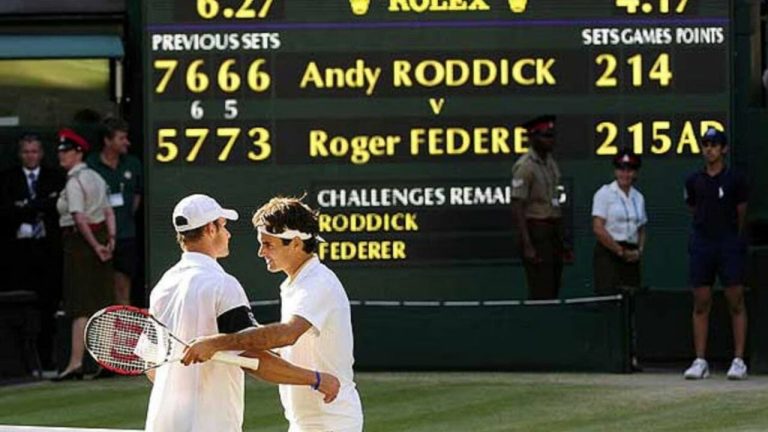
Here’s where a lot of tennis content on the internet is quietly out of date. Deciding sets used to be chaos — every Grand Slam did it differently, and marathon finishes (Isner–Mahut’s 70–68 fifth set at Wimbledon in 2010) forced the issue.
Since March 2022, all four Grand Slams use the same rule: at 6–6 in the final set, a 10-point tiebreak (win by two) decides the match. The Grand Slam Board announced it jointly for the Australian Open, Roland-Garros, Wimbledon and the US Open, specifically to create consistency for players and fans.
| Tournament | Old final-set rule (pre-2022) | Now |
|---|---|---|
| Australian Open | 10-point tiebreak at 6–6 | 10-point tiebreak at 6–6 |
| Roland-Garros (French Open) | Advantage set — no tiebreak at all | 10-point tiebreak at 6–6 |
| Wimbledon | 7-point tiebreak at 12–12 | 10-point tiebreak at 6–6 |
| US Open | 7-point tiebreak at 6–6 | 10-point tiebreak at 6–6 |
So if you read somewhere that the French Open can go on forever, or that Wimbledon waits until 12-all — that information is more than four years stale. The endless fifth set is history at the majors, though it survives in some team competitions like the Davis Cup’s older formats and certain amateur leagues that never got the memo.
Scoring variants you’ll actually meet
| Format | How it works | Where you’ll see it |
|---|---|---|
| No-ad scoring | At deuce, one deciding point; the receiver chooses which side to receive from | College tennis, many leagues, most doubles |
| 10-point match tiebreak | Replaces a full third set — first to 10, win by 2 | Doubles, recreational leagues, Grand Slam final sets |
| Pro set | First to 8 games (tiebreak at 8–8) instead of a full match | Practice matches, time-limited events |
| Fast4 | First to 4 games, no-ad, tiebreak at 3–3 | Exhibitions, junior formats |
| Short sets | First to 4 games, tiebreak at 4–4 | Some team competitions |
All of these exist for one reason: the traditional format has no clock and courts do. If you join a league, ask which variant they use before your first match — turning up expecting advantage scoring and getting a sudden-death deuce point is a rude introduction.
The quirk: you can win more points and lose the match
Here’s something the scoring system does that no other major sport allows, and it’s the key to understanding why tennis feels the way it does. Points are not equal. A point at 40–love is nearly worthless; a point at 30–40 can decide a set. Because points are bundled into games and games into sets, where you win your points matters more than how many you win.
The consequence: a player can win considerably more total points than their opponent and still lose the match. It happens at every level, including Grand Slam finals. Imagine one player loses three sets 6–4, 6–4, 6–4 but wins every one of their own service games to love and loses the rest at deuce — they’d have won more points and lost in straight sets.
This is a feature, not a bug. It’s what makes tennis matches recoverable: you can be thoroughly outplayed for an hour, win one tight game at the right moment, and still be level. In a sport with a running total — basketball, say — a bad hour is fatal. In tennis, sets reset the arithmetic. The scoring system is a comeback machine, and it’s why ‘momentum’ isn’t just commentary filler here; the structure genuinely rewards it.
Which is why break points are everything
Because the server has a real advantage — they choose the first ball of every rally — holding serve is the expectation and losing it (a ‘break’) is the exception. Most sets are decided by exactly one break. That’s why you’ll see commentators lose their minds over a single point at 30–40 in the fifth game of a set: it’s not drama for its own sake. That point is, statistically, worth more than the twenty before it.
💡 Watching tip: ignore the total score for a moment and just track break points won and saved. It predicts match outcomes better than almost any other simple stat — and it explains why a player who looks dominant can lose.
The five things beginners get wrong
| The mistake | The correction |
|---|---|
| Calling 3–3 ’40-all’ | It’s deuce. 40-all doesn’t exist as a call |
| Calling your own score second | The server’s score always comes first, whoever is speaking |
| Thinking 6–5 wins a set | You need a two-game margin — play on to 7–5, or 6–6 and a tiebreak |
| Assuming the tiebreak stops at 7 | Win by two. 7–6 in a tiebreak is not a win; it goes on |
| Serving from the wrong side after deuce | Deuce is always served from the right (deuce) court; advantage from the left (ad) court |
That last one deserves a beat. The court sides have names for exactly this reason: the deuce court is the right half (from the server’s view) and the ad court is the left. Every game starts serving to the deuce court, and you alternate every point. So an even total of points played = deuce court; odd = ad court. If you’re ever lost mid-game, count the points played and the side tells you the score is consistent.
Doubles scoring differences
The point system is identical. What changes:
- No-ad is standard in most doubles, including professional tour doubles — at deuce, one point decides the game and the receiving team picks who takes it.
- The third set is usually a 10-point match tiebreak rather than a full set.
- Serving order is fixed at the start of each set: each team decides which partner serves first, and the rotation runs through all four players.
- Receiving order is also fixed per set — you can’t swap mid-set to hide a weaker returner.
Frequently asked questions
Why is zero called ‘love’ in tennis?
The likeliest explanation is French l’œuf — ‘the egg’ — describing a zero’s shape, anglicised into ‘love’. The romantic theory (playing ‘for love’, i.e. for nothing) is charming and probably invented later.
Why does tennis go 15, 30, 40 instead of 1, 2, 3?
Medieval French scoring, probably tied to a clock face, with 45 shortened to 40 in speech. The system predates any governing body by centuries — nobody chose it so much as inherited it.
What happens at 6–6 in a set?
A tiebreak: first to 7 points, win by two, with the set recorded as 7–6. In a deciding set at a Grand Slam since 2022, it’s a 10-point tiebreak instead.
Who serves first in a tiebreak?
Whoever’s turn it was to serve. They serve one point, then serves alternate in pairs. Ends change every six points, and the first server in the tiebreak receives first in the next set.
What’s a ‘golden set’?
Winning a set 6–0 without losing a single point — 24 consecutive points. It has happened only a handful of times in professional tennis history.
Can a tennis match still go on forever?
Not at the Grand Slams — the 2022 unified 10-point final-set tiebreak ended that. Isner–Mahut’s 11-hour, 70–68 fifth set at Wimbledon 2010 is now permanently unrepeatable at the majors, which is either a mercy or a tragedy depending on who you ask.
How do I keep score if there’s no umpire?
The server calls the score aloud before every point — their own score first. It’s not optional etiquette; it’s how recreational tennis avoids the argument at 4–4 about whether it’s 4–4.