Best Cleats for Soccer: A Decision Guide to Every Cleat on This Site


This page is a decision guide, not another top-10 list: the best cleats for soccer depend on your surface, position, foot width, and age, and this site publishes eight in-depth guides covering each situation with its own verified, real products. Work through the sections below to find yours, or use the three overall default picks if you just want one solid answer.
⚽ Soccer Hub: Explore all 30 cleat reviews, striking tutorials, and recruiting guides in our Complete Soccer Resource Hub.
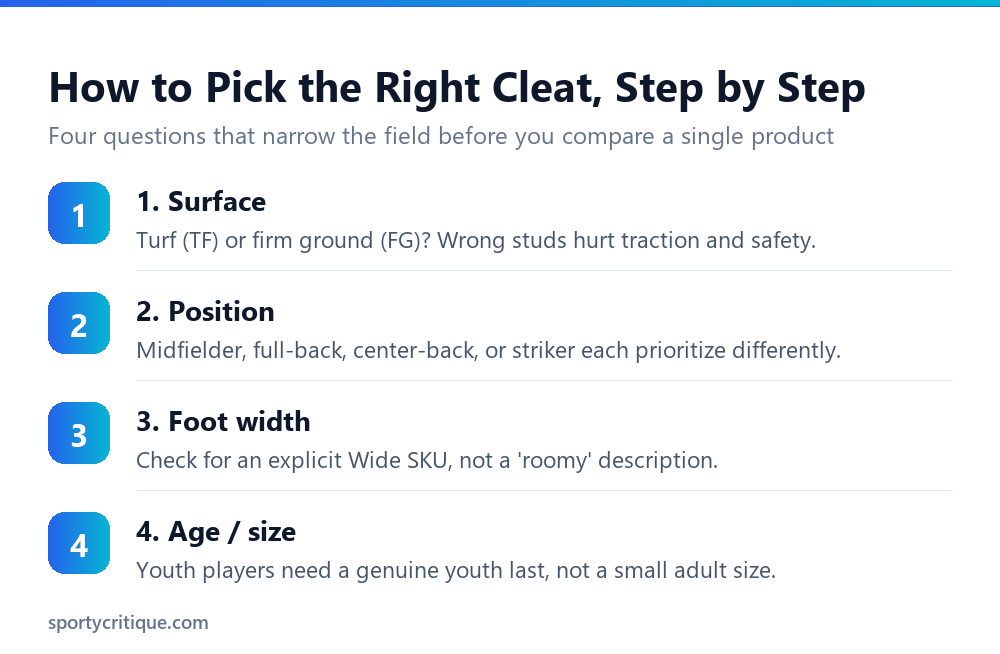
The best cleats for soccer depend on four things in order: what surface you play on, your position, your foot width, and your age or size. There is no single universal answer, which is why this page works as a decision guide with links to eight in-depth reviews rather than one generic top-10 list. If you just want one solid default pick, the adidas Unisex-Adult Goletto IX Firm Ground/Multi Ground Soccer ($50.00) is a reasonable all-around starting point.
- →Surface (turf vs. firm ground) is the first and most consequential decision, since the wrong stud pattern actively hurts traction and safety
- →Position changes what a boot should prioritize: touch and stamina for midfielders, durability and crossing for full-backs, aerial stability for center-backs
- →Foot width and age both narrow the field to specific verified SKUs, not general-purpose boots assumed to fit
- →This site publishes 8 separate in-depth cleat guides, plus this decision hub, each covering a real, distinct angle rather than overlapping content
- →All three default picks below were checked against Amazon’s live catalog on 2026-09-13 for real price and stock
Table of Contents
Start with surface, before anything else
Surface is the first decision because it’s the one with a real safety and performance cost for getting wrong. Firm-ground (FG) studs, the longer bladed or conical studs most boots ship with by default, are built for natural grass. Turf (TF) outsoles use dozens of short, dense rubber studs built for artificial turf’s shallow infill layer. Wearing FG studs on turf is a common cause of ankle rolls, since the studs can catch in turf fibers instead of releasing cleanly on a turn.
If most of your play happens on artificial turf, start with our dedicated turf cleat guide, which verifies real TF-outsole products rather than firm-ground boots wearing a turf label.
Then narrow by position
Once surface is settled, position is the next biggest factor, and it’s one most generic buying guides skip entirely by treating every cleat as interchangeable. It isn’t. A midfielder covering the most total ground on the pitch needs different priorities than a center-back winning aerial duels, and a full-back’s wide-running, tackling workload differs from both.
Foot width: don’t assume ‘roomy’ means wide
Very few soccer cleat lines manufacture an actual wide-width SKU, and a listing that says a boot ‘runs roomy’ is making a different, more subjective claim than a true wide last does. If standard-width boots have consistently pinched across the forefoot, our wide-foot cleat guide verifies which current listings carry an explicit Wide designation and which are currently in stock.
Age and size: youth players need their own last
A child’s foot isn’t just a scaled-down adult foot, it’s proportionally wider through the forefoot with a less developed arch, and adult-length studs put more ankle leverage on a lighter body during a turn. Our kids’ cleat guide covers genuine youth-specific SKUs and realistic growth-room sizing, rather than an adult boot offered in smaller numeric sizes.
⚠️ Watch out: Skipping the surface and position steps and buying whatever cleat has the best star rating is the single most common mistake in this category. A five-star firm-ground boot is still the wrong purchase for someone who plays exclusively on turf.
A few other real, distinct guides on this site
Beyond surface, position, width, and age, this site also covers heel comfort specifically. If Achilles sensitivity or heel pain is the actual problem rather than general fit, our heel-comfort cleat guide covers what causes it and verifies real insole and heel-cup products built specifically for that issue, since very few current cleat listings document a soft heel-collar spec in enough detail to recommend on that basis alone.
If you just want one solid default: our overall picks
Not everyone wants to work through eight guides before buying a pair of cleats. If that’s you, here are three verified, currently purchasable defaults that cover most casual and club-level firm-ground play reasonably well, checked directly against Amazon’s product API on 2026-09-13.

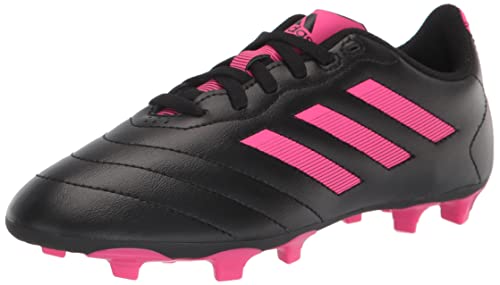
adidas Unisex-Adult Goletto IX Firm Ground/Multi Ground Soccer: best all-around default
Listed at $50.00 at last check (in stock at last check). The FG/MG dual stud rating covers both natural grass and harder training surfaces, which makes this the most broadly useful single pick on this page if you don’t fit neatly into one narrow category below.
New Balance Men’s 442 V2 Academy FG Soccer Shoe: best control and build quality
Listed at $68.58 at last check (in stock at last check). New Balance markets its entire 442 line around touch and control rather than top-end speed, and the extra cost over the Goletto IX mostly buys upper material quality that improves first touch under pressure.
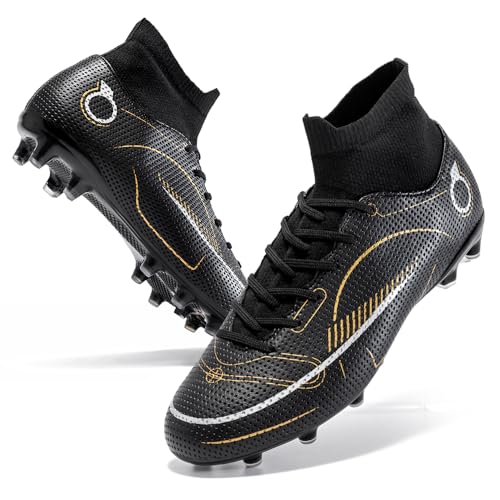
DREAM PAIRS Men’s Soccer Cleats, Lightweight: best budget default
Listed at $25.99 at last check (in stock at last check). A straightforward firm-ground boot without the control-specific upper technology of the other two, reasonable for a developing player or anyone who wants a dependable option before committing to a higher price point.
- ✓Confirm your primary playing surface first, then filter by position
- ✓Check for an explicit Wide designation if standard boots have pinched before
- ✓Shop a youth-specific last for a growing player, not a small adult size
- ✓Use one of the three overall picks above if none of the narrower guides fit your situation
- ✕Buy based on star rating alone without checking surface and position fit
- ✕Assume ‘roomy’ in a description means the same thing as a manufactured wide SKU
- ✕Buy two sizes up for a kid ‘to save money’; it hurts control and increases blister risk
- ✕Treat every defender as the same buying decision; full-backs and center-backs have different needs
💡 Pro tip: If you’re not sure which guide applies to you, start with surface. It’s the one factor with a real performance and safety cost for getting wrong, and it immediately narrows the field before position, width, or age even come into play.
A worked example: how the decision actually plays out
Say you’re a 13-year-old full-back who trains on turf twice a week and plays matches on grass. Surface comes first: since most of your total footwork happens on turf, a dedicated TF outsole from our turf guide makes more practical sense than a firm-ground boot, even though match day is on grass. Age comes next: a genuine youth-sized cleat from our kids’ guide, not a small adult size. Position matters less at this stage than surface and age do, since a 13-year-old full-back’s actual gear priority is fit and appropriate stud pattern first, positional nuance second.
Compare that to an adult center-back playing exclusively on grass with wide feet. Here, surface settles quickly (firm ground), which pushes the decision straight to width and position together: check our wide-foot guide for a genuinely wide SKU first, since fit is a non-negotiable baseline, then weigh that against the ankle-support priorities in our center-back guide if the wide-width options don’t also happen to offer a high-top design.
These two examples land on completely different final products despite both being ‘defenders,’ which is exactly the point of routing through surface, position, width, and age in order rather than reaching for one generic ‘best defender cleat’ list.
What this hub deliberately does not do
This page doesn’t try to rank all nine cleats across every guide on this site against each other, since they solve different problems and a ranking implies a false equivalence between them. It also doesn’t repeat the full product reasoning from each linked guide, since that reasoning is specific to the surface, position, width, or age angle each one covers and reads better in that context than compressed into a summary here.
What it does do is save you from reading eight full guides to find the one that actually applies to you, and give you three dependable default picks if none of the narrower situations describe your needs closely enough to matter.
Why this site has 8 separate cleat guides instead of one
A single generic ‘best soccer cleats’ list either has to pick one narrow use case and pretend it fits everyone, or pad itself with products that don’t actually differ from each other to look comprehensive. Neither approach actually serves someone shopping for a real, specific situation: a turf-only player, a full-back who slides into tackles, a parent buying for a growing kid, or someone dealing with Achilles pain.
This page exists to route you to the guide that actually matches your situation, with its own verified products and its own reasoning, rather than repeating the same list under eight different headlines.
Bottom line
Work through surface, then position, then width and age, using the linked guides above for your specific situation. If none of those apply cleanly or you just want a dependable default, the adidas Goletto IX FG/MG is the broadest all-around pick on this page, with the New Balance 442 V2 as a control-focused upgrade and the DREAM PAIRS option as a budget entry point.
Every guide linked from this page, and every product recommended on it, was checked against real Amazon catalog data rather than assumed or carried forward from an outdated draft, so the price and stock notes above reflect what was actually purchasable at the time this page was last updated.
Frequently asked questions
What are the best cleats for soccer overall?
There’s no single universal answer, since surface, position, foot width, and age all change what ‘best’ means. For a broad default, the adidas Goletto IX FG/MG covers both grass and hard training surfaces reasonably well; for a specific situation, the linked guides on this page verify picks tailored to it.
How do I know which cleat guide on this site applies to me?
Start with surface: turf or firm ground. Then narrow by position if you play a specific role regularly, then check foot width and age if either has been a fit problem in the past.
Is it fine to just buy the cheapest cleat that fits?
For casual, low-frequency play, yes, a budget option like the DREAM PAIRS pick above is reasonable. For regular training and matches, matching the boot to your actual surface and position, rather than price alone, makes a bigger practical difference.
Why does this site have separate guides instead of one list?
Because surface, position, width, and age actually change which product is the right answer. A single list either ignores those differences or pads itself with near-duplicate entries, neither of which actually helps someone shopping for their specific situation.
What if I don’t fit neatly into any of the eight specific guides?
Use one of the three overall default picks on this page. The adidas Goletto IX FG/MG covers the broadest range of casual and club-level firm-ground play, and it’s a reasonable starting point until a more specific need, like a surface, position, or fit issue, shows up.
As an Amazon Associate, we earn from qualifying purchases through links on this page.