Best Tennis Rackets for Intermediate Players in 2026


Once you’ve outgrown a starter racket, the next step isn’t guessing at a bigger name brand. Tennis rackets for intermediate players occupy a clearly distinct tier, in head size, string pattern, and price, from both true beginner sets and tour-level frames, and knowing what that tier actually looks like makes the upgrade worth it.
Tennis rackets for intermediate players sit in a clearly different tier from both true beginner rackets and the tour-level frames advanced players use. Two well-established, verified options in this tier are the HEAD Graphene XT Radical MP and the HEAD Graphene XT Speed MP, both listed by Amazon as intermediate-adult frames, both priced around $99, and both distinct in feel: the Radical leans toward a more consistent, control-friendly response, while the Speed leans toward a slightly more versatile, all-court response.
If you’ve already moved past your first recreational racket, the kind bundled in a set with balls and a bag, and you’ve got a consistent enough swing that you’re starting to notice a racket’s limitations rather than your own, you’re in intermediate territory. This guide focuses specifically on that tier: not a starter frame, and not the specialized, less forgiving frames tournament players reach for.
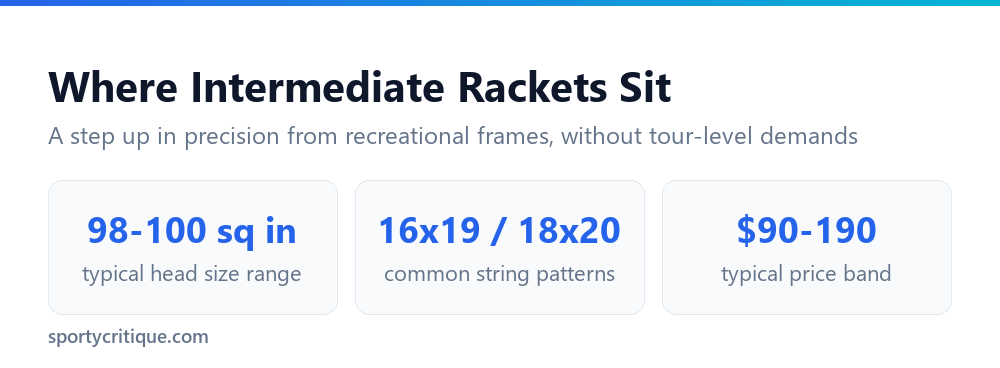
- →Intermediate rackets typically run 98-100 square inch heads, a step down from the 105+ sq in common on beginner sets, trading some forgiveness for more precision
- →String patterns split between open 16×19 (more spin and pop) and denser 18×20 (more control) at this tier, so pattern matters as much as brand
- →Price is a reasonable proxy for tier here: true beginner rackets often run under $50, while intermediate frames commonly land in the $90-190 range
- →A racket a step above your comfort zone can still play well if your technique is consistent; the mistake is skipping tiers, not moving up one
Table of Contents
What actually separates intermediate rackets from beginner rackets
The jump from a beginner racket to an intermediate one is rarely about a single dramatic change. It’s a combination of a slightly smaller head size, a tighter string pattern, and usually a bit more weight and swingweight, all of which trade some forgiveness for more precision and feedback. A beginner racket is built to make contact easy and reduce mishits. An intermediate racket assumes you’re making contact consistently enough that you’re ready to start shaping shots rather than just getting the ball back over the net.
That doesn’t mean intermediate rackets are unforgiving; frames like the two featured here still have generous 98-100 square inch heads, well within the range most club players use for years. The difference from a true beginner frame is more about string pattern density and overall build quality than head size alone.
Our picks: two verified intermediate-tier rackets
Both rackets below are officially listed by their Amazon product pages as intermediate-adult frames, and both prices and stock status reflect live data at the time of writing, since Amazon pricing changes regularly.
The Graphene XT Radical MP carries HEAD’s Radical lineage, historically built around a denser string pattern and a control-first feel. It’s a reasonable choice if your groundstrokes are getting more consistent and you’re starting to want more predictability on faster exchanges rather than more raw pop.
The Graphene XT Speed MP takes a more all-court approach, with an open string pattern that adds a bit more spin potential and forgiveness. It’s a reasonable default if you’re not sure yet whether you lean toward a control or power-oriented game and want a frame that doesn’t commit hard to either.
⚠️ Watch out: Neither of these should be your very first racket if you’ve never played before. Their denser string patterns and higher swingweight compared to a true beginner set reward a swing that’s already reasonably consistent; if you’re brand new to the sport, a more forgiving beginner frame will make learning faster and more enjoyable.
How to tell you’re actually ready for an intermediate racket
- ✓You can rally consistently from the baseline without frequent mishits
- ✓You’ve noticed your current racket feels ‘too easy’ or lacks feedback on well-struck shots
- ✓You’re starting to care about spin and shot shape, not just getting the ball over the net
- ✓You’ve played regularly for at least several months, not just a handful of sessions
- ✕You still mishit frequently or aren’t consistently making clean contact
- ✕You’ve played only a few times and haven’t settled into a repeatable swing yet
- ✕You’re buying based on a pro’s racket choice rather than your own game
- ✕You’re choosing purely on price without considering string pattern or head size
String pattern at this tier matters more than brand
At the intermediate level, the difference between a 16×19 and 18×20 string pattern is often more noticeable in day-to-day play than the difference between two similarly specced rackets from different brands. An open 16×19 pattern lets the strings move more at contact, adding spin potential and a slightly springier feel. A denser 18×20 pattern restricts that movement, trading some spin and pop for a flatter, more controlled response. Neither is objectively better; it depends on whether your game currently needs more help generating spin and pace, or more help controlling shots that are already fast.
💡 Pro tip: If you’re between the two patterns and can’t decide, an open 16×19 pattern is generally the safer default at the intermediate tier, since it’s more forgiving of a swing that’s still developing while still offering more precision than a true beginner frame.
Grip size and weight still matter as much as the model
Whichever frame you choose, grip size has an outsized effect on comfort and injury risk, more than most players expect. A grip that’s too small forces excess wrist action to control the racket face, which is a common contributor to wrist and elbow strain over time. A grip that’s too large restricts natural wrist snap and can feel clumsy on volleys. If you’re unsure of your size, most racket shops offer a quick measurement, and it’s worth doing before committing to a specific model.
Where to go if you’re not quite at this level yet
Restringing: the upgrade most intermediate players skip
New rackets ship pre-strung at a factory tension chosen to be broadly acceptable rather than ideal for any one player. At the intermediate level, restringing at a tension suited to your own swing is one of the cheapest upgrades available, often more noticeable day-to-day than the difference between two similarly specced racket models. A lower tension within the racket’s printed range generally adds power and a slightly larger sweet spot, while a higher tension generally adds control and a firmer, more precise feel.
String type matters too, separate from tension. Synthetic gut is the common factory default and holds tension reasonably well for the price, while multifilament strings trade some durability for a softer, more comfortable feel, and polyester strings trade comfort for durability and control, which is why they’re common among players generating more pace. If you’re restringing an intermediate racket for the first time, asking a stringer for a recommendation based on your swing speed and any arm sensitivity is worth more than picking a string based on brand alone.
Balance: head-light, head-heavy, and even balance
Balance describes where a racket’s weight sits along its length relative to its midpoint, commonly expressed in points head-light or head-heavy. A head-light balance concentrates more weight in the handle, making the racket feel quicker and more maneuverable, which suits faster hands at net and quick reactions on serve returns. A head-heavy balance shifts weight toward the head, adding plow-through and stability on contact at the cost of maneuverability. Most intermediate frames, including both picks in this guide, use a moderate head-light balance, which tends to suit a broad range of playing styles better than either extreme.
📊 Note: Balance and swingweight are related but not the same measurement. Two rackets with identical static weight and balance can still have different swingweights if their weight is distributed differently along the frame length, which is part of why demoing a racket in person tells you more than reading a spec sheet.
When to move up again
There’s no fixed timeline for moving from an intermediate racket to a more advanced one. The better signal is the same one that got you here: once a racket starts feeling like it lacks feedback on well-struck shots, or once you’re consistently generating more spin and pace than the frame seems to reward, that’s a sign to look at a denser pattern or a smaller, more control-oriented head. For most club-level players, though, a well-chosen intermediate racket like either pick here can comfortably last for years of regular play without needing an upgrade.
Caring for your racket at this level
Beyond restringing, a few habits keep an intermediate racket performing well for longer. Store it away from extreme heat, a hot car trunk in summer can soften the resin in the frame and the string bed over time. Wipe the strings down after sweaty sessions, since dried sweat and dirt accelerate string wear. And check the grip periodically; a worn, slick overgrip is a common, easily fixed cause of a racket feeling like it’s slipping or that you’re gripping tighter than you should have to, which itself is a contributor to arm fatigue over a long session.
Bottom line
Both the HEAD Graphene XT Radical MP and the HEAD Graphene XT Speed MP are verified, honestly intermediate-tier frames rather than relabeled beginner or advanced rackets. Choose the Radical if your game is leaning toward control and consistency, or the Speed if you want a bit more forgiveness and spin potential while you keep developing.
What makes a racket ‘intermediate’ rather than beginner or advanced?
It’s a combination of head size, string pattern density, and swingweight. Intermediate rackets typically use a slightly smaller head and denser string pattern than beginner sets, which trades some forgiveness for more precision, without the very low forgiveness of specialized advanced frames.
Is a denser 18×20 string pattern better for an intermediate player?
It depends on your game. A denser pattern favors control and predictability, which suits a player who already generates decent pace and wants more consistency. An open 16×19 pattern favors spin and forgiveness, which suits a player still developing pace and spin.
How much should an intermediate tennis racket cost?
Based on current listings, a reasonable intermediate racket commonly falls in the $90-190 range, noticeably more than a sub-$50 beginner set but well below $250-300 tour-level frames.
Can I skip the intermediate tier and go straight to an advanced racket?
You can, but it’s usually not a good trade. Advanced frames are tuned for swing speeds and consistency that take time to develop, and skipping tiers often just makes contact harder without a matching benefit.
How often should an intermediate player restring their racket?
A common rule of thumb is to restring as many times a year as you play per week, so someone playing twice a week might restring roughly twice a year. Strings also lose tension gradually even without breaking, so a racket that feels noticeably different from when it was new is often due for a fresh string job regardless of visible wear.
As an Amazon Associate, we earn from qualifying purchases through links on this page.