How to Waterproof a Wound for Swimming (And When Not To)


You can waterproof a minor, clean, closed wound for swimming: clean it, add a thin barrier of ointment, cover it with a waterproof dressing cut larger than the wound so it seals onto dry skin, reinforce the edges with waterproof tape, and change it as soon as you get out. What you can’t do is make a deep, open, gaping, or infected wound safe to submerge — no dressing achieves that, and those wounds mean staying out of the water. And unlike an ordinary cut, a fresh tattoo can’t be reliably waterproofed at all.
Unlike some things people try to waterproof for swimming, an ordinary minor wound genuinely can be covered well enough to get in the water — a healing graze or a small closed cut doesn’t have to cancel your swim. The key is knowing which wounds this works for, doing it properly, and being honest about the limits.
Because the honest version matters here: a waterproof dressing protects a minor, healing wound for a swim. It does not turn a wound that shouldn’t be submerged into one that can be.
- →Minor, clean, closed wounds can be waterproofed for a swim — deep or open ones can’t.
- →Clean the wound first; a dressing seals in whatever’s underneath.
- →Use a waterproof dressing larger than the wound, sealed onto dry skin.
- →The edges are where water gets in — reinforce them with waterproof tape.
- →Change the dressing immediately after every swim, even if it looks dry.
- →Infected wounds and fresh tattoos should not be submerged at all.
Table of Contents
Can this wound go in the water at all?
This is the first question, and it matters more than the technique. Waterproofing is for protecting a minor, healing wound — it isn’t a way to override common sense about a wound that has no business being in a pool.
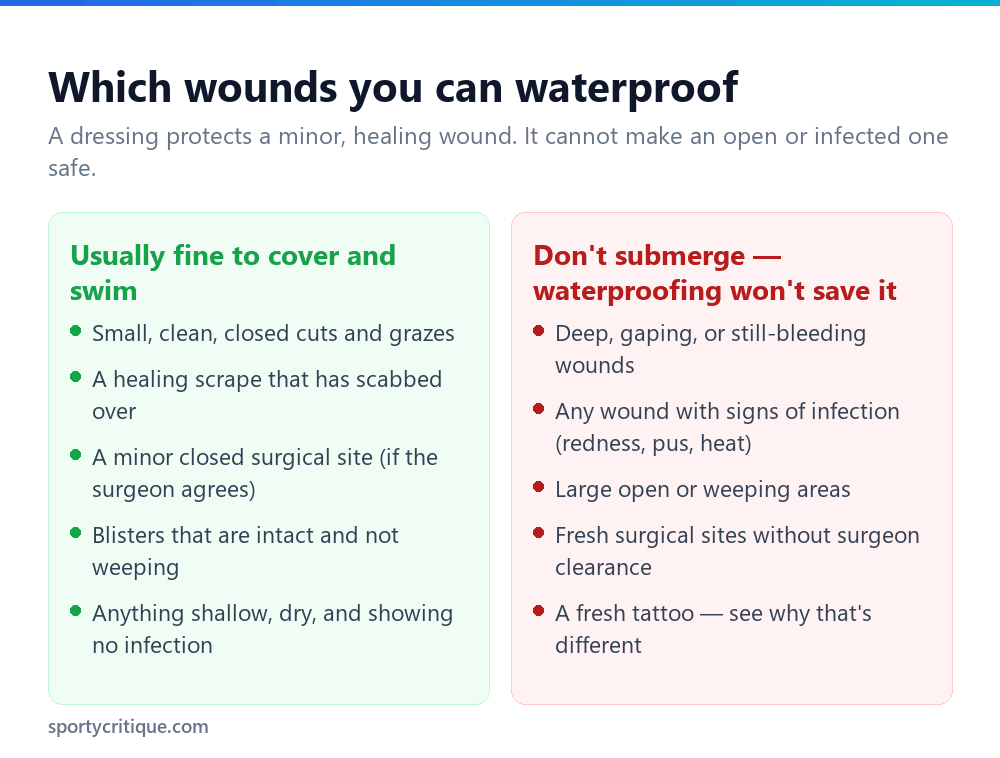
Good candidates are small, clean, closed wounds: a graze that has scabbed over, a shallow cut whose edges have come together, an intact blister, a minor healing surgical site your surgeon is happy about. These are essentially sealed already; the dressing just adds a barrier against the water and the pool’s chemicals.
Wounds to keep out of the water entirely are deep, gaping, or still-bleeding cuts, anything large or weeping, fresh surgical sites without clearance, and — crucially — any wound showing signs of infection: spreading redness, warmth, swelling, or pus. Submerging an infected or open wound risks introducing more bacteria and spreading the infection, and no dressing reliably prevents that. For these, the answer isn’t a better bandage; it’s waiting until the wound has healed enough to belong to the first group.
A waterproof dressing protects a minor wound during a swim. It does not make an open or infected wound safe to submerge — that’s a decision about the wound, not the tape.
⚠️ Watch out: A fresh tattoo is a special case and does not belong in the “waterproof and swim” group, even though it seems like an ordinary wound. It’s a large, shallow, weeping wound that needs to breathe and stay dry to heal, and sealing all of it under adhesive for a swim works against that — our guide to swimming after a tattoo explains why waiting is the only real answer there.
How to waterproof it properly
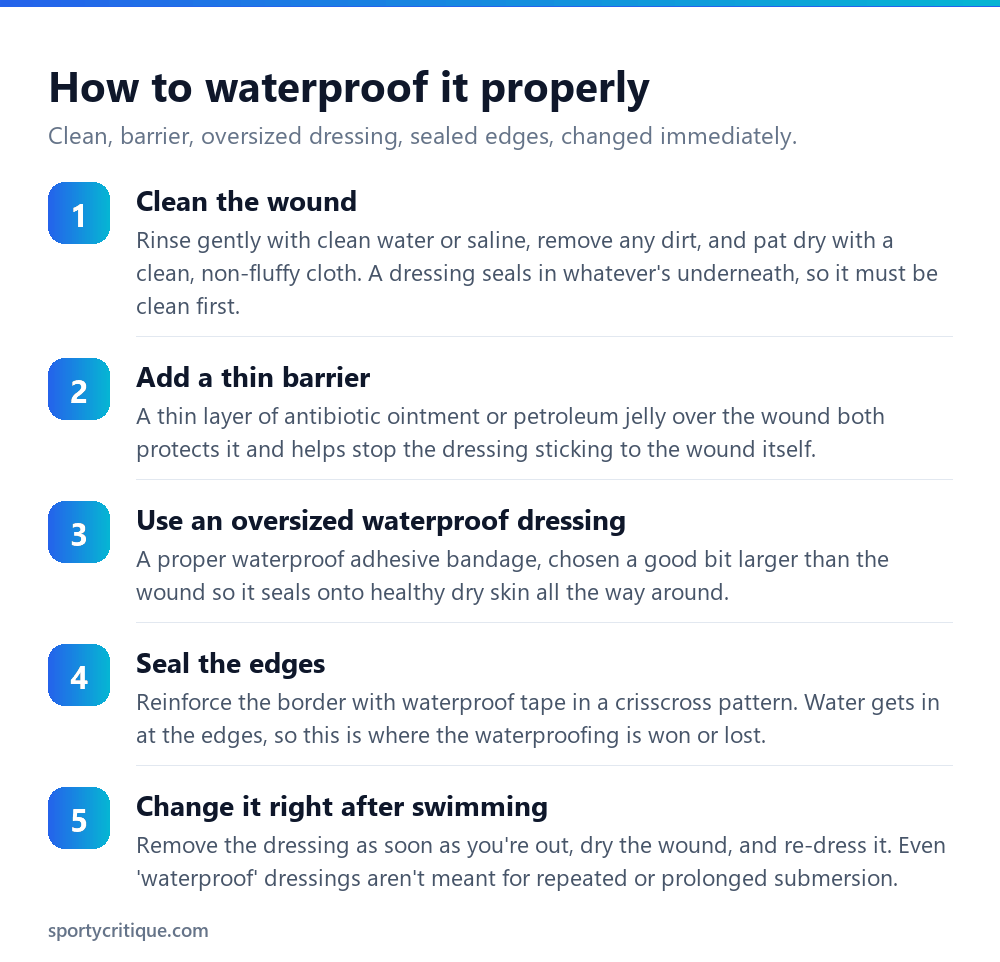
For a wound that’s a good candidate, the method is straightforward — and each step matters.
Clean it first. Rinse gently with clean water or saline, make sure there’s no dirt or grit left, and pat it dry with a clean, lint-free cloth. A dressing seals in whatever’s under it, so anything you don’t clean off now stays trapped against the wound for the whole swim.
Add a thin barrier. A thin smear of antibiotic ointment or plain petroleum jelly over the wound gives an extra layer of protection and stops the dressing adhering to the wound itself, which makes removal painless and avoids disturbing any scab.
Use an oversized waterproof dressing. Buy a purpose-made waterproof adhesive bandage — the ones marked for swimming or showering — and choose one noticeably larger than the wound. The seal has to be on clean, dry, healthy skin all the way around the wound, not on the wound edge, so the more dry-skin margin you have, the better it holds.
Seal the edges. This is where waterproofing succeeds or fails, because water always finds the edges. Reinforce the whole border with waterproof tape, ideally in a crisscross pattern that presses the dressing down on every side. Some people add a further layer — a waterproof sleeve or, for a limb, even a sealed plastic covering — for longer swims.
Change it the moment you’re out. Remove the dressing as soon as you finish, dry the wound, check it, and apply a fresh dressing. Even the best waterproof dressings aren’t designed for repeated or prolonged submersion, so a fresh one after each swim keeps the wound clean and dry between sessions.
The honest limits
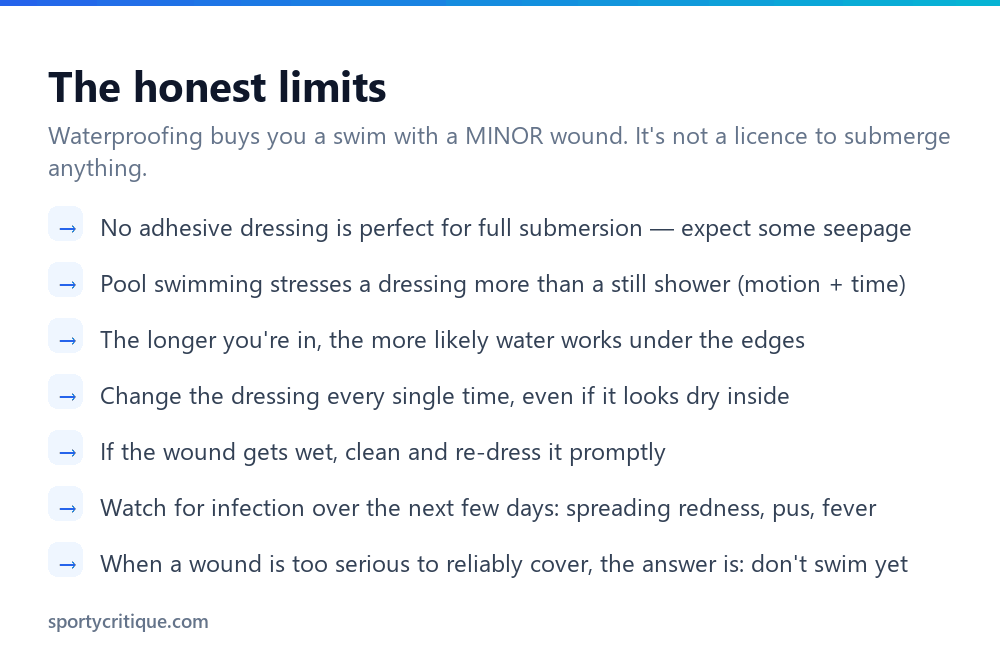
Waterproof dressings are genuinely useful, and it’s worth being clear about what they can and can’t do so you don’t over-trust them.
No adhesive dressing is perfectly waterproof under real swimming conditions. A still shower is one thing; swimming means constant movement, stretching skin, and extended time submerged, all of which work water under the edges eventually. Expect that a long swim may let a little moisture in even with a good seal — which is fine for a minor healing wound and exactly why you change the dressing straight afterward.
The practical rule is that time and motion are the enemies of the seal. A quick dip stresses a dressing far less than an hour of laps. If your wound really needs to stay bone-dry, a short swim is safer than a long one, and no swim is safer still. And if you find yourself needing plastic bags, multiple tapes, and elaborate sealing just to cover a wound, that’s usually a sign the wound isn’t ready for the water yet.
Finally, watch the wound over the following days. Even with careful covering, keep an eye out for signs of infection — increasing or spreading redness, warmth, swelling, pus, or feeling unwell — and see a doctor if they appear. A minor wound you covered well and cleaned promptly afterward should heal normally; the point of watching is to catch the rare exception early.
📊 Note: This is general guidance, not medical advice. For surgical wounds, deep or slow-healing wounds, or anything you’re unsure about, ask the doctor or nurse who’s treating it before swimming — they know the specific wound and whether it’s ready for water, which a general article can’t.
Choosing the right dressing
Not all “waterproof” coverings are equal, and picking the right one for the wound and the swim makes the difference between a clean session and a soggy, peeling mess.
Two placement realities are worth knowing. Joints and creases — elbows, knees, knuckles — are the hardest places to keep sealed, because the skin stretches and folds with every movement and breaks the adhesive bond; over a joint, a stretchier film dressing plus generous edge taping works better than a stiff plaster. And hairy skin undermines any adhesive seal, so a wound in a hairy area may need the surrounding skin trimmed (not shaved raw) for the dressing to grip dry skin properly.
If it’s not ready, protect the swim habit instead
When a wound genuinely can’t be covered safely, the useful reframe is that it’s a short pause, not the end of your swimming.
Most minor wounds heal enough to swim within days to a couple of weeks, and there’s plenty you can do meanwhile: dry-land training, technique work, or simply resting. Pushing into the water with a wound that isn’t ready risks an infection that could keep you out far longer than waiting would — the same logic that applies to swimmer’s ear and to fresh tattoos. A few days out is quickly forgotten; an infected wound is not.
💡 Pro tip: Keep a small swim-specific kit — a few oversized waterproof dressings and a roll of waterproof tape — in your swim bag. Minor grazes are common, and having the right dressing on hand means a small cut doesn’t cost you a session, while also stopping you from improvising a poor seal with whatever’s lying around.
Frequently asked questions
Can you swim with a wound if you cover it?
Yes, if it’s a minor, clean, closed wound — a healing graze or a small cut — covered with a proper waterproof dressing sealed onto dry skin and changed straight after. What you can’t safely do is submerge a deep, open, gaping, or infected wound, or a fresh tattoo; no dressing makes those safe, and they should stay out of the water until healed.
What’s the best way to waterproof a cut for swimming?
Clean the cut, add a thin layer of ointment or petroleum jelly, cover it with a waterproof adhesive dressing chosen larger than the wound so it seals on dry skin, and reinforce the edges with waterproof tape in a crisscross pattern. Then change the dressing as soon as you finish swimming. The edges are the weak point, so that’s where to focus the seal.
Do waterproof bandages really keep water out when swimming?
Mostly, but not perfectly. They’re much better than ordinary plasters, but swimming involves movement, stretching, and time submerged, which can eventually let a little water under the edges — more so on a long swim than a quick dip. That’s fine for a minor healing wound as long as you change the dressing straight afterward, but don’t rely on one to keep a wound that must stay bone-dry completely sealed for an hour of laps.
Can I swim after surgery if I cover the wound?
Only with your surgeon’s clearance. Some minor, closed surgical sites can be covered and swum with once healing is underway, but many need to stay dry and unsubmerged for a set period, and swimming too early risks the wound and the result. This is exactly the case to ask the person who did the surgery rather than follow a general rule — they know your wound and the timeline it needs.
How do I know if a wound is too serious to swim with?
If it’s deep, gaping, still bleeding, large, weeping, or shows any sign of infection — spreading redness, warmth, swelling, or pus — it’s too serious to submerge, and waterproofing won’t change that. A good candidate for covering is small, clean, closed, and dry. If you’re needing elaborate sealing just to cover it, that’s a sign it isn’t ready for the water yet.
Can I waterproof a fresh tattoo the same way?
No — a fresh tattoo is different from an ordinary wound. It’s a large, shallow, weeping wound that needs to breathe and stay dry to heal well, and no covering reliably keeps a whole tattoo dry through a swim; sealing it under adhesive traps moisture against it. The only safe approach with a new tattoo is to wait until it’s fully healed, which our tattoo guide explains in detail.
- →Swimming after a tattoo — why a fresh tattoo can’t be waterproofed like a wound
- →Relieving swimmer’s ear — another swimmer’s health issue
- →How to breathe while swimming — back to the technique