Pool Cue Weight by Play Style: Break, Control, and Finesse Explained

Pool cue weight changes what a shot actually does, not just how heavy the stick feels in your hand. Here’s how weight maps to break shots, finesse play, and everyday all-around use, with real examples at each end of the range.
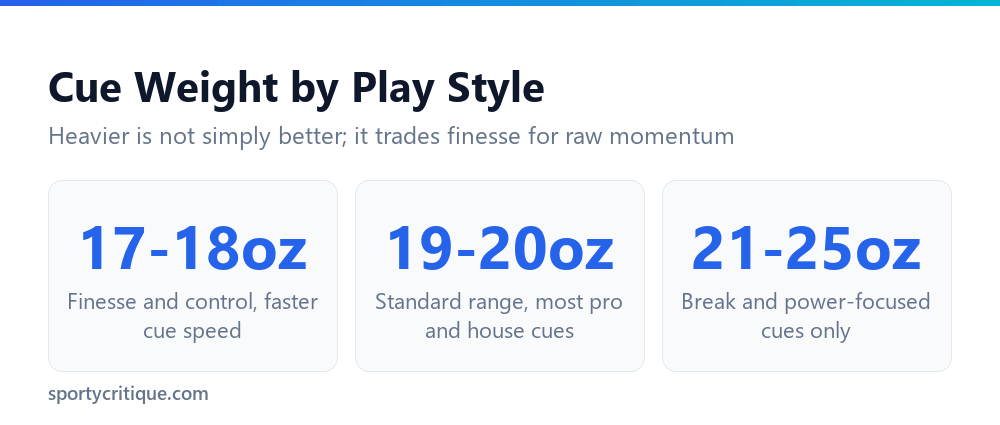
Pool cue weight isn’t a single ‘best’ number, it depends on what you’re doing with the cue. Standard all-around play sits at 19-20 ounces, the range most touring professionals and house cues use. Heavier cues, 21 ounces and up, trade control for raw momentum and suit break-focused shots specifically. Lighter cues, 17-18 ounces, favor faster cue speed and finesse shots where touch matters more than power. Balance point, where the cue’s weight is distributed, matters alongside the total number and can make two cues at an identical weight feel completely different.
If you’re shopping specifically for budget 8-ball league play, this site has a dedicated guide covering that narrower question with a specific budget-friendly recommendation. This guide is broader and not tied to a price tier: it’s about how weight interacts with different play styles and shot types, whatever cue you’re currently using or shopping for.
The short version is that weight is a tool, not a fixed spec to get right once and never think about again. Understanding how it changes your shots lets you make an informed choice for your primary cue, and explains why dedicated break cues exist as a separate category from your everyday playing cue.
- →19-20oz is the standard, safest range for all-around play, matching most house cues and pros
- →Heavier cues (21oz+) trade control for momentum, which mainly benefits break shots specifically
- →Lighter cues (17-18oz) move faster through the stroke, favoring finesse and touch-dependent shots
- →Balance point changes how a cue feels independently of its total weight; both matter together
- →Many serious players keep a separate heavier break cue rather than using one cue for everything
Table of Contents
The standard range, and why it’s standard
Across recreational and competitive play, cue weight clusters overwhelmingly between 18.5 and 20.5 ounces, with 19 ounces the single most common weight among touring professionals across 8-ball, 9-ball, and straight pool. That range balances cue ball control and spin responsiveness against the stability needed for confident, repeatable shot-making, which is why it’s the default recommendation for a single, all-purpose cue rather than a narrow niche choice.
This is also why most house cues at bars and pool halls cluster in the 19-20oz range: venues need equipment that works reasonably well across the widest range of players and shot types without stocking a full spread of specialty weights.
Heavier cues: why break shots specifically benefit
A break shot is the one moment in a rack where raw momentum transfer matters more than touch or spin control. A heavier cue carries more momentum at a given swing speed, which translates into more energy transferred into the rack on contact, scattering the balls more forcefully and improving the odds of a legal break with balls actually pocketed. This is the entire reason dedicated break cues exist as their own category, often built specifically at 21 to 25 ounces with a harder, more durable tip designed to survive repeated full-power hits.
The RAGE Heavy RGJBHH Hitter Jump/Break Billiard Pool Cue Stick, Red, 25oz is a real example built specifically for this purpose: a 25-ounce, three-piece jump/break cue verified at $152.10 at the time of writing. It’s not designed as your everyday playing cue, its weight and hardness are purpose-built for the single break shot at the start of each rack, and most players who own one use it exclusively for that shot before switching back to their standard-weight cue for the rest of the game.
📊 Note: The listing for this cue did not return a standard in-stock/out-of-stock flag at verification, showing instead as available by a specific ship date. Confirm current availability on the listing before ordering if you need it by a specific date.
Lighter cues: where finesse and touch benefit
On the other end, lighter cues in the 17-18oz range move faster through the stroke for the same effort, which some players find gives more precise touch on delicate position play and safety shots where you’re deliberately not hitting hard. The tradeoff is that a lighter cue is less forgiving on off-center or slightly mishit shots, since there’s less mass to carry through minor stroke inconsistencies.
The CRICAL 58-Inch Carbon Fiber Pool Cue, Low Deflection, 12.5mm Tip pairs a lighter, faster-feeling carbon fiber shaft with genuinely lower cue ball deflection, a combination some players specifically seek out for finesse-heavy games like straight pool or precise safety play in 9-ball. Its listing did not return live price or stock data at the time of verification, so treat it as a real, correctly identified product to research further rather than a confirmed in-stock price quote.
Balance point: the factor weight alone doesn’t capture
Two cues at an identical stated weight can feel noticeably different depending on where that weight sits along the length, a property called balance point. A cue balanced closer to the joint feels different in the bridge hand than one with more weight concentrated in the butt, even at the exact same total ounces. On a standard 58-inch cue, balance point typically falls somewhere between 18 and 19 inches from the butt end; a cue that balances noticeably outside that range can feel front-heavy or back-heavy regardless of what the total weight spec says.
💡 Pro tip: Check balance point yourself in under a minute: rest the cue across a single finger and see where it settles level. If a cue feels off despite matching your preferred weight number, balance point, not weight, is usually the reason.
- ✓Start at 19-20oz for an all-around cue if you don’t have a strong existing preference
- ✓Consider a dedicated heavier break cue if you play seriously enough that break quality matters
- ✓Try a lighter cue specifically if you play a lot of safety-heavy games like straight pool
- ✓Check balance point alongside weight; they’re separate factors that both affect feel
- ✕Assume a heavier cue is always more powerful for every shot, not just the break
- ✕Switch your primary cue’s weight right before an important match without practice time to adjust
- ✕Buy a break cue expecting to also use it as your everyday playing cue
- ✕Ignore balance point just because two cues share the same stated ounce weight
Do you actually need a separate break cue?
For casual and social play, no. A single 19-20oz all-around cue handles the break shot adequately, just with somewhat less raw power than a dedicated heavy break cue would deliver. A separate break cue becomes worth the investment once you’re playing competitively enough that break quality, more balls pocketed off the break, a cleaner spread for your next shot, meaningfully affects your results across a match or tournament, or once you’re breaking hard enough and often enough that you’d rather not subject your primary playing cue’s tip to that repeated impact.
Adjusting weight as your game develops
Many newer players start slightly heavier, 19-20oz, since the added mass forgives minor stroke inconsistencies while they’re still building fundamentals. As technique becomes more consistent, some players gradually shift toward the lighter end of the standard range for the added cue speed and spin control it offers. This isn’t a required progression, plenty of experienced players stay at 19oz for their entire playing life, but it’s a common and reasonable adjustment to make once you notice yourself wanting more from your finesse shots than your current weight comfortably provides.
How tip hardness interacts with weight choice
Tip hardness is a separate spec from weight, but the two interact more than people expect. A harder tip transfers energy more directly into the cue ball, which pairs well with a heavier break cue since you want maximum energy transfer on that one shot rather than cushioning. A softer tip holds the cue ball slightly longer on contact, which some players prefer pairing with a lighter cue for finesse shots, since it gives a bit more feel for exactly how much spin and speed you’re putting on the ball. Neither pairing is a strict rule, but it’s worth knowing when you’re evaluating a cue built for a specific role rather than assuming tip and weight are independent decisions.
Weight and shaft diameter: a common point of confusion
Shaft diameter, typically 12.5mm or 13mm at the tip, is often confused with weight because both get discussed in the same breath when comparing cues, but they’re unrelated specs. A thinner 12.5mm shaft can exist on a heavy or light cue just as easily as a thicker 13mm one; diameter affects how much surface area contacts the cue ball on a hit, which relates more to spin control than to weight or power. Don’t assume a listing’s tip diameter tells you anything about where the cue sits on the weight spectrum; check the two specs separately.
A practical way to test your own preference
If you already own a cue and are wondering whether a different weight would suit your game better, the cheapest way to find out isn’t buying a second cue outright. Most pool halls stock house cues across a spread of weights, often labeled on a small sticker near the joint. Spend a session deliberately trying a noticeably heavier and a noticeably lighter house cue than your own, paying attention specifically to how each feels on break shots versus delicate position shots. That real comparison, even with imperfect house equipment, tells you more about your actual preference than reading further specs ever will.
Bottom line
Pool cue weight isn’t one universal right answer, it’s a tool that changes what a shot does. Standard 19-20oz play covers the large majority of shots well, heavier cues earn their place specifically on the break, and lighter cues suit finesse-heavy styles. Balance point matters alongside the number on the spec sheet, and neither factor should be chosen purely from a listing description without considering how you actually play.
See also: Best Pool Cue Weight for 8-Ball League Play (Budget Options) for a budget-specific recommendation if you play organized 8-ball league, or Intermediate Pool Cue Specs Explained for the construction specs that matter beyond weight.
What is the best pool cue weight overall?
19-20 ounces is the standard, safest default for all-around play, matching what most house cues and professional players use. It’s not the ‘best’ for every shot type, but it’s the right starting point if you don’t have a specific reason to go heavier or lighter.
Why do dedicated break cues exist if a standard cue can break too?
Break shots benefit specifically from extra momentum, which a heavier cue (21-25oz) delivers better than a standard-weight cue. A standard cue still breaks adequately for casual play; a dedicated break cue matters more once break quality affects competitive results.
Is a lighter cue better for beginners or advanced players?
Neither exclusively. Lighter cues (17-18oz) suit finesse-heavy play styles and faster cue speed regardless of skill level, though they’re less forgiving on off-center contact, which matters more while a player is still developing a consistent stroke.
Does balance point matter as much as total weight?
Yes, and it’s often overlooked. Two cues at the same total weight can feel very different depending on where that weight sits along the cue’s length, so it’s worth checking alongside the ounce number rather than relying on weight alone.
As an Amazon Associate, we earn from qualifying purchases through links on this page.