Best Knee Pads for Volleyball: Padding, Sleeve Style & Fit Compared

The best knee pads for volleyball depend on your position: liberos and defensive specialists need thicker, higher-density padding, while hitters and setters usually do better with a lower-profile fit. Here’s how padding density, attachment style, and sizing actually compare across real products.
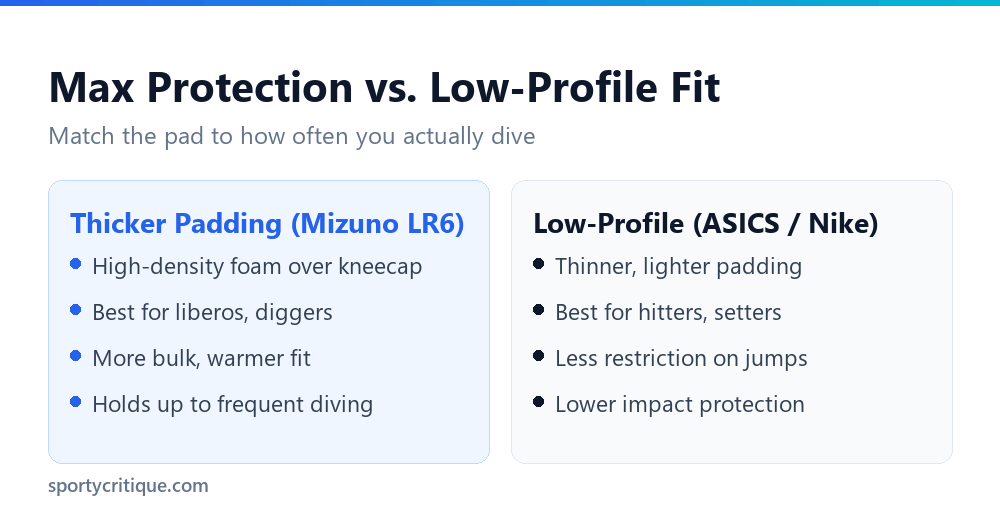
The right volleyball knee pad depends on your position and how hard you land. Liberos and defensive specialists who dig and dive constantly want thicker, higher-density padding like a Mizuno LR6, even though it’s bulkier. Hitters and setters who mostly need light, occasional protection do better with a lower-profile pad like an ASICS Competition or Nike Streak, which stays out of the way during jumping and quick footwork.
Volleyball knee pads all look similar from a distance, foam padding inside a fabric sleeve, but the real differences that matter for actual play are padding density and thickness, how the pad attaches (a full sleeve versus a strap-on style), and how low- profile the design is around the knee joint. Those three specs, more than brand name alone, determine whether a pad protects well on hard dives without feeling like you’re playing in a brace.
- →Padding density and thickness matter more for liberos and defensive specialists who dive and dig often
- →Low-profile pads trade some impact protection for better mobility on jumps and quick footwork
- →Sleeve-style pads (pull over the whole lower leg) generally stay in place better than strap-on styles
- →Sizing is based on measured knee or leg circumference, not shoe size or general clothing size
- →Expect foam padding to compress and lose some protection over a season of heavy diving; replace accordingly
Table of Contents
Padding density: the spec that actually matters most
Foam density inside a knee pad determines how much impact it actually absorbs versus how much force still reaches your knee on a hard dive. Higher-density foam compresses less under a hard impact, which means more of that impact gets absorbed by the pad instead of transferred straight through to the joint. Lower-density foam feels softer and lighter to wear, but it bottoms out faster on a genuinely hard landing, offering less real protection exactly when you need it most.
This is also why a thicker pad isn’t automatically a better pad. Thickness and density are related but not identical; a thick pad made from lower-density foam can still bottom out on a hard hit, while a thinner pad built from higher-density material sometimes protects comparably well while adding less bulk. Reading the specific foam type or density rating in a listing, when it’s provided, tells you more than judging thickness by eye.
Sleeve vs. strap-on: how the pad actually attaches
Most competitive players end up on a sleeve-style pad specifically because it doesn’t shift position during a dive the way a strap-on pad can. A pad that’s slipped even an inch out of place on impact protects noticeably less than one still centered on the kneecap, and repeated repositioning mid-game is its own distraction. Strap-on styles still have a place for lighter practice use or for players who find a full sleeve too warm or restrictive.
Our picks for volleyball knee pads
The Mizuno LR6 Volleyball Kneepad (our product data feed did not return a current price or stock status for this listing at last check; confirm both on the Amazon page before buying) is built with high-density padding specifically in the direct-impact zone over the kneecap, plus a cutout design elsewhere in the pad that helps it flex with the knee during jumps rather than binding. It’s on the bulkier end of this category, which is the right tradeoff for liberos and defensive specialists who dive frequently and need serious protection more than a minimal feel.
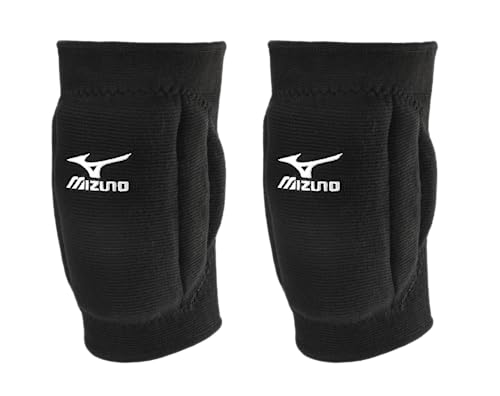
The Mizuno T10 Volleyball Kneepads (our product data feed did not return a current price or stock status for this listing at last check; confirm both on the Amazon page before buying) uses a five-section contoured pad design rather than one solid foam block, which is a middle-ground approach: more targeted protection than a minimal low-profile pad, with somewhat better flexibility than a single-piece high-density pad like the LR6.
The ASICS Competition 2.0G Volleyball Kneepads (our product data feed did not return a current price or stock status for this listing at last check; confirm both on the Amazon page before buying) is built low-profile from the ground up, latex-free with a shorter sleeve length than the Mizuno options above. It suits hitters, setters, and outside players who want basic protection for occasional floor contact without the bulk a full defensive-specialist pad adds.
The Nike Streak Dri-Fit Volleyball Knee Pads (XL/XXL) (about $31 at last check, only a handful left in stock) splits the difference with Dri-Fit moisture-wicking fabric and foam padding that’s noticeably lighter than the Mizuno LR6 but more substantial than the ASICS low-profile option, a reasonable all-around choice for a player who doesn’t fit neatly into either the defensive-specialist or minimal-pad category.
Sizing a knee pad correctly
Size a knee pad by measuring your leg circumference roughly 4 to 6 inches above the kneecap, following the specific brand’s chart rather than assuming your general clothing size translates directly. A pad that’s too loose slides down during play, which is both distracting and reduces protection at the moment of impact. One that’s too tight can restrict circulation over a long match and feels noticeably more fatiguing by the third set.
- ✓Choose thicker, higher-density padding if you’re a libero or defensive specialist diving often
- ✓Choose a lower-profile pad if you mainly need light protection and want to jump freely
- ✓Measure actual leg circumference above the knee before ordering a size
- ✓Replace pads once the foam visibly compresses or stops rebounding after a season of hard use
- ✕Assume a thicker pad is automatically better protection without checking foam density
- ✕Buy a strap-on style for frequent diving if a sleeve style is available and fits your budget
- ✕Guess sizing from shoe size or general clothing size instead of measuring
- ✕Keep using a pad with visibly flattened, permanently compressed foam
💡 Pro tip: If you play multiple positions or rotate between defense and hitting, a mid-weight option like the Mizuno T10 or Nike Streak is a more practical single pair than committing to either the heaviest defensive pad or the lightest low-profile option.
⚠️ Watch out: Foam padding compresses permanently over repeated hard impacts, and a pad that’s lost its rebound no longer absorbs shock the way it did new, even if it still looks intact from the outside. Press the padding with a thumb periodically; if it feels noticeably flatter or slower to spring back than when new, it’s due for replacement regardless of how the fabric looks.
How position actually changes what you need
A libero or back-row defensive specialist hits the floor on nearly every rally during a close match, which makes padding density and how securely the pad stays in place the priority over nearly everything else, including weight and breathability. A middle blocker or outside hitter spends far more time jumping than diving, so a lower-profile, more flexible pad that doesn’t restrict knee bend on a max-effort jump usually serves them better than the bulkiest available option.
Setters fall somewhere in between: less floor contact than a libero, but enough low, quick movement to justify more than a bare-minimum pad. Most setters land on a mid-weight option for this reason, prioritizing mobility slightly over maximum impact protection since their floor contact tends to be lower-impact than a full diving dig.
Washing and replacing knee pads
Most sleeve-style knee pads can be hand-washed or, depending on the specific product’s care label, machine-washed on a gentle cycle and air-dried. Skipping regular washing through an active season leads to odor buildup in the foam that’s difficult to fully remove once it sets in, so washing every week or two during regular use is worth the small time cost.
Plan on replacing knee pads roughly once a season for a player diving regularly, sooner if the foam shows visible compression or the fabric develops holes at the high-wear points over the kneecap. A pad that’s stopped absorbing impact properly is a false sense of protection, not a cost saving, if you keep diving on it anyway.
Breathability and heat: an underrated factor
A knee pad that fits perfectly and offers great protection can still be a bad choice if it traps heat badly enough to distract you during a long tournament day. Thicker, higher-density pads generally run warmer since there’s simply more foam and fabric covering the joint, while low-profile pads breathe better by design. Moisture-wicking fabric on the sleeve itself, like the Dri-Fit material on the Nike option above, helps offset some of that heat buildup regardless of padding thickness, which is worth checking for if you play in a hot gym or outdoors.
Tournament days with back-to-back matches make this a bigger factor than a single practice session would suggest. A pad that felt fine for a one-hour practice can feel noticeably hotter and more irritating by the third match of a long day, so players who compete regularly in full-day tournaments often weigh breathability more heavily than a purely practice-focused player would.
Youth and junior sizing considerations
Several brands in this category, including Mizuno and ASICS, sell youth-specific versions of their adult knee pads rather than just a smaller cut of the same design. These junior models typically use a shorter sleeve length and softer, lighter padding suited to a smaller frame and generally lower-impact play, rather than simply shrinking down adult-level high-density foam. For a younger player just starting competitive club or school volleyball, checking specifically for a youth or junior line, rather than sizing down within the adult lineup, usually gets a better actual fit.
Growth is also worth planning around for younger players. A knee pad sized precisely for a growing kid’s current measurements may not fit well in six months, and sizing slightly roomier within the recommended range, rather than for an exact snug fit, can extend how long a single pair stays usable through a season of growth.
Bottom line
Match padding density and pad style to your actual position and diving frequency rather than picking by brand alone. Liberos and defensive specialists should lean toward thicker, higher-density sleeve-style pads like the Mizuno LR6, while hitters and setters generally do better with a lower-profile option that doesn’t restrict jumping.
What knee pads do volleyball liberos usually wear?
Liberos and defensive specialists typically wear thicker, higher-density sleeve-style pads built for frequent diving, such as a Mizuno LR6, since impact protection and staying in place through hard movement matter more to them than a minimal, lightweight feel.
Are thinner, low-profile knee pads worth it for hitters and setters?
Often, yes. Hitters and setters spend far more time jumping than diving, and a lower- profile pad restricts knee bend less during a max-effort jump. The tradeoff is somewhat less impact protection on the occasional hard floor contact.
How do I know when to replace volleyball knee pads?
When the foam feels visibly flatter or slower to rebound than when new, or when fabric at the high-wear point over the kneecap starts developing holes. For a player diving regularly, that’s typically once per season under heavy use.
Should I size knee pads by shoe size or clothing size?
Neither. Measure your actual leg circumference a few inches above the kneecap and check it against the specific brand’s sizing chart, since sizing systems vary between manufacturers.
As an Amazon Associate, we earn from qualifying purchases through links on this page.