Golf Club Fitting for Tall Players: What Actually Changes

Golf club fitting for tall golfers isn’t about buying a longer set off the rack and calling it done. Standard clubs are built around a golfer roughly 5’9″ tall with average arm length, and every inch above that changes how a club should be built, not just how long it should be. Here’s what a real fitting actually adjusts, why each change matters, and what happens if a tall player skips it.
For golf club fitting, tall golfers mainly need three adjustments: longer shafts (typically +0.5in to +1.5in over standard, depending on height and wrist-to-floor measurement), a more upright lie angle so the clubface points where it’s aimed at address, and sometimes larger grips if hand size scales with height. Standard off-the-rack clubs are built for golfers around 5’9″, so anyone over about 6’1″ is playing equipment built for someone else’s body unless it’s been adjusted.
- →Standard clubs are built for a golfer around 5’9″; most of the adjustment math starts there
- →Wrist-to-floor measurement predicts fit better than height alone, since arm length varies independently of height
- →Shaft length changes lie angle requirements too; lengthening a shaft without adjusting lie angle can throw off the clubface
- →Grip size should scale with glove size and hand measurement, not height directly
- →Standard-length irons force tall players to hunch or bend more at address, which shows up as inconsistent contact over a round
Table of Contents
Why height changes the fitting math
A golf club’s standard length assumes a specific posture at address: knees slightly flexed, spine tilted forward from the hips, arms hanging naturally under the shoulders. That posture only works with a club of the right length for the golfer’s build. Give a 6’4″ player a standard-length iron and one of two things happens: they bend over further at the waist to reach the ball, or they stand more upright and reach out with their arms. Neither is a swing flaw. Both are the body compensating for equipment that doesn’t fit.
That compensation matters because it isn’t consistent. A golfer bending over more than their natural posture wants will unconsciously stand up slightly during the swing to relieve the strain, and that small movement changes the low point of the swing arc. The result is the kind of inconsistent contact, thin shots one hole and fat shots the next, that gets blamed on tempo or focus when the actual cause is a setup position the body never wanted to be in.
Wrist-to-floor: the measurement that matters more than height
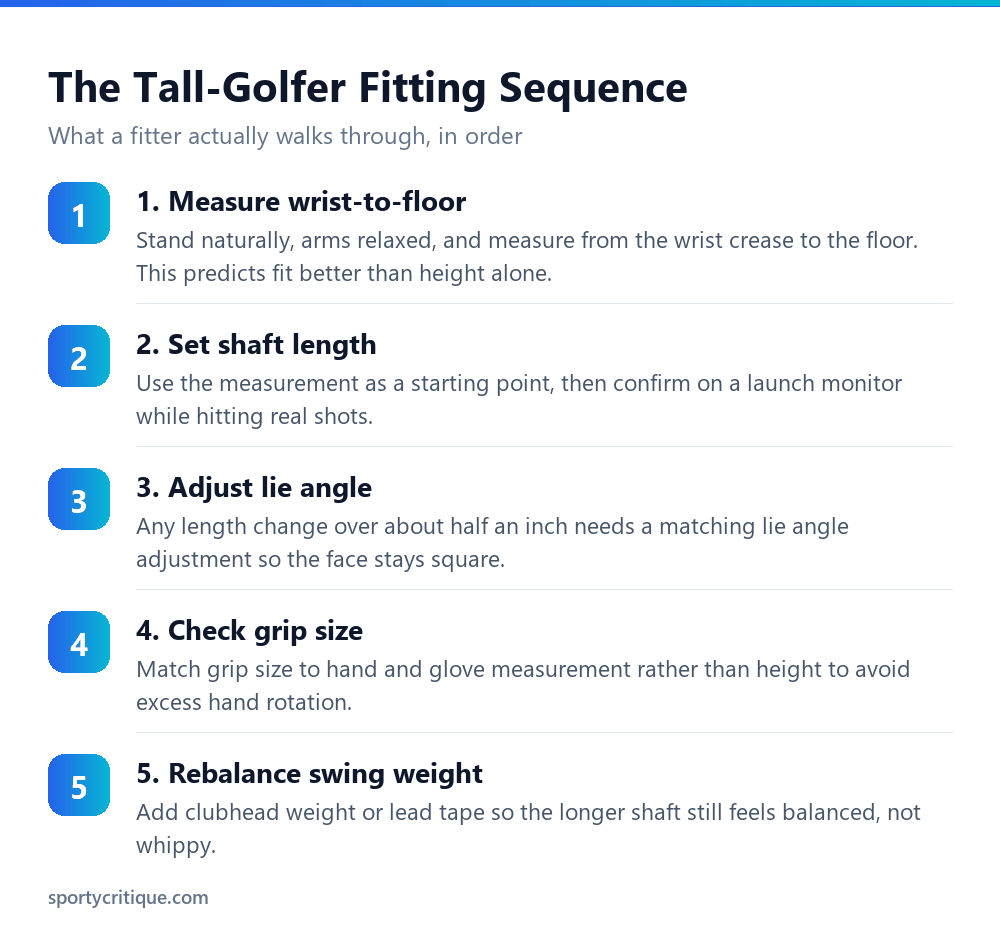
Height alone is a rough guide, not a real fitting measurement. Two golfers who are both 6’3″ can need noticeably different shaft lengths if one has long arms relative to their height and the other doesn’t. The measurement that actually predicts fit is wrist-to-floor: stand naturally with arms relaxed at the sides, and measure from the crease where the wrist meets the hand straight down to the floor.
📊 Note: This chart is a starting point for the conversation with a fitter, not a final answer. Swing style, posture preference, and even the shoes worn during the measurement can shift the right number by a quarter inch or more.
Shaft length: the adjustment tall golfers already expect
Most tall golfers already know shaft length is the obvious fix, and it is the biggest lever in a fitting. A golfer around 6’4″ typically ends up somewhere around 1 to 1.25 inches over standard length across the iron set, adjusted from the wrist-to-floor number and confirmed by how contact looks on a launch monitor or impact tape. Woods and the driver get adjusted too, though usually by a smaller amount than the irons, since an overly long driver shaft costs control faster than it adds distance.
Extending every club is not automatically the right move for every tall player, though. Some golfers with long arms and a wrist-to-floor measurement on the lower end of their height range need less extension than their height alone would suggest. This is exactly why the measurement, not a height chart, drives the number.
For a low-cost way to test whether extra length helps before committing to a full custom set, some players start by extending an existing driver or fairway wood shaft with a Toddmomy Golf Club Shaft Extensions to feel the difference at the range. It’s not a substitute for a proper fitting on irons, where lie angle and swing weight both shift with length, but it’s a cheap way to sense whether more length feels natural before spending real money on a full set.
Lie angle: the change most tall golfers miss
Lengthening a shaft without adjusting lie angle is a common mistake, and it undoes a lot of the benefit of the length change. Lie angle is the angle between the shaft and the ground when the clubhead is soled correctly at address. As a club gets longer, the golfer stands slightly further from the ball, which changes the angle the shaft needs to sit at for the face to point at the target rather than left or right of it.
Tall golfers typically need a more upright lie angle, often 2 to 3 degrees beyond standard, though the exact number depends on posture and swing plane as much as height. A club that’s too flat for a tall golfer’s swing tends to produce a toe-down impact and shots that leak right for a right-handed player; too upright produces the opposite miss. Impact tape or a lie board during a fitting shows this directly instead of guessing from a chart.
⚠️ Watch out: Buying a longer set online without a lie angle adjustment is one of the most common mistakes tall golfers make. The length feels better immediately, so the miss pattern that shows up over the following weeks gets blamed on swing mechanics instead of the actual cause: a clubface that isn’t square at impact because the lie angle never got adjusted for the new length.
Grip size, swing weight, and stance width
Grip size should follow hand measurement and glove size, not height directly, though the two often correlate. A grip that’s too thin for a large hand encourages the hands to overactively rotate through impact, which shows up as an inconsistent draw-to-hook pattern. Most tall golfers with proportionally large hands end up in a midsize or jumbo grip rather than standard, and a fitter checks this by measuring glove size and watching grip pressure during test swings.
Extending a shaft without adding weight to the clubhead makes the club feel lighter and less controlled, since swing weight is a function of both length and head weight. A proper fitting compensates by adding a small amount of lead tape or swapping to a heavier head weight so the extended club still feels balanced through the swing rather than whippy at the top.
Stance width and ball position aren’t club specs, but they’re part of the same conversation. Taller golfers often need a slightly wider stance for stability and should double check ball position hasn’t crept too far forward or back as a side effect of adjusting to longer clubs, since that shift alone can change contact quality independent of anything mechanical in the club itself.
- ✓Get a wrist-to-floor measurement before assuming a shaft length from height alone
- ✓Adjust lie angle any time shaft length changes by more than half an inch
- ✓Check grip size against actual glove size, not a general height guideline
- ✓Book an in-person fitting session if you’re over 6’2″, where small errors compound faster
- ✕Don’t buy a longer standard set online and skip the lie angle adjustment
- ✕Don’t assume two golfers of the same height need the same shaft length
- ✕Don’t extend shaft length without also addressing swing weight
- ✕Don’t ignore persistent toe-down or heel-down wear patterns on the clubface; they usually point to a lie angle mismatch
Two myths worth clearing up
What an actual fitting session covers
A real fitting for a tall golfer usually starts with the wrist-to-floor measurement and a look at current equipment, checking existing wear patterns on the clubface for clues about lie angle. From there, most fitters use a launch monitor and either impact tape or a lie board while the golfer hits a range of shaft lengths and lie angles, adjusting in small increments and watching both ball flight and strike pattern rather than relying on the measurement chart alone.
Expect the session to run 60 to 90 minutes for a full bag, longer if driver and irons are being fit separately. It costs more upfront than buying off the rack, but for anyone over 6’2″ specifically, it’s usually the difference between clubs that quietly fight the swing every round and ones that stop being something to think about.
💡 Pro tip: Bring the shoes you actually golf in to a fitting session. Posture and wrist-to-floor measurement both shift slightly with shoe height, and a fitting done in dress shoes or bare feet can be off by enough to matter once you’re back on the course in golf shoes.
What a fitting actually costs, and where the money goes
A dedicated fitting session at a golf shop or fitting studio typically runs somewhere between $75 and $200 depending on region and whether driver, irons, and putter are all included, and that fee is often credited toward a purchase if new clubs get ordered afterward. The bigger cost usually isn’t the session itself, it’s the upcharge for extended shafts and swing weight adjustments on a new set, which most manufacturers price as a build option rather than folding into the base price.
That upcharge is worth comparing against the alternative, which is playing an ill-fitting set for years and never quite knowing whether a bad round came from swing mechanics or equipment. For a tall golfer who plays regularly, the fitting fee and build upcharge tend to pay for themselves in fewer wasted range sessions spent compensating for a setup position the body never wanted to be in.
Bottom line
For tall golfers, club fitting is not just about adding length. Shaft length, lie angle, grip size, and swing weight all move together, and changing one without the others usually just trades one inconsistency for another. Start with a wrist-to-floor measurement, get an in-person fitting if you’re over 6’2″, and treat any ‘tall’ or ‘big and tall’ club line as a better starting point than standard clubs, not a finished fit.
How much longer should golf clubs be for a tall golfer?
It depends on wrist-to-floor measurement more than height alone, but a common range is +0.5in to +1.5in over standard length, with taller golfers and those with a higher wrist-to-floor number toward the higher end of that range.
Does lie angle really matter if I just get longer clubs?
Yes. Lengthening a shaft changes the angle the club sits at address, and without a matching lie angle adjustment the clubface often stops pointing square at the target, which shows up as a consistent miss to one side.
At what height should a golfer get professionally fitted?
Most fitters consider it worthwhile above about 6’1″, and strongly recommend an in-person session above 6’2″, where small measurement errors have a bigger effect on ball flight.
Are ‘tall’ or ‘big and tall’ golf club lines good enough without a fitting?
They’re a better starting point than standard clubs, since they apply a general length and lie adjustment, but they’re not tuned to an individual’s wrist-to-floor measurement or swing plane the way a real fitting session is.
Do tall golfers need bigger grips too?
Often, but it should be based on hand size and glove size rather than height directly. A grip that’s too thin for a large hand tends to encourage extra hand rotation through impact.
As an Amazon Associate, we earn from qualifying purchases through links on this page.