How to Read Greens and Improve Your Putting Stroke


Search how to read greens golf forums and you will find plenty of theory and not much process. Reading a green well is less about talent and more about a repeatable routine: gather information early, look from the right vantage point, and commit before doubt creeps into your stroke. Here is that process, plus what actually builds a putting stroke that starts the ball where you read it.
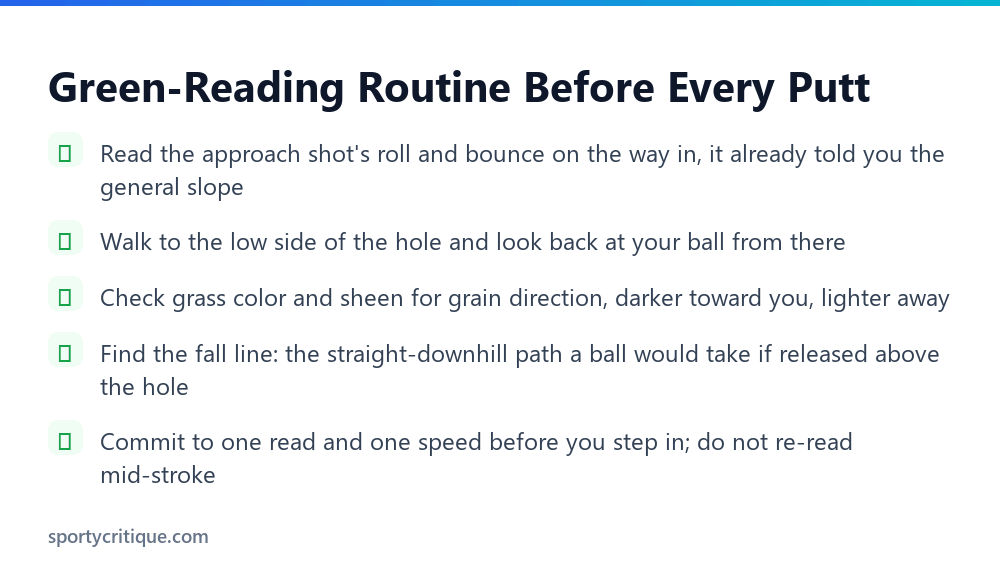
To read greens in golf, first watch how your approach shot rolls out, it already shows you the general slope. Then walk to the low side of the hole and look back at your ball to find the fall line, the straight path a ball would take downhill if released above the cup. Check grass grain by color, darker green usually means the grain runs toward you and the putt will play slower. Commit to a single read and a single speed before you take your stance; most missed putts come from indecision, not a wrong read.
Reading greens gets treated like a mystical skill some players just have and others do not, but most of it is a repeatable process: gather information from a few consistent vantage points, weigh slope against grain, and commit to a line and a speed before you ever take your stance. The stroke itself matters just as much. A perfect read paired with an inconsistent stroke still misses, and a decent read paired with a repeatable pendulum stroke holes more putts than either piece alone.
- →Your approach shot already gave you information; watch how it rolls out before you even reach the green
- →The fall line is the straight downhill path a ball takes if released above the hole; find it from the low side
- →Grass grain affects speed more than most players account for; darker grain runs toward you and plays slower
- →Speed control misses more putts than line does; a putt with the wrong speed rarely goes in even on a good line
- →Commit to one read and one speed before your stance; re-reading mid-routine is where doubt creeps into the stroke
Table of Contents
Start reading before you reach the green
Green reading starts on your approach shot, not once you are standing over the putt. Watch how the ball reacts when it lands and rolls out on the green. A ball that kicks noticeably left or right after landing, or one that releases and keeps rolling toward a specific side, is telling you which way the green generally tilts before you have even walked up to mark your ball. Caddies use this constantly; recreational players almost never do, and it costs them free information.
Find the fall line from the low side
The fall line is the straight path a ball would roll if you released it from a point directly above the hole with no sideways push, just gravity pulling it downhill. Once you know the fall line, every putt is really a question of how far off that line your ball’s actual position sits, and how much that gap will curve the ball back toward it. The best vantage point for spotting the fall line is standing on the low side of the hole and looking back up the slope toward your ball, not standing behind your ball looking at the hole, which is the angle most amateur golfers default to and the one that hides slope the most.
Reading grain, and when it actually matters
Grass grain, the direction individual blades lean as they grow, affects speed more than it affects break on most putting surfaces, though it can do both on Bermuda greens where grain tends to run stronger. Look at the color and sheen of the green from a few feet away. Grass that looks darker and duller usually has its grain growing toward you, which slows the putt down. Grass with a lighter, shinier sheen usually has grain growing away from you, which speeds the putt up. On bentgrass greens, which are cut short and mowed frequently, grain effects are usually small enough to ignore in favor of pure slope reading. On Bermuda greens, grain can meaningfully outweigh a mild slope, which is why the same length putt can play completely differently on two different grass types.
⚠️ Watch out: Shadows and the position of the sun distort how much break you perceive, often making a mild slope look more severe than it is. If a putt looks unusually dramatic right at sunrise or sunset, walk the green rather than trusting your eyes from one angle, since low light exaggerates contour more than midday sun does.
A repeatable putting stroke matters as much as the read
A putting stroke is a pendulum, not a wrist flick. The putter should swing from the shoulders with the wrists staying quiet through impact, which keeps the putter face square to your intended start line at contact. Ball position sits slightly forward of center in your stance so the putter meets the ball on a very slight upward arc rather than still descending, which reduces the initial skid and gets the ball rolling true sooner.
Grip pressure is where a lot of missed putts actually start. Gripping too tightly tenses the forearms and turns a smooth pendulum into a jabby, wrist-driven stroke, especially under pressure on a short putt. Aim for the lightest grip pressure that still lets you control the putter, roughly the pressure you would use to hold a tube of toothpaste without squeezing any out.
Using a training aid to check your read and your setup
Reading a green accurately is a learnable skill, and a purpose-built tool speeds up the learning curve. Something like the Dr.Putter Golf Green Reader Mirror is designed specifically to help you sight the slope and aim line from directly over the ball, which is useful while you are still training your eye to spot fall lines on your own. It will not replace the on-course habit of walking the low side of the hole, but as a practice-green tool for building the visual instinct, it removes some of the guesswork while that skill develops.
💡 Pro tip: Practice lag putts from 20-30 feet far more than short putts. Most recreational golfers drill 3-footers because they feel high-stakes, but three-putts almost always start with a poorly paced long putt, not a missed short one. Fixing speed control on longer putts removes more strokes from your score than perfecting a stroke you rarely have to hit under real pressure.
Reading greens in wind and wet conditions
Wind affects a rolling ball far less than most players assume, since a ball on the ground has much less surface area exposed than a ball in flight. On an exposed, elevated green in a strong crosswind, you can account for a small amount of push on longer putts, but treating wind as a major factor on anything inside 15 feet usually does more harm than good. The bigger practical effect of wind is on your setup and stroke tempo. A gusty day makes it harder to hold a stable posture over the ball, and that instability causes far more missed putts than the wind actually moving the ball ever does.
Wet greens play slower and hold slightly less break than dry ones because moisture adds friction that slows the ball down before it can respond fully to slope. Morning dew has the same effect and tends to burn off unevenly across a green, which is why a putt that broke one way during an early tee time can behave differently on the same green later that afternoon. If you are playing early, expect greens to run a touch slower and hold a fraction less break than the same putt would in the afternoon.
Practice drills that actually transfer to the course
The gate drill builds a square putter face without needing a training aid: set two tees just wider than your putter head a few inches in front of the ball, on your intended start line, and roll putts through the gate without clipping either tee. It gives instant feedback on face angle at impact, which is the single biggest factor in whether a putt starts on your read or misses it before slope ever gets a chance to matter.
The clock drill builds distance control, which matters more than most players practice for it. Place balls at 3, 6, 9, and 12 feet around a hole and putt each one, moving around the clock face rather than repeating the same length putt over and over. This forces you to recalibrate pace for a new distance on every single putt, which is closer to how a real round actually plays than hitting twenty putts in a row from the same spot.
Common myths about green reading
Building the read-to-stroke routine
- ✓Gather information from your approach shot before you even reach the green
- ✓Look from the low side of the hole at least once, not just from behind your ball
- ✓Commit to one line and one speed before taking your stance
- ✓Practice speed control on lag putts more than short putts
- ✕Standing over the ball re-reading the line after you have already committed
- ✕Reading break from directly behind the ball only, which hides most of the slope
- ✕Gripping the putter tightly enough to turn the stroke into a wrist-driven jab
- ✕Ignoring grain on Bermuda greens where it can outweigh a mild slope
Bottom line
Reading greens well is mostly about vantage point and discipline: gather information from your approach shot and the low side of the hole, weigh grain against slope honestly instead of guessing, and commit to a single line and speed before you take your stance. Pair that with a quiet, pendulum putting stroke and light grip pressure, and most of what looks like green-reading talent turns out to be a process anyone can copy with enough deliberate practice.
What is the fall line in putting?
The fall line is the straight downhill path a ball would take if released directly above the hole with no sideways push, just gravity. Every putt breaks relative to that line, so finding it first, usually by looking from the low side of the hole back toward your ball, makes the rest of the read much easier.
Does grass grain really affect putts?
Yes, mainly speed rather than break, and the effect is strongest on Bermuda greens where grain grows more aggressively than on bentgrass. Darker, duller grass usually means the grain runs toward you and the putt plays slower; lighter, shinier grass usually means it runs away and the putt plays faster.
Why do I read greens correctly but still miss putts?
Speed control misses more putts than a wrong read does. A putt with the correct line but the wrong pace either dies short of the break it needed to take, or races through it without curving at all. Practicing lag putts from 20-30 feet usually fixes more three-putts than refining your read further.
Should I use the plumb-bob method to read greens?
It can help confirm which way a green tilts, but it only tells you general slope direction, not grain or the exact fall line. Most players get more reliable information from walking the low side of the hole and watching how their approach shot rolled out than from plumb-bobbing alone.
As an Amazon Associate, we earn from qualifying purchases through links on this page.