Golf Swing Adjustments for Wet and Windy Conditions


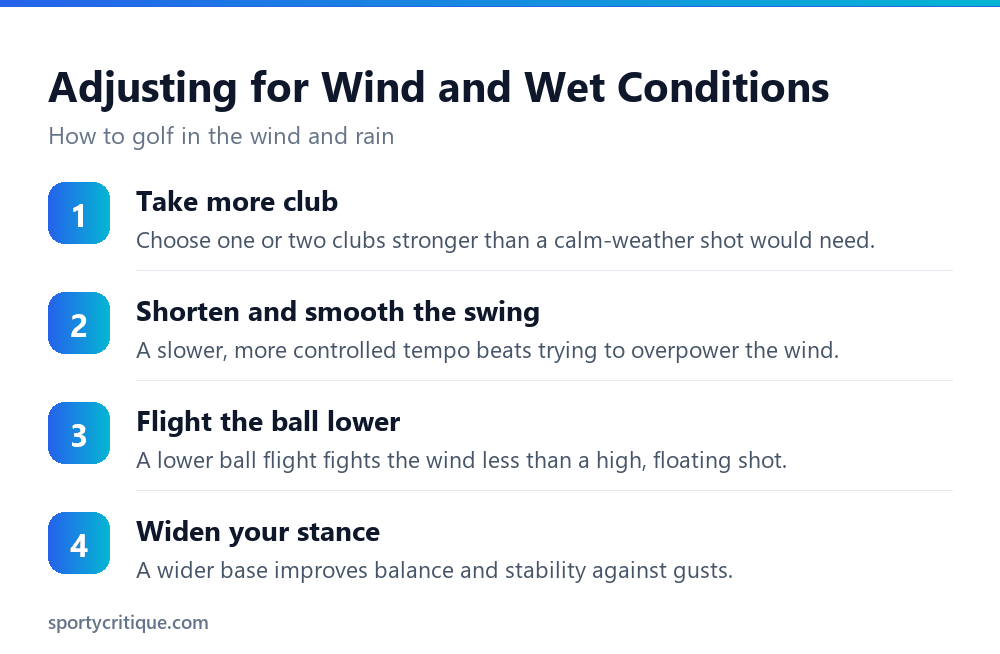
How to golf in the wind and rain comes down to four adjustments: taking more club than a calm-day shot would need, shortening and smoothing the swing tempo instead of swinging harder, flighting the ball lower to reduce wind resistance, and widening the stance slightly for better balance against gusts. None of these require a fundamentally different swing, just deliberate adjustments to club selection, tempo, and ball flight.
Bad weather exposes swing flaws that calm, dry conditions can mask entirely. A golfer who swings too hard, rushes their tempo, or relies on a high ball flight will see those tendencies punished far more severely in wind and rain than on a still, sunny day, which is exactly why deliberate weather adjustments matter more than simply gritting through conditions with an unchanged swing.
- →Take one or two clubs more than a calm-day shot to the same distance would require
- →Shorten and smooth the swing tempo rather than trying to swing harder against wind
- →A lower ball flight reduces wind resistance more effectively than a high, floating shot
- →A wider stance improves balance and stability against gusts, especially at the top of the swing
- →Wet grips and wet grass both require specific, separate adjustments beyond wind alone
Table of Contents
Club Selection: Take More Than You Think
Wind robs distance more aggressively than most golfers instinctively account for, particularly into a headwind, where the effect compounds rather than simply subtracting a fixed number of yards. A shot that would carry 150 yards on a calm day might need a club normally reserved for 170 yards once a meaningful headwind is factored in, and guessing conservatively on club selection in these conditions consistently beats guessing aggressively.
Downwind shots present the opposite miscalculation risk: golfers often overestimate how much extra distance a tailwind actually adds, since wind assistance affects a ball less predictably than headwind resistance does, especially depending on the shot’s launch angle and spin rate. A more conservative club selection downwind, rather than assuming maximum wind assistance, tends to produce more consistent results.
💡 Pro tip: A rough rule some experienced players use is one extra club per noticeable 10 mph increment of headwind, adjusted based on personal experience and the specific shot’s trajectory, rather than a rigid formula applied without any feel for the day’s actual conditions.
Tempo: Slower, Not Harder
The natural instinct in windy conditions is to swing harder to fight through resistance, but this almost always backfires, since a faster, more aggressive swing tends to produce less consistent contact and a higher, more wind-affected ball flight rather than the low, penetrating shot that actually performs better in wind.
⚠️ Watch out: Swinging harder into wind is one of the most common and costly mistakes recreational golfers make in bad weather. A smoother, more controlled tempo with a stronger club selection almost always outperforms a harder swing with a weaker club aimed at the same target distance.
A shortened, three-quarter length backswing paired with smooth tempo produces a more compact, repeatable motion that holds up better under the added physical strain of wind, rain, and often colder temperatures than a full, maximum-effort swing attempted in the same conditions.
Flighting the Ball Lower
A lower ball flight spends less time exposed to wind’s sideways and vertical push than a high, floating shot covering the same distance, which is why experienced players deliberately flight shots lower in windy conditions rather than accepting their normal, calm-weather trajectory. Playing the ball slightly back in the stance and choking down slightly on the grip are common, simple ways to lower launch angle without a major swing overhaul.
A punch shot, an abbreviated swing with a lower, more controlled trajectory, is a specific technique worth practicing deliberately before needing it in an actual windy round. Trying to improvise a lower ball flight for the first time mid-round, without any prior practice, produces far less reliable results than a shot that’s been rehearsed beforehand.
Stance and Balance in Gusty Conditions
Widening the stance slightly beyond a normal setup improves stability against gusts, particularly at the top of the backswing and through impact, where a narrow base is most vulnerable to being pushed off balance by a sudden wind gust. This adjustment costs essentially nothing in terms of swing mechanics while meaningfully reducing the chance of a wind-induced mishit.
Timing the swing to start during a lull rather than fighting through a strong, sustained gust is a simple situational adjustment that costs only a few seconds of patience but can meaningfully improve contact quality. Watching flag movement or grass sway in the moments before starting the swing helps gauge whether a gust is building or settling.
Common Wind and Rain Mistakes
- ✓Take more club and swing smoothly rather than harder with a weaker club
- ✓Flight the ball lower using stance and grip adjustments, not a completely different swing
- ✓Widen your stance slightly for better balance against gusts
- ✓Time your swing to start during a lull in sustained wind when possible
- ✕Swinging harder to fight through wind, which usually produces worse, higher-flighted contact
- ✕Assuming a tailwind adds as much predictable distance as a headwind subtracts
- ✕Keeping a narrow, calm-day stance in genuinely gusty conditions
- ✕Attempting a low punch shot for the first time mid-round without any prior practice
Wet Grips and Wet Grass: Separate Adjustments
Rain and wet grass introduce challenges distinct from wind alone. A wet grip is more likely to slip during the swing, and players should grip slightly firmer than usual, dry their hands and grip between shots when possible, and consider rain gloves specifically designed to maintain traction when soaked, since a standard glove often performs worse wet than no glove at all.
Wet grass under the ball reduces spin significantly on approach shots, since moisture between the clubface and ball at impact interferes with the grooves’ ability to generate normal spin rates. This means approach shots from wet fairway lies tend to release and roll out further than the same shot would from a dry lie, requiring a club or landing-spot adjustment to compensate for the reduced stopping power.
📊 Note: This wet-lie spin reduction affects shots from the fairway rough or first cut noticeably less than shots from a clean fairway lie, since longer grass already reduces spin significantly even in dry conditions, leaving less additional room for wetness to reduce it further.
Putting in Wind and Wet Greens
Wind affects putting more than most golfers expect, particularly on longer putts where a strong crosswind can meaningfully push the ball off its intended line over the ball’s full travel distance. Widening the stance slightly on the green and, on very windy days, timing the putting stroke to start during a lull mirror the same principles used for full swings.
Wet greens generally run slower than dry ones, since surface moisture adds friction that slows ball roll, meaning putts on a rain-affected green typically need a firmer stroke than the same line and length would require on a dry, faster green. Reading green speed carefully on the first few holes of a wet round helps calibrate stroke firmness for the rest of the round.
Playing a Crosswind Correctly
A crosswind requires a different mental approach than a straight head or tailwind, since the goal shifts from adjusting distance to accounting for lateral push on the ball’s flight path. Two common strategies exist: aiming to allow for the wind’s push and letting it carry the ball back toward the target, or deliberately shaping a shot that fights the wind’s direction to hold a straighter line.
For most recreational players, aiming off-target and allowing the wind to do the correcting work is more reliable than attempting to intentionally shape a shot against the wind, which requires a level of shot-shaping control many golfers haven’t specifically practiced. Committing fully to the chosen aim point, rather than second-guessing mid-swing, matters more than which specific strategy gets chosen.
💡 Pro tip: Picking an intermediate target, a specific spot on the fairway or green rather than the ultimate hole location itself, makes it easier to commit to a crosswind aim adjustment than trying to visualize the correction relative to a distant final target alone.
Course Management Adjustments
Bad weather rounds reward more conservative course management than a calm, sunny day would call for, since the margin for error on aggressive shots shrinks considerably when wind and rain are already working against clean contact and predictable ball flight. Aiming for the center of greens rather than tucked pin positions, and favoring the wider side of doglegs, reduces the compounding risk of a weather-affected shot combined with an already aggressive target choice.
Accepting a bogey as a reasonable outcome on a genuinely difficult, weather-affected hole, rather than forcing a risky recovery shot to save par, keeps a bad-weather round from spiraling into a much higher score through compounding mistakes. This mental adjustment matters as much as any physical swing change for keeping a wet, windy round respectable.
Small Equipment Adjustments Worth Making
Carrying a couple of towels, one to keep dry for wiping hands and grips and a separate one for cleaning wet clubheads, is a simple but often overlooked preparation step for a rainy round. A dry towel kept inside an umbrella or a golf bag’s rain hood stays usable far longer than one left exposed to ongoing rain throughout the round.
Umbrella positioning during the actual swing matters too; propping it against the bag or having a playing partner hold it, rather than trying to swing while holding an umbrella oneself, protects both swing mechanics and balance from the added complication of managing rain gear mid-motion.
Frequently Asked Questions
How much extra club should I take in wind?
A common starting guideline is one extra club per noticeable 10 mph increment of headwind, adjusted based on personal experience with a specific shot’s trajectory and spin.
Why does swinging harder in wind make shots worse?
A harder swing tends to produce a higher, less controlled ball flight, which is more exposed to wind’s effects, not less. A smoother tempo with a stronger club selection performs more consistently.
Does rain really reduce spin that much on approach shots?
Yes, meaningfully. Moisture between the clubface and ball at impact interferes with groove performance, reducing spin and causing the ball to release and roll out further than the same shot from a dry lie.
Should I change my putting stroke in wind?
Widening your stance for stability and, on very windy days, timing your stroke to start during a lull both help. Strong crosswinds can meaningfully affect longer putts specifically.
What’s the best way to keep a firm grip when it’s raining?
Grip slightly firmer than usual, dry your hands and grip between shots when possible, and consider rain-specific gloves designed to maintain traction when wet, since a standard glove often performs worse soaked than bare hands.
Do wet greens run faster or slower than dry ones?
Slower. Surface moisture adds friction that slows ball roll, so putts generally need a firmer stroke on wet greens than the same line and length would require on a dry, faster green.
None of these adjustments require rebuilding a golf swing from scratch. Club selection, tempo, ball flight, and stance are all small, deliberate dials a player can turn based on the day’s actual conditions, and practicing them ahead of time, rather than improvising for the first time mid-round, is what actually makes bad-weather golf scores hold up close to a player’s normal average.
As an Amazon Associate, we earn from qualifying purchases through links on this page.