Shuffleboard League Rules and Tournament Format Explained

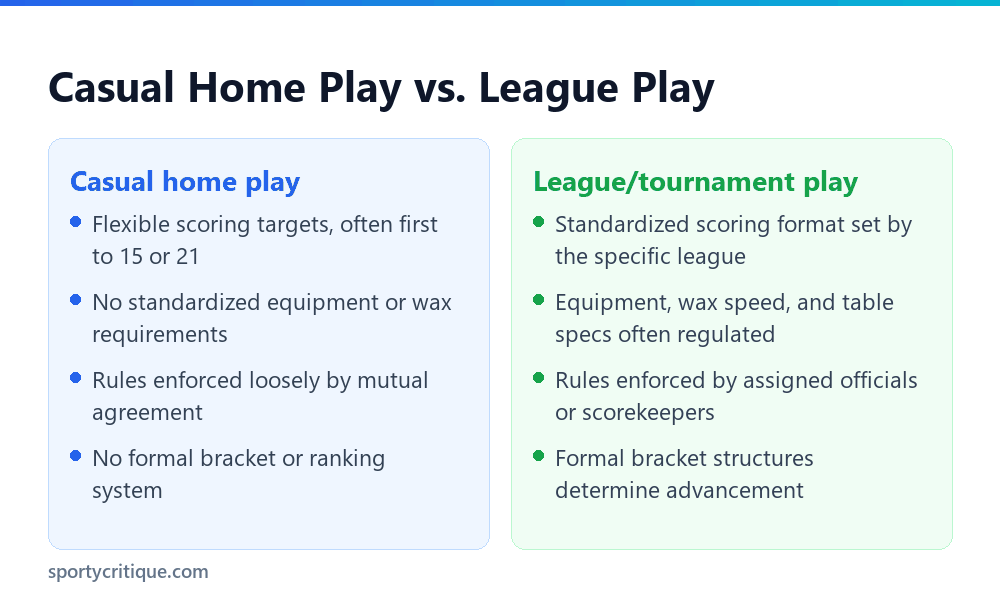
Competitive shuffleboard league rules differ from casual home play primarily in standardization: leagues set a specific scoring target, often 15 points in singles play and higher totals in doubles, regulate equipment and wax speed to keep competition fair across different venues, and use formal bracket or round-robin structures to determine tournament advancement rather than informal, single-game casual matches. Understanding these structural differences helps a player transitioning from home games to organized competitive play know what to actually expect.
Most shuffleboard content available online focuses on casual home play, basic rules, scoring, and technique for a backyard or game room setting, leaving a real gap for players interested in joining an organized league or entering tournament competition for the first time. This guide covers that more structured, competitive side of the sport specifically.
- →League scoring targets are typically standardized, often 15 points for singles play
- →Equipment and wax speed regulation keeps competition fair across different venues and tables
- →Bracket and round-robin formats determine tournament advancement, unlike casual single games
- →Doubles play in competitive shuffleboard often follows different scoring targets than singles
- →League rules are typically stricter and more consistently enforced than casual home game norms
Table of Contents
Standardized Scoring in Competitive Play
While casual home games often play to a flexible target, first to 15, 21, or simply until players decide to stop, organized league and tournament play typically standardizes on a specific scoring target set by the governing league or tournament organization, commonly 15 points for singles matches.
⚠️ Watch out: A player assuming their home league’s specific scoring format matches every other league’s standard risks confusion when competing in an unfamiliar tournament. Checking a specific competition’s exact scoring rules before playing, rather than assuming universal consistency across all organized shuffleboard, avoids this common surprise.
Doubles Format Differences
Doubles competitive shuffleboard, played with two-person teams per side, often uses a higher scoring target than singles play, reflecting the format’s typically longer games and different strategic dynamics with two players per team alternating or coordinating shots.
Team communication and shot-calling strategy become significantly more relevant in doubles competitive play than in singles, since partners need to coordinate on which pucks to protect, which to knock away, and how to divide the specific shots each partner takes during a frame.
Equipment and Wax Regulation
Many organized leagues specify approved wax speed ranges or even specific wax brands to ensure consistent puck behavior across different venues and tables within the same league or tournament, since dramatically different table speeds between venues would otherwise create an uneven competitive playing field.
Table dimensions and construction specifications are similarly regulated in serious competitive play, ensuring a 22-foot tournament table at one venue plays comparably to the same length table at a different venue, rather than allowing meaningful variation that would advantage players more familiar with their specific home table’s particular quirks.
Bracket and Tournament Structures
Single-elimination brackets, where a loss ends a player’s or team’s participation immediately, are common in shorter tournaments needing to complete within a single day or weekend, prioritizing a faster overall event timeline over giving every participant maximum total playing time.
Round-robin formats, where every participant or team plays every other participant at least once before final standings are determined, are more common in longer league seasons where the additional time investment produces a more thorough, statistically reliable ranking of participants than a single-elimination format’s faster but less comprehensive structure allows.
💡 Pro tip: Double-elimination brackets, which give a participant a second chance after one loss before being fully eliminated, offer a middle ground between single-elimination’s speed and round-robin’s thoroughness, a format some tournaments specifically choose to balance these competing priorities.
Common League Rule Confusions
- ✓Confirm the specific scoring target for a given league or tournament before playing
- ✓Check equipment and wax regulations specific to that competition
- ✓Understand whether the event uses single-elimination, double-elimination, or round-robin
- ✓Recognize doubles often uses different scoring targets and strategy than singles
- ✕Assuming every league or tournament uses an identical scoring target
- ✕Bringing personal wax or equipment without checking if it meets competition regulations
- ✕Confusing single-elimination and round-robin formats when planning tournament expectations
- ✕Applying singles strategy directly to doubles without adjusting for team coordination
Officiating and Scorekeeping in Competitive Play
Organized league and tournament matches typically assign a dedicated scorekeeper or official specifically to track frame scores and resolve disputes, a level of formal oversight absent from most casual home games where players simply track and agree on scoring themselves.
This formal officiating matters more as stakes increase, since a disputed close-frame measurement, determining which puck is actually closest to the scoring area, benefits from a neutral third party’s measurement and ruling rather than relying purely on the competing players’ own potentially biased assessment.
Ranking and Season-Long Standings
Many organized leagues track player or team standings across an entire season, using a points system based on match wins, losses, and sometimes margin of victory, to determine playoff eligibility or seeding, a structure entirely absent from casual, one-off home games between friends or family.
Understanding a specific league’s exact standings and playoff qualification system before the season begins helps a new competitive player set realistic expectations and plan their season strategy, rather than discovering partway through that they’ve misunderstood how advancement actually works within that specific league’s structure.
Getting Started in Competitive Shuffleboard
Local bars, dedicated shuffleboard clubs, and some community recreation centers commonly host organized leagues, and searching for these specific options in a given area, rather than assuming only casual home play is available, opens up the competitive format covered throughout this guide for players interested in that structure.
Attending a league’s matches as a spectator before committing to join, when possible, gives a prospective player direct exposure to that specific league’s actual scoring format, pace, and competitive atmosphere, information that’s often more useful than reading a league’s written rules alone before deciding whether to participate.
Frames and Match Structure
A frame, a single round where each team or player slides all their pucks before scoring is tallied and the table cleared, is the basic scoring unit in competitive shuffleboard, with a full match consisting of enough frames to reach the target score, 15 points in a typical singles format.
Some leagues additionally cap the maximum number of frames a match can run, adding a tiebreaker or sudden-death mechanism if the score target isn’t reached within that frame limit, a structural detail specifically meant to keep match length predictable for tournament scheduling purposes rather than allowing an unusually close, extended match to run indefinitely.
The Hammer and Shooting Order
The “hammer,” the advantage of shooting last in a frame, matters strategically since the final shooter can see exactly how many points are needed and adjust their shot accordingly, either playing defensively to protect an existing lead or aggressively to overtake an opponent’s positioned pucks.
Most competitive formats determine hammer possession based on the previous frame’s outcome, often awarding it to the team that didn’t score or scored fewer points in the prior frame, a rule specifically designed to help balance the game rather than letting one team’s early advantage compound automatically through repeated hammer possession.
Puck Weight and Equipment Rules
Competitive leagues typically specify approved puck weights and materials, ensuring all participants compete with comparably performing equipment rather than allowing one player’s custom or non-standard pucks to create an unfair advantage through unusual weight or surface characteristics.
Checking a specific league’s approved equipment list before a first competitive match avoids the situation of arriving with personal pucks that don’t actually meet that league’s specific regulations, which could require borrowing approved house equipment at the venue instead.
Fouls and Rule Violations in Competitive Play
A puck that goes off the table entirely, called a “in the ditch” or a similar term depending on regional terminology, is typically removed from play for that frame without scoring, and understanding a specific league’s exact terminology and handling of this and other common situations avoids confusion during an actual competitive match.
Foot fault rules, governing where a player must stand while releasing a shot, and time limits on how long a player can take between shots, are both more strictly enforced in organized competitive play than in casual home games, where these details are rarely even discussed, let alone formally regulated and enforced by an official.
Handicap Systems in Recreational Leagues
Some recreational or mixed-skill leagues implement a handicap system, adjusting scoring targets or starting points based on a player’s tracked skill rating, specifically to keep matches competitive and enjoyable between players of genuinely different skill levels within the same league.
This handicap approach is more common in casual or beginner-friendly league formats than in serious, high-level competitive tournaments, where participants are typically grouped into skill-based divisions instead of using a handicap adjustment within a single mixed-skill division.
📊 Note: A player new to competitive shuffleboard should specifically ask whether a prospective league uses a handicap system before joining, since this detail significantly affects how competitive matches actually feel for a newer or less experienced player entering an established league.
Frequently Asked Questions
What’s the standard scoring target in competitive shuffleboard?
Commonly 15 points for singles matches, though this varies by league, with doubles often using a higher target reflecting the format’s typically longer games.
Do all leagues use the same wax and equipment?
No. Many leagues specify approved wax speed ranges or table specifications to keep competition fair, but these standards vary between different leagues and organizing bodies.
What’s the difference between single-elimination and round-robin formats?
Single-elimination ends a participant’s tournament after one loss, prioritizing a faster event; round-robin has everyone play everyone else, producing a more thorough ranking but taking considerably longer.
Why does doubles shuffleboard use different strategy than singles?
Team communication and shot-calling become significantly more relevant, since partners need to coordinate on which pucks to protect, knock away, and divide during each frame.
Do casual home games need to follow league rules?
Not at all. Casual play can use whatever flexible scoring and informal enforcement players agree on; league rules exist specifically for structured, competitive settings.
How do I find a shuffleboard league to join?
Check local bars, dedicated shuffleboard clubs, and community recreation centers, which commonly host organized leagues in many areas.
Showing up to one league night as an observer before committing to a full season is a low-cost way to see all of this in action firsthand, and most established leagues are happy to have curious newcomers watch a match or two before deciding whether to sign up for the full season ahead.
Competitive shuffleboard’s added structure, standardized scoring, regulated equipment, formal officiating, and organized tournament formats, transforms the sport from a casual backyard activity into a genuinely competitive pursuit, and understanding these differences helps any player make a smooth transition from home games to organized league or tournament play.
None of these structural details should feel intimidating to a player considering competitive play for the first time. Most leagues, especially recreational ones, are set up specifically to welcome newer players, and asking a league organizer directly about scoring format, equipment rules, and handicap policy before the first match clears up the large majority of uncertainty that might otherwise hold someone back from trying organized play.
The jump from casual home games to a first organized league match feels bigger in anticipation than it usually does in practice, since the core skills, aim, weight control, and reading the table, transfer directly regardless of how formal the surrounding scoring and officiating structure happens to be.
As an Amazon Associate, we earn from qualifying purchases through links on this page.