Best Golf Launch Monitors Under $1,000: Radar vs Photometric Testing

Precision ball tracking has moved from PGA Tour practice tees into home garages and backyard net enclosures. Until recently, capturing accurate clubhead delivery, ball launch angles, and total backspin required commercial systems costing more than ten thousand dollars. Today, personal golf launch monitors priced under one thousand dollars offer dedicated Doppler radar transceivers and dual-camera optical photometrics that record crucial swing metrics within three percent of tour-grade reference units.
Selecting an accurate personal launch monitor demands understanding the physical differences between microwave Doppler radar and high-speed photometric cameras. Radar units track the golf ball as it flies away from the sensor, requiring specific flight distances to calculate true spin axis and descent trajectories. In contrast, photometric units capture microsecond flash exposures at the instant of strike, measuring initial face orientation and spin rates independent of ball travel space. This engineering review analyzes five top launch monitors under one thousand dollars based on Doppler frequencies, high-speed optical capture, indoor garage enclosure space requirements, and total data fidelity.
Table of Contents
Quick Comparison: Top Golf Launch Monitors Under $1,000
| Launch Monitor Model | Tracking Technology | Key Metrics Measured | Indoor Space Needed | Best Application |
|---|---|---|---|---|
| Garmin Approach R10 | 24 GHz Radar | Ball Speed, Club Speed, Launch Angle, Spin Axis, Carry | 14–16 Feet (Tee to Net + Behind) | Best Overall Portability & Battery Life |
| FlightScope Mevo+ | 3D Doppler Radar (Multi-Freq) | 16 Swing Metrics, Spin Rate, Height, Flight Time | 16 Feet (8ft Flight + 8ft Sensor) | Best Tour-Grade Data Analytics |
| Rapsodo MLM2PRO | Dual Optical Cameras + Doppler | Measured Spin Rate, Spin Axis, Impact Vision Video | 14 Feet Total Depth | Best Measured Spin & High-Speed Video |
| Voice Caddie SC300i | Doppler Radar + Barometric Sensors | Carry, Total Distance, Smash Factor, Apex | 5–6 Feet Behind Ball | Best Standalone Screen Without Phone |
| Swing Caddie SC4 | Doppler Radar + Voice Output | Ball Speed, Swing Speed, Carry, Launch Direction | 5 Feet Behind Ball | Best Budget Practice Bay Companion |
Engineering Anatomy: Doppler Radar vs Photometric High-Speed Imaging
Understanding the physics behind launch monitor sensors prevents costly measurement errors when setting up indoor simulation environments. Launch monitors calculate shot data through two distinct physical mechanisms: continuous-wave microwave Doppler frequency shifts and optical infrared strobe photography.
1. 24 GHz Doppler Radar Tracking
Doppler radar units, such as the Garmin Approach R10 and FlightScope Mevo, emit microwave frequencies in the 24 GHz spectrum. When the moving clubhead and golf ball travel through this emitted radar wave, the frequency of the reflected signal changes proportionally to velocity according to the classical Doppler equation:
Δf = 2 * (v / c) * f0 * cos(θ)
Where v is target velocity, c is the speed of light, f0 is carrier frequency, and θ is the angle between radar axis and ball trajectory. Radar excels outdoors on driving ranges because it tracks the entire parabolic flight path from impact to earth touchdown. However, inside a garage or basement studio, radar units require a minimum ball flight of 8 feet before striking a projection net, plus 6 to 8 feet of clear floor behind the tee for the sensor tripod. Metallic objects, concrete rebar, and spinning garage door opener motors can produce electronic backscatter that distorts spin algorithms unless metallic dot stickers (RCT balls) are applied to the golf ball surface.
2. Dual High-Speed Optical Cameras
Photometric devices use high-speed infrared cameras operating at exposure durations shorter than 1/10,000th of a second. Instead of tracking the ball across dozens of yards of flight, optical cameras photograph the dimple patterns and painted logos on the golf ball cover across the first two to four inches of movement immediately off the clubface. By comparing the rotation of dimple landmarks across consecutive visual frames, optical processors calculate exact backspin and side spin rpm without needing dozens of feet of ball flight. Photometric units sit perpendicular to the target line right next to the tee, making them ideal for compact indoor studios where floor depth is restricted.
3. Hybrid Fusion Systems (Radar + Optics)
Modern sub-thousand-dollar innovations, led by the Rapsodo MLM2PRO, combine dual optical cameras with an integrated Doppler radar transceiver. The radar module tracks initial clubhead acceleration and exit velocity, while the primary 240-frame-per-second shutter camera photographs ball dimple rotation and strike contact. This dual-sensor design delivers true measured spin metrics rather than algorithmic approximations, providing simulator accuracy once reserved for five-figure studio hardware.
In-Depth Reviews: Top 5 Personal Golf Launch Monitors
1. Garmin Approach R10 — Best Overall Portability & Ecosystem
The Garmin Approach R10 established the benchmark for sub-thousand-dollar launch monitor technology. Weighing under eight ounces and mounting magnetically onto an adjustable aluminum tripod, the R10 uses a 24 GHz Doppler radar transceiver to measure clubhead speed, ball speed, launch angle, launch direction, and estimated backspin rates across every club from sand wedge to driver.
During outdoor testing, the Approach R10 matched commercial GCQuad carry distances within 2.5 yards on mid-iron shots. The unit pairs directly with Garmin Golf software, displaying animated 3D driving range dispersions and automated video recording of every swing through your smartphone camera. When used indoors into a practice net, pairing the R10 with Titleist Pro V1 RCT (Radar Capture Technology) golf balls eliminates radar spin calculation drift, locking down exact backspin readings within 150 rpm. With up to ten hours of continuous internal battery run time, the R10 remains the benchmark for golfers practicing across both backyard nets and open grass practice ranges.
Key Technical Specifications:
- Sensor Technology: 24 GHz Doppler Radar Transceiver
- Tracked Metrics: Clubhead Speed, Ball Speed, Smash Factor, Launch Angle, Launch Direction, Club Path, Face Angle, Spin Axis, Carry Distance
- Battery Life: Up to 10 Hours Internal Rechargeable Lithium-ion
- Software Compatibility: Garmin Golf App, E6 Connect, Awesome Golf, The Golf Club 2019
- Indoor Space Required: 6–8 Feet Behind Ball + 8–10 Feet Ball Flight to Net
2. FlightScope Mevo+ — Best Tour-Grade Data Analytics
The FlightScope Mevo+ represents the pinnacle of Doppler radar engineering in the consumer pricing tier. Utilizing proprietary 3D Doppler tracking radar with multi-frequency signal processing, the Mevo+ tracks sixteen distinct data parameters natively, including vertical launch, horizontal launch, total spin rate, spin axis tilt, apex height, flight time, and lateral dispersion angle.
The strength of the Mevo+ lies in its mathematical precision. FlightScope allows custom sensor pitch and roll angle calibration down to 0.1 degrees using an integrated internal camera alignment tool. This optical alignment step ensures that your target line in the software aligns with your physical hitting mat. For players focused on competitive iron gapping and driver launch optimization, the FS Golf software provides detailed group dispersion ellipses and club delivery metrics that highlight whether distance loss stems from dynamic loft delivery or off-center face contact.
Key Technical Specifications:
- Sensor Technology: Multi-Frequency 3D Doppler Tracking Radar
- Tracked Metrics: 16 Base Parameters (Ball Speed, Club Speed, Smash Factor, Spin Rate, Spin Axis, Apex, Carry, Total Distance, Angle of Attack)
- Alignment: Internal Optical Target Camera with Electronic Leveling
- Software Integration: FS Golf, FS Skills, E6 Connect (5 Free Courses Included)
- Space Requirement: 7–8 Feet Sensor to Tee + 8–10 Feet Tee to Impact Net
3. Rapsodo MLM2PRO — Best Dual-Camera Optical Precision
The Rapsodo MLM2PRO transforms compact garage simulator setups by integrating two distinct optical cameras with high-frequency Doppler radar. While radar units under one thousand dollars traditionally guess ball spin rates indoors based on mathematical algorithm models, the MLM2PRO measures exact ball rotation using its High-Speed Impact Vision camera paired with Callaway RPT (Rapsodo Precision Technology) Chrome Soft golf balls.
The primary high-speed shutter camera fires at 240 frames per second, freezing the golf ball at the exact moment of strike to capture clubface contact, face strike location, and spin axis tilt. Meanwhile, the wide-angle camera records full-body swing video with synchronized graphical data overlays. For golfers who practice indoors into a net with limited ball flight distance, the MLM2PRO delivers measured spin rates that rival commercial studio units, preventing the artificial calculation spikes common to radar-only devices in confined spaces.
Key Technical Specifications:
- Sensor Technology: Dual High-Speed Optical Cameras + Doppler Radar
- Camera Frame Rate: 240 FPS Impact Vision + Wide-Angle Shot Vision
- Ball Tracking: Direct Measured Spin Rate & Spin Axis via Callaway RPT Patterned Balls
- Compatibility: iOS, Android, E6 Connect, Awesome Golf, Rapsodo Virtual Golf (30,000+ Courses)
- Space Requirement: 6.5–8.5 Feet Behind Ball + 8 Feet Ball Flight to Net
4. Voice Caddie SC300i — Best Standalone Screen Without Phone
The Voice Caddie SC300i is designed for golfers who desire immediate, high-contrast numeric feedback on the practice tee without having to connect a smartphone, tablet, or external monitor. Positioned five feet directly behind the golf ball, the SC300i displays instant carry distance, swing speed, ball speed, and smash factor on its large orange back-lit LCD display within two seconds of impact.
Under the chassis, the SC300i uses dual Doppler radar antennas paired with atmospheric barometric pressure sensors. By calibrating readings against ambient elevation, humidity, and temperature, the unit prevents cold-weather air density changes from skewing expected yardage output. An integrated voice synthesis output reads out your exact carry distance aloud through a rear-facing speaker, allowing you to cycle through club gapping sessions continuously without stopping to bend down and check a screen.
Key Technical Specifications:
- Sensor Technology: Dual-Antenna Doppler Radar with Atmospheric Barometric Pressure Sensor
- Display: Integrated 5.3-inch Backlit High-Contrast Orange LCD Screen
- Audio: Real-Time Voice Output Distance Announcer
- Remote Control: Wireless Remote Included for Club Switching Without Touching Unit
- Battery Life: Up to 12 Hours Continuous Practice
5. Swing Caddie SC4 — Best Budget Practice Bay Companion
The Swing Caddie SC4 represents the latest generation of hybrid portable launch monitors. It functions both as a standalone LCD practice assistant on the grass driving range and as a full virtual simulator engine when connected via Bluetooth to a tablet running E6 Connect or the MySwingCaddie mobile application.
Equipped with an advanced Doppler radar sensor, the SC4 records apex height, launch direction, smash factor, launch angle, swing speed, ball speed, and calculated total spin. A prominent front display allows fast visual verification on bright sunny days where phone screens suffer from glare. The included magnetic wireless remote attaches directly to your alignment stick or golf cart, enabling rapid club adjustments between 5-iron, 7-iron, and wedge repetitions.
Key Technical Specifications:
- Sensor Technology: Doppler Radar Transceiver with Digital Signal Processing
- Display: Direct High-Resolution Screen with Graphic Ball Flight Tracing on App
- Simulation Capabilities: Includes 1 Free Virtual E6 Connect Golf Course + Driving Range
- Audio & Remote: Voice Distance Output + Magnetic Pocket Remote
- Space Requirement: 5 Feet Behind Ball + 8 Feet Ball Flight to Net
Smash Factor Physics: Calculating Club Energy Transfer Efficiency
A primary diagnostic metric calculated by personal launch monitors is Smash Factor, defined as the ratio between exit ball speed and incoming clubhead speed:
Smash Factor = Ball Speed / Clubhead Speed
Under USGA and R&A equipment regulations governing the Coefficient of Restitution (COR limited to 0.830) and Characteristic Time (CT limited to 257 microseconds), the maximum achievable smash factor with a legal modern driver on a centered strike is approximately 1.50. Shorter, higher-lofted clubs produce lower smash factors due to oblique impact angles that convert incoming linear energy into rotational ball spin rather than forward velocity:
- Driver (9°–10.5° Loft): 1.48 – 1.50 Benchmark Smash Factor
- 3-Wood (15° Loft): 1.45 – 1.48 Benchmark Smash Factor
- 5-Iron (24° Loft): 1.37 – 1.40 Benchmark Smash Factor
- 7-Iron (32° Loft): 1.32 – 1.35 Benchmark Smash Factor
- Pitching Wedge (46° Loft): 1.20 – 1.25 Benchmark Smash Factor
When analyzing your practice data, a sudden drop in smash factor without a drop in clubhead speed indicates heel or toe impact dispersion rather than physical swinging fatigue. High-accuracy monitors isolate this metric to help players diagnose strike consistency.
Indoor Studio Setup: Room Dimensions and Radar Interference Mitigation
Setting up an indoor golf simulator in a home garage, spare bedroom, or basement requires strict adherence to spatial clearances to ensure Doppler radar units capture clean signal returns.
1. Total Linear Floor Depth Requirements
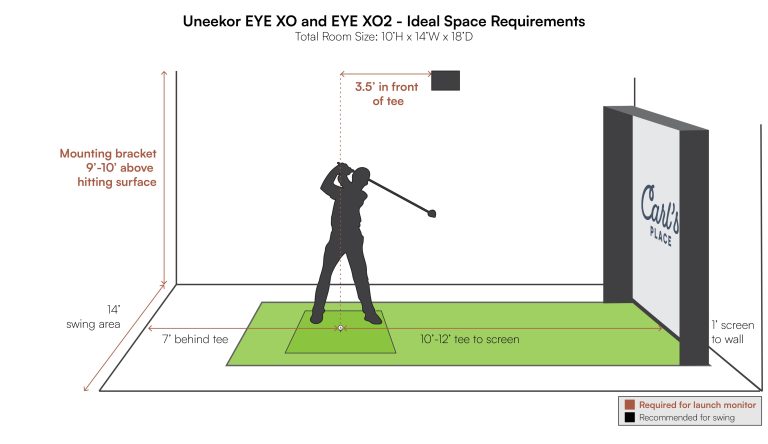
Doppler radar launch monitors must be positioned 6 to 8 feet directly behind the golf ball on the target line. In addition, the ball requires 8 to 10 feet of unobstructed forward flight before impacting the containment net or impact screen. This establishes a required room depth of at least 14 to 18 linear feet. If your indoor room length is under 14 feet, radar tracking will struggle to resolve spin axis, making an optical camera system such as the Rapsodo MLM2PRO the preferred selection.
2. Ceiling Height and Lateral Width Clearances
To safely swing a 45.5-inch driver without striking structural elements, a minimum ceiling height of 9.5 feet is recommended (10 feet for players taller than 6 feet with upright swing planes). The room width should measure at least 10 feet for centered tee positions, or 12 to 14 feet if accommodating both right-handed and left-handed players without sliding the mat laterally.
3. Electronic Noise and Backscatter Elimination
Microwave radar reflections can bounce off exposed concrete walls, steel support posts, metal garage doors, and overhead fluorescent lighting ballasts. To eliminate ghost readings, hang heavy canvas curtains or foam sound-dampening tiles along sidewalls. If you detect intermittent phantom club readings, turn off oscillating fans, space heaters, and fluorescent fixtures operating near the radar antenna path.
Frequently Asked Questions
Do launch monitors under $1,000 measure real spin or calculate it?
Most radar-only units under $1,000 estimate ball spin using complex mathematical algorithms based on launch angle and ball speed unless metallic reflective stickers (RCT balls) are applied. However, camera-assisted units like the Rapsodo MLM2PRO photograph actual dimple rotation to measure true spin directly.
How much indoor room depth is required for a Doppler radar launch monitor?
A standard Doppler radar setup requires a minimum of 14 to 18 linear feet: 6 to 8 feet from the radar unit to the golf ball, plus 8 to 10 feet of clear ball flight from the tee to the impact net.
Are special golf balls necessary for indoor launch monitor practice?
For Doppler radar units like the Garmin R10 and FlightScope Mevo, Titleist RCT golf balls containing internal radar-reflective foil patterns drastically improve spin accuracy indoors. For the Rapsodo MLM2PRO, Callaway RPT balls with high-contrast dots are required for visual optical spin capture.
Can these launch monitors connect to virtual simulator software?
Yes. The Garmin R10, FlightScope Mevo+, Rapsodo MLM2PRO, and Swing Caddie SC4 all integrate with third-party virtual simulator platforms including E6 Connect, Awesome Golf, and The Golf Club 2019 via Bluetooth or Wi-Fi.