
Best Rectangle Trampoline for Gymnastics Training at Home


Looking for the best rectangle trampoline for gymnastics training rather than a general backyard model? Shape matters here more than most buyers expect, and this is also one of the higher-risk purchases in a home gymnastics setup. Here are verified real options across the price range, what the rectangular shape actually changes, and the supervision realities worth being honest about before buying.
A rectangular trampoline, not a round backyard trampoline, is the right shape for gymnastics skill training because its springs and bed produce an even, predictable bounce down the center line instead of pulling a jumper toward the middle. Real options at home-training scale include the ACON X 17ft, the ACON 16 HD, and the SkyBound 10×17, all verified as currently listed products. This is also one of the higher-risk categories in home gymnastics equipment, and no trampoline, rectangular or otherwise, replaces a coached gym environment for learning new skills.
If you’ve read our overview of home gymnastics equipment, you already know this is the category we recommend treating with the most caution: the highest space requirement, the highest price, and the highest injury risk of anything on that list. That doesn’t mean skip it. It means go in with realistic expectations about supervision and what a home trampoline is actually for.
- →Rectangular beds bounce evenly across the whole surface; round beds pull toward the center
- →A 10×17 footprint is the common size for home skill-training use, closer to competition proportions than smaller rectangles
- →Verified options span a wide price range, from roughly $1,200 to over $4,000 depending on frame grade and included accessories
- →This is a higher-risk equipment category; supervision and coaching context matter more here than product choice
- →A trampoline supplements coached training, it doesn’t replace it, especially for learning new skills
Table of Contents
Why rectangle over round for gymnastics specifically
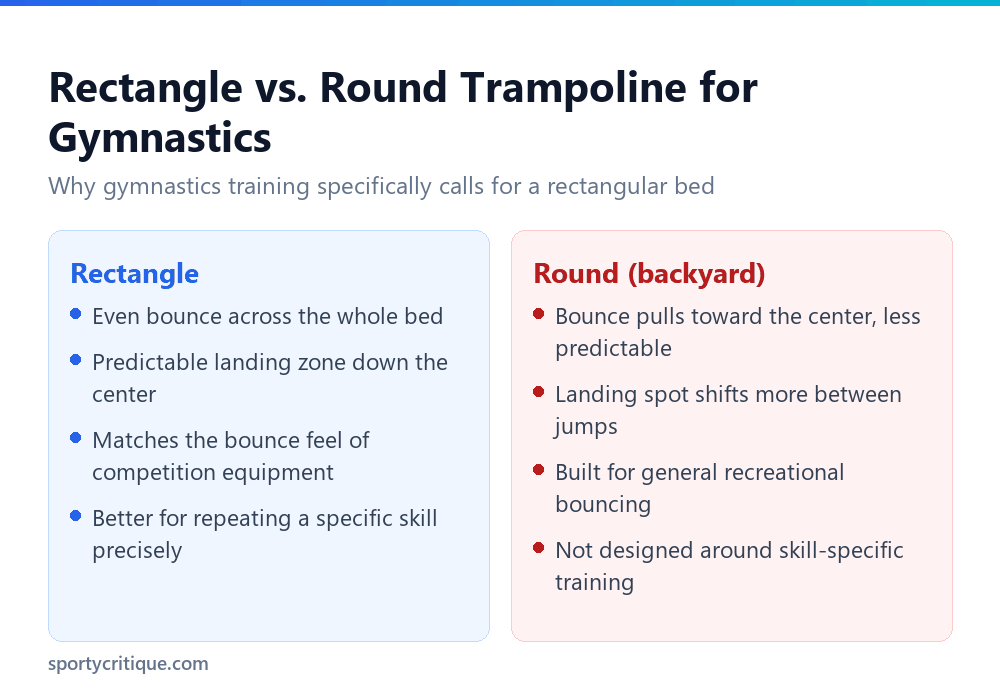
A round trampoline’s springs pull energy toward the center from every direction equally, which is exactly what makes it fun for general bouncing but unpredictable for someone trying to land in the same spot repeatedly while drilling a specific skill. A rectangular bed’s springs are arranged so the bounce stays consistent along the length of the mat, which is why competition trampolines, and the trampolines gymnastics programs actually train on, are built rectangular rather than round. That consistency is the entire reason to pay more for a rectangular trampoline instead of buying whatever round trampoline is cheapest at a big-box store.
This matters more as skill level increases. A beginner bouncing straight up and down barely notices the difference. A gymnast working on a specific twisting or flipping pattern, where landing in a consistent spot with a consistent bounce height is part of the skill itself, notices immediately, and an inconsistent bounce actively works against building that skill safely.
Size: why 10×17 is the common home-training footprint
A 10-foot by 17-foot rectangle is the size that shows up most often in home and small-training-facility trampolines aimed at gymnastics use, and it’s sized that way because it gets reasonably close to the proportions of trampolines used in coached settings without requiring a dedicated facility. Smaller rectangular trampolines exist, including 13×8-foot models, and they work for basic bounce conditioning, but they shrink the usable landing zone in a way that matters once a gymnast is doing anything beyond simple jumps.
⚠️ Watch out: Check ceiling height and surrounding clearance before buying any size. A 10×17 trampoline with a proper enclosure net still needs enough vertical clearance for a real jump height, and enough horizontal buffer around the frame that a jumper landing off-center hits the net or padding, not a wall, fence, or overhanging branch.
Verified options at different price points
The ACON X 17ft Rectangular Trampoline with Enclosure sits at the premium end of this category, listed at $4,099.00 at the time this was written. It’s built around a 17-foot rectangular frame with a full safety enclosure, safety pad, adjustable ladder, and ground anchors included, aimed specifically at gymnastics and advanced trick training rather than general backyard use. At this price, it’s a purchase for a household that’s committed to serious, ongoing skill training, not a casual addition to a backyard.
The ACON 16 HD Rectangular Trampoline, 17×9.8 ft, 140 HD Springs is a step down in price at $2,599.00, still a 17×9.8-foot rectangular frame from the same manufacturer, with 140 heavy-duty springs and a reinforced steel frame rated to 1,650 pounds. It’s a reasonable middle option if the full ACON X package’s accessories aren’t necessary but the frame quality and bounce consistency still matter.
The SkyBound Rectangular Trampoline with Enclosure Net, 10×17 FT is the most accessible verified option here at $1,199.99, a true 10×17-foot rectangular bed with an enclosure net and a reinforced welded base. It won’t match the spring count or frame rating of the ACON models, but it’s a legitimate rectangular training trampoline at roughly a third of the ACON X’s price, and a sensible starting point for a household that isn’t ready to commit four figures to this category.
The Happy Trampoline Pro Rectangle Trampoline, 750lbs Capacity rounds out the options, rated to a 750-pound jumping capacity with a full net enclosure. Amazon didn’t return a current listed price for it at the time of writing, so check the live listing directly before comparing it against the priced options above.
💡 Pro tip: Buy the enclosure net as a non-negotiable, not an optional add-on. All four models above include one, and that’s not a coincidence, an unenclosed trampoline used for skill training, where jumpers are deliberately attempting rotations and off-center movement, meaningfully raises the odds of a fall off the bed entirely.
Real safety notes, stated plainly
Trampolines are a genuinely higher-risk category of home sports equipment than mats, beams, or grips, and that’s true whether the bed is round or rectangular. Household trampoline injuries are common enough that pediatric and orthopedic guidance regularly recommends adult supervision for any home trampoline use, and a rectangular gymnastics-oriented trampoline doesn’t remove that risk just because the shape is more purpose-built. If anything, the skills a rectangular trampoline is designed to support, twists, flips, precision landings, carry more injury risk per attempt than simple vertical bouncing on a round backyard model.
None of this means a home trampoline can’t be used well. It means the honest framing is: a supervised tool for reinforcing skills already introduced by a coach, not a place to attempt something new and unsupervised because the trampoline happens to be in the backyard. If a specific skill hasn’t been cleared by a coach for unsupervised repetition, the trampoline is the wrong place to try it for the first time, regardless of how good the equipment is.
- ✓Choose a rectangular bed specifically for skill-specific training over a round backyard trampoline
- ✓Confirm ceiling height and surrounding clearance before ordering any size
- ✓Treat the enclosure net as required equipment, not an optional accessory
- ✓Keep supervision in place for every session involving skills beyond basic bouncing
- ✕Buy the largest trampoline you can afford without checking your actual available space first
- ✕Assume a rectangular shape by itself makes the equipment safe to use unsupervised
- ✕Skip the enclosure net to save money on any model in this category
- ✕Let a gymnast attempt an uncoached new skill on a home trampoline before a coach has cleared it
Indoor versus outdoor placement
Most rectangular trampolines at this size are designed and sold as outdoor equipment, and the ceiling clearance a real jump needs rules out an indoor setup for almost any home short of a dedicated gym space with double-height ceilings. Placing one outdoors adds its own considerations: a level, firm surface underneath rather than soft ground that can shift the frame over time, and enough of a clear buffer zone around the whole footprint that nothing overhangs the jumping area, fences, trees, or a nearby patio cover included. Wind exposure is also worth checking; a large rectangular frame with an enclosure net catches more wind than a compact round trampoline, which is part of why ground anchors matter as much as they do.
Who should skip this category entirely
If there isn’t a reliable adult available to supervise every session, or if the household doesn’t have the ceiling height and clear buffer space a 10×17 footprint actually needs, this is a category worth skipping regardless of budget. A mat and, if already coached on it, a low beam cover far more of a beginner or intermediate gymnast’s actual practice needs at a fraction of the cost and risk. A trampoline earns its place once bounce-dependent skills are specifically what’s being worked on and supervision is a genuine, consistent yes, not a sometimes.
Setup and maintenance basics
Ground anchors, included with the ACON X and available separately for other models, matter more for a rectangular frame than people expect, since a large rectangular trampoline catches wind differently than a compact round one and can shift or tip in a strong gust if left unanchored outdoors. Check spring tension and net attachment points at the start of each season if the trampoline lives outside year-round, since UV exposure and temperature swings degrade webbing and spring coating faster than most buyers expect. A frame that’s rattling or springs that have visibly stretched or corroded are reasons to stop using the trampoline until repaired, not cosmetic issues to ignore.
Bottom line
For gymnastics-specific skill training at home, a rectangular trampoline in the 10×17 range is the right shape and size for most households serious enough about this category to buy one at all. The ACON X and ACON 16 HD lead on frame quality and accessories at a real price premium; the SkyBound 10×17 is the more accessible entry point without giving up the rectangular bounce profile that makes this category worth choosing over a round trampoline in the first place. Whichever one you buy, supervision and a coach’s input on what skills are actually ready for home repetition matter more than the spec sheet.
Why is a rectangular trampoline better than a round one for gymnastics?
A rectangular bed’s spring layout produces a consistent bounce down the length of the mat, which supports repeating a specific skill in a predictable landing zone. A round trampoline’s springs pull energy toward the center from every side, which is fine for general bouncing but less predictable for precision skill work.
What size rectangle trampoline is best for gymnastics at home?
10×17 feet is the common size for home skill-training setups, offering a usable landing zone closer to competition proportions than smaller rectangles. Smaller options exist and work for basic conditioning, but they reduce the usable space once a gymnast progresses past simple jumps.
Is a home trampoline safe for gymnastics training?
Only with real supervision and a clear understanding that it supplements, rather than replaces, coached training. Trampolines are one of the higher-risk categories in home sports equipment, and that risk applies to rectangular training-oriented models as much as round backyard ones.
How much does a real gymnastics-training rectangle trampoline cost?
Verified options span roughly $1,200 to over $4,000 depending on frame grade, spring count, and included accessories like enclosure nets and ground anchors. Prices and stock change on Amazon without notice, so check the current listing before comparing options.
As an Amazon Associate, we earn from qualifying purchases through links on this page.


