
Best Gymnastics Equipment for Home: Which Guide Fits You


Searching for the best gymnastics equipment for home usually turns up one-size-fits-all lists that skip the actual question: which category fits your space, budget, and the skill level being coached right now. This page is the overview and decision map; six dedicated guides on this site cover the specific products in each category in full.
🤸 Gymnastics Hub: Explore all 26 skill tutorials, home equipment reviews, and scoring guides in our Complete Gymnastics Resource Hub.
There’s no single “best gymnastics equipment for home”; the right piece depends entirely on which skill you’re practicing, how much floor space and ceiling height you actually have, and your budget. A folding mat is the right starting point for nearly everyone. A balance beam only makes sense once basic beam work is already being coached elsewhere. A trampoline needs the most space and the most supervision. This page is a map to our category-specific guides, plus two starter picks if you just want a reasonable answer without reading six separate articles.
This site publishes separate, detailed buying guides for each category of home gymnastics equipment, mats, beams, trampolines, grips, ankle support, and training clothes, because each one has meaningfully different things to check before buying. This page isn’t a seventh version of any of those guides. It’s the overview that tells you which one to actually go read, based on what you’re trying to solve.
- →Start with a mat before any other category; it’s the cheapest, safest, and most broadly useful piece
- →A balance beam only makes sense once a coach has confirmed the gymnast is ready for unsupervised beam repetition
- →Trampolines need the most floor and ceiling clearance, and carry the highest injury risk of any category here
- →Grips and ankle braces are skill-specific and usually not a first purchase
- →Budget and space, not ambition, should decide which single category you buy first
Table of Contents
The core tradeoff: space, budget, skill level
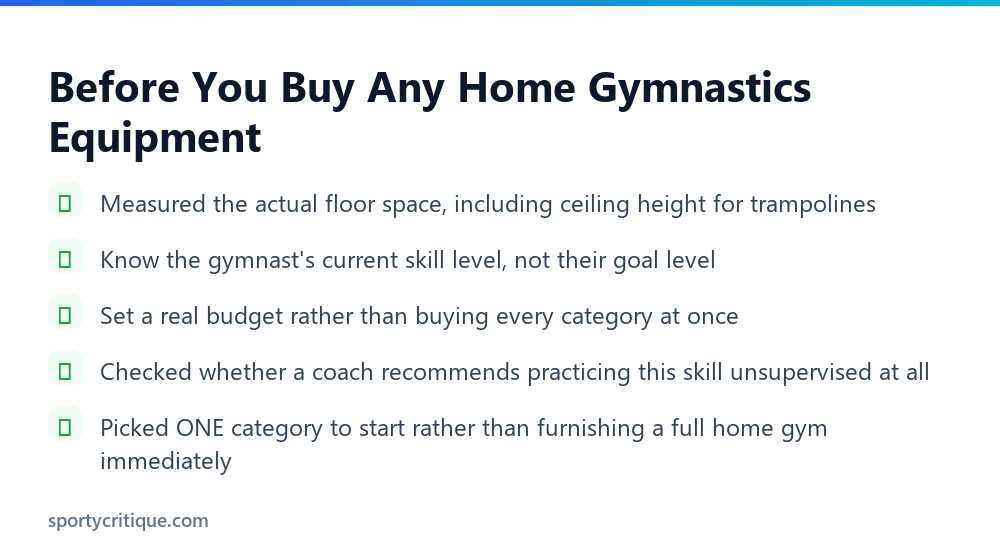
Every piece of home gymnastics equipment trades off against the same three things, and it’s worth being honest about all three before opening a shopping tab. Space isn’t just floor footprint; a trampoline needs overhead clearance most garages and bedrooms don’t have, while a folding mat needs almost none and stores flat against a wall. Budget ranges enormously across categories: a decent mat runs under $60, while a rectangle trampoline built for actual skill training runs into the hundreds. Skill level matters most and gets ignored most often. Buying a balance beam for a gymnast who hasn’t yet been cleared by a coach to drill beam skills without direct supervision doesn’t accelerate progress, it just moves unsupervised risk into the living room.
Mats: the right first purchase for almost everyone
If you’re only going to buy one thing, buy a mat. It cushions landings for basic tumbling and conditioning, gives a gymnast a defined practice zone on a hard floor, and doubles as a stretching surface on days there’s no specific drill planned. It’s also the lowest-risk category here; a mat can’t fail in a way that causes injury the way a poorly assembled beam or trampoline can.
Balance beams: only once beam work is already coached
A low folding beam at home is a real help for a gymnast who’s already drilling beam skills in the gym and wants extra repetition on basics: walks, turns, simple leaps, at a height where a fall means stepping off rather than a real drop. It is not a substitute for coached beam training, and it’s not a place to attempt new skills without a coach’s specific green light. If a gymnast hasn’t reached that stage yet, a home beam mostly sits unused or gets used for skills nobody’s supervising.
Trampolines: highest ceiling, highest risk, highest reward
A rectangular trampoline, not a round backyard trampoline, is the right shape for gymnastics-specific bounce training, since rectangular beds give a consistent, predictable bounce down the center line the way a round bed doesn’t. This is also the category with the most real injury risk of anything on this page, and it should never be framed as a replacement for a coached gym environment. Supervision matters more here than for any other category.
⚠️ Watch out: Don’t buy a trampoline as the first purchase for a beginner gymnast. It’s the equipment with the highest floor-space requirement, the highest price, and the highest injury risk if used without supervision or without the skill level to control basic jumps safely.
Grips, ankle braces, and clothing: skill- and need-specific
These three categories aren’t really “equipment” in the sense of changing what a gymnast can practice at home; they support the body doing the practicing. Grips matter once a gymnast is doing enough bar work that hand tears or grip slippage become a real recurring problem, not before. An ankle brace is for a specific diagnosed issue or a return from injury, not a default purchase. Training clothes matter mainly for fit and range of motion at the hip and shoulder; expensive isn’t the same as functional here.
See Best Gymnastics Grips, Best Ankle Brace for Gymnastics, and Best Clothes for Gymnastics for the specifics on each.
Our two starter picks, if you just want an answer
For most households starting from zero, the BalanceFrom 10×4 Feet 4-Panel Folding Gymnastics Mat is a reasonable, verified starting mat: a 10×4-foot folding panel mat with a vinyl surface and carrying handles, sized enough for basic tumbling and stretching without taking over a room. If a coach has already confirmed the gymnast is ready for home beam repetitions, the FC FUNCHEER 8FT Folding Balance Beam is a straightforward 8-foot folding beam with a wood core and non-slip base that folds down for storage, listed at $49.99 at the time this was written; check the current listing for today’s price, since Amazon pricing changes without notice.
📊 Note: Both picks are examples of what a reasonable option looks like in their category, not a claim that they’re the single best product on Amazon. Read the dedicated category guide linked above if you want a fuller comparison before buying.
What a coach usually checks before recommending home equipment
Coaches who are asked about home equipment tend to check the same few things before answering, and it’s worth running through them yourself first. Is the gymnast asking for extra repetition on something already being drilled in class, or trying to skip ahead to a skill nobody has cleared yet? Is there an adult available to actually watch every session, not just be somewhere in the house? And does the equipment being considered match a real gap, more mat time for landings, more beam reps for confidence, rather than just looking like what a serious gymnast’s home setup should include? A coach’s honest answer is usually narrower than a parent expects, and that’s a useful signal rather than a disappointment.
Buying used versus new
Mats and beams show up reasonably often in local resale listings and gymnastics club surplus sales, and a used mat in decent condition, no tears, no flattened or crumbling foam, is a fine way to save money on the lowest-risk category on this page. Trampolines are the one category worth being more careful about buying used, since spring fatigue and frame stress aren’t always visible on inspection, and a trampoline is already the highest-risk item here even when it’s new and undamaged. If buying used, a beam or mat is a reasonable place to save money; a trampoline is not.
A realistic buying order
If budget forces a choice between categories rather than buying everything at once, mats first, then whichever single category matches the skill currently being coached, beam work gets a beam, bar work with grip problems gets grips, and so on. Trampolines come last unless bounce-dependent skills are the specific, current coaching focus and adult supervision is reliably available every time it’s used. Buying in this order avoids the common mistake of furnishing a home gym around what looks impressive rather than what the gymnast is actually working on right now.
- ✓Buy a mat first if you’re only buying one thing this year
- ✓Match the equipment to the skill currently being coached, not the skill being aimed for
- ✓Confirm ceiling clearance and safety net space before considering any trampoline
- ✓Read the specific category guide before buying; this page is the map, not the destination
- ✕Buy a full “home gym” of six categories at once before knowing which ones get used
- ✕Treat a home beam or trampoline as a substitute for a coached gym environment
- ✕Assume the most expensive option in a category is automatically the safest or best-fitting one
- ✕Skip supervision on a trampoline because the gymnast “already knows how to bounce”
How this hub relates to the category guides
Each linked guide on this page goes deep on one category: specific products, thickness or size comparisons, and the kind of detail that only matters once you’ve already decided a category is the right one for your situation. This page exists because that decision, which category first, gets skipped over in most buying guides, which jump straight to product comparisons and assume the reader already knows what they’re shopping for. If you already know you need a mat, skip ahead to that guide directly. If you’re not sure yet, the sections above are the actual starting point.
Bottom line
There isn’t one best gymnastics equipment for home; there’s a best category for what you’re actually trying to solve right now. Start with a mat, add whatever matches current coaching, and treat a trampoline as the highest-risk, highest-supervision category rather than the default fun purchase. The six linked guides on this page cover the actual product comparisons in each category in the depth this overview intentionally skips.
What’s the single best piece of gymnastics equipment for home?
For most people, a folding mat. It’s the cheapest category, needs the least space, carries the lowest injury risk, and supports the widest range of practice, from stretching to basic tumbling and landings, regardless of skill level.
Is a home balance beam safe for beginners?
A low folding beam is reasonably safe for basic reps once a coach has confirmed the gymnast is ready for beam basics. It’s not the right place to attempt new or unsupervised skills, and it shouldn’t replace coached beam training.
Should I buy a trampoline for gymnastics training at home?
Only if bounce-dependent skills are the current coaching focus, you have real ceiling and floor clearance, and an adult can supervise every session. It’s the highest-risk category on this page and shouldn’t be a first purchase for a beginner.
How much does it cost to set up basic home gymnastics equipment?
A mat alone runs roughly $30 to $90. Adding a beam brings a starter setup to somewhere around $100 to $200 total. A full setup including a rectangle trampoline can run several hundred dollars more, which is why buying by current coaching need, rather than all at once, keeps the cost reasonable.
As an Amazon Associate, we earn from qualifying purchases through links on this page.


