How to Build a Beginner Swim Training Plan

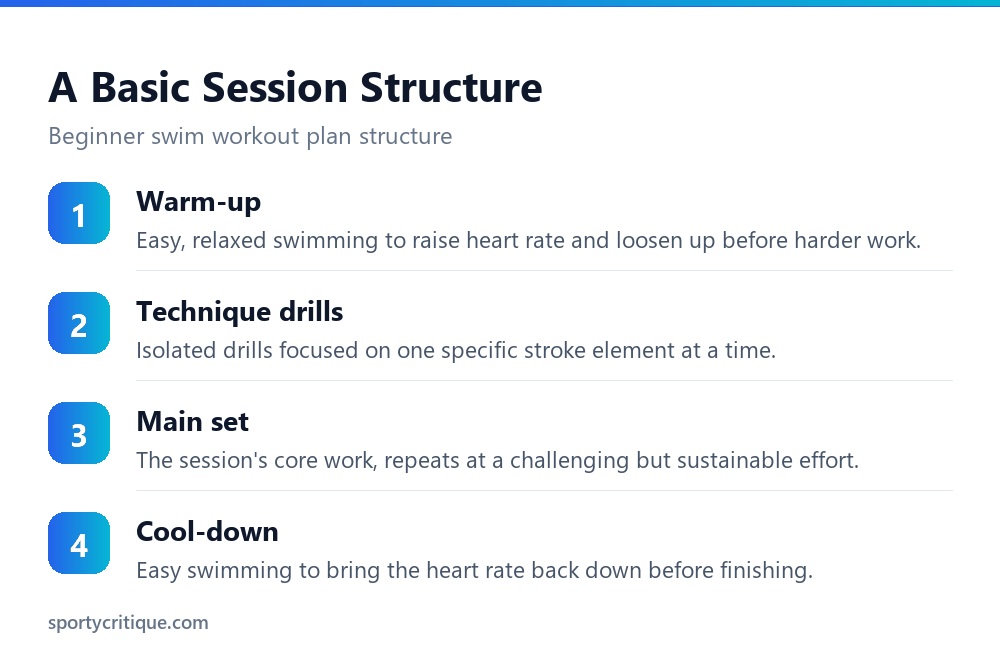
A good beginner swim workout plan typically starts with two to three sessions a week, each structured around a warm-up, technique-focused drills, a main set of repeats at a challenging but sustainable effort, and a cool-down. Total session length usually starts around 30 to 45 minutes for a true beginner, building gradually in both frequency and duration over several weeks rather than jumping straight into a demanding, high-volume schedule that a still-developing swimmer’s technique and endurance aren’t ready to support.
New swimmers often make one of two mistakes: doing unstructured, aimless laps without any real plan, or trying to copy an advanced swimmer’s demanding training volume before their own technique and fitness can support it. A simple, structured beginner plan avoids both problems, building genuine capability progressively rather than either wasting pool time or risking injury and burnout from doing too much too soon.
- →Two to three sessions a week, 30-45 minutes each, is a reasonable starting frequency for beginners
- →Every session should include a warm-up, drills, a main set, and a cool-down
- →Technique drills matter more early on than raw distance or speed
- →Progression should increase gradually, adding volume or intensity, not both at once
- →Rest days between sessions matter as much as the swimming itself for a beginner’s development
Table of Contents
The Four Parts of a Basic Session
A warm-up of easy, relaxed swimming, typically 5 to 10 minutes of mixed or freestyle-focused swimming at a comfortable effort, raises heart rate and loosens the body before any harder work begins, reducing injury risk and improving the quality of the technique work that follows.
Technique drills, isolating one specific element of a stroke, like a single-arm drill for freestyle catch or a kick-only drill using a kickboard, deserve real attention early in a beginner’s development, since raw fitness built on top of flawed technique tends to reinforce inefficient habits that become harder to correct as they compound with growing endurance.
The main set, the session’s core work, might be something as simple as several 50-meter repeats with rest between each one, at an effort that’s genuinely challenging but sustainable across the full set rather than an all-out sprint that leaves a beginner unable to complete the planned volume. A cool-down of easy swimming closes out the session, bringing heart rate back down gradually.
Frequency and Progression
Starting with two to three sessions a week gives a true beginner enough consistency to build real progress while allowing adequate recovery time between sessions, which matters more for a developing swimmer than it might for an already-conditioned athlete adapting to a new sport.
⚠️ Watch out: A common beginner mistake is increasing both training volume and intensity simultaneously, swimming longer sessions at a harder effort all at once, rather than progressing one variable at a time. This combined jump increases injury and burnout risk far more than progressing volume and intensity separately and gradually.
A reasonable progression model adds either duration or a small amount of additional intensity every one to two weeks, not both simultaneously, giving the body time to adapt to each specific increase before layering on the next one. This patient approach produces more sustainable long-term progress than an aggressive, rushed timeline.
Which Stroke to Focus on First
Freestyle is the most common starting stroke for beginner training plans, given its relatively straightforward technique compared to butterfly specifically, and its direct usefulness for general fitness and endurance-focused swimming that most beginners are initially working toward.
Introducing backstroke and breaststroke gradually alongside freestyle, rather than mastering one stroke completely before ever touching another, builds a more well-rounded swimmer and keeps training varied enough to maintain interest and engagement, which matters considerably for long-term consistency, especially for an adult beginner without competitive obligations forcing continued attendance.
💡 Pro tip: Butterfly is generally introduced later in a beginner’s progression, after freestyle, backstroke, and breaststroke fundamentals feel comfortable, given its higher coordination and strength demands relative to the other three competitive strokes.
A Sample Beginner Week
📊 Note: This sample week is a starting template, not a rigid prescription. Adjusting specific days and focuses based on personal schedule, pool access, and how the body responds to the initial weeks of training matters more than following any single sample plan exactly as written.
Common Beginner Training Mistakes
- ✓Structure every session with a warm-up, drills, main set, and cool-down
- ✓Progress volume or intensity one variable at a time, not both simultaneously
- ✓Prioritize technique drills early rather than chasing raw distance immediately
- ✓Take rest days seriously as part of the training plan, not just empty schedule gaps
- ✕Swimming unstructured, aimless laps without any session plan
- ✕Copying an advanced swimmer’s training volume before technique and fitness can support it
- ✕Increasing both duration and intensity together in the same week
- ✕Skipping rest days because more swimming feels like it should always mean faster progress
Tracking Progress as a Beginner
Simple metrics, total distance completed in a session, how a specific main set felt compared to previous weeks, or basic times for a repeated set distance, give a beginner concrete feedback on actual progress without needing elaborate tracking systems or equipment beyond a basic pool clock or personal watch.
Noting technique-related observations, like how a specific drill felt or whether a stroke element that used to feel awkward is starting to feel more natural, matters just as much as numerical metrics for a beginner whose primary early goal is usually building solid technique rather than chasing competitive times.
When to Consider Coaching or Lessons
A self-guided beginner plan like the one outlined here works well for building general fitness and basic comfort in the water, but a beginner specifically struggling with technique issues they can’t self-diagnose, or one preparing for a specific competitive goal, benefits from at least periodic coaching feedback rather than relying purely on self-directed practice indefinitely.
Even a small number of lessons focused specifically on correcting persistent technique issues can meaningfully accelerate progress compared to continuing to self-train around an unaddressed flaw for months, since some technique problems are genuinely difficult to identify and correct without an outside, trained eye watching in real time.
Basic Equipment Worth Having
A well-fitted pair of goggles and a swim cap cover the essential equipment most beginners actually need to get started, with a kickboard and a pull buoy as useful, low-cost additions for the technique drills that isolate specific parts of the stroke discussed earlier in this guide.
Fins can help a beginner still building leg strength and ankle flexibility feel more comfortable with kicking drills specifically, though they shouldn’t become a permanent crutch that prevents a swimmer from eventually developing kick strength without assistance. Introducing fins temporarily during specific drill work, rather than using them for entire sessions indefinitely, keeps this balance reasonable.
Breathing: A Common Early Struggle
Many beginners find breathing coordination, timing an inhale to a specific point in the stroke cycle without disrupting body position or stroke rhythm, one of the most frustrating early hurdles, often more challenging than the arm and leg mechanics of the stroke itself.
Practicing breathing specifically in isolation, standing in shallow water or holding onto a pool wall while practicing the head-turn and inhale motion without the added complexity of a full stroke, helps some beginners build this coordination faster than only practicing it embedded within full-stroke swimming from the very start.
💡 Pro tip: Bilateral breathing, alternating breathing sides rather than always breathing to the same side, is worth introducing gradually once basic breathing coordination feels comfortable, since it builds a more balanced stroke and gives a swimmer flexibility to breathe away from waves, other swimmers, or sun glare depending on the situation.
Transitioning to Open Water Eventually
A beginner plan built entirely in a pool doesn’t automatically prepare a swimmer for open water conditions, waves, current, reduced visibility, and the absence of lane lines or a solid pool bottom for orientation, all of which introduce genuine new challenges beyond pure swimming fitness and technique.
Swimmers planning to eventually swim in open water, for a triathlon or simply recreational lake or ocean swimming, benefit from gradually introducing some open-water-specific practice, ideally with a buddy or in a supervised setting, once pool-based fundamentals feel solid, rather than attempting a first open-water swim as a complete surprise after months of pool-only training.
Basic Nutrition and Hydration for Swim Training
Swimming is easy to underestimate as a calorie and hydration demand compared to land-based exercise, since the water’s cooling effect masks how much a swimmer is actually sweating during a session, but proper hydration before and after training still matters as much as it does for any other form of exercise.
A light, easily digestible snack an hour or so before a session, rather than either training on a completely empty stomach or right after a large meal, generally supports better energy levels through a workout without the digestive discomfort a heavier, more recent meal can cause during swimming specifically.
Staying Consistent and Motivated
Setting small, specific short-term goals, completing a particular set without stopping, or noticing a specific technique improvement, keeps a beginner motivated through the early weeks when overall fitness gains aren’t yet dramatic enough to feel obviously rewarding on their own.
Training with a friend, joining a masters swim program, or simply keeping a basic log of sessions completed all provide the kind of accountability and structure that helps many beginners stick with a new training habit through the weeks when motivation alone isn’t quite enough to guarantee consistent attendance.
Frequently Asked Questions
How many times a week should a beginner swim?
Two to three sessions a week is a reasonable starting frequency, giving enough consistency for progress while allowing adequate recovery time between sessions.
How long should a beginner’s swim session be?
Roughly 30 to 45 minutes total, including warm-up, drills, main set, and cool-down, building gradually longer over several weeks as fitness and technique improve.
Which stroke should beginners focus on first?
Freestyle is the most common starting point, given its relatively straightforward technique and direct usefulness for general fitness. Backstroke and breaststroke are often introduced gradually alongside it.
Why is technique more important than distance for beginners?
Raw fitness built on flawed technique tends to reinforce inefficient habits that become harder to correct later. Prioritizing technique early produces a more solid long-term foundation.
How should I progress my training over time?
Increase either duration or intensity every one to two weeks, not both simultaneously, giving the body time to adapt to each specific increase before adding the next one.
Do I need a coach to follow a beginner swim plan?
Not necessarily for general fitness goals, but periodic coaching feedback helps significantly with persistent technique issues that are difficult to self-diagnose without an outside, trained eye.
A structured beginner swim plan doesn’t need to be complicated to be effective. Consistent frequency, a repeatable session structure, patient progression, and attention to technique over raw volume cover the fundamentals that actually determine how quickly and safely a new swimmer improves.
None of this needs to be perfect from the first week. Adjusting the plan as real feedback comes in, from the body, from the calendar, and from how a given week actually went, matters more than sticking rigidly to any single template written before a swimmer has even gotten in the water.
As an Amazon Associate, we earn from qualifying purchases through links on this page.