How to Clean White Tennis Shoes (And Stop Them Yellowing)

Quick Answer: Make a paste of baking soda and a little hydrogen peroxide, scrub it into the uppers in small circles with a toothbrush, let it sit and dry for 30 minutes, then rinse. Use a melamine sponge on rubber soles. And avoid the two things that yellow white shoes permanently: chlorine bleach and drying them in the sun.
White shoes make two promises. They look brilliant for about a week, and they hold a grudge against every surface you walk on. Keeping them white isn’t one trick — it’s the right method for the material, the right paste for the stain, and knowing which ‘cleaning’ habits are quietly destroying them. All three below.
Table of Contents
Why white shoes go yellow (the part that explains everything)
This is the bit no cleaning guide covers, and it’s why so many people ‘clean’ their shoes into a worse state than they started.
White shoes don’t get dirty and then yellow. Those are two entirely separate problems. Dirt sits on the surface and comes off. Yellowing is a chemical change in the material itself — the polyurethane in midsoles, the adhesives in the construction, and the synthetic components of the upper all oxidise over time. Oxidation turns them cream, then yellow, then amber, and it happens from the inside of the material outward.
That distinction matters enormously, because it means scrubbing harder does nothing for yellowing. You cannot remove a colour change from within the material with a brush. What you can do is slow the oxidation down, and avoid the two things that dramatically accelerate it.
It also explains the cruellest fact about white shoes: a pair sitting unworn in a box will still yellow. Time and air are enough. Sneaker collectors have known this for decades, which is why the shoe you ‘saved for good’ looks worse than the one you wore.
The two things that yellow white shoes permanently
⚠️ 1. Chlorine bleach. This is the counter-intuitive one that gets people. Bleach reacts with polyurethane and the synthetic adhesives in shoe construction, and the reaction leaves a cream-yellow tint you cannot wash out. You reach for bleach because the shoes look dingy; you end up with shoes that are permanently the colour of weak tea. If you must use a bleach on canvas, use oxygen bleach — a completely different chemistry — diluted in water.
⚠️ 2. Sun-drying. UV light drives the oxidation reaction directly, and any residual detergent left in the fabric accelerates it further. So the instinct to ‘dry them in the sun to get them really white’ does precisely the opposite: it’s the single fastest way to yellow a freshly cleaned white shoe. Always air dry indoors.
Between them, these two account for most ‘my shoes went yellow after I cleaned them’ stories. The cleaning didn’t fail — the method did.
The baking soda method (your default)
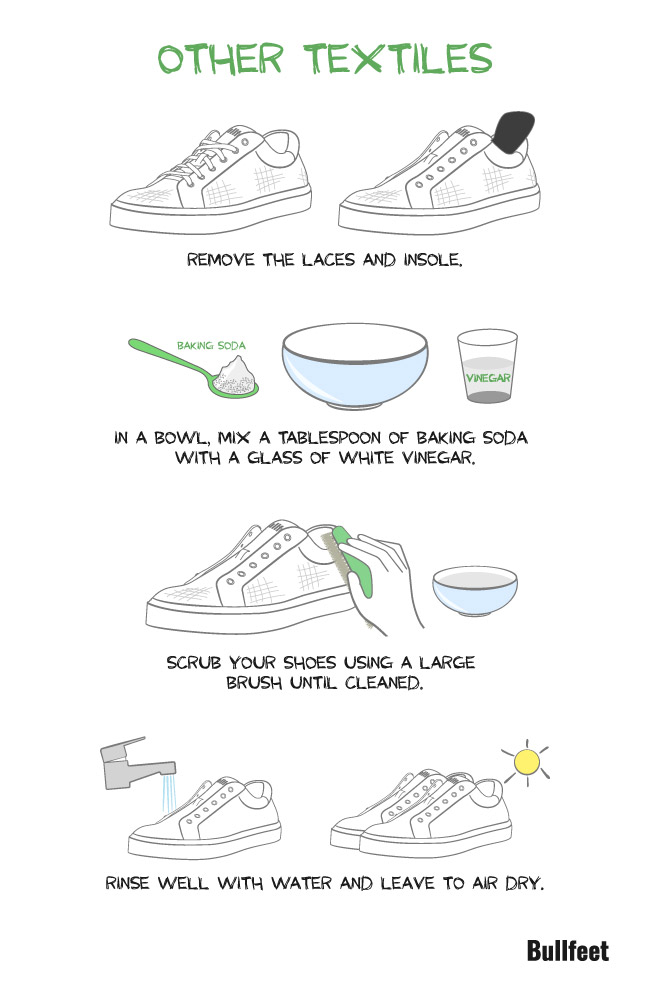
- Laces off. Wash them separately — in the leftover paste water, or in the machine inside a sock. Grey laces make clean shoes look dirty, and it’s the highest-impact five minutes of the whole job.
- Mix the paste: roughly two parts baking soda to one part hydrogen peroxide, into a spreadable consistency. No peroxide? Baking soda and water works, just less powerfully.
- Dry-brush the shoe first to knock off loose dirt. Wet dirt smears and sets — this step is not optional.
- Work the paste in with an old toothbrush, small circles, focusing on scuffs and stained areas.
- Let it sit and dry for 30 minutes. This is where the lifting actually happens. Rinsing early wastes the whole effort — the paste needs to dry to pull the grime out with it.
- Rinse with clean water, blot with a cloth, and air dry indoors, stuffed with white paper.
💡 Stubborn rubber soles and toe caps need a different tool. A melamine sponge (magic eraser) removes scuffs from rubber that no paste will touch — it’s mildly abrasive at a microscopic level and it is genuinely remarkable on white midsoles. Just keep it off the fabric uppers, where that same abrasiveness fuzzes the material.
Match the method to the material
| Material | Best approach | Avoid |
|---|---|---|
| Canvas | Baking soda paste; oxygen bleach soak for overall dinge | Chlorine bleach |
| Leather | Dish soap on a damp cloth, then white shoe cream/polish | Soaking, abrasive pastes |
| Mesh / knit | Diluted dish soap, soft brush, patience | Hard scrubbing — it fuzzes and pills |
| Rubber soles & toes | Melamine sponge, then paste | Nothing much — rubber is tough |
| Suede (white) | Suede brush and eraser only — no water | Everything wet |
Leather deserves a note most guides skip: after cleaning, condition it. Cleaning strips the oils that keep leather flexible, and stripped leather cracks. A white shoe cream both conditions and restores colour, which is why leather whites can be brought back from a state that would finish a canvas pair. General washing technique for all materials is in our main shoe cleaning guide.
Yellowed soles: the hard case
Fabric yellowing you can often prevent. Sole yellowing is a different beast — it’s the rubber and midsole foam oxidising, and by the time you notice it, the chemistry has already happened inside the material.
What works on surface oxidation of rubber outsoles and toe caps: a hydrogen peroxide paste, applied thickly, covered with plastic wrap and left for a few hours in indirect light. Repeat as needed. It’s slow, it’s fiddly, and it recovers a genuine amount of the original white.
What doesn’t work: anything, on deeply yellowed midsole foam. Sneaker collectors use salon-strength peroxide treatments (sometimes called ‘sole sauce’) with UV lamps to reverse deep oxidation, and the results range from impressive to catastrophic — the process can bleach unevenly, damage adjacent materials, or make the foam brittle. It’s a serious undertaking on a collectible, not a Tuesday-evening job on your trainers.
The honest advice for most people: prevent it, don’t chase it. Store shoes away from light and heat, clean them before residue sets, and accept that a heavily-worn white midsole will eventually go cream. That’s the material aging, not you failing.
Stains on white: each one needs a different answer
White shows everything, and the instinct is to attack every mark the same way. That’s how people set stains permanently — several of the most common ones get worse with the default approach.
| Stain | The right move | The mistake people make |
|---|---|---|
| Mud | Let it dry COMPLETELY, brush it off, then wash | Attacking it wet — smears it deep into the weave |
| Grass | Dish soap + a little white vinegar, blot | Scrubbing — grass is a dye, you’ll spread it |
| Oil / grease | Cornstarch or baby powder overnight to absorb, then wash | Water first — oil and water genuinely don’t mix |
| Blood | Cold water only | Hot water — it cooks the protein and sets it forever |
| Coffee / soda | Blot immediately, then dish soap | Letting it dry — sugar caramelises into the fibre |
| Ink | Dab with rubbing alcohol on a cotton bud | Rubbing — spreads it into a larger stain |
| Red clay | Dry brush thoroughly first, then damp cloth | Washing it in — it dyes white uppers orange, permanently |
The pattern across all of them: time and temperature matter more than effort. Mud wants patience. Blood wants cold. Oil wants an absorbent. Almost nothing wants aggressive scrubbing, and everything wants to be dealt with before it dries. The single best stain technique is dealing with it the same evening.
Can you machine wash white shoes?
If they’re canvas or sturdy mesh, yes — with the same rules as any shoe, plus one white-specific addition.
Laces and insoles out, shoes in a mesh bag or knotted pillowcase, two or three towels in the drum for ballast, cold water, gentle cycle, liquid detergent, no fabric softener. The white-specific part: add a scoop of oxygen bleach to the wash if the shoes are generally dingy rather than spot-stained. It brightens without the yellowing reaction chlorine causes.
What the machine won’t do is fix yellowing, because yellowing isn’t dirt — it’s the material itself having changed. If your shoes come out clean and still cream-coloured, that’s not a failed wash. That’s the shoe telling you what it is now.
⚠️ Leather, faux leather and suede never see a machine, whatever colour they are. And nothing at all goes in the dryer — heat warps soles, melts adhesive, and shrinks uppers. A washed shoe needs 12–24 hours of indoor air drying, which is the real reason to wash them on a Sunday and not a Friday.
Prevention beats whitening, every time
Everything above is damage control. This is the part that actually keeps shoes white:
- Protector spray on day one. Hit new (or freshly cleaned) white shoes with a fabric/leather protector. It creates a barrier that makes dirt sit on the shoe instead of soaking into it — which means a wipe removes what would otherwise become a stain.
- Wipe them the same day. Thirty seconds with a damp cloth on the evening you got them muddy saves the 45-minute deep clean next month. Dirt that dries in is dirt that’s bonded.
- Store them out of light and heat. UV and warmth are what drive oxidation. A closet beats a windowsill by years.
- Rotate pairs. Shoes worn daily never dry out fully, and permanently damp materials degrade faster.
- Replace the laces. The cheapest way to make an old white pair look reborn — and new laces cost less than a coffee.
Knowing when to stop
An honest section, because most shoe-care advice pretends every pair can be resurrected.
There’s a point where a white shoe has aged past cleaning, and recognising it saves you an afternoon and a bottle of peroxide. The signs: the midsole foam has gone uniformly cream right through rather than on the surface; the upper has yellowed in the areas that never touch the ground (which means oxidation, not dirt); or the material has that slightly stiff, papery feel that means the polymer itself has degraded.
At that point, the shoe isn’t dirty. It’s old. You can spend three hours and a peroxide treatment recovering perhaps 20% of the original white, or you can accept that white shoes are a consumable — which is what they’ve always been, and what everyone selling you cleaning products would rather you didn’t dwell on.
The reframe that helps: a white shoe’s lifespan is measured in how long it stays white, not how long the sole lasts. Buy accordingly. If you want a shoe that looks good for three years, buy one in a colour that hides age. If you want white, budget for replacing it and enjoy the year it looks incredible. Neither choice is wrong; pretending white is permanent is.
What never touches white shoes
| Never | Why |
|---|---|
| Chlorine bleach | Reacts with polyurethane — permanent yellow tint |
| Sun-drying | UV drives oxidation; residual detergent accelerates it |
| The dryer | Heat warps soles, melts adhesive, shrinks uppers |
| Newspaper stuffing | Ink transfers into damp white fabric. Use plain white paper |
| Hot water | Sets stains and softens glue |
| Wire brushes | Shreds fabric; you can’t un-shred it |
Frequently asked questions
Does toothpaste really whiten shoes?
Plain white paste works passably in a pinch — it’s mildly abrasive, essentially a weak baking soda paste. Gel doesn’t work at all, and coloured stripes can tint light fabric. It’s a hack, not a method.
How do I whiten yellowed soles?
Surface oxidation on rubber responds to a peroxide paste under plastic wrap, left a few hours in indirect light. Deep midsole yellowing is essentially permanent without the risky salon-strength treatments collectors use.
Can white laces go in the washing machine?
Yes — in a sock or mesh bag with regular detergent. Or just replace them; it’s the cheapest possible refresh.
Why did my shoes yellow after I cleaned them?
Almost certainly bleach or sun-drying. Both cause chemical yellowing that no amount of further cleaning reverses. It’s the most common self-inflicted shoe injury there is.
Do white shoes yellow even if I never wear them?
Yes. Oxidation happens with time and air alone — which is why the pair you saved for a special occasion looks worse than the pair you actually wore. Store them cool and dark to slow it, but you can’t stop it.
Is oxygen bleach safe on white canvas?
Yes, diluted, for an occasional soak on overall dinginess. It’s completely different chemistry from chlorine bleach and it doesn’t cause the yellowing reaction.
How often should I clean white shoes?
Wipe after any dirty wear; deep clean when they need it rather than on a schedule. Over-cleaning wears the material faster than the dirt does — and every wash is a chance to make one of the two permanent mistakes.