Volleyball Double Contact and Lift Violations: What’s Actually Legal

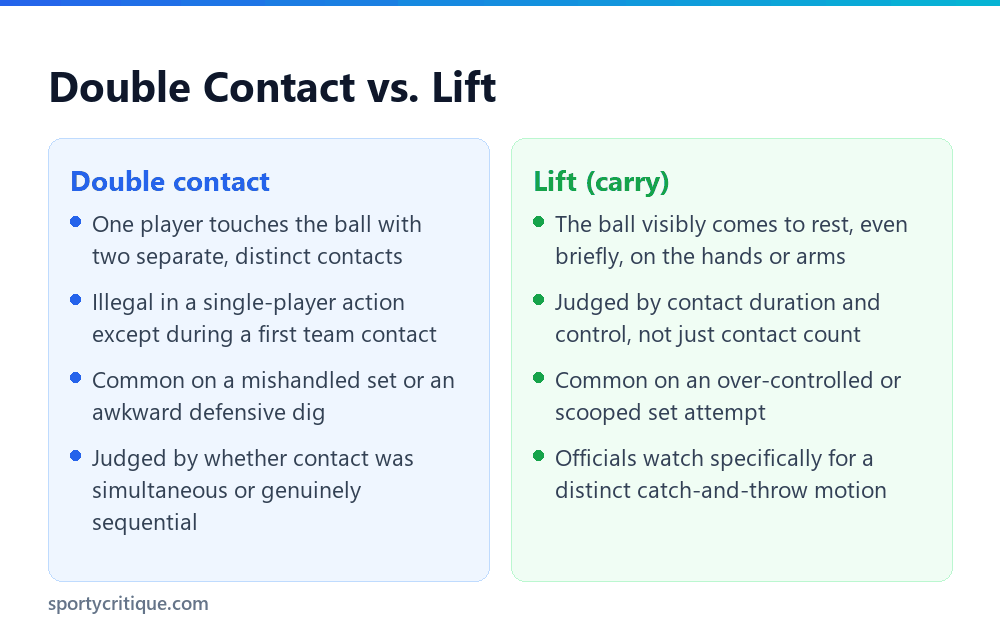
The volleyball double contact lift rule works like this: a double contact fault occurs when a single player contacts the ball twice in succession during what should be one playing action, illegal except during a team’s first contact after certain plays like a block touch or a hard-driven attack. A lift, or carry, occurs when the ball visibly comes to rest, even briefly, on a player’s hands or arms rather than being cleanly hit, judged by contact duration and control rather than contact count alone. Both faults get more leeway on defensive digs and blocks than on a controlled set, where officials expect cleaner, more precise contact.
These two faults are among the most subjectively judged calls in volleyball, since both depend on split-second timing and contact quality that even trained officials sometimes disagree on in borderline situations. Understanding what officials are actually watching for clarifies why some seemingly similar contacts get called while others don’t.
- →A double contact is two separate touches by one player during a single playing action
- →A lift is judged by contact duration and control, not simply how many times the ball is touched
- →Blocks and hard-driven defensive digs get more leeway than a controlled set attempt
- →A double contact during a team’s legal first contact is allowed in many rule sets
- →Officials watch for a distinct catch-and-throw motion specifically to identify a lift
Table of Contents
What Counts as a Double Contact
A double contact happens when a single player touches the ball twice in immediate succession during what’s meant to be one continuous playing action, most commonly on a mishandled set where the ball contacts one hand slightly before the other, or bounces awkwardly off the fingers before a second, separate contact occurs.
⚠️ Watch out: A common misunderstanding is that any two-handed contact where the ball doesn’t touch both hands at the exact same instant automatically counts as a double contact fault. In practice, officials judge whether contacts were genuinely sequential and separate, not whether they were microscopically simultaneous, which allows for normal, legal hand-setting technique.
Most rule sets specifically allow a double contact during a team’s first contact of a rally, following certain plays like a hard-driven attack or a block touch, recognizing that a defender reacting to a fast, unpredictable ball needs more contact leeway than a player making a controlled, deliberate set.
What Counts as a Lift or Carry
A lift, sometimes called a carry, occurs when the ball visibly comes to rest, even momentarily, on a player’s hands or arms, rather than being cleanly and immediately redirected through contact. This is judged primarily by contact duration and visible control rather than by how many times the ball technically touches the player.
A set with proper technique, hands positioned to redirect the ball through a brief, clean contact, differs from a lift specifically in how long the ball actually stays in contact with the hands and whether that contact shows a distinct “catching and throwing” quality rather than a quick, deflecting touch.
💡 Pro tip: Watching high-level volleyball specifically for the difference between a clean set and a borderline lift call helps develop an eye for this distinction, since the difference is often quite subtle and easier to recognize through repeated observation than through a purely verbal rule description alone.
Why Setting Gets Stricter Scrutiny Than Digging
A controlled set, typically a slower, more deliberate action where a player has time to position properly, is held to a stricter standard for both double contact and lift calls than a fast, reactive defensive dig against a hard-driven ball, where officials recognize a defender has far less control over exact contact quality in that split-second reaction.
This distinction reflects a practical officiating philosophy: penalizing a defender for imperfect contact on a ball traveling too fast to control precisely would make defensive play nearly impossible, while a set, happening at a controlled pace with more setup time, reasonably can and should meet a higher standard for clean, legal contact.
Common Double Contact and Lift Confusions
- ✓Understand that double contact is about sequential, separate touches, not microscopic timing
- ✓Recognize that a lift is judged by contact duration and control, not contact count
- ✓Expect stricter scrutiny on a controlled set than on a fast defensive dig
- ✓Know that first-contact leeway applies specifically after certain plays like a hard attack
- ✕Assuming any two-handed contact automatically counts as an illegal double contact
- ✕Judging a lift purely by whether the ball touched the hands more than once
- ✕Expecting the same contact standard on a defensive dig as on a controlled set
- ✕Assuming double contact leeway applies to every single team contact regardless of context
Blocking and Double Contact Leeway
A block is treated as a distinct action from a player’s individual contact count for the purposes of counting a team’s three allowed hits per rally, and multiple touches during a single blocking action by one or more blockers at the net are generally not counted as a fault or against a team’s contact count the way a double contact elsewhere on the court would be.
This blocking-specific rule exists because a block often involves rapid, nearly simultaneous contact from multiple points on one or more players’ hands and arms as the ball is intercepted at the net, a physically different situation from a single player double-touching the ball during a standard set or dig elsewhere on the court.
How Officials Actually Make These Calls
Officials watching for these specific faults position themselves to observe contact quality closely, particularly during sets near the net where these calls happen most frequently, since borderline lift and double contact situations are quite difficult to judge accurately from a poor viewing angle or excessive distance.
At higher levels of play with video review available, these specific calls are among those eligible for review given how often they’re actually close, split-second judgment situations even for an experienced, well-positioned official. Lower levels without review technology rely entirely on the official’s real-time judgment, which is part of why these calls sometimes generate more disagreement at recreational or youth levels.
Leeway on Serve Reception
Passing a serve, similar to a hard-driven attack, often receives similar contact leeway to defensive digs, since a serve can arrive with significant speed and spin that makes perfectly clean, single-contact reception truly difficult even for a well-positioned, skilled passer.
This leeway doesn’t mean serve reception has no standard at all; an obvious, extended carry on a serve reception still draws a fault call, but the threshold for what counts as an illegal double contact or lift shifts somewhat compared to the stricter standard applied to a controlled, second-contact set.
How These Rules Have Changed Over Time
International volleyball’s governing rules have loosened contact standards somewhat over past decades specifically for double contact and lift calls, reflecting a broader officiating philosophy shift toward allowing more natural ball-handling variation rather than penalizing every minor technical imperfection in contact.
Older officiating standards, particularly from decades past, were notably stricter about setting technique specifically, calling faults on contact that would likely be allowed under current standard interpretations. A player or fan familiar only with older rule descriptions should update their expectations to match how these calls are actually made under current standards.
Coaching Technique to Avoid These Faults
Coaches teaching proper setting technique emphasize quick, symmetric hand contact and immediate ball release, since this technical foundation naturally avoids both double contact and lift faults far more reliably than a player consciously trying to avoid these specific calls during live play without solid underlying mechanics.
Video review of a player’s own setting technique, watching specifically for asymmetric hand timing or extended ball contact, helps identify a technical habit that might be drawing borderline calls even when a player doesn’t feel they’re doing anything wrong during the actual motion itself.
💡 Pro tip: Practicing sets against a wall or with a partner specifically focused on contact speed and symmetry, rather than only practicing in live gameplay, isolates and corrects the specific technical habits most likely to draw these particular fault calls.
Handling Disputed Calls
Given how subjective these calls actually are, even among trained officials, accepting a close call gracefully rather than disputing every borderline decision reflects better sportsmanship and keeps the pace of play moving, particularly at levels without video review available to settle a truly close situation definitively.
Team captains are typically the only players permitted to formally question a call with an official, and even then, most officiating standards expect this to happen respectfully and briefly rather than as an extended argument over a judgment call that ultimately comes down to the official’s real-time read of a fast, close situation.
Frequently Asked Questions
Is any two-handed set automatically a double contact fault?
No. Officials judge whether the two contacts were truly sequential and separate, which allows for normal, legal hand-setting technique rather than penalizing every non-simultaneous two-hand touch.
What’s the actual difference between a lift and a legal set?
Contact duration and visible control. A lift shows the ball coming to rest, even briefly, with a catching-and-throwing quality, while a legal set redirects the ball through a brief, clean contact.
Why do defensive digs get more contact leeway than sets?
Because a defender reacting to a fast, hard-driven ball has far less control over exact contact quality than a player making a controlled, deliberate set with more setup time.
Does a double contact during a block count against my team?
Generally no. Blocking contact, including from multiple players or multiple touch points during a single blocking action, is treated differently from a standard double contact fault elsewhere on the court.
When is a double contact actually allowed?
During a team’s legal first contact following certain plays, like a hard-driven attack or a block touch, in most standard rule sets.
Why do these calls seem inconsistent between different officials?
Both faults involve highly subjective, split-second judgment even for experienced officials, which is why video review is available for these specific calls at higher levels of competitive play.
Players benefit from the same understanding just as much as spectators and officials, since knowing exactly where the line sits helps a setter push their technique right up to that boundary with confidence, rather than playing overly cautiously out of uncertainty about where exactly a specific call is likely to land in a given match or level of competition.
Understanding that both double contact and lift calls depend on context, contact timing, and control quality, not simple, absolute rules about touch count, explains why these calls can look inconsistent to a casual observer while making sense to an official trained specifically on these distinctions.
Watching a full match with these distinctions specifically in mind, rather than reading the rules once and expecting immediate fluency, is the fastest practical way for a new player, coach, or fan to build a genuinely reliable feel for how these calls actually get made in real time.
None of this requires memorizing an exhaustive legal text; the underlying logic, context and control matter more than a rigid count of touches, carries through every specific situation covered in this guide and applies just as consistently whether watching a casual recreational match or a nationally televised professional one.
That consistency, once it clicks, is what turns a source of frustration for new players and spectators into just another well-understood, predictable part of how the sport actually works, call after call, match after match, on any court from a school gym to a stadium.
As an Amazon Associate, we earn from qualifying purchases through links on this page.