Best Outdoor/Grass Volleyball: Weather-Resistant Picks Compared

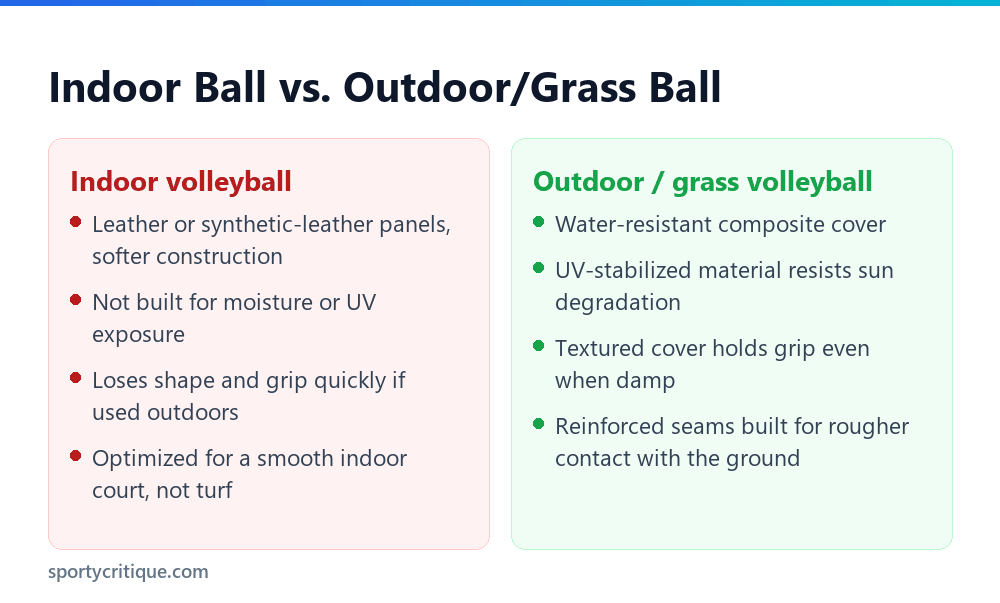
The best outdoor volleyball for grass has a water-resistant composite cover, UV-stabilized material, and reinforced seams built to handle repeated contact with dirt, grass, and moisture without losing shape or grip. An indoor leather ball isn’t a safe substitute; it degrades quickly outdoors. Four real outdoor-rated balls, from a simple recreational option to the official FIVB beach ball, are compared below.
Grabbing whatever volleyball is already in the garage for a backyard game usually works fine for one afternoon, but a ball not built for outdoor conditions starts showing it fast: the cover picks up grass stains and grit that roughen its surface, moisture gets absorbed into seams not designed to resist it, and UV exposure over repeated use dries out and cracks materials meant to stay indoors under consistent, controlled conditions.
An outdoor or grass-rated ball is built specifically to handle that environment instead of merely surviving it. That distinction matters more for anyone playing regularly outside, a weekly backyard league, a beach trip every summer, a standing Sunday game at the park, than for a single one-off session where any ball on hand will get the job done.
- →Outdoor volleyballs use water-resistant composite covers; indoor leather balls degrade quickly outside
- →UV-stabilized material resists the sun damage that cracks and dries out indoor-rated covers over time
- →Reinforced, raised seams handle repeated ground contact better than a smooth indoor-style seam
- →Official beach balls (like the Mikasa VLS300) work well on grass too, since the construction goals overlap
- →A dedicated recreational outdoor ball is a reasonable, lower-cost choice for casual, infrequent play
Table of Contents
What Actually Makes a Cover Grass-Durable
Three material properties do most of the work. Water resistance keeps the cover, and critically the stitching and seams underneath it, from absorbing moisture from wet grass or morning dew, which over time weakens seams and changes the ball’s weight and balance. UV stabilization slows the sun-driven breakdown that causes indoor-rated synthetic leather to dry out, stiffen, and eventually crack after repeated outdoor sessions. And a textured, slightly grippier surface than an indoor ball’s smoother finish helps maintain control even when the ball has picked up some moisture or dirt mid-game.
Seam construction matters just as much as the panel material itself. Reinforced, raised seams hold up to the repeated ground contact that comes with digs and rolls on grass, where a ball regularly hits dirt, rocks, and uneven turf, conditions an indoor court never puts a ball through.
4 Real Outdoor/Grass Volleyballs, Compared
📊 Note: All four are legitimately outdoor-rated by their manufacturers, not repurposed indoor balls with outdoor marketing added. The differences between them come down to construction quality and intended level of play, from casual backyard use up to official beach competition, more than any single one being unsuitable for grass.
The Mikasa carries the most name recognition and the official FIVB endorsement, which matters if consistency with tournament-standard equipment is a priority. The Tachikara’s raised, reinforced seams are worth a specific look for anyone expecting heavy ground contact from regular diving and rolling, since that construction detail is built precisely for that kind of repeated wear. The two Wilson options serve more casual, lower-stakes use where budget and simplicity matter more than tournament-grade construction.
Beach Ball vs. Grass-Specific Ball: Does It Matter?
Most balls marketed for beach play, including the official FIVB Mikasa VLS300, work well on grass too, since the underlying construction goals largely overlap: water resistance, UV durability, and a grippy outdoor cover matter in both environments. Beach-specific balls sometimes lean slightly softer to reduce hand sting on repeated sand play, which isn’t a problem on grass either, just a design choice rather than a genuine limitation for grass use.
A ball marketed specifically as a “grass” or general “outdoor recreation” ball, rather than a dedicated beach ball, sometimes uses a slightly firmer cover better suited to a harder, more uneven playing surface than loose sand. For most casual and even semi-serious backyard play, either category works fine; the beach-vs-grass distinction on the label matters more to players optimizing for a specific competitive format than to someone setting up a weekend game.
Buying Checklist
- ✓Look for an explicit water-resistant or outdoor rating on the ball, not just a general description
- ✓Check for reinforced or raised seams if regular ground contact (digs, rolls) is expected
- ✓A beach-rated ball works fine on grass; don’t rule one out just because it’s marketed for sand
- ✓Match tier to actual use: casual backyard play doesn’t need a competition-grade ball
- ✕Using an indoor leather ball outdoors regularly and expecting it to hold up
- ✕Assuming any ball labeled “volleyball” is outdoor-rated without checking the material
- ✕Overspending on a competition-tier ball for occasional, casual use
- ✕Ignoring UV exposure as a factor if the ball gets stored outside between uses
Bladder Type: Why It Matters More Outdoors
Every volleyball has an internal bladder, usually butyl or a similar synthetic rubber, that holds air. Butyl bladders hold pressure longer and are less sensitive to temperature swings than cheaper alternatives, which matters more outdoors than indoors simply because outdoor temperature swings are larger and less predictable than a climate-controlled gym.
A ball with a lower-quality bladder can lose noticeable pressure over a single outdoor session as temperatures shift, or between sessions if stored somewhere hot. That’s a separate issue from cover material and seam construction, and it’s worth checking, or at least being aware of, on a budget option specifically, since bladder quality is one of the first places manufacturers cut cost on a lower-tier ball.
💡 Pro tip: Carrying a hand pump and checking pressure before each outdoor session, rather than assuming the ball held its inflation from last time, catches bladder-related pressure loss before it affects play. This matters more for a budget ball than a premium one, though it’s good practice regardless of which tier gets chosen.
Manufacturer specs usually list a recommended pressure range printed directly on the ball itself, and staying within that range rather than guessing by feel keeps the touch consistent session to session. A ball pumped too firm plays fast and stings hands on contact; one left too soft feels mushy and loses accuracy on passes and sets alike.
Size and Weight: Official vs. Recreational Balls
Official-size volleyballs measure roughly 65 to 67 centimeters in circumference and weigh between 260 and 280 grams, a standard shared across indoor, beach, and most outdoor recreational balls marketed for serious or club-level play. Recreational and children’s balls sometimes run smaller and lighter, which makes them easier to control for younger or less experienced players but means they won’t feel consistent with a regulation ball if a player later transitions to organized play.
For anyone using a backyard ball as practice supplementing organized indoor or club volleyball, sticking to official size and weight keeps the touch and feel consistent between the two settings. For purely casual, no-stakes backyard games, especially with younger kids involved, a lighter recreational ball can actually be the more practical, less intimidating choice.
Inflation and Storage Affect Outdoor Durability Too
Temperature swings change air pressure inside any ball, and that effect is more pronounced outdoors where temperature isn’t climate-controlled the way an indoor gym is. A ball inflated correctly in a cool morning can play noticeably firmer by a hot afternoon, and checking pressure before a session, rather than assuming it’s unchanged from last time, keeps play consistent.
Storage matters just as much as the ball’s build quality. Leaving any volleyball, even a well-built outdoor-rated one, sitting in direct sun or a hot car trunk between uses accelerates the exact UV and heat degradation the outdoor-rated material is designed to resist during actual play, not indefinite storage. Bringing the ball indoors or into shade between sessions meaningfully extends its usable life regardless of which of the four above gets chosen.
Rinsing a ball off with plain water after a session on grass or sand, then letting it air dry away from direct sun before storing it, is a simple habit that removes dirt and organic material before it has a chance to work into the cover’s texture over repeated sessions. It takes under a minute and meaningfully slows the gradual roughening that eventually affects every outdoor ball regardless of how well it’s built.
Frequently Asked Questions
Can I use an indoor volleyball outside occasionally?
For a single casual session, yes, it won’t be ruined immediately. Regular outdoor use is where an indoor ball’s lack of water resistance and UV stability becomes a real problem, showing up as a roughened, degraded cover and softened seams within a handful of sessions.
Is a beach volleyball the same as a grass/outdoor volleyball?
They overlap significantly in construction and often work interchangeably. Beach balls sometimes use a slightly softer cover to reduce hand sting on sand, which isn’t a problem on grass either, so a beach-rated ball is generally a safe choice for grass play too.
How long does an outdoor volleyball typically last?
It varies widely with frequency of use and storage habits, but a quality outdoor-rated ball used regularly and stored out of direct sun between sessions commonly lasts multiple seasons, compared to a much shorter usable life for an indoor ball used outdoors regularly.
Do I need a different ball for grass versus sand specifically?
Not strictly. Most outdoor-rated balls perform reasonably on both surfaces, since the core durability requirements (water resistance, UV stability, grip) apply to both environments. A dedicated competition-grade ball for one surface may have minor tuning for that specific surface, but it isn’t a hard requirement for casual or even club-level play on the other.
What bladder type should I look for in an outdoor volleyball?
Butyl or a similar synthetic rubber bladder holds pressure more consistently through outdoor temperature swings than lower-cost alternatives. It’s less visible than cover material on a product listing, but it’s worth checking or asking about on a budget-tier ball specifically.
Is a heavier or lighter volleyball better for outdoor play?
Official weight (roughly 260-280 grams) matches organized indoor and club play, which matters if the outdoor ball doubles as practice for that setting. For purely casual backyard games, especially with kids, a lighter recreational ball is easier to control and less intimidating without meaningfully changing how enjoyable the game is.
None of these four is a bad choice within its intended tier. The real mistake is buying an indoor-only ball and treating it as interchangeable with an outdoor one simply because both are used for the same sport and share roughly the same size and shape. That single decision, outdoor-rated cover versus indoor cover, matters far more to how long a ball lasts than any difference between the four options compared above.
As an Amazon Associate, we earn from qualifying purchases through links on this page.