Wedge Bounce and Loft Explained

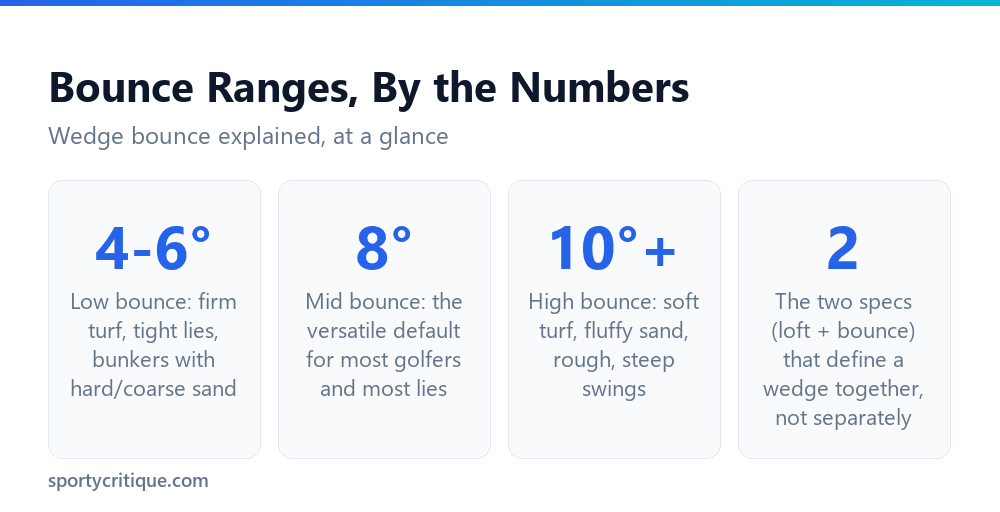
Bounce is the angle between the ground and a wedge’s leading edge when the sole rests flat. Low bounce (4 to 6 degrees) suits firm turf and tight lies, since the leading edge can get to the ball cleanly without the sole skidding. High bounce (10 degrees or more) suits soft turf, fluffy sand, and steep swings, since the extra sole angle keeps the club from digging in. Mid bounce, around 8 degrees, is the versatile default that works reasonably across most lies for most golfers. Loft, separately, determines trajectory and distance; bounce determines how the sole interacts with the turf or sand at impact.
Most golfers pick a wedge by loft alone, a 56-degree sand wedge, a 60-degree lob wedge, without ever checking the bounce number stamped next to it. That’s leaving half the specification unconsidered. Loft controls how high and how far the ball flies; bounce controls whether the club actually makes clean contact with the ball in the first place, on the exact turf and sand conditions a golfer actually plays most often.
- →Bounce is the angle between the ground and the leading edge when the sole rests flat
- →Low bounce (4-6 degrees) suits firm turf, tight lies, and hard or coarse bunker sand
- →High bounce (10+ degrees) suits soft turf, fluffy sand, rough, and steeper swing angles
- →Mid bounce (around 8 degrees) is the versatile default most golfers should start with
- →Too little bounce causes digging and chunked shots; too much causes skidding and thin, bladed contact
Table of Contents
What Bounce Actually Is
Set a wedge down with its sole flat on the ground and look at the leading edge, the front edge of the clubface closest to the turf. On most wedges, that leading edge sits slightly higher off the ground than the trailing edge of the sole behind it. The angle between the ground and that leading edge is bounce, and it’s what determines whether the club’s sole glides through the turf or sand at impact, or digs straight into it.
This matters because the sole, not the leading edge, is what actually contacts the ground first on most properly struck wedge shots. Bounce is what lets that sole interact with the surface the way it’s designed to, deflecting the club slightly upward through impact instead of letting the leading edge catch and dig in.
Low Bounce (4-6 Degrees): Firm Turf and Tight Lies
Low bounce wedges work best on firm fairways, tight lies, and bunkers with hard or coarse sand, conditions where the club needs to get to the ball cleanly without the sole skipping off a hard surface before reaching it. Because there’s less sole angle to deflect the club upward, low bounce rewards a shallow, precise swing more than it forgives a steep or inconsistent one.
Better ball strikers and lower handicaps tend toward low bounce specifically because their contact is more consistent, which lets them take advantage of the precision low bounce offers without paying the penalty of an occasional digging or bladed shot that a less consistent swing would suffer more often.
Mid Bounce (Around 8 Degrees): The Versatile Default
Mid bounce splits the difference, working reasonably across fairway lies, rough, and “fried egg” semi-embedded bunker lies without excelling specifically at any single condition. For most golfers who don’t have a strong reason to go low or high, mid bounce is the sensible starting point, since it doesn’t punish an inconsistent lie or swing pattern the way either extreme can.
💡 Pro tip: If unsure which bounce to buy, mid bounce around 8 degrees is the safer default until enough rounds have been played to identify a clear pattern, like consistently firm home-course turf or consistently soft, wet conditions, that would justify moving toward one extreme or the other.
High Bounce (10+ Degrees): Soft Conditions and Steeper Swings
High bounce wedges resist digging on soft, wet turf and fluffy bunker sand, and they’re generally more forgiving for players with a steeper angle of attack, since the extra sole angle compensates for a swing that would otherwise drive the leading edge into the ground too aggressively. Higher handicap players generally benefit from more bounce, not less, contrary to what the “precision equipment for better players” framing around low bounce might suggest.
This is one of the more counterintuitive parts of wedge fitting: golfers newer to the game, who most need forgiveness on mishit or fat shots, are frequently sold low-bounce wedges because that’s what better players use, when a higher bounce wedge would actually be more forgiving for their specific swing pattern and typical playing conditions.
⚠️ Watch out: Copying a tour player’s exact bounce specification without accounting for swing type or home course conditions is a common equipment mistake. Bounce should match the individual golfer’s attack angle and typical turf and sand conditions, not a specific player’s setup regardless of skill level.
How Loft and Bounce Work Together
Loft and bounce are specified independently of each other, which is why two wedges with identical loft, say, two different 58-degree lob wedges, can play completely differently depending on their bounce and sole grind. A golfer building out a wedge set should think through both numbers for each club, not just the loft gaps between them.
📊 Note: A wedge like the Titleist Vokey SM10 Lob Wedge (58°/10°, S Grind) ($159.99) pairs a 58-degree loft with 10 degrees of bounce and an S grind, a combination built toward players who need extra sole relief around the greens without going to a full high-bounce sand-specific grind. It’s a concrete example of how loft and bounce get chosen as a matched pair for a specific role, not picked independently.
Matching Bounce to Your Game
- ✓Check bounce, not just loft, when buying or fitting a new wedge
- ✓Start with mid bounce if unsure, then adjust based on actual playing conditions
- ✓Match bounce to your typical home-course turf and sand firmness
- ✓Consider a higher bounce if you tend to take deep divots or play steep
- ✕Copying a tour player’s bounce spec regardless of your own swing type
- ✕Assuming low bounce is always the “better player” choice worth chasing
- ✕Ignoring bounce entirely and buying based on loft number alone
- ✕Using one bounce spec across radically different course conditions without reconsidering it
Sole Grind: The Third Variable
Beyond loft and bounce, most premium wedges also come in different sole grinds, shapes cut into specific areas of the sole that fine-tune how the club interacts with turf at different swing angles and face positions. A grind can effectively reduce or increase the functional bounce presented to the ground depending on how the club is set up at address, particularly on shots played with an open face.
This is a more advanced consideration than most golfers need to dig into immediately, but it’s worth knowing it exists, since two wedges with identical stamped loft and bounce numbers can still play noticeably differently if they use different grinds. A full grind, common on more forgiving, general-purpose wedges, presents more of the sole’s bounce consistently; a heel or toe relief grind removes material from specific areas to change how the club performs on shots played with the face opened or closed.
📊 Note: Grind selection matters most to better players who manipulate face angle deliberately for specialty shots. A golfer just starting to pay attention to bounce for the first time gets most of the practical benefit from choosing the right bounce range alone, without needing to evaluate grind options in the same purchase.
Checking What Bounce Your Current Wedges Already Have
The bounce number is typically stamped directly on the sole of the wedge, often alongside the loft number, written as something like “56.10” or “56-10” meaning 56 degrees of loft and 10 degrees of bounce. If it’s not visible or worn off an older wedge, the manufacturer’s website or a golf shop can usually identify the spec from the model and grind stamped elsewhere on the club.
Checking existing wedges before buying a new one prevents accidentally duplicating a bounce spec already in the bag, or creating an awkward gap where two wedges share nearly identical loft and bounce while a meaningful gap sits unaddressed elsewhere in the set. This is a common oversight when wedges get added to a bag one at a time over several years rather than fitted as a complete set from the start.
Swing Type and Attack Angle
Attack angle, how steeply or shallowly the club approaches the ball at impact, is the single biggest factor connecting a golfer’s individual swing to the right bounce choice. A steep attack angle drives the leading edge down into the turf more aggressively, which is exactly the digging tendency higher bounce is built to counteract. A shallow attack angle already approaches the ball at a lower, sweeping angle, which is why it pairs more naturally with lower bounce that doesn’t need to fight against excess digging in the first place.
A launch monitor or a qualified club fitter can measure attack angle directly, which removes the guesswork from this part of the decision. Short of a formal fitting, paying honest attention to divot depth and shape, deep and taking large divots generally signals a steeper attack angle, shallow and skimming signals a shallower one, gives a reasonable starting estimate.
Frequently Asked Questions
How do I know what bounce I need?
Pay attention to your typical misses and course conditions. Chunked, fat shots on soft turf suggest more bounce would help; thin, bladed shots on firm turf suggest less bounce might help. A club fitting can measure attack angle directly for a more precise recommendation.
Can one wedge bounce work for both fairway and bunker shots?
Mid bounce, around 8 degrees, is specifically chosen for this kind of versatility across different lies. Dedicated low or high bounce wedges perform better in their specific conditions but trade away some of that cross-condition flexibility.
Does bounce affect how far the ball travels?
Not directly. Loft is the primary driver of trajectory and distance; bounce affects contact quality and turf/sand interaction. Poor contact from mismatched bounce can indirectly hurt distance and consistency, but bounce itself isn’t a distance specification.
Should every wedge in my bag have the same bounce?
Not necessarily. Many golfers run different bounce specs across their wedge set, often more bounce on the sand wedge for bunker and soft-lie performance and less on a lob wedge meant for precise, controlled shots from tighter lies.
Does sole grind matter as much as bounce for a beginner?
Not as much. Grind fine-tunes how bounce presents itself on specialty shots with an opened or closed face, which matters more to better players manipulating face angle deliberately. A beginner gets most of the practical benefit from choosing the right bounce range first.
Bounce is the specification most golfers skip past entirely when shopping for a wedge, and it’s frequently the one that determines whether a new club actually fixes a chronic problem or just adds another loft option that behaves the same way the old one did.
As an Amazon Associate, we earn from qualifying purchases through links on this page.