How to Swim Breaststroke: Technique Breakdown

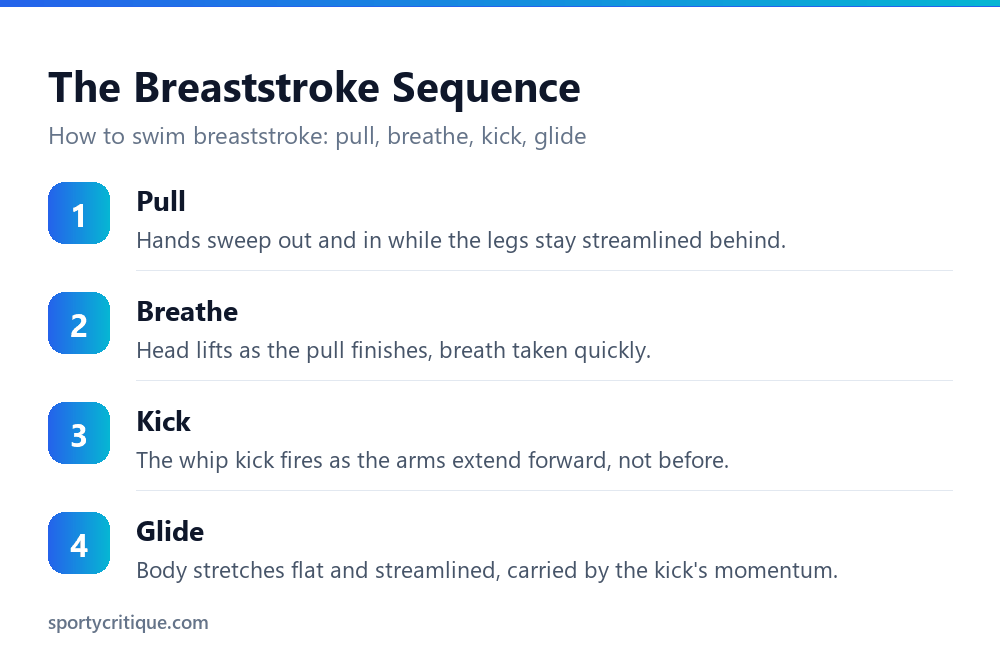
Breaststroke follows a strict sequence: pull, breathe, kick, glide, in that exact order, never overlapping the pull and the kick. The arms sweep out and in while the legs stay streamlined behind, the head lifts to breathe as the pull finishes, the whip kick fires as the arms extend forward again, and the body glides flat and streamlined before the next stroke begins. The most common technical error is pulling and kicking at the same time, which kills momentum instead of building it.
Breaststroke looks simple from the pool deck, slow and rhythmic compared to freestyle’s constant motion, which is part of why so many swimmers underestimate how easy it is to get the timing wrong. The stroke’s entire propulsion depends on never having two body parts working against each other at the same moment, and that discipline is harder to maintain than it looks once fatigue sets in.
- →The sequence is pull, breathe, kick, glide, always in that order, never overlapping
- →The whip kick uses narrow, hip-width knees and a fast circular snap, not a wide symmetrical press
- →Hands should recover forward near the surface after the pull; too high causes the hips to sink
- →The glide phase is where breaststroke actually generates forward distance; cutting it short kills speed
- →One foot turned out and the other turned in (a scissors kick) is illegal in competitive swimming
Table of Contents
The Pull: Four Connected Parts
The arm pull breaks into glide, outsweep, insweep, and recovery. From the streamlined glide position, the hands sweep outward and slightly downward, then reverse and sweep inward and up, which is what lifts the upper body and shoulders out of the water for the breath. The hands then drive forward again, back to the extended glide position, completing the cycle.
⚠️ Watch out: Dropping the elbows during the pull is one of the most common technical faults, and it significantly reduces how much water each stroke actually catches and moves. Keeping the elbows relatively high through the insweep, rather than letting them sink toward the hips, keeps the pull’s propulsive surface working the way it’s meant to.
The Whip Kick: Narrow, Not Wide
The breaststroke kick, often called a whip kick or frog kick, starts by drawing both heels up toward the backside with the knees bent, feet flexed. From there, the legs kick out and around in a fast, circular arc before snapping back together behind the body. The power comes specifically from that fast whipping motion at the end, not from a slow, wide press outward through the whole kick.
A common misconception treats the kick as a wide, symmetrical leg press, similar to a breaststroke-adjacent scissoring motion, when the correct mechanics keep the knees roughly hip-width apart throughout, with the feet turning outward and the real propulsion coming from the fast circular snap at the finish, not the width of the initial outward motion.
📊 Note: A scissors kick, one foot turned out and the other turned in rather than both feet matching, is a specific, disqualifying fault in competitive swimming, not just an inefficiency. Checking that both feet turn the same direction through the kick matters for anyone swimming in any kind of sanctioned or timed event, not just for raw speed.
Timing: Why Pull and Kick Can Never Overlap
The hands should be extending forward into the glide as the legs finish their kick, not before the kick has even started and not while the kick is still in progress. A swimmer whose arms are already pulling back while the legs are still kicking has both limbs working against each other, canceling out propulsion instead of adding to it.
Breathing timing follows the same overlap principle: the breath should happen as one continuous motion with the pull, the head lifting as the insweep finishes, not delayed until after the pull has already completed. Breathing too late disrupts the flow directly into the kick and glide phases that are supposed to follow immediately.
💡 Pro tip: Think of the sequence as a single continuous wave rather than four separate, disconnected actions. Pull flows into breathe, breathe flows into kick, kick flows into glide, each phase beginning as the previous one finishes rather than after a pause. Breaking the stroke down into fully separate, deliberate steps during practice is useful for learning, but the finished stroke should feel like one connected motion.
The Glide: Where the Stroke Actually Moves You Forward
Between the kick and the next pull, the body should stretch out fully horizontal and streamlined: arms extended forward, hands together, legs straight behind, chin tucked toward the chest. This is the position that actually carries the momentum the pull and kick just generated, and it’s the part of the stroke most commonly cut short by swimmers eager to start the next pull.
Rushing through or skipping the glide doesn’t make the stroke faster; it wastes the propulsion just generated by starting the next cycle before the current momentum has been used. A stroke with a full, deliberate glide often covers more distance per cycle than a rushed one, even though the rushed version feels like it’s working harder.
Hand Recovery Height and Hip Position
After finishing the pull, the hands should recover forward staying right near the surface of the water, not lifted high above it. Hands recovering too high force the hips to sink to compensate for the body’s changed weight distribution, which increases drag and undermines the streamlined glide position the whole stroke depends on.
Common Breaststroke Mistakes
- ✓Keep the pull, breathe, kick, and glide phases connected but never overlapping
- ✓Keep knees roughly hip-width during the whip kick, both feet matching
- ✓Recover the hands forward near the surface, not lifted high
- ✓Hold a full, deliberate glide before starting the next pull
- ✕Pulling and kicking at the same time
- ✕Using a wide, symmetrical leg press instead of a fast, narrow whip kick
- ✕Lifting the hands too high on recovery, which sinks the hips
- ✕Rushing or skipping the glide phase to start the next stroke sooner
Isolating the Kick to Fix It
Breaststroke kick drills with a kickboard let a swimmer focus entirely on the whip kick’s narrow, circular mechanics without simultaneously managing the arm pull and breathing timing. A Speedo Swim Training Kickboard ($34.00) held out in front keeps the upper body stable and supported while the legs work through the kick pattern in isolation, which is often where a wide, incorrect kick habit actually gets corrected.
Once the kick feels correct in isolation, reintroducing the arm pull and breathing gradually, rather than immediately combining all three elements at full speed, keeps the focus on maintaining correct kick mechanics through the transition rather than losing the fix the moment the full stroke’s complexity returns.
The Pullout: What Happens Off Every Start and Turn
After a start or a turn, competitive breaststroke swimmers use a specific underwater sequence called the pullout before surfacing into the normal stroke cycle. From a streamlined push-off, a single large pull sweeps all the way back to the hips, followed by a single underwater dolphin kick (legal specifically within the pullout, not the rest of the stroke), then the arms recover forward and a breaststroke kick brings the swimmer to the surface.
This underwater phase is faster than surface swimming for a brief distance, which is why competitive swimmers use it off every start and turn rather than surfacing immediately. Rules limit how far underwater a swimmer can travel before the head must break the surface, so the pullout is a bounded, specific technique rather than an invitation to swim as far underwater as possible.
📊 Note: The single dolphin kick allowed within the pullout is a rules exception specific to that moment; a dolphin kick anywhere else during breaststroke is illegal. Understanding this distinction matters for anyone swimming breaststroke in a timed or sanctioned setting, even casually, since it’s an easy rule to misapply without realizing it.
How Breaststroke Differs From the Other Strokes
Breaststroke is the only competitive stroke with a mandatory glide phase built into its timing, and the only one where the kick and pull are required to happen in strict, non-overlapping sequence rather than continuously and simultaneously the way freestyle and backstroke’s flutter kicks run alongside the arm stroke throughout. That structural difference is exactly why breaststroke timing errors are so common among swimmers coming from a freestyle-first background, where overlapping limb motion is the norm rather than a mistake.
It’s also the slowest of the four competitive strokes at a comparable effort level, a trade-off for the glide-heavy, sequential mechanics rather than a sign anything is being done incorrectly. Comparing breaststroke pace directly to freestyle pace and expecting them to match sets an unrealistic benchmark that has nothing to do with actual technique quality.
Adjustments for Beginners
New swimmers often benefit from learning the kick and the pull as fully separate skills before combining them, since breaststroke’s strict non-overlapping timing is genuinely harder to internalize than freestyle’s more continuous, forgiving rhythm. Kick-only drills with the arms extended in a streamlined position, followed separately by pull-only drills using a pull buoy to remove the kick from the equation, build each half of the coordination challenge independently.
Combining the two prematurely, before either the kick or the pull individually feels automatic, tends to produce exactly the overlapping-limb timing fault that undermines the whole stroke’s propulsion. Patience with this separated, staged approach pays off faster in the long run than rushing straight to full-stroke swimming and hoping the timing sorts itself out through repetition alone.
Frequently Asked Questions
Why does breaststroke feel like it’s not moving me forward?
Pulling and kicking at the same time, rather than in strict sequence, is the most common cause, since the two motions cancel each other out instead of adding together. Cutting the glide phase short is the second most common cause, wasting momentum the kick just generated.
Is the breaststroke kick supposed to be wide or narrow?
Narrow. The knees should stay roughly hip-width apart, with power coming from a fast, circular snap at the end of the kick rather than a wide, symmetrical outward press.
What’s a scissors kick, and why does it matter?
It’s when one foot turns outward and the other turns inward during the kick instead of both matching. It’s a specific, disqualifying fault in competitive swimming, not just an inefficiency, so it’s worth checking for even outside formal competition.
Why do my hips sink when I swim breaststroke?
Recovering the hands too high above the water after the pull is a common cause, since it shifts weight distribution and forces the hips down to compensate. Keeping hand recovery low and close to the surface helps maintain a flatter, more streamlined body position.
Why is my breaststroke so much slower than my freestyle?
That’s expected, not a sign of a problem. Breaststroke’s glide-heavy, strictly sequential timing makes it the slowest of the four competitive strokes at a comparable effort level, a structural trade-off rather than a technique failure.
Is it legal to dolphin kick during breaststroke?
Only once, within the underwater pullout immediately after a start or turn. A dolphin kick anywhere else during breaststroke swimming is illegal in competitive rules.
The stroke rewards patience over raw effort more than any of the other three competitive strokes, which is exactly why the swimmers who look the most relaxed doing it are often the ones actually swimming it fastest.
As an Amazon Associate, we earn from qualifying purchases through links on this page.