How to Fix a Foosball Table: Bearings, Wobbles, and Worn Parts

Most foosball table faults are cheap and owner-fixable. Draggy rods mean dirty or worn bearings. A wobble almost always means loose bolts — tighten everything before touching the levellers. Spinning men need their retaining screw tightened. Bearings, balls, grips, and bumpers are the only real consumables, and all four are inexpensive. The one genuinely fatal fault is a warped playfield from water damage, which can’t be repaired.
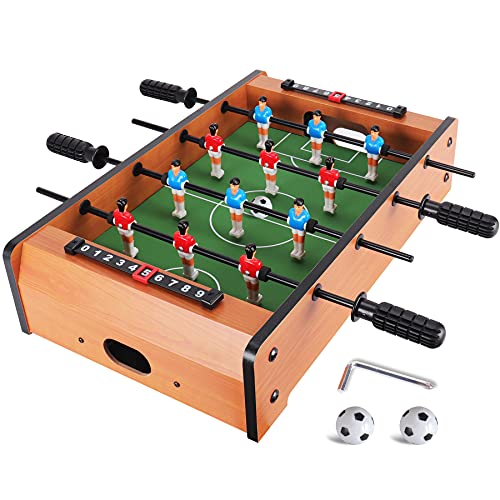
Foosball tables are refreshingly simple machines. There’s no motor, no electronics, and nothing calibrated — just a wooden box, eight steel rods, some plastic bearings, and a set of figures held on with screws. Almost anything that goes wrong is either something that came loose or a consumable that wore out.
That means the repair question is usually not “can this be fixed” but “which cheap part is it.” Below is how to work that out, in the order that finds the answer fastest — starting with the fact that a great many “broken” tables are simply filthy.
- →Clean before you diagnose — dirt imitates half the faults on this list.
- →Loose bolts cause most wobbles. Tighten the whole cabinet before adjusting levellers.
- →Bearings are the main determinant of feel, and they’re cheap. Replace as a set.
- →A spinning man just needs its retaining screw tightened — don’t overtighten into plastic.
- →Worn grips are the cheapest upgrade that actually improves your play.
- →A water-warped playfield is the one fault not worth repairing.
Table of Contents
Clean it before you diagnose it
This deserves to come first because it saves people from buying parts they don’t need. A dirty table convincingly imitates a worn one: rods drag, the ball rolls unevenly, shots lose pace, and everything feels tired.
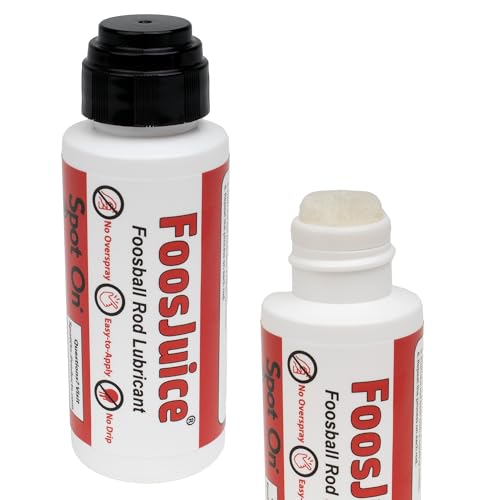
The mechanism is covered fully in our cleaning guide, but the short version is that grit collects inside the bearings and forms a paste with old lubricant. That produces exactly the same symptoms as a worn bearing — and replacing a perfectly good bearing without cleaning simply installs a new part into a dirty hole.
So the sequence is always: clean thoroughly, lubricate with silicone, play for ten minutes, and then decide what’s actually broken. A surprising proportion of the time, nothing is.
A dirty foosball table imitates a worn one almost perfectly. Clean first, or you’ll buy parts to fix a problem that was dust.
Working out what’s wrong
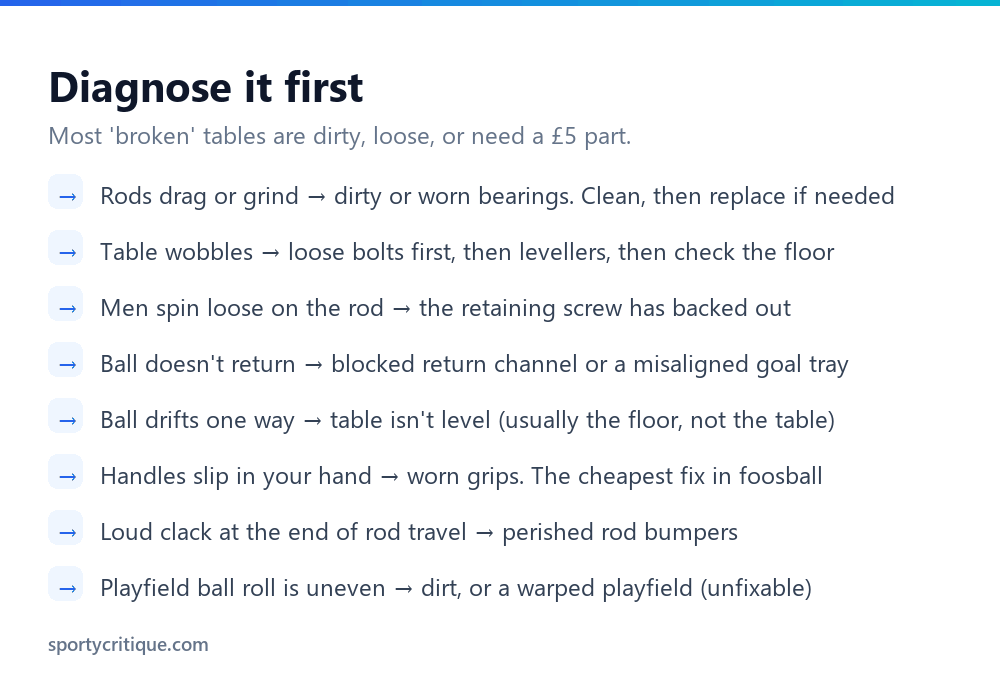
Foosball faults are unusually easy to diagnose because the whole mechanism is visible and you can feel it directly. Move each rod through its full travel, spin it, rock the cabinet, and roll a ball across the playfield from several directions. The symptom points almost uniquely at the cause.
The one genuinely diagnostic skill is distinguishing dirty from worn. Dirty bearings feel gritty or scratchy but consistent — the resistance is the same everywhere along the rod’s travel. Worn bearings feel loose: the rod has visible play, it rattles when you shake it laterally, and you may hear a click as it changes direction. Grit you clean; play you replace.
Replacing bearings

Bearings do more to determine how a table feels than any other component, and they’re consumables — a heavily used table wears them out in a few years, which is normal rather than a defect.
Replace them as a complete set. Mixing new and worn bearings gives the table an inconsistent feel — some rods gliding, others dragging — which is more irritating in play than uniformly worn ones. A full set for an eight-rod table is genuinely cheap and it’s the closest thing to a rebuild that a foosball table has.
💡 Pro tip: If your table is an unbranded supermarket model and you can’t source matching bearings, measure the rod diameter and the bearing’s outer diameter and check general foosball parts suppliers — many budget tables use one of a handful of common sizes. Take the old bearing with you if buying in person.
Wobble, level, and the floor
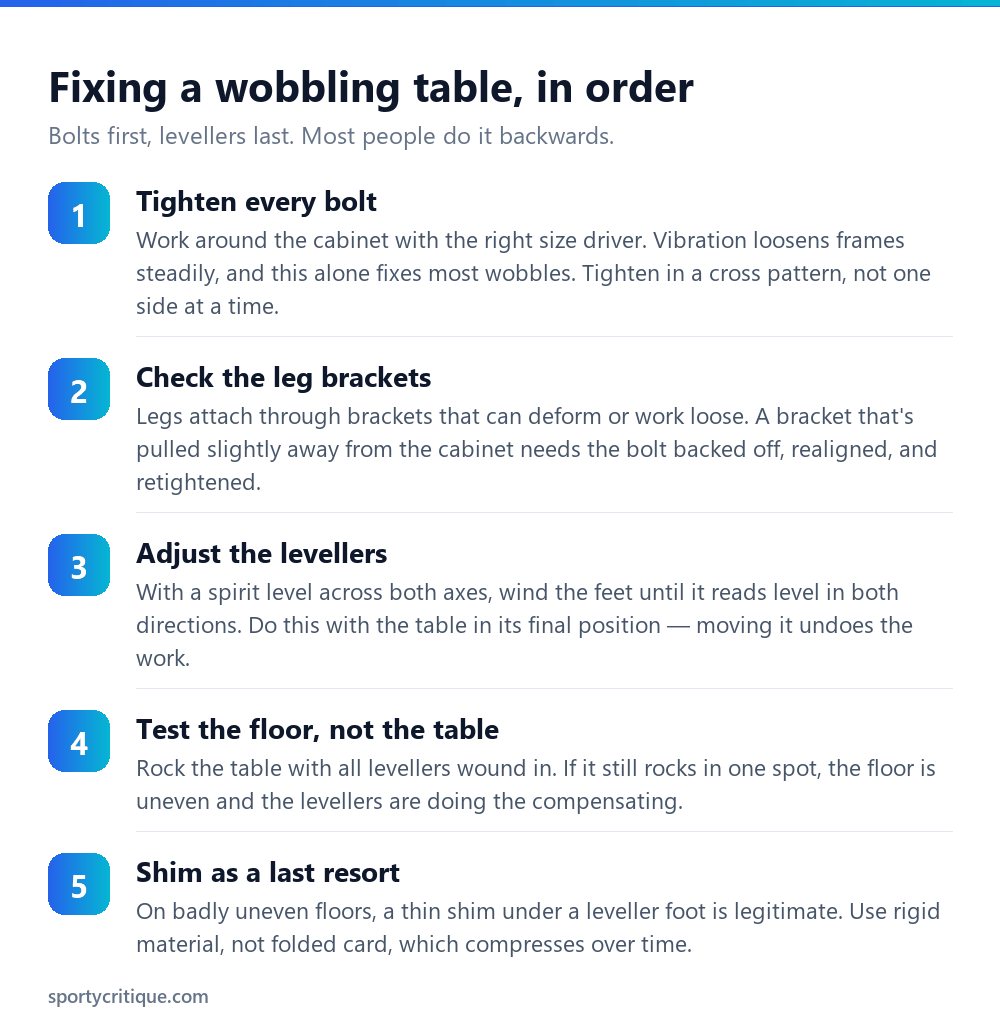
A wobbling table is the most common complaint after draggy rods, and the instinct — reach straight for the levellers — is the wrong first move.
Start with the bolts. Foosball generates a lot of vibration and lateral force, and cabinet bolts loosen steadily over months. Going around the whole table with the correct driver takes ten minutes and resolves most wobbles outright. Tighten progressively in a cross pattern rather than fully tightening one corner at a time, which can pull the cabinet out of square.
Only then adjust the levellers, with a spirit level laid across the playfield in both directions. Do it with the table where it will actually live — levelling a table and then sliding it two feet undoes the whole job.
It’s worth separating two different problems here. A table that rocks has one foot not touching, which levellers fix. A table that flexes when players lean into it has a structural issue — loose bracing, a deformed leg bracket, or simply a lightweight cabinet that was never rigid enough. The first is a five-minute fix; the second may not be fixable at all, which is why cabinet weight matters so much when choosing a table.
📊 Note: If a ball consistently drifts toward one corner even after levelling, check the floor rather than the table. Older houses often have floors well out of level, and the levellers may not have enough range to compensate. A rigid shim under one foot is a legitimate fix — use plastic or hardwood, not folded card, which compresses within weeks.
The small fixes that make a big difference
Spinning or loose men. Each figure is held on by a screw through the rod. These back out with play, and a loose man rotates slightly on impact, sending shots off-line for no visible reason — players almost always blame their own technique. Tighten each one, but stop as soon as it’s snug: on many tables the screw threads into plastic and will strip. If a thread is already stripped, a slightly longer screw or a nylon insert usually saves the figure.
Worn handle grips. The cheapest repair on the table and one of the most worthwhile. Polished, split, or sticky grips force you to hold tighter, and gripping tighter directly slows your wrist — the loose grip that good play depends on becomes impossible. Replacement handles cost very little and pull off after loosening a single screw.
Perished rod bumpers. These are the small rubber or foam rings that stop the rod slamming into the bearing at the end of its travel. When they harden or disintegrate you get a loud clack on every full stroke, and metal is hitting plastic directly, which accelerates bearing wear considerably. They’re pennies and they protect a more expensive part.
Ball return blockages. If a ball doesn’t reappear, look inside the cabinet before assuming a design fault. Return channels collect dust, coins, bottle caps, and occasionally a second ball wedged sideways. A vacuum with a narrow attachment usually clears it. If the goal tray has shifted out of alignment, loosening its screws, repositioning, and retightening solves it.
Playfield damage: what’s fixable
The playfield is the one component where the answer is sometimes genuinely bad news, so it’s worth knowing which side of the line you’re on.
Fixable: surface scratches, worn graphics, and general grime. Scratches in a laminate surface can’t be removed but rarely affect play. Dirt affects play significantly and cleans off. Small chips at the edges are cosmetic.
Not worth fixing: a warped, swollen, or bubbled playfield. This comes from moisture reaching the particleboard or MDF substrate — a spilled drink that soaked in, a damp garage, a leak. The board swells irreversibly, the surface is no longer flat, and ball roll is permanently unpredictable. Replacement playfields are available for some premium brands and typically cost a substantial fraction of a new table; for everything else, it’s the end of that table’s useful life.
⚠️ Watch out: This is why the drinks rule matters more than any maintenance routine. The cabinet rail is exactly where people set a glass down, and a single spill that wicks into the playfield edge causes the one form of damage you cannot undo. It’s also why buying used requires sighting along the playfield before handing over money.
When to stop repairing
Foosball tables are worth repairing far longer than most household items, because the parts are cheap and the structure is simple. But there are two clear stopping points.
The first is a warped playfield, as above. The second is cabinet failure — particleboard that has crumbled around the bolt holes so nothing tightens properly, or a frame that flexes visibly no matter how much you tighten. Once the box itself won’t hold its shape, replacing bearings and rods is putting good parts into a bad structure.
Short of those two, repair is almost always the right call. A tired but structurally sound table restored with a set of bearings, fresh balls, new grips, and a thorough clean will outplay a new budget table — and it’s the reason the second-hand market is such good value, as our buying guide argues at length.
Frequently asked questions
Why are my foosball rods sticking?
Dirty bearings, nine times out of ten. Grit mixes with old lubricant to form a paste inside the bearing collar. Clean inside each bearing, lubricate with silicone, and only conclude the bearings are worn if the drag persists or the rod has visible side-to-side play. Our rod guide covers the process.
How do I stop my foosball table wobbling?
Tighten every bolt on the cabinet first — vibration loosens them steadily and this fixes most wobbles on its own. Then adjust the levellers with a spirit level, in the table’s final position. If it still rocks with all levellers down, the floor is uneven and needs a rigid shim.
Can you replace foosball bearings yourself?
Yes, and it’s one of the more satisfying home repairs. Remove the rod, press or tap the old bearing out, seat the new one square, reassemble and lubricate. Order by table brand rather than measurement, since sizes aren’t standardised, and replace the full set at once so every rod feels the same.
My foosball men keep spinning on the rod. How do I fix it?
The retaining screw has worked loose — tighten it, but only until snug, because on many tables it threads into plastic and will strip. If the thread has already gone, a slightly longer screw or a nylon insert usually rescues it. Loose men send shots off-line unpredictably, so it’s worth checking all of them periodically.
Is a warped foosball playfield repairable?
Realistically no. Warping comes from moisture swelling the particleboard or MDF substrate, and the swelling is irreversible — sanding or weighting it down doesn’t restore flatness. Replacement playfields exist for some premium brands at significant cost; for most tables it marks the end of its life. Prevention is the only real answer.
Is it worth repairing an old foosball table?
Usually yes. Bearings, balls, grips, and bumpers are all inexpensive, and a well-built older table restored with those parts will play better than a new budget table. Stop only if the playfield is warped or the cabinet itself has failed — crumbling particleboard around the bolt holes means nothing will hold tight again.
- →Cleaning a foosball table — do this before diagnosing anything
- →Cleaning and lubricating the rods — the bearing detail
- →Assembling a foosball table — and how to avoid stripping screws
- →Choosing a foosball table — what to check when buying used
- →How to play foosball — the real rules