How Scoring Works in Volleyball: Rally Points, Sets, and Win by Two


Under rally scoring, every rally scores a point for whoever wins it — serving or receiving, it doesn’t matter. Sets go to 25 points, you must win by two, and a match is usually best of five with a shortened deciding set to 15. If the receiving team wins the rally, they take the point and the serve, and rotate one position clockwise.
Volleyball scoring is genuinely simple once you’ve seen it, but it’s confusing to read about because the sport changed its scoring system in 1999 and the internet never fully caught up. Search around and you’ll still find pages describing games to 15 where only the serving team can score. That’s not how anyone has played competitively in over 25 years.
Here’s the current system, why it replaced the old one, and the situations that actually cause arguments at the scorer’s table — deuce, the deciding set, and the running score in beach doubles.
- →Every rally produces a point — there is no such thing as a scoreless rally.
- →Sets are to 25 (deciding set to 15), and you must always win by two.
- →Win a rally while receiving and you get the point AND the serve, then rotate clockwise.
- →Most points at beginner level are errors, not winners — which makes consistency worth more than power.
- →Beach volleyball scores to 21, best of three, with a switch of ends every 7 points.
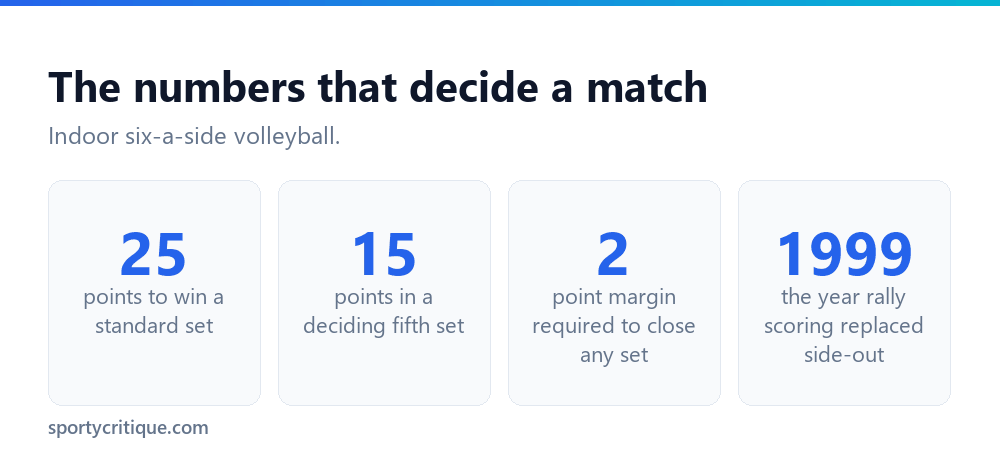
Table of Contents
Rally scoring, in one rule
The entire modern system reduces to a sentence: the team that wins a rally scores a point. No conditions, no exceptions for who served. If the ball hits the floor, goes out, or a fault is whistled, somebody just scored.
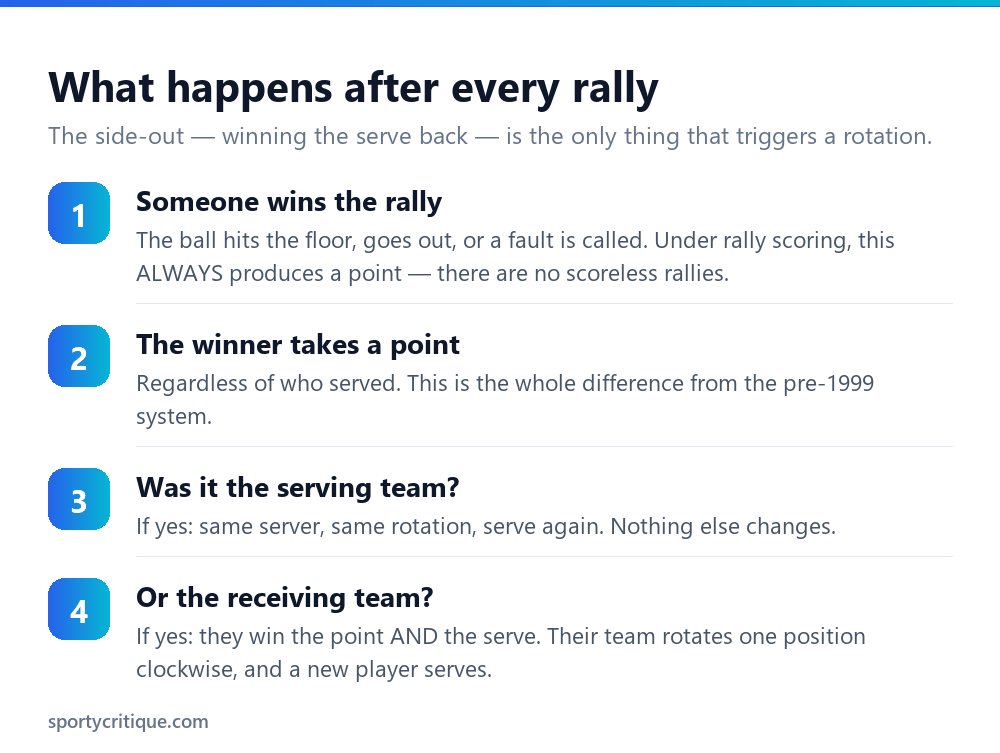
The one wrinkle worth internalising: winning the rally as the receiving team does two extra things. You take over the serve, and your team rotates one position clockwise. If you were already serving, nothing rotates — the same player serves again. This is why a strong server can rip off six or seven straight points from the same position: their team isn’t rotating during that run.
Why the system changed in 1999
Before 1999, volleyball used side-out scoring: only the serving team could score. Win a rally on receive and your reward was just the right to serve — the scoreboard didn’t move. Two evenly matched, defensively stubborn teams could trade side-outs for twenty minutes without a single point being scored.
That made matches unpredictable in length, which made them nearly impossible to schedule for television. Rally scoring solved it: every rally now moves the scoreboard, so a set takes a roughly knowable amount of time, and a match fits in a broadcast window.
But the change did something more interesting than shortening matches — it re-priced every error in the sport. Under side-out scoring, a missed serve cost you the serve and nothing else, so blasting away at an ace was close to free. Today, every missed serve is a point handed over. That single change is why modern coaching obsesses over serve error rates, and why the advice in our serving guide is to serve at 70–80% with placement rather than swinging for aces.
Rally scoring didn’t just make matches shorter. It turned every error into a point, which is why consistency became the most valuable skill in volleyball.
The two ways to score
Points come from exactly two sources, and the split between them tells you a lot about the level you’re watching.
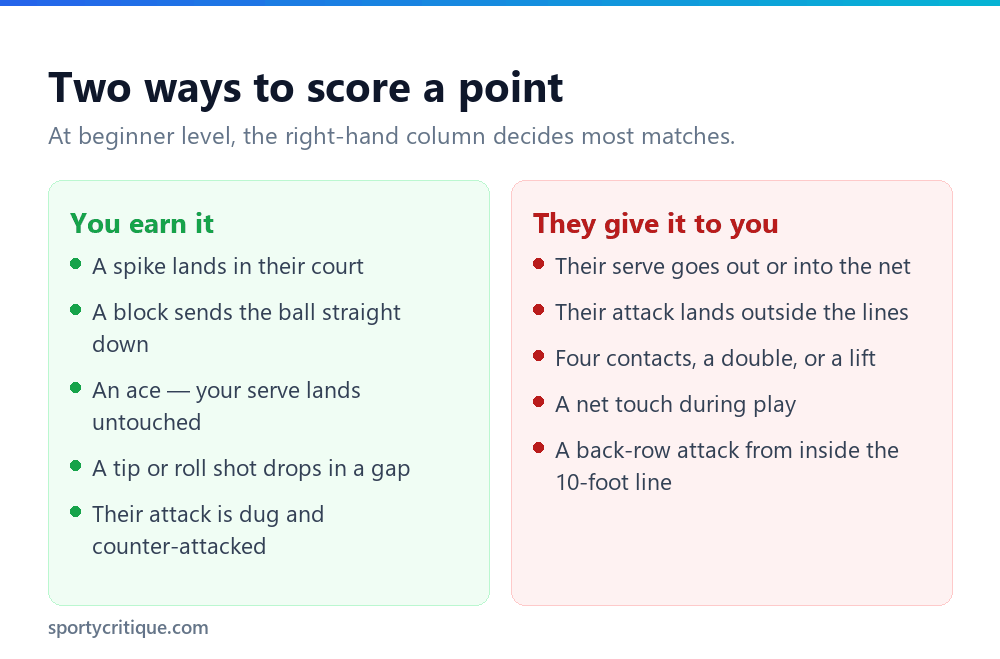
Here’s the part that reframes how beginners should practise: at recreational and school level, the large majority of points are unforced errors rather than winners. Missed serves, balls hit long, four contacts, net touches. Two teams of beginners mostly hand points back and forth.
Which means the fastest way to win more volleyball is not learning to spike harder. It’s serving in, passing to the setter, and keeping your attack inside the lines. A team that simply makes fewer mistakes than the other team wins comfortably without ever hitting a highlight-reel ball. Power is worth chasing later, once the errors are gone — and our spiking guide makes the same argument about shot selection.
💡 Pro tip: Track it yourself for one match: put a tally mark for every point your team wins with a genuine attack, and one for every point that came from an opponent’s error. Most rec players are shocked by the ratio — and it usually changes how they practise.
Set and match formats
A detail that catches people out: there’s no cap on a set. “Win by two” means exactly that, and if both teams keep side-outing at 24–24, the set continues. Scores like 32–30 are unusual but entirely normal, and they’re the sets people remember.
Switching ends is the other bit of format bookkeeping. Indoors, teams change ends between sets. On the beach, teams switch every 7 points (every 5 in the deciding set) to keep sun and wind advantages fair — which is the kind of rule that only makes sense once you’ve played a set staring directly into a low sun.
Deuce: what happens at 24–24
When a set reaches 24–24, nothing special happens procedurally — play simply continues until a two-point gap appears. But the scoring situation changes the psychology enough that it’s worth understanding as its own phase:
⚠️ Watch out: The most common deuce mistake in rec volleyball is the ambitious serve. Someone decides the moment calls for an ace, aims for the line, and misses. Two of those in one set decides matches.
The other question: how do you actually score more points?
Half the people searching this phrase want the rules above. The other half mean something completely different: how do I put the ball away? Both are fair readings of “how to score in volleyball,” so here’s the second answer.
The uncomfortable truth is that trying to score is usually how beginners stop scoring. The instinct when the ball comes to you is to swing as hard as possible at the middle of the court — which is where all six defenders are standing. Points come from putting the ball where people aren’t, and that’s a decision more than it is a skill.
- Aim at the gaps between players, not at open floor
- Deep corners force a defender to move backwards, the hardest direction
- Cross-court is the longest line on the court — the most margin for error
- Swing at the blocker’s outside hand deliberately
- The ball ricochets out of bounds off the block — your point
- Called ‘tooling’ the block, and it is completely legal
- A tip or roll shot into an empty spot scores constantly at rec level
- Defenders set up deep expecting power — short balls hurt them
- Sell it with a full approach or nobody is fooled
- Aces are free points, and tough serves wreck their whole offence
- A bad pass means no set, which means no attack
- Target their weakest passer, relentlessly
And the least glamorous scoring strategy of all, which happens to be the most effective below elite level: reduce your own errors first. If your team hands over 12 points a set through missed serves and balls hit long, no amount of attacking brilliance closes that gap. Get your serve in, keep your attack inside the lines, and let the other team make the mistakes. It isn’t exciting advice, but it’s the one that wins Tuesday nights.
Scoring by level: what changes and what doesn’t
The 25-point rally-scored set is close to universal now, but the surrounding format varies by where you’re playing:
📊 Note: If you play in a league with a hard points cap, find out before your first match. A capped set changes late-game tactics completely — at 26–26 with a cap of 27, the next rally is the match, and the safe play becomes even more valuable than usual.
Reading a volleyball scoreboard
Scoreboards show two numbers per team: the current set score and the sets won. A board reading Home 2 — 18 | Away 1 — 22 means the home team has won two sets to one but is losing the current set 22–18. Since a match is best of five, the home team needs one more set; the away team needs two.
On paper scoresheets you’ll also see the running score kept as a grid, with each server’s run recorded — which is how statisticians reconstruct who served during a 7-point run. If you ever volunteer to keep score at a junior tournament, ask for five minutes of training first; the sheet is more particular than it looks, and the referee will thank you.
Frequently asked questions
Can you score a point on serve?
Yes — a serve that lands in their court untouched is an ace, and it’s a point like any other. You can also win the point if the receiving team shanks the pass out of bounds or into the net. Under rally scoring, the serve is a genuine attacking weapon rather than just a way to start the rally.
Does the serving team keep serving after scoring?
Yes. The same player continues serving, and the team does not rotate. Rotation only happens when a team wins the serve back from the opposition. A hot server staying in one rotation is how teams rattle off long runs.
What is a side-out?
Winning the rally while your team is receiving serve — you gain the point and the serve. The term survives from the old scoring system, where a side-out gave you only the serve. Coaches still talk about ‘side-out percentage’ because converting serve receive into points is the core measure of an offence.
Do you have to win by two points?
Always, in every set and every format, and there is no ceiling. If the score reaches 24–24, play continues until one team is two clear — 26–24, 30–28, whatever it takes. Casual games sometimes agree a cap beforehand; competitive volleyball never does.
Why is the fifth set only to 15?
Fatigue and time. After four full sets, both teams are exhausted and the match has run 90 minutes or more. A shortened deciding set keeps the finish sharp and the schedule intact — the same reasoning that produced rally scoring in the first place. Note that the win-by-two rule still applies.
Is beach volleyball scored the same way?
Same rally scoring principle, different numbers: sets to 21 (deciding set to 15), best of three, win by two. Beach also switches ends every 7 points to share out the wind and sun. The bigger scoring difference is subtler — a block counts as one of your three touches on the beach, so a dug block leaves you only two touches to build an attack. See our guide to playing volleyball for the full indoor-versus-beach comparison.
- →How to play volleyball — rules, rotation, and positions
- →How to serve a volleyball — where most beginner points are won and lost
- →How to spike a volleyball — turning rallies into earned points
- →How to hit a volleyball — the attacking fundamentals