How to Clean a Shuffleboard Table (And Fix a Slow Surface)


Sweep off the old powder with a dry cloth or brush, wipe any grime with a barely damp cloth and dry it immediately, polish with a silicone-based shuffleboard polish, then spread fresh powder sparingly down the table. Test with a weight and adjust — more powder for speed, sweep some off if it’s too fast. Never use furniture polish, ammonia cleaners, or abrasives: the surface is polyurethane over hardwood and those strip or scratch it permanently.
A shuffleboard table that feels sluggish, grabby, or unpredictable almost never has anything wrong with it. It has old powder on it, mixed with dust and whatever has been spilled on it, and the fix takes twenty minutes.
This is worth knowing because table speed isn’t a cosmetic issue — it’s the central variable of the game. As our strategy guide explains, knowing your table’s speed is a genuine competitive advantage, and a table whose speed changes unpredictably from week to week makes the game far less satisfying to play.
- →Old powder is the usual cause of a slow, grabby table — not wear.
- →Shuffleboard ‘wax’ is silicone beads, not wax, and it comes in numbered speeds.
- →Never use furniture polish, ammonia, or abrasives on the playing surface.
- →Keep moisture off the surface. Damp cloth only, dried immediately.
- →Clean the weight bottoms too — grit there scratches the playfield.
- →Add powder sparingly and test. Too much is as bad as too little.
Table of Contents
What shuffleboard wax actually is
Worth clearing up first, because the naming causes real confusion and leads people to reach for the wrong products.
Table shuffleboard “wax” is not wax. It’s tiny silicone or plastic beads — also called sand, powder, salt, or cheese depending on where you’re from — that sit on top of the table’s finish and act like microscopic ball bearings under the weights. That’s what allows a heavy metal puck to travel twenty feet from a gentle push.
The confusion matters because someone told to “wax the table” may reasonably reach for furniture wax or polish, which does the opposite of what’s wanted: it leaves a sticky film that grabs the weights and takes considerable effort to remove. The beads sit on the finish, they don’t soak into it.
Underneath the powder, the table has a polyurethane finish over hardwood — usually maple. That finish is what needs protecting from moisture and abrasives, and a silicone-based polish is what keeps it slick so the powder works properly.
Shuffleboard wax isn’t wax. It’s silicone beads sitting on the finish — which is exactly why furniture polish ruins a table.
The clean and re-wax
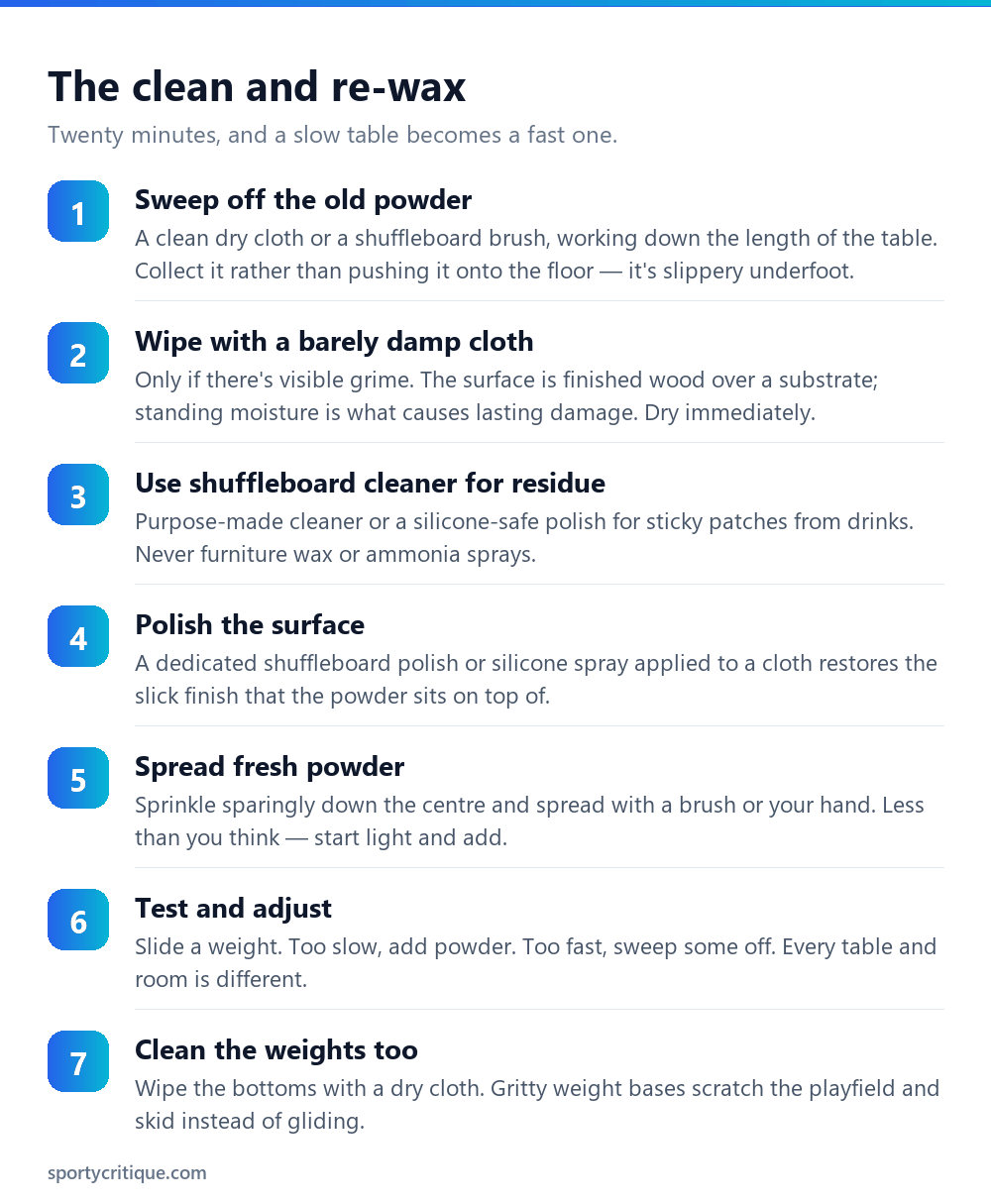
Sweep before you wipe. Old powder mixed with dust becomes a paste the moment it meets moisture, so get the loose material off first with a dry cloth or a purpose-made shuffleboard brush. Collect it rather than brushing it onto the floor — silicone beads underfoot are genuinely slippery, particularly on a hard floor.
Damp, never wet. Only bring moisture in if there’s visible grime, and then use a barely damp cloth followed immediately by a dry one. Standing moisture is the one thing that causes irreversible damage: it works through the finish into the wood or substrate and causes swelling that no amount of refinishing fixes. Never spray liquid directly onto the surface.
Polish, then powder. A silicone-based shuffleboard polish applied to a cloth restores the slick finish. Then spread the powder sparingly — sprinkle a little down the centre line and brush it out along the table. The instinct is to use too much, which makes the table wildly fast and inconsistent, and then people sweep frantically to compensate. Start light and add.
Then test. Slide a weight the full length and see what happens. Too slow, add a little more powder. Too fast, sweep some off. This is the only reliable method, because the right amount depends on the powder speed, the table’s finish, the humidity, and how the room feels that day.
Choosing a powder speed
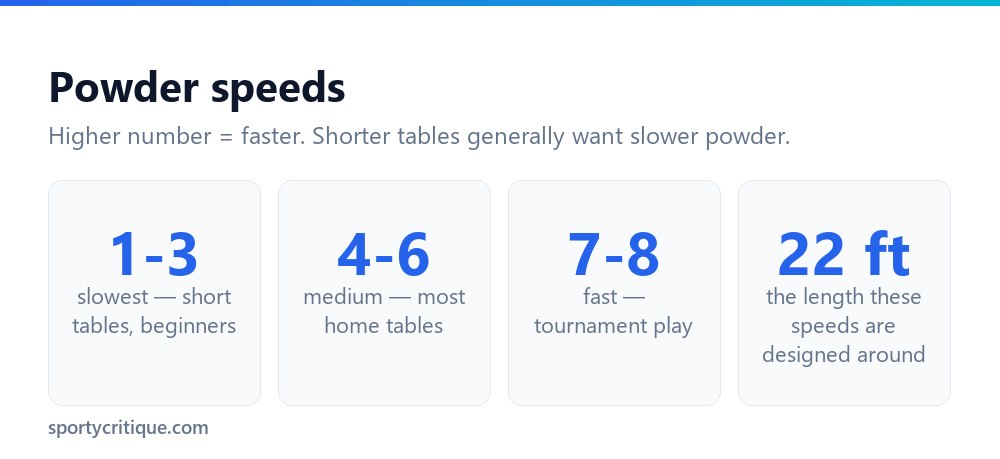
Powders are sold in numbered speeds, and the numbering is straightforward: higher means faster. What’s less obvious is that the right choice depends heavily on your table’s length.
Speed grades are designed around a 22-foot regulation table. On a 9- or 12-foot home table, a fast powder makes the game almost unplayable — weights that need barely a nudge to reach the far end leave no room for touch or tactics. Shorter tables generally want slower powder, and many home players settle around the 3–5 range.
Serious players often buy two or three speeds and blend them to get a surface they like, which sounds fussy and is genuinely how tournament tables are dialled in. If you’re starting out, buy a medium speed, learn what it feels like, and adjust from there rather than guessing.
📊 Note: Humidity affects speed noticeably. The same table with the same powder plays slower on a damp day, because moisture makes the beads clump slightly and increases friction. If your table lives somewhere with big seasonal swings, expect to adjust powder amounts through the year rather than finding one permanent setting.
Products to avoid
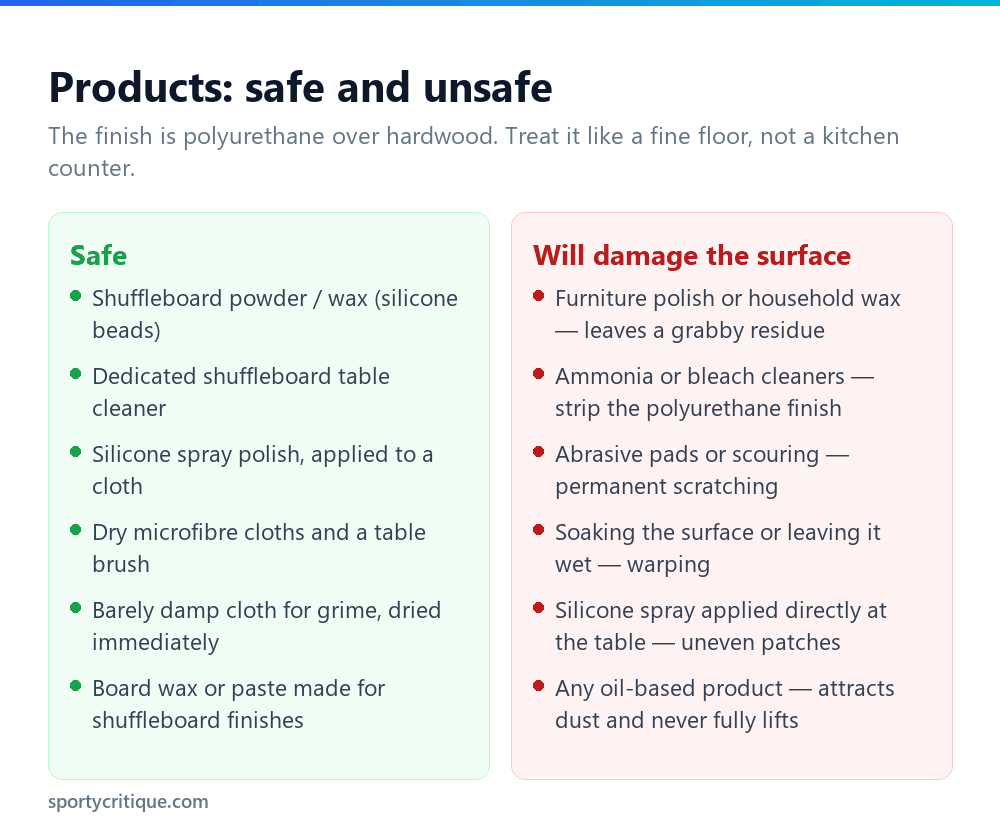
The playing surface is a finished piece of hardwood, and the mistakes people make come from treating it like ordinary furniture or a kitchen surface.
Furniture polish and household wax are the most common error, encouraged by the word “wax.” They leave a residue that makes the surface grabby and inconsistent — slick in some places, sticky in others — and removing it properly means stripping the whole surface back.
Ammonia and bleach-based cleaners attack the polyurethane finish. The damage is gradual and cumulative: the finish dulls and eventually becomes porous, at which point the wood underneath is exposed to moisture and the table’s life is effectively over.
Abrasives — scouring pads, powder cleansers, aggressive scrubbing — leave scratches that are permanent and that catch the weights. There is no gentle way to sand or buff a shuffleboard playfield at home; refinishing is a professional job and usually costs a substantial fraction of the table’s value.
⚠️ Watch out: Silicone spray polish should always go onto a cloth first, never sprayed directly at the table. Spraying produces uneven patches and, worse, overspray onto the cabinet and floor. The same rule applies to any liquid product near a shuffleboard surface.
The weights, the gutters, and the climate adjusters
Three parts of the table get forgotten and all three affect play.
The weights. Wipe the bottoms with a dry cloth regularly. Grit embedded in the base doesn’t just make a weight slide unpredictably — it scratches the playfield on every shot, which is how tables accumulate fine scoring over years. If a weight’s plastic cap is chipped or worn unevenly, replace it; caps are cheap and a damaged one will never run true.
The gutters. The troughs down each side collect powder, dust, and whatever gets knocked off the table. Vacuum them out periodically. They don’t affect play directly, but a full gutter means weights bouncing back onto the playing surface, which is both irritating and a way to chip the table edge.
Climate adjusters. Better tables have a set of tensioning bolts running underneath the playfield, designed to counteract the natural warping that hardwood undergoes with humidity changes. If your table has developed a bow — weights consistently drifting to one side, or a visible dip when you sight along it — these are the intended fix. Adjust them a small fraction of a turn at a time and leave the table a day between adjustments; wood moves slowly, and over-adjusting creates a worse problem than the one you started with.
Reviving a neglected table
Inheriting a table that’s been sitting in a bar basement or a garage is a bigger job than routine maintenance, but the outcome is usually better than it looks. Hardwood playfields are tough, and most of what appears to be damage is decades of compacted powder and residue.
The judgement call is when the finish itself has gone — dull, porous, or worn through to bare wood in the high-traffic areas near the foul lines. At that point polish won’t restore slickness and the table needs professional refinishing, which typically costs a meaningful fraction of a replacement. For a good-quality table it’s often still worth it; for a budget one it rarely is.
How often
For a home table with regular play, sweep and add fresh powder every few sessions and do a full clean-and-polish every few months. A table in a bar needs the full treatment far more often, because of both volume and spilled drinks.
The signal is feel rather than the calendar. When weights start behaving inconsistently — one shot sliding beautifully and the next grabbing halfway — the powder is dirty or unevenly distributed. That inconsistency is the thing to watch for, more than outright slowness, because a uniformly slow table is at least predictable while an inconsistent one makes the game unplayable.
A quick sweep after each session is the habit that prevents most problems, exactly as it is with a bar table in regular use. It takes under a minute and it stops the powder from accumulating the dust and residue that makes a full strip necessary.
Frequently asked questions
What is shuffleboard wax made of?
Silicone or plastic beads, despite the name — also sold as powder, sand, salt, or cheese. They sit on top of the table’s finish and act like tiny ball bearings under the weights. It is emphatically not furniture wax, and using actual wax on a shuffleboard table makes it sticky and unplayable.
Why is my shuffleboard table so slow?
Almost always old or insufficient powder. Sweep off what’s there, polish the surface with a silicone-based shuffleboard polish, and spread fresh powder. If it’s still slow with fresh powder, you may be using too low a speed grade for your table’s length — try a faster number.
Can I use furniture polish on a shuffleboard table?
No. It leaves a residue that makes the surface grabby and inconsistent, and removing it properly means stripping the whole playing surface. Use a purpose-made shuffleboard cleaner and polish, or a silicone spray applied to a cloth rather than to the table.
How much powder should I use?
Less than you think. Sprinkle lightly down the centre and brush it out, then test with a weight and add more if needed. Too much powder makes the table wildly fast and inconsistent. The right amount varies with your powder speed, table length, and even the humidity that day.
How do I fix a shuffleboard table that’s warped?
If the table has climate adjusters — tensioning bolts under the playfield — that’s what they’re for. Turn them a small fraction at a time and wait a day between adjustments, since wood moves slowly. If there are no adjusters, or the warping is severe and from water damage, it’s usually beyond home repair.
Should I clean the weights?
Yes, and it’s often skipped. Wipe the bottoms with a dry cloth regularly — grit in the base makes a weight slide unpredictably and scratches the playfield on every shot. Replace caps that are chipped or worn unevenly, since they’ll never run true again.
- →How to play table shuffleboard — rules, scoring and technique
- →Strategy and how to win — why table speed is an advantage
- →How to play shuffleboard — both versions of the game
- →Best shuffleboard tables — sizes and build quality