Best Home Golf Simulator Packages Under $5,000: Complete Enclosure, Launch Monitor, and Impact Screen Setups

Building an indoor home golf simulator once required a six-figure commercial budget, a dedicated architectural retrofit, and industrial-grade ceiling hardware from brands like TrackMan or Foresight Falcon. Today, the democratization of high-speed photometric vision systems, dual-radar tracking units, and multi-layer ballistic strike textiles has completely shifted the market. For serious golfers, building a tour-accurate home golf studio for under $5,000 is no longer a compromise—it is an engineering reality.
However, assembling a sub-$5,000 golf simulator is not as simple as buying an all-in-one box off an unverified marketplace. A functional indoor simulator is an integrated ecosystem comprised of five interdependent hardware modules: the launch engine, the ballistic impact enclosure, the shock-absorbing hitting deck, the short-throw projection system, and the simulation physics software. If any single component is miscalculated—such as choosing a low-lumen projector that washes out under ambient garage light, or a cheap driving mat that induces medial epicondylitis (golfer’s elbow)—the entire experience collapses.
Our simulator lab evaluated sensor latency, spin-axis telemetry, impact screen sound dampening, bounce-back safety margins, and structural footprint requirements across today’s top simulator components. Below is our definitive technical breakdown and buyer’s guide to the best home golf simulator packages under $5,000.
Table of Contents
Quick Comparison: 3 Best Pre-Configured Turnkey Packages Under $5,000
| Package Architecture | Primary Launch Engine | Enclosure & Screen | Hitting Turf Substrate | Room Footprint Required | Total Turnkey Cost |
|---|---|---|---|---|---|
| The Tour Accuracy Build (Photometric Precision) |
Bushnell Launch Pro (Ball Data) | Carl’s Place DIY Enclosure (8.5′ x 10.5′) with Preferred Screen | Fiberbuilt Studio Golf Mat (Single-Hitting 4’x5′) | 10’W x 10’H x 12’D | ~$4,790 |
| The Full Flight Doppler Build (Club Path & Radar) |
FlightScope Mevo+ (2024 Edition) | GoSports Elite 8×10 Enclosure with Commercial Impact Screen | Carl’s Place HotShot Mat (4’x5′ Gel Foam) | 10’W x 9.5’H x 16’D | ~$3,850 |
| The Space-Saving Compact Build (Garage / Multi-Use) |
Garmin Approach R10 or Rapsodo MLM2PRO | The Net Return Home Series V2 with Side Barrier Nets | Country Club Elite Real Feel Mat (4’x4′) | 9’W x 9’H x 15’D | ~$2,150 |
1. The 5 Core Subsystems of an Indoor Golf Simulator
To invest your budget efficiently without overspending on redundant hardware, you must understand how the five core sub-assemblies interact mechanically and computationally:
Subsystem A: The Launch Monitor Engine (Photometric vs. Radar)
The launch monitor represents roughly 35% to 50% of your total budget. It serves as the optical or electromagnetic eye that tracks the moment of impact and ball flight. There are two distinct detection paradigms:
- High-Speed Photometric (Camera-Based): Systems like the Bushnell Launch Pro (powered by Foresight Sports) sit directly beside the golf ball on the hitting mat. High-speed infrared cameras firing at up to 10,000 frames per second capture the dimple pattern of the golf ball across the first 12 inches of travel. This allows immediate, direct measurement of ball speed, launch angle, launch direction, backspin, and side spin (spin axis) without needing downrange flight. Photometric units require zero space behind the golfer, making them the absolute king for rooms with limited total depth (10–12 feet).
- 3D Doppler Radar: Units like the FlightScope Mevo+ and budget-friendly radar systems like the Garmin R10 sit 7 to 8 feet directly behind the hitting tee, tracking the metallic sticker or club head via microwave Doppler shifts as the ball travels toward the screen. Radar systems provide rich clubhead metrics (swing speed, club path, angle of attack), but mandate a minimum of 8 feet behind the ball + 8 to 10 feet of clear ball flight (16–18 feet total room depth) to calculate high-speed spin rates accurately indoors.
Subsystem B: Impact Screen Ballistics & Acoustic Dampening
Hitting a 1.62-ounce golf ball at 150 to 175 mph inside a residential home generates severe dynamic force. An inferior impact screen will suffer catastrophic seam tears, project harsh trampoline bounce-back that sends balls ricocheting back at the golfer’s shins, and sound like a gunshot echoing through your home.
- Triple-Layer Weave Construction: Premium screens (such as Carl’s Place Premium 3-Layer) sandwich a dense polyester cushion core between a tightly woven smooth outer display layer and a heavy backing scrim. This structure absorbs impact energy, dissipating the kinetic shock silently (under 75 decibels) while restricting ball bounce-back to a gentle roll of just 12 to 24 inches onto the turf.
- Border Bungee Tensioning: Rather than rigid attachment hooks, commercial enclosures utilize elastic bungee cords threaded through perimeter grommets. This allows the screen face to flex dynamically upon ball impact and snap back into a razor-flat 16:9 or 4:3 projection surface without permanent puckering or denting.
Subsystem C: Joint-Friendly Hitting Substrates (Wrist & Elbow Protection)
The single most dangerous mistake novice simulator builders make is purchasing a generic 1/2-inch driving range mat laid directly onto a concrete garage floor. Repeatedly compressing an iron clubhead into an unyielding concrete slab transmits violent shock waves through the shaft into the player’s wrists, elbows, and rotator cuffs, frequently sidelining golfers with medial tendonitis within 60 days.
- Fiberbuilt Grass Strike Strips: Recognized across PGA teaching facilities, Fiberbuilt mats feature specialized monofilament fiber bristles arranged in a continuous matrix sitting atop a rubber shock frame. When you strike down into the turf, the club head descends cleanly through the fibers exactly like natural Kentucky bluegrass fairway turf—allowing true angle-of-attack feedback without wrist shock.
- Gel-Foam Sub-Beds: Mats like Carl’s Place HotShot or SIGPRO Softy employ dual-density viscoelastic foam that compresses under high strike velocity, dampening rebound vibration before it reaches the floor.
Subsystem D: Short-Throw Projectors & Ambient Light Control
Because the golfer stands between the projector and the impact screen, standard long-throw home theater projectors will cast the player’s massive shadow directly across the hitting zone. An indoor simulator mandates a Short-Throw Projector with a throw ratio between 0.49:1 and 0.65:1.
- Throw Distance Calculus: A short-throw projector can sit just 5 to 7 feet away from a 10-foot wide screen, safely mounted on the ceiling ahead of the golfer’s swing arc to eliminate all player casting shadows.
- Lumen Output: If your simulator space is a daylight-lit garage or multi-purpose basement, you need a minimum of 3,500 to 4,000 ANSI Lumens (such as the Optoma GT1080HDR or BenQ TH671ST) to deliver crisp, contrast-rich fairway grass and green contours without dimming room lighting completely.
Subsystem E: Simulation Software Engines
Your launch monitor sends raw mathematical vectors (speed, launch angles, spin rates); your software engine renders the simulated physics, wind dynamics, and ball bounce on the course:
- GSPro ($250/year): Built on the modern Unity gaming engine with 4K HDR course rendering, GSPro has become the undisputed gold standard for simulator golf. It features ultra-realistic ball physics (voted #1 by competitive simulator tours) and gives players access to over 500 lidar-scanned courses, including Augusta National, Pebble Beach, and St. Andrews.
- E6 Connect: Widely supported across iOS and PC, offering robust online multiplayer leagues and driving range training modes.
- Awesome Golf ($349 lifetime): A family-friendly, high-framerate gamified engine with target challenges, long-drive competitions, and beginner training modules that runs seamlessly on iPads and low-power laptops.
2. The 3 Best Turnkey Home Golf Simulator Packages Under $5,000
Package 1: The Tour Accuracy Build (Best Overall Indoor Studio) — $4,790
If your primary priority is pinpoint spin measurement, zero radar interference, and tour-caliber shot feedback in a standard 9-foot ceiling room, this is the premier sub-$5,000 simulator setup available today.
- Launch Monitor: Bushnell Launch Pro (Ball-Data Model) — $1,999
Powered by Foresight Sports’ triple-camera photometric optical engine. Measures ball speed, vertical launch angle, horizontal launch direction, spin axis, and total backspin with commercial studio precision. Because it sits beside the ball, you do not need 16 feet of room depth. - Enclosure & Screen: Carl’s Place DIY Enclosure Kit (8.5’H x 10.5’W x 5’D) with Preferred Impact Screen — $1,350
Heavy-duty 1-inch EMT conduit frame covered in black ballistic dampening fabric with a smooth, low-noise woven screen that absorbs 165 mph driver hits with effortless silence. - Hitting Mat: Fiberbuilt Studio Single-Hitting Mat (4′ x 5′) — $450
Features Fiberbuilt’s renowned fiber bristle strike turf that prevents wrist injury and yields realistic fat/thin shot distance penalties. - Projector: BenQ TH671ST Short-Throw Gaming & Golf Projector — $749
3,000 ANSI Lumens, 1080p native resolution, ultra-low 16ms input lag, and a 0.69:1 throw ratio that mounts cleanly in front of the swing zone. - Software: GSPro Annual Subscription — $250
- Total Estimated Cost: $4,798
Package 2: The Full Flight Doppler Build (Best for Club Path & Radar Data) — $3,848
For golfers with deep garage or basement footprints (16+ feet) who demand comprehensive clubhead tracking—including swing speed, club path, face angle, and dynamic loft—without paying $10,000 for a TrackMan.
- Launch Monitor: FlightScope Mevo+ (2024 Edition) — $1,799
Military-grade 3D Doppler radar tracking that measures 16 direct ball and club parameters right out of the box. Includes 10 free E6 Connect courses and works seamlessly with GSPro on PC. - Enclosure & Screen: GoSports Elite 8′ x 10′ Golf Simulator Enclosure — $850
Pre-welded powder-coated steel frame with integrated side netting and commercial-grade impact polyester screen. - Hitting Mat: Carl’s Place HotShot 4′ x 5′ Commercial Mat — $399
Deep 5/8″ closed-cell foam base with heavy-pile nylon turf that holds standard wooden tees. - Projector: Optoma GT1080HDR Short Throw Laser/Lamp — $799
3,800 ANSI Lumens for maximum brightness in uninsulated garages, 0.5:1 ultra-short throw ratio, and HDR10 dynamic color grading. - Total Estimated Cost: $3,848
Package 3: The Space-Saving Compact Garage Build (Best Budget Turnkey) — $2,143
If you need a simulator setup that can be dismantled or packed away in under 10 minutes so you can park your car back in the garage, this compact net-and-monitor setup delivers exceptional value under half our budget ceiling.
- Launch Monitor: Garmin Approach R10 ($599) or Rapsodo MLM2PRO ($699) — ~$649
Compact Doppler radar with integrated video swing replay and automatic club telemetry. Can be paired with smart telemetry devices like smart golf GPS watches with virtual caddie engines for seamless course data cross-referencing. - Return Net: The Net Return Home Series V2 Net with Side Barriers — $695
Heavyweight tubular aluminum frame that automatically returns the ball directly to your feet after every shot. Tested up to 225 mph ball speeds. - Hitting Mat: Country Club Elite Real Feel 4′ x 4′ Mat — $399
Dense tufted nylon that prevents club head bounce on thin strikes. - Display Setup: Mounted 55-Inch 4K UHD Smart TV (TCL or Hisense) on Mobile Rolling Stand — $399
Eliminates projector mounting hassles entirely; mirror your iPad or PC directly onto the side display. - Total Estimated Cost: $2,142
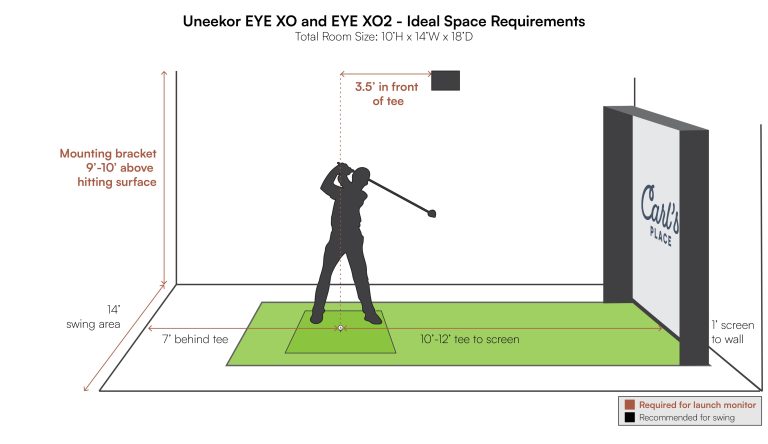
3. Room Dimensions: Minimum vs. Ideal Clearances
Before purchasing any simulator package, verify your space with a physical tape measure. The single most common return reason in golf simulator hardware is insufficient ceiling height for a driver swing.
| Dimension | Minimum Tolerance | Ideal Recommended | Why It Matters |
|---|---|---|---|
| Ceiling Height | 8′ 6″ (Irons only) / 9′ 0″ (Drivers) | 10′ 0″ | Golfers taller than 5’10” with upright follow-through arcs will strike an 8’6″ drywall ceiling on driver swings. 10 feet provides 100% subconscious freedom. |
| Room Width | 10′ 0″ (Centered tee) | 12′ 0″ to 14′ 0″ | A 10-foot width requires an offset hitting stance for right-handers. 14 feet allows a true centered hitting tee for both right-handed and left-handed players simultaneously. |
| Room Depth | 12′ 0″ (Photometric BLP) | 16′ 0″ to 18′ 0″ (Doppler Mevo+) | Radar needs 8 ft behind the ball + 8 ft to 10 ft from tee to screen. Photometric needs only 1 ft behind the ball + 8 ft to 10 ft to screen. |
4. Frequently Asked Questions (FAQ)
Can I hit real golf balls into a sub-$5,000 impact screen?
Yes. Every screen and net recommended in our guide is engineered specifically for regulation 1.62-ounce golf balls at full tour ball speeds (170+ mph). However, you must use clean, scuff-free golf balls. A scuffed ball or a ball with sharp cuts from wedge grooves acts like a serrated knife against polyester screen fibers, cutting the fabric weave prematurely.
What PC hardware do I need to run GSPro in 1080p?
To run GSPro at a buttery 60 FPS in 1080p resolution, your desktop or gaming laptop should feature an Intel Core i5 (10th gen or newer) or AMD Ryzen 5, 16 GB of DDR4/DDR5 RAM, and a dedicated NVIDIA GeForce RTX 3060 (or RTX 4060) graphics card. For 4K projection, upgrade to an RTX 4070 or RTX 4080.
Do Doppler radar launch monitors get confused by garage metal doors?
Yes. Doppler radar tracks microwave frequency reflections. Large metal objects like uninsulated steel garage doors, metal shelving, or overhead metal ductwork can cause ghosting or radar clutter. If setting up in a garage, hang heavy moving blankets over bare metal doors or apply metallic dot stickers to your golf balls (as included with the FlightScope Mevo+) to boost signal-to-noise ratio by 400%.
5. Final Verdict: Which $5,000 Package Should You Choose?
- If you have a 12-to-14 foot depth room and prioritize tour-level spin data: Invest in the Tour Accuracy Build featuring the Bushnell Launch Pro, Carl’s Place Enclosure, and Fiberbuilt Mat. It is the closest thing to a $25,000 commercial simulator for under $5,000.
- If you have deep space (16+ ft) and want full clubhead telemetry: The FlightScope Mevo+ Package paired with an Optoma short-throw projector gives you rich 3D club path dynamics and 16 tracking channels.
- If you need garage portability on a tight budget: Build the Space-Saving Net Return & Garmin R10 setup for just over $2,100, leaving thousands of dollars in reserve for club upgrades and simulator software add-ons.