Volleyball Defensive Footwork Drills: Move Before the Ball

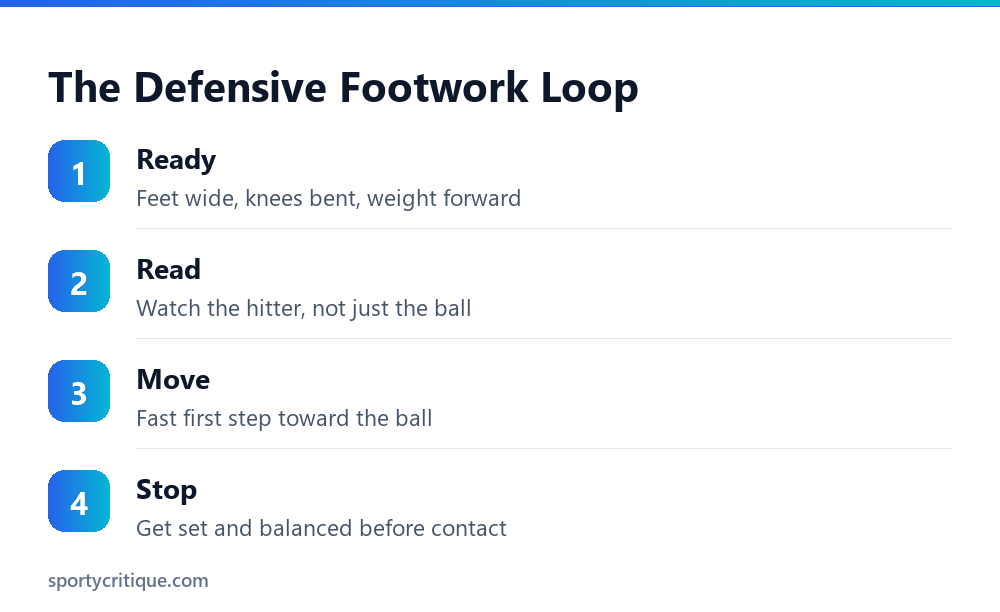
Good volleyball defensive footwork drills train a loop: get ready, read the hitter, move fast, and stop balanced before the ball arrives. Start with the ready position, then practice the first step, short shuffles, and a controlled stop. The 4 Square drill, where a player sprints to a coach-called cone and returns to a ready stance, builds quick changes of direction and the habit of resetting. Arriving late, or moving while still contacting the ball, makes a clean pass much harder, so footwork helps a lot on defense.
Defense in volleyball looks like arm skill, but it starts at the feet. A player who reaches the right spot early has time to square the platform and pass the ball to the target. A player who arrives late has to lunge, swing the arms, and hope. The difference is rarely strength. It is preparation.
- →Defense is a loop of ready, read, move, and stop, and each part can be trained
- →A balanced ready position makes the first step faster in every direction
- →Reading the hitter lets you start moving before the ball is struck
- →Getting stopped before contact is what lets the arms work from a stable base
- →Short, frequent drills beat occasional long sessions
Table of Contents
The Ready Position
A common ready position looks like this: feet about shoulder width apart, knees bent, weight forward on the balls of the feet, a straight back, and hands in front of the body. The exact stance varies by coach and player, but the idea is a position from which you can move in any direction without first having to shift your weight.
A common mistake is standing too tall. Upright players have to bend first, then push, which costs time. Another is leaning back on the heels. Weight that sits behind the feet slows the first step toward the net and toward the sidelines.
💡 Pro tip: Check your ready position with a mirror or a phone video. Many players think their knees are bent, but they are not bent enough to load the legs.
Read Before You Move
Good defenders do not wait for the ball to leave the hitter’s hand. They watch the setter, the hitter’s approach, and the angle of the shoulders, and they start moving toward where the ball is likely to go. A coach may call this reading the hitter.
Reading is a skill you can practice. In a game, ask yourself before each rally where the hitter wants to go and what shot is most likely from their position, then check whether you were right. Over a season, your guesses improve.
📊 Note: Reading helps, but it is not a license to guess early and commit. Good defenders move toward the likely spot and stay balanced enough to adjust if the hitter changes the shot.
The First Step and Short Shuffles
The first step is the one that decides whether you arrive early or late. Start it from the ready position with your hips low, and keep it short and quick rather than a long reach. Your coach can show you the footwork they prefer for each direction.
For short distances, shuffle with quick, small steps and keep your feet apart. Crossing your feet is faster over longer distances, but it leaves you off balance at the end, so many coaches teach players to cross over for a few steps and then plant and re-square.
Whatever the distance, finish with a stop. Players who arrive while still moving have to contact the ball on the run, which makes the platform unstable and the pass unpredictable.
Drill 1: The 4 Square Drill
Sportplan describes a simple drill called 4 Square. Set up four cones in a square in the back court and letter them A to D. One player stands in the middle in a ready position. The coach calls a cone, and the player sprints to it, returns to the center, and gets back into a ready position.
As soon as the player is ready, the coach calls another cone. The drill builds spatial awareness, quick changes of direction, and the habit of resetting into a ready stance between movements. It is also a good way to practice reaching difficult balls quickly.
You do not need real cones. A 12-pack of 9 inch rubber spot markers ($18.79, checked October 7, 2026) works well, since flat markers do not trip anyone, and you can lay out the square in a few seconds. Call the markers by letter or color, and have a partner call them in an unpredictable order.
Drill 2: Shadow and Stop
Pair up. One player stands in a ready position, and the other points or signals a direction and a distance. The first player moves to the spot, stops balanced, and freezes in a platform position. The partner checks the feet, the knees, and the arms.
The point is the stop. Freeze for a second at each spot, then go back to ready. Do ten to fifteen repetitions, rest, and repeat. Keep it unhurried at first, and add speed only when the stop is clean.
Drill 3: Read and React With a Partner
One player stands on a box or at the net with a ball, and the other defends in a ready position a few meters back. The first player shows a shot, such as a line shot or an angle shot, by moving the ball, and the defender reads the move and steps toward it.
No ball is thrown at first. The goal is to train the read and the first step. Once the defender reacts well, the partner can toss a soft ball to the spot, and the defender passes it back with a clean platform.
Drill 4: Solo Footwork Ladder of Distances
If you are alone, use markers to set short, medium, and long distances from a central spot, in two or three directions. Start in a ready position, step to a marker, stop, and return.
Mix the order, so you cannot predict the next marker, and add a ball when you can. Keep each round to around fifteen to twenty seconds, then rest, since quality drops quickly when you are tired.
Common Footwork Mistakes
Footwork Habits
- ✓Return to a ready position after every movement
- ✓Move early toward where the ball is likely to go
- ✓Stop and square up before contact
- ✓Practice short, frequent sets with rest between
- ✕Stand upright with straight legs
- ✕Wait to move until the ball is struck
- ✕Contact the ball while still running
- ✕Drill to exhaustion and let form fall apart
Warming Up Before Defensive Work
Cold legs and quick direction changes are a poor mix. Spend a few minutes on easy jogging, leg swings, lateral shuffles at half speed, and a few bodyweight squats before any footwork drill. The aim is to raise your heart rate, loosen the hips and ankles, and practice the movement patterns slowly before asking for speed.
Include a short set of ankle and hip mobility moves, since defensive movement asks them to work through a wide range. If you have a history of ankle or knee injury, ask a coach or physiotherapist what warm-up suits you.
Staying Ready Between Rallies
Footwork starts before the rally. Between points, take a breath, check your position, and get set a second before the serve. Players who drift out of a ready position after a long rally often arrive late on the next ball, and the habit is easy to fix with a simple reset routine.
Use a cue, such as touching your knees or a quick step into position, that tells your body to load up. Consistent routines also help with focus, which matters as much as the movement itself when matches run long.
Progressing Drills to Game Speed
Start each drill slowly and clean. Once the stop and the ready position look right at slow speed, add speed, then add decisions, such as a partner calling the direction at the last moment, and finally add a ball. Each step makes the drill more like a match.
Do not skip stages. A drill that is hard to read at slow speed becomes sloppy at fast speed, and sloppy repetitions build habits you will have to unlearn later. If form slips, drop back one stage and rebuild.
Finish practice with a few game-like repetitions, such as digging balls tossed from the net in a random order. The footwork you built in drills only pays off when it shows up under match pressure, so give it a chance to do so.
Back Row Positioning and Footwork
Where you start affects how far you have to move. A Human Kinetics volleyball coaching excerpt places back-row defenders at roughly 15 feet from the net and 7 feet inside the sidelines for the left and right back, with the middle back deep or up on the attack line. Teams vary, so use the system your own coach teaches.
Practice footwork from your actual starting spot, not from the center of the court. Drills that begin where you normally stand teach distances you will really cover in a match.
Building a Weekly Plan
Spend five to ten minutes on footwork at the start of practice when your legs are fresh, and two or three days a week is enough to see change. Add the ball once the movement is clean, and keep rest breaks short but real.
Track one metric at a time, such as how often you stop balanced, or how many times in a row you reach the marker in time. A simple log shows progress that is hard to feel.
⚠️ Watch out: Stop any drill that causes pain in the knees, ankles, or back, and check with a coach or a physiotherapist. Fast changes of direction load the joints, so build up gradually.
Working With Your Team
Footwork drills work best when the team agrees on the calls. Decide who takes the ball in the middle, who takes the line, and who calls for it, and practice those calls with the movements. A well-placed player who moves early still needs to tell teammates, so no one else steps in.
For more on how the setter, middle blocker, and outside hitter fit into defense, see our guides on what an outside hitter and a middle blocker do, and on serve receive platform technique.
Frequently Asked Questions
What is the best volleyball defensive footwork drill?
A drill that trains the full loop of ready, read, move, and stop. The 4 Square drill is a simple, well known example.
How do I get a faster first step in volleyball?
Keep your knees bent and weight forward in the ready position, keep your first step short and quick, and practice short, explosive starts.
Should I cross my feet or shuffle on defense?
Shuffle for short distances. For longer distances, many coaches teach a few crossover steps and then a plant to re-square before contact.
Can I practice volleyball defense alone?
Yes. Set markers at different distances and directions, step to each, stop balanced, and return.
Why do I keep arriving late to the ball?
Common causes are standing too tall, waiting for the ball to be hit before moving, or not reading the hitter.
How often should I do footwork drills?
Two or three short sessions a week, with the ball added once the movement is clean.
Defensive footwork is trainable. Build a balanced ready position, practice reading the hitter, drill the first step and the stop, and the ball will seem to arrive more slowly, because you will already be there.
As an Amazon Associate, we earn from qualifying purchases through links on this page.