Volleyball Hand Signals Explained: Referee and Player Signals Decoded

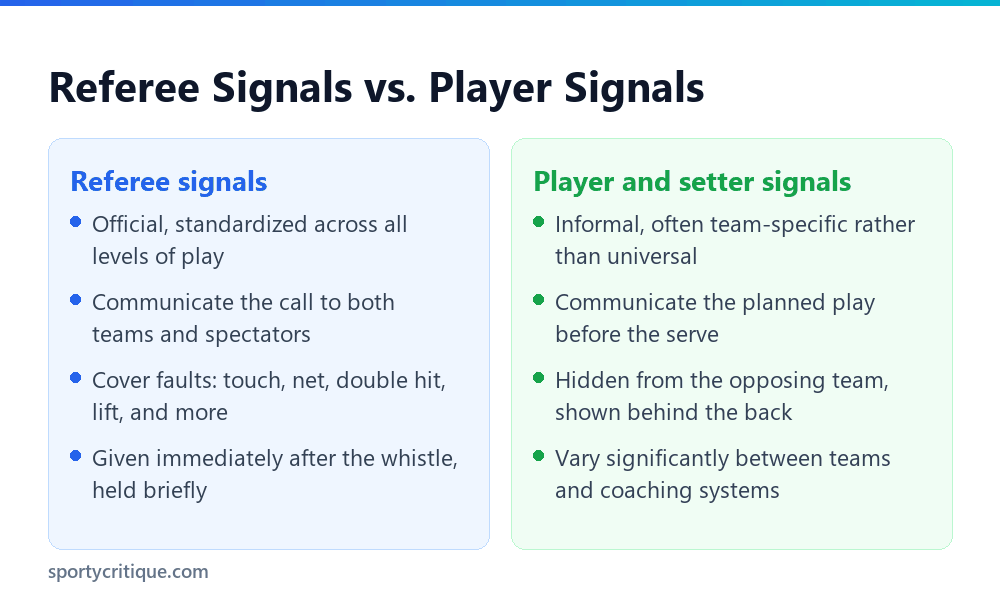
Volleyball hand signals explained simply: they fall into two distinct categories. Referee signals are official, standardized gestures given after the whistle to communicate a specific call, a fault, a violation, or the outcome of a rally, to both teams and spectators. Player and setter signals are informal, team-specific gestures, often shown behind the back before the serve, used to communicate an upcoming play to teammates without tipping off the opposing team.
New players and even longtime fans often mix these two systems up, assuming every hand gesture on a volleyball court has some official rulebook meaning. In reality, only the referee’s signals are standardized and defined by the rules; everything a setter or hitter signals to a teammate is a team-specific code with no official governing body defining it.
- →Referee signals are official and standardized; player signals are informal and team-specific
- →Referee signals communicate a call to both teams and spectators after the whistle
- →Player and setter signals communicate an upcoming play, hidden from the opposing team
- →Common referee signals include ball in, ball out, double hit, and net touch
- →Learning to read referee signals helps fans and new players follow calls in real time
Table of Contents
Official Referee Signals
Referee hand signals are standardized specifically so that players, coaches, and spectators at any level of organized play, from a school gym to an international tournament, can understand a call without needing to hear a verbal explanation. This matters especially in loud arenas where a spoken call might not carry, and it keeps officiating consistent across different leagues and countries that share the same signal system.
📊 Note: Referees typically hold a signal for a few seconds after making it, giving both teams and the scoring table time to register the call clearly before play resumes. Rushing through a signal too quickly defeats the purpose of having a standardized visual system in the first place.
The Second Referee’s Role
In matches with two officials, the first referee, positioned on a stand above the net, makes the primary calls, while the second referee, positioned at floor level near the net post, watches for violations the elevated position can’t see clearly, like a foot fault on the service line, a player touching the net, or a substitution request from the bench.
Both officials use the same standardized signal vocabulary, but a call from the second referee specifically often relates to net play or substitutions, given their closer, lower vantage point relative to those specific parts of the court. Understanding that two officials are watching different aspects of play helps explain why a call sometimes originates from the floor-level official rather than the elevated first referee.
Player and Setter Signals
Unlike referee signals, player signals have no official rulebook definition and vary significantly from team to team, sometimes even changing from season to season within the same program as coaches introduce new systems. A setter commonly flashes a quick hand signal behind their back before the serve, indicating to hitters which play is coming, a quick set, an outside set, a back-row attack, without the opposing team being able to see or intercept the information.
⚠️ Watch out: Because these signals are team-specific, there’s no universal chart a new player can memorize to understand another team’s system. Anyone joining a new team should expect to learn that program’s specific signal vocabulary from scratch, even with prior volleyball experience elsewhere.
💡 Pro tip: Teams often use simple, memorable systems, numbers held against the leg, or specific finger combinations, rather than complex signals that are easy to fumble under match pressure. The goal is quick, reliable communication in the few seconds available before serve, not an elaborate code.
Why Player Signals Stay Hidden
- ✓Give signals behind the back or below net height, out of the opponent’s sightline
- ✓Keep the signal system simple enough to execute quickly under match pressure
- ✓Change signals periodically if an opponent appears to be reading them
- ✓Confirm signals with teammates during timeouts if there’s any confusion
- ✕Signaling in a way visible to the opposing team’s blockers or bench
- ✕Using an overly complex system that increases the chance of a missed or wrong signal
- ✕Assuming an opponent can’t or won’t try to read an exposed signal
- ✕Sticking with a compromised signal system out of habit rather than adjusting it
Libero and Captain Communication
The libero, a defensive specialist with restricted rotation and attack rules, sometimes uses specific signals to communicate with the setter about rotation or coverage responsibilities, separate from the offensive play-calling signals used by a setter and front-row hitters. This communication tends to focus more on defensive positioning than on calling a specific attack.
Team captains, meanwhile, are the only players permitted to formally address the referee about a call or a rule interpretation, and this interaction is typically verbal rather than signal-based, since it involves an actual conversation about a specific ruling rather than a quick, silent communication during live play.
Signals From the Bench
Coaches sometimes relay play calls or defensive adjustments to players on the court using their own hand signals from the sideline, a practice that’s legal in most competitive levels as long as it doesn’t cause unreasonable delay or unsporting conduct. These bench signals operate under the same team-specific, informal logic as setter signals, varying entirely by program and coaching staff.
At higher levels of play, some organizations restrict how much in-game coaching from the sideline is permitted, which affects how much a team can rely on bench signals during active play versus limiting that communication to timeouts and between-set breaks. Checking the specific rules for a given league or tournament clarifies what’s actually allowed before relying heavily on sideline signaling during a match.
Learning to Read Referee Signals as a Fan or New Player
For someone new to watching or playing volleyball, the fastest way to learn referee signals is watching matches with the signal chart open alongside, pausing on close calls to match the gesture with the outcome being announced. Live matches move quickly enough that trying to learn signals purely by watching without any reference material tends to be slow and frustrating compared to studying them directly first.
Once the small set of common signals, ball in, ball out, double hit, net touch, and lift, becomes familiar, following a match without needing a verbal explanation from a broadcast commentator or a more experienced friend becomes considerably easier. These handful of core signals cover the large majority of calls seen in a typical match.
Timeout and Substitution Signals
Beyond fault calls, referees use a distinct set of signals for administrative stoppages: a flat hand chopping motion typically signals a timeout, while a rotating forearm motion signals a substitution request being processed at the scoring table. These signals matter to spectators and broadcast viewers just as much as fault calls, since they explain why play has paused even when no fault has actually occurred.
The scoring table itself, separate from the two on-court officials, also has its own set of signals and buzzer or light cues to formally register a timeout or substitution request before the referee waves play to resume. Watching for this handoff between the table and the referee clarifies why there’s sometimes a brief pause between a coach’s request and play actually stopping.
Hand Signals in Beach Volleyball
Beach volleyball uses largely the same referee signal vocabulary as indoor volleyball, since both fall under related international governing structures, but the two-player format changes how player signals get used tactically. With only two players per side and no dedicated setter role in the same sense as the six-player indoor game, hand signals in beach volleyball more often communicate blocking strategy, which side of the court a blocker plans to take away, rather than calling a specific offensive play.
These beach volleyball blocking signals are typically given by the blocker to their diving partner behind their back before the serve, letting the defender know which half of the court to prioritize covering. Because the format has only one primary attacking option per side at a time rather than multiple hitters running different plays, the signaling system tends to be simpler than the play-calling signals used in the indoor six-player game.
Video Challenge and Review Signals
At higher competitive levels where video review or challenge systems are available, referees use an additional signal, often a hand motion mimicking a television screen or a specific gesture toward the review official, to indicate that a call is under review rather than final. This signal tells both teams and spectators to wait before assuming the original call stands.
Once a review concludes, the referee typically repeats the original signal if the call is upheld, or gives the corrected signal if the review overturns it, following the same standardized signal vocabulary used for any other call. Lower levels of play without access to video review systems don’t use this signal at all, since there’s no review process available to indicate in the first place.
Frequently Asked Questions
Are volleyball referee signals the same at every level of play?
Largely yes; the core signal set is standardized across most organized volleyball, from high school to international competition, though minor stylistic differences can exist between specific officiating bodies.
Why do setters hide their hand signals behind their back?
To communicate the planned play to teammates without letting the opposing team’s blockers see and anticipate what’s coming. Since these signals are informal and team-specific, they only work as intended if kept hidden from the opponent.
Is there a universal chart for player and setter signals?
No. Unlike referee signals, player signals vary by team and coaching system, so there’s no single universal chart. A player joining a new team has to learn that program’s specific signal vocabulary.
What does it mean when a referee sweeps a hand under the other, palm up?
This typically signals a lift or carry, a fault where the ball rests too long on a player’s hands or arms rather than being cleanly hit.
Can coaches legally signal plays from the sideline?
In most competitive levels, yes, within reasonable limits on delay and conduct, though some organizations restrict in-game coaching more heavily. Checking a specific league’s rules clarifies exact limits.
Do libero signals differ from setter signals?
Generally yes in purpose. Libero-related signals tend to focus on defensive positioning and coverage, while setter signals typically call the specific offensive play or attack.
Understanding both signal systems, official referee calls and informal team communication, gives a much fuller picture of what’s actually happening on a volleyball court beyond just tracking the score. Referees keep the game consistent and fair across every level of play, while player signals are one of the quieter tactical layers that separates a well-coordinated offense from one that’s guessing at what comes next.
None of these signal systems require special equipment or formal training to learn; they simply take repeated exposure, watching matches, playing on an organized team, or officiating a few games, before they become second nature to read and use correctly.
As an Amazon Associate, we earn from qualifying purchases through links on this page.