How to Get Faster at Running: Speed Work That Actually Works

You get faster by building a large aerobic base with mostly easy running, then adding one hard session a week — intervals for your ceiling, tempo runs for your sustainable effort. Add strides (6–8 x 20 seconds fast, full recovery) after easy runs for almost free speed, and strength train twice a week to improve running economy. The order matters enormously: speed work layered on a thin aerobic base produces a few weeks of improvement and then a plateau or an injury.
Getting faster is the goal almost everyone has and almost everyone approaches backwards. The instinct is to run faster more often. The reality is that speed sits on top of endurance, and the runners who improve year after year are the ones who spend most of their time running slowly enough that it barely feels like training.
This guide assumes you can already run continuously for half an hour and have a few months of consistent running behind you. If not, start with how to start running — and if your base is thin, building endurance will make you faster than any speed session will.
- →Speed is built on endurance. Base first, speed second — not the other way round.
- →One hard session a week is enough for most runners. Two is the maximum.
- →Strides are the cheapest speed gain available and almost nobody does them.
- →Running economy — oxygen cost at a given pace — is the most trainable lever.
- →Strength training makes you faster without running a single extra mile.
- →Race-specific training beats generic speed work once you have a goal.
What actually determines your speed
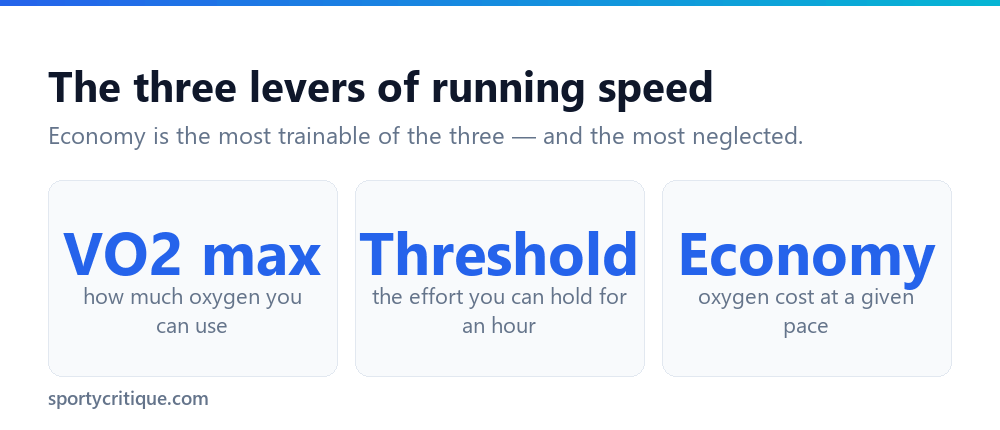
Three physiological qualities set how fast you can run a given distance, and knowing which is which tells you what to train.
VO2 max is the maximum rate at which you can take in and use oxygen — effectively your engine size. It responds to hard interval work, improves relatively quickly in untrained runners, and then becomes stubborn. It’s also the most genetically constrained of the three, which is why chasing it exclusively frustrates people.
Lactate threshold is the effort you can sustain before fatigue accumulates faster than you can clear it — roughly the pace you could hold for an hour. This is far more trainable than VO2 max and matters more for anything from 5k upward. Tempo runs target it directly.
Running economy is how much oxygen you burn at a given pace — the fuel efficiency of your running. Two runners with identical VO2 max can differ substantially in race times because one uses less oxygen to run the same speed. It’s the most trainable quality of the three and the one amateur runners almost entirely ignore, because it improves through strength work, strides, and accumulated mileage rather than through anything that feels like a hard workout.
Two runners with the same engine can be minutes apart over 10k. The difference is economy — and it’s the lever almost nobody trains deliberately.
The order that works
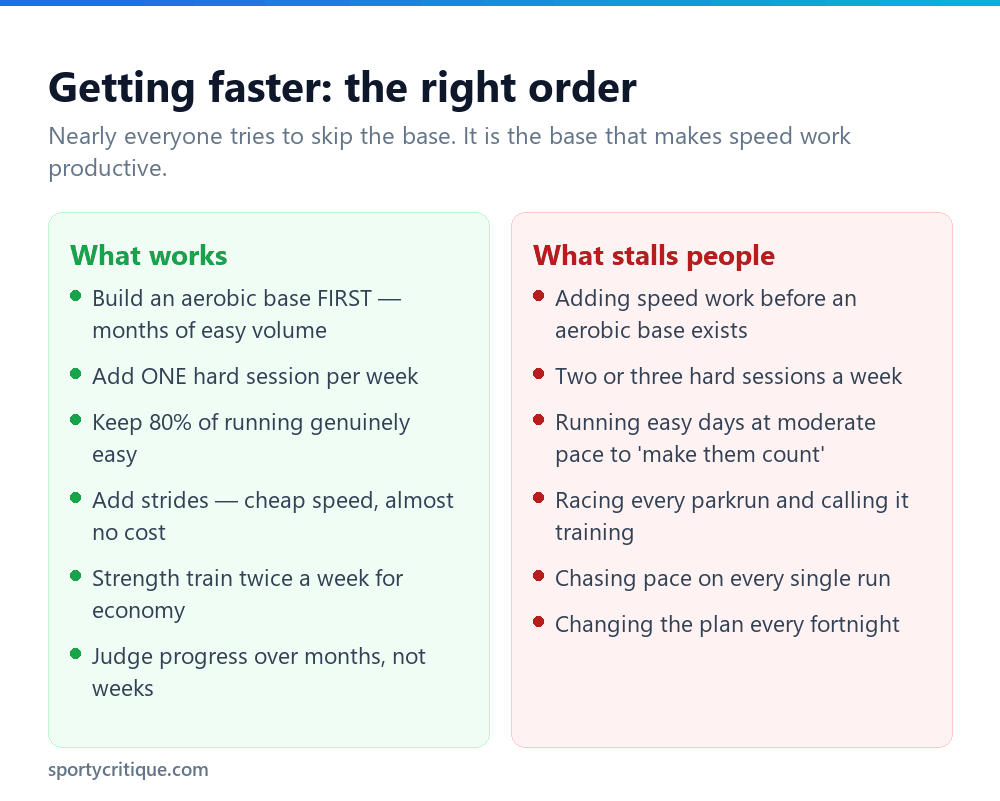
The single most common mistake is adding speed work too early. It’s seductive because it works — for about six weeks. A runner with a thin aerobic base who starts doing intervals will improve quickly, then plateau hard, then usually get injured or burn out.
The reason is that speed work is a stimulus, not a foundation. Intervals sharpen what you already have; they don’t build the capillary density, mitochondrial volume, and structural resilience that let you absorb hard training week after week. Without that underneath, you’re sharpening a blunt tool and wearing it out.
So the sequence is: months of mostly easy running to build the base, then one hard session per week layered on top, with the easy running continuing around it. If you’re ever forced to choose between dropping your hard session or dropping your easy volume, drop the hard session — the base is what makes everything else possible.
⚠️ Watch out: The subtlest failure mode is easy runs creeping faster. Once you start doing speed work, there’s a strong pull to make every run ‘count’, and within a month all your easy runs are moderate. That’s the grey zone described in our endurance guide, and it’s where progress dies quietly.
The four sessions
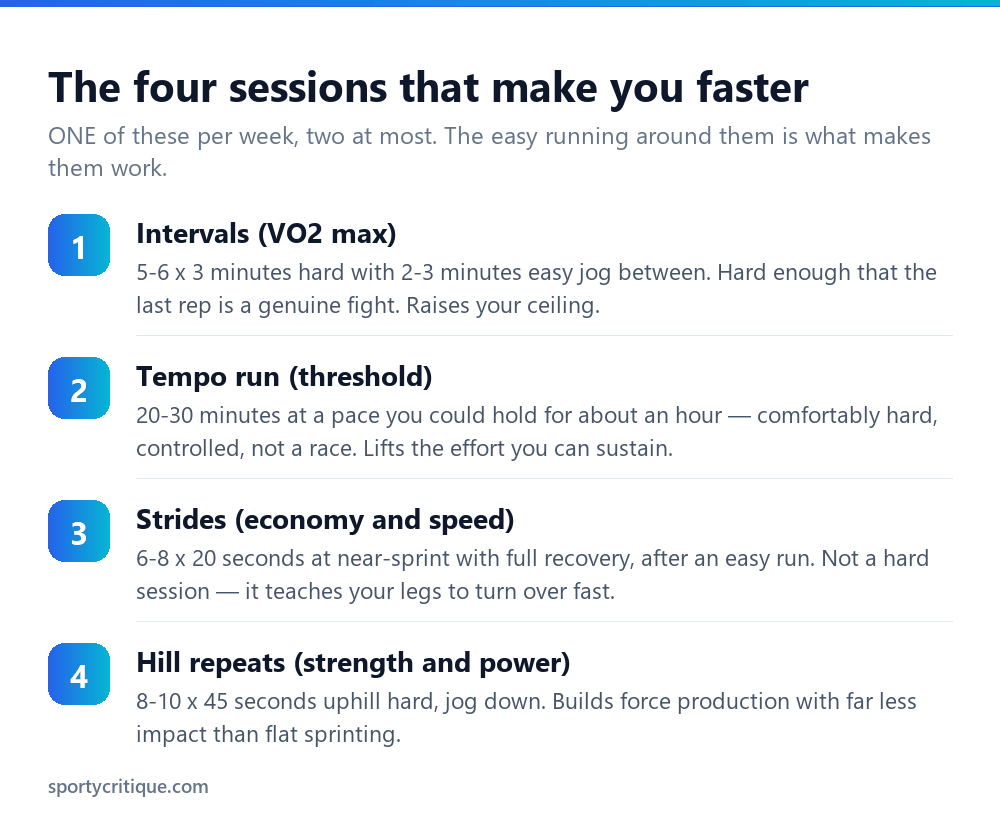
You don’t need all four in a week — you need one, chosen for what you’re trying to improve. Rotate them across a training block rather than stacking them.
Strides deserve special mention because they’re the closest thing to free speed in running and hardly anyone does them. Six to eight accelerations of about 20 seconds, run fast but relaxed, with full walking recovery between, tacked onto the end of an easy run twice a week. They’re not hard enough to require recovery, they don’t disrupt your easy days, and they teach your nervous system and legs to move quickly — which directly improves economy and makes faster paces feel less foreign.
Cadence and form: the economy levers
Economy is where the accessible gains are, and two things move it without any extra running.
Cadence. Many recreational runners take long, reaching strides at around 150–160 steps per minute, landing with the foot well ahead of the body. Each of those landings applies a braking force you then have to overcome. Nudging cadence upward — toward 170–180 — shortens the stride and brings the landing under your centre of mass, cutting the braking and reducing impact. Increase by about 5% at a time; a jump of twenty steps per minute at once just feels ridiculous.
Relaxation. Tension is expensive. Clenched fists, hunched shoulders, and a tight jaw all burn oxygen doing nothing useful. A periodic check — drop the shoulders, unclench the hands, relax the face — is worth real seconds over a long race, and it’s the easiest change on this page.
What isn’t worth much: consciously changing your foot strike. Despite years of argument about heel versus midfoot, the evidence that deliberately switching foot strike improves economy or reduces injury is thin, and forcing it often creates new problems in the calf and achilles. Fix cadence instead and foot strike tends to sort itself out as a consequence.
💡 Pro tip: Count your steps for 30 seconds on your next easy run and double it. If you’re under about 165, cadence is probably your cheapest available gain — and unlike interval training it costs you no recovery.
Strength training makes you faster
This is the most under-used speed tool for distance runners, and it works through economy rather than through anything that feels like running fitness.
Heavy, low-rep strength work — squats, deadlifts, split squats, calf raises — improves the stiffness and force-producing capacity of your legs and tendons. A stiffer, stronger leg returns more energy on each footstrike, so you spend less oxygen at the same pace. The effect shows up in trained runners without any increase in mileage, and it’s especially valuable for runners who can’t add volume without getting injured.
Two sessions a week is plenty. Keep it heavy and low-rep (3–5 sets of 4–6) rather than high-rep circuit work, which just adds fatigue without the strength stimulus. Add plyometrics — bounds, hops, skips — once you’re comfortable, since they train the elastic recoil that economy depends on. And schedule it away from your hard running days, not the day before them.
Train for your distance
Generic speed work gets you started; specific training is what produces race results. The closer you get to a goal race, the more your hard sessions should look like the race itself.
The other half of racing faster is pacing, and it’s where most amateurs lose the most time. Starting too fast is nearly universal and costs far more than it gains — the adrenaline of a start line makes a suicidal pace feel comfortable for about two kilometres. Negative splitting, running the second half slightly faster, produces better times for almost everyone and feels dramatically better.
Testing whether it’s working
Training without a benchmark turns into guesswork, and guesswork is how people abandon plans that were working fine. Pick one test and repeat it every six to eight weeks under similar conditions — same route, similar weather, similar time of day.
A time trial is the simplest option: warm up thoroughly, run 3km or 5km as hard as you can sustain evenly, and record it. It’s unpleasant, which is why people avoid it, but it gives you an unambiguous number. A parkrun serves the same purpose with company and a clock, provided you treat it as a test rather than racing it every single week.
A gentler alternative is a fixed effort check: run a set route at a genuinely conversational pace and record the time. Improvement shows up as the same effort producing a faster time, and it costs you nothing in recovery. This is often the earliest indicator that training is working — easy pace tends to improve before race pace does.
📊 Note: Don’t test more often than every six weeks. Adaptations take that long to show, and testing fortnightly mostly measures how tired you are on the day — which then prompts people to change a perfectly good plan.
Frequently asked questions
How long does it take to get faster at running?
Beginners often see substantial improvement in 2–3 months simply from consistency. For an experienced runner, meaningful gains come over a full season and are measured in seconds per kilometre rather than minutes. The improvement curve flattens the fitter you get, which is normal rather than a sign you’re doing something wrong.
Should I do speed work every week?
One hard session a week suits most runners; two is the upper limit and only once you have a solid base and good recovery. What matters more than the number is that everything else stays genuinely easy — two hard sessions plus moderate ‘easy’ runs is a recipe for stagnation and injury.
Will running more make me faster?
Usually yes, and it’s the most reliable lever there is — provided the extra running is easy and you build up gradually (about 10% a week). More easy volume improves your aerobic base, which raises what your speed work can build on. Most amateurs would gain more from adding two easy runs a week than from adding a second hard session.
Do I need a running watch to get faster?
No, though it helps with pacing sessions. Effort-based training works perfectly well — tempo pace is ‘comfortably hard’, intervals are ‘hard’, easy is ‘conversational’. Some runners actually improve when they stop staring at pace, because they finally let their easy runs be easy.
Why am I slower than I was last year despite training more?
The most common causes are accumulated fatigue from too much intensity, insufficient sleep, or under-fuelling. ‘Training more’ with no easy days produces a runner who is chronically tired rather than fit. Take an easy week — genuinely easy — and see how you feel; many people discover they were simply exhausted.
Does losing weight make you faster?
It can, and it’s also the area where running culture does the most harm. Under-fuelling degrades training quality, weakens bones, and disrupts hormones, and plenty of runners get slower chasing a lower number. Train consistently, eat enough to support it, and let body composition settle where it settles — performance is the better metric.
- →Improve running endurance — the base that speed work is built on
- →How to start running — if you are still building the habit
- →How to breathe while running — rhythm during hard efforts