What Does a Middle Blocker Do in Volleyball? Role, Responsibilities, and Plays


SportyCritique is reader-supported. When you purchase through links on our site, we may earn an affiliate commission at no extra cost to you. As an Amazon Associate, we earn from qualifying purchases.
If you ask athletic trainers which position endures the most brutal physical workload in competitive volleyball, the answer is unanimous: the Middle Blocker (MB). While outside hitters take prolonged breaks between spikes and liberos stay safely grounded in the back row, a middle blocker jumps on virtually every single play—defending against opposing quicks, sprinting 15 feet laterally to form a double block on the outside pin, landing, retreating 10 feet off the net tape, and immediately accelerating back into an explosive 1st-tempo approach.
Positioned centrally in Zone 3, the middle blocker functions as the defensive anchor of the front row and a lightning-fast offensive weapon. Even when a middle blocker doesn’t touch the ball, their approach pulls opposing blockers toward the center of the court, creating one-on-one attacking windows for their wing teammates. This comprehensive guide details the core responsibilities of the middle blocker, lateral crossover footwork mechanics, reading opposing setters, the difference between quicks and the single-leg slide attack, and diagnostic corrections for match play. For a complete guide to defensive net rules, review our breakdown on how to block in volleyball, or explore our central Volleyball Guide.
Table of Contents
The 3 Core Responsibilities of a Middle Blocker
A middle blocker fulfills three distinct responsibilities on every rally:
- Antenna-to-Antenna Net Defense: The middle blocker is the “first blocker everywhere.” Starting in the center of the net, they must read the opposing setter, anticipate the set trajectory, and sprint laterally to either antenna to close a double block with the outside or opposite hitter. There can be zero space between their inside shoulder and the pin blocker’s arm.
- Running 1st-Tempo Fast Attacks: Offensively, middle blockers do not wait for high, slow sets. They run quick 1st-tempo balls (such as the “1” or “quick”) where the middle is already leaping into the air with their arm cocked as the setter contacts the ball. Striking the ball 1 to 2 feet above the tape beats opposing blocks before they can jump.
- The Offensive Decoy: Even when the pass is off-target or the setter chooses to set the outside pin, the middle blocker must execute a 100% full-speed approach. Jumping as a decoy forces the opposing middle blocker to commit, leaving the outside hitter facing an open, single-block net.
Lateral Footwork: The 3-Step Crossover vs. Shuffle Step
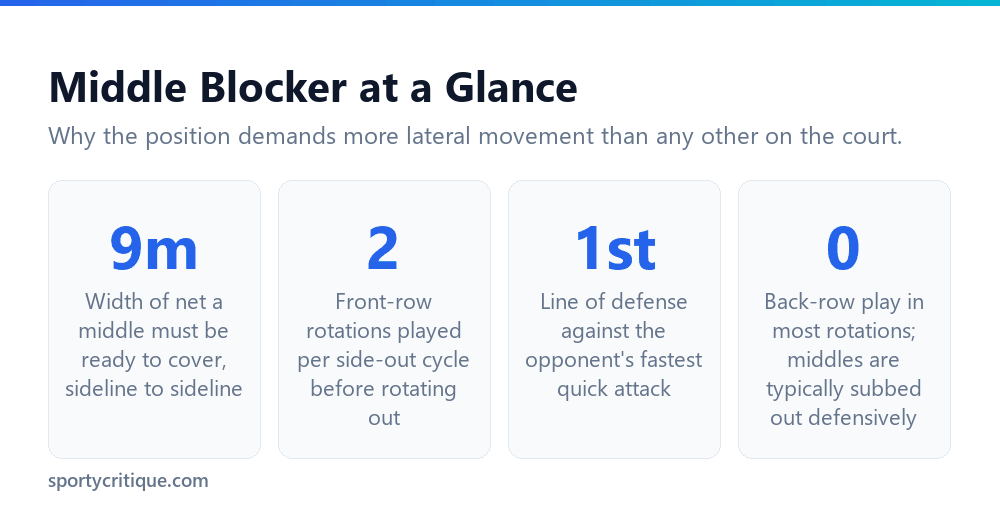
Covering the 15 feet between the center of the net and the outside pins requires strict footwork efficiency. Middles use two primary footwork patterns:
| Footwork Pattern | Foot Mechanics | Distance Covered | When to Deploy |
|---|---|---|---|
| The 3-Step Crossover (Swing Blocking) | Directional lead step → Long dynamic crossover stride → Plant-and-brake block step | 10 to 15 feet (full lateral sprint) | High pin sets to Zone 4 or Zone 2; generates maximum vertical jump height via arm swing |
| The 2-Step Shuffle (Slide-Step) | Lateral push-off step → Quick slide step without crossing feet; torso remains square to net | 3 to 6 feet | Slow, high-trajectory passes, defending the opponent’s middle quick, or tight off-target sets |
The Golden Footwork Rule: When executing a 3-step crossover to the pin, turn your final plant foot 30 to 45 degrees inward toward the center of the court. This heel-strike functions as an emergency brake, converting your lateral sprinting momentum into pure vertical jump lift and preventing you from drifting into the net mesh or rolling an ankle across the centerline.
Defensive Reading: Read Blocking vs. Commit Blocking
Middle blockers cannot jump blindly; they operate within two tactical defensive systems dictated by the coach:
- Read Blocking: The middle blocker stays grounded, tracking the opposing setter’s hand release. Only after the ball leaves the setter’s hands does the middle identify the set direction and sprint to close the block. Read blocking minimizes mistakes against deceptive setters, but requires exceptional lateral closing speed to arrive at the pin on time.
- Commit Blocking: The middle blocker commits 100% to jumping with the opposing middle hitter, leaping simultaneously to roof the quick 1-ball. Commit blocking completely shuts down an opponent’s middle offense, but leaves the outside pins exposed to single blocks if the setter distributes the ball outside.
- Bunch vs. Spread Formations: In a “bunch” defense, the middle stands with feet shoulder-width apart, arms raised at chest level, within 3 feet of the setter. In a “spread” formation, the middle cheats wider toward the opponent’s primary power attacker.
Offensive Weapons: The 1-Ball (Quick) vs. The Slide Attack
Middle blockers run distinct offensive routes designed to exploit gaps in the opponent’s blocking wall:
1. The 1-Ball (A-Quick)
The staple middle attack. The middle takes a compact 2-step or 3-step approach directly in front of the setter. The middle takes off into the air before or simultaneously with the setter contacting the ball. The setter delivers a fast, low ball directly into the middle’s hitting window 1 to 2 feet above the tape. The middle snaps their wrist over the ball, driving it sharply down into the 10-foot area.
2. The Slide Attack (Single-Leg Takeoff)
The slide attack is one of the most effective offensive plays in competitive women’s collegiate and international volleyball. The middle fakes an approach toward the center of the net, then accelerates laterally behind the setter toward the right antenna (Zone 2). The middle leaps off one foot (like a basketball layup), drifting horizontally through the air while chasing a fast set floated behind the setter. Because the middle is moving sideways at speed, the opposing middle blocker cannot establish a stationary block, creating an easy kill off the blocker’s outside hands.
Why Middle Blockers Sub Out for the Libero in the Back Row
Middle blockers are typically the tallest players on the team, often ranging from 6’1″ to 6’6″ in women’s collegiate volleyball and 6’6″ to 7’0″ in men’s play. While height and long wingspans are massive assets at the net tape, they are liabilities in back-row defense. Tall athletes have a higher center of gravity, slower lateral acceleration for diving, and struggle to drop under fast float serves.
Under official rotation rules (rotation rules guide), as soon as a middle blocker rotates into the back row (or after their service turn under USAV rules), the Libero enters via the replacement zone to take over back-row defense in Zones 6 and 5. This preserves team passing stability while giving the middle blocker rest before their next front-row rotation.
Middle Blocker vs. Outside Hitter vs. Opposite Hitter
| Position | Court Zone | Primary Offensive Role | Primary Defensive Role | Back-Row Duty |
|---|---|---|---|---|
| Middle Blocker (MB) | Zone 3 (Center Net) | 1st-tempo quick attacks (“1-balls”), slides, offensive decoy | Primary blocker everywhere; closes double blocks on both pins | Substituted out for the Libero; rarely passes or digs |
| Outside Hitter (OH) | Zone 4 (Left Pin) | High-volume power attacks; out-of-system emergency high sets | Blocks opponent Opposite; anchors cross-court defense | Primary serve-receive passer; plays 6 full rotations |
| Opposite Hitter (OPP) | Zone 2 (Right Pin) | Heavy power hitting from right pin; back-row attack out of Zone 1 | Sets the block against the opponent’s primary Outside Hitter | Digs hard-driven spikes in Zone 1; acts as backup setter |
Diagnostic Troubleshooting: 6 Common Middle Blocker Errors & Fixes
If you play middle blocker and find yourself arriving late to the pins or getting whistled for net faults, reference this diagnostic table:
| Observable Breakdown | Biomechanical Root Cause | Immediate Correction Cue |
|---|---|---|
| Ball consistently splits between you and pin blocker (Open Seam) | Arriving late to the pin or jumping with hands drifting apart from teammate | Commit your eyes to the setter release earlier; seal your inside shoulder tightly against the pin blocker’s arm |
| Frequent net violations on your chest or stomach | Broad-jumping forward during crossover steps rather than braking vertically | Turn plant foot 45° inward on final approach step; direct jump 100% upward from 12 inches off net mesh |
| Arriving late to outside pin sets | Using small shuffle steps instead of an explosive 3-step crossover approach | Take a long, powerful crossover stride with arms driving backward to gain lateral distance |
| Consistently getting blocked on quick sets | Jumping after the setter releases the ball rather than being airborne during contact | Speed up approach; you must be in the air with arm cocked as the ball enters the setter’s hands |
| Severe knee pain (Patellar Tendonitis / Jumper’s Knee) | Landing stiff-legged on single feet or absorbing landing shock strictly in knees | Land softly on the balls of both feet simultaneously; bend knees to 90° to load glutes and hamstrings |
| Getting whistled for reaching over the net | Touching the ball on the opponent’s side before or during the opponent’s attack swing | Wait for the attacker to initiate contact before penetrating wrists across the vertical net plane |
Essential Equipment for Middle Blockers
Middle blockers perform over 250 vertical jumps per match, subjecting knees, ankles, and fingers to heavy stress. These four gear items maximize jumping performance and joint safety:
| Product | Category / Purpose | Key Specifications | Target Benefit | Check Price |
|---|---|---|---|---|
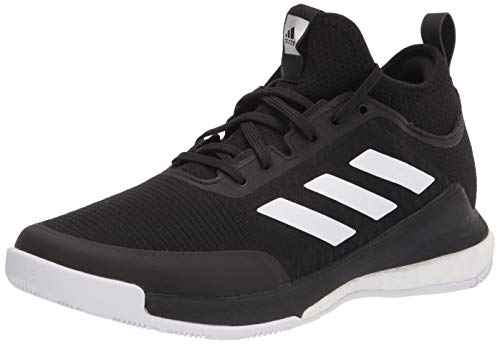
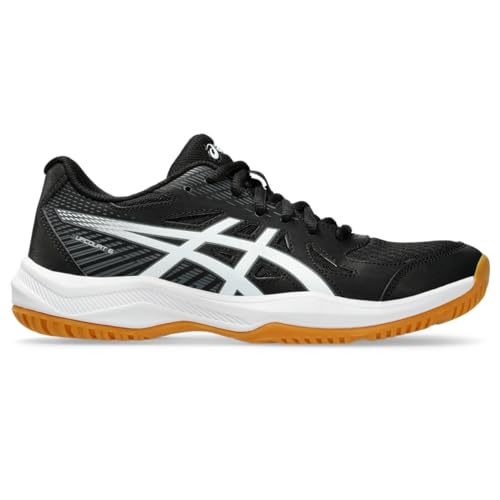
| Mizuno Wave Momentum 3 Court Shoes | Max Cushion & Landing Shock Footwear | Full-length Enerzy foam cushioning, high midfoot collar, non-marking gum rubber sole | Absorbs heavy vertical landing shock on hardwood floors and provides lateral stability on crossover stops | View on Amazon |
| Bauerfeind GenuTrain Knee Support | Patella Tendon & Joint Stabilization | Medical-grade compression sleeve with contoured Viscoelastic Omega pad | Relieves patellar tendonitis (jumper’s knee) pain and stabilizes kneecaps during repetitive jump loading | View on Amazon |
| Mueller Athletic Zinc Oxide Finger Tape | Finger Protection & Joint Splinting | 100% cotton rigid adhesive tape; tear-resistant support | Buddy-tapes middle and ring fingers together to prevent dislocations when blocking 65+ mph spikes | View on Amazon |
| Active Ankle T2 Rigid Ankle Brace | Bilateral Ankle Roll Protection | Rigid bilateral plastic shell with foam padding and quick single-strap system | Protects ankles from catastrophic sprains when landing near teammate feet or crossing centerline | View on Amazon |
Frequently Asked Questions
How tall does a middle blocker have to be?
While no minimum height is mandated by rule, height is critical for the position. In NCAA Division 1 women’s volleyball, middle blockers typically range between 6’1″ and 6’5″. In men’s collegiate and international competition, middles average 6’7″ to 7’0″. However, exceptional lateral speed, explosive vertical leap, and disciplined penetration over the net tape can compensate for shorter stature at high school and club levels.
What is the difference between a 1-ball and a slide in volleyball?
A 1-ball is a 1st-tempo set delivered directly in front of the setter where the middle takes off from a two-foot plant in the center of the court. A slide is an attack where the middle approaches behind the setter toward the right antenna, leaping off a single foot while drifting horizontally through the air to hit a floating set.
Can a middle blocker serve in volleyball?
Yes. Under standard rotation rules, when a middle blocker rotates from Zone 2 to Zone 1, they take their regular turn to serve. If their team loses the rally on their serve, the middle is replaced by the Libero for the remaining back-row rotations (Zones 6 and 5). Under USAV rules, teams may also choose to have the libero serve in place of the middle blocker.
What does “closing the block” mean in volleyball?
“Closing the block” means the middle blocker moves laterally from the center of the net to position their inside arm tightly against the pin blocker’s outside arm, leaving zero space between them. Closing the block creates a solid, unified two-person wall that prevents the attacker’s spike from slipping through the seam.
Why is middle blocker called the most thankless job in volleyball?
Middle blockers jump on nearly every single rally—often over 200 to 300 times in a 5-set match—yet receive fewer sets than outside hitters. Much of their offensive value comes from sprinting as a decoy to draw opposing blockers away from teammates without ever touching the leather. Their work requires immense selflessness and endurance.
Deepen Your Volleyball Skills:
- Volleyball Cornerstone Guide — Master rules, court dimensions, positions, and gear guides.
- How to Block in Volleyball — Swing blocking, net penetration, and stopping the tool.
- What Does a Setter Do? — Reads, decision-making, and offensive set distribution.
- What Does a Libero Do? — Responsibilities, jersey regulations, and setting restrictions.
- How to Spike a Volleyball — In-depth vertical approach, penultimate brake, and attack timing.
- Volleyball Rotation Rules Explained — 5-1 vs 6-2 systems, overlap rules, and attack lines.
- Serve Receive Platform Technique — Master 4-step platform anatomy and the 0-to-3 passing scale.
- How to Set a Volleyball — Hand shape, footwork stagger, back set, and offensive set tempos.
- How to Play Volleyball — Complete beginner rules, rotations, and positions.
- How to Hit a Volleyball — Passing, setting, attacking, and defensive digging mechanics.
- How Volleyball Scoring Works — Rally scoring rules, side-outs, and tiebreak sets.
- Volleyball PSI & Inflation Guide — Regulation air pressure standards for indoor and beach play.