Outdoor Shuffleboard: Court Rules, Scoring, and Cue Technique

Outdoor shuffleboard — also called deck, court, or floor shuffleboard — is played on a court 39 feet long and 6 feet wide, using a long cue to push flat discs into a scoring triangle at the far end. Zones score 10, 8, 8, 7, 7, and behind them sits the −10 ‘kitchen’, which subtracts ten points. Both players score every disc that lands fully inside a zone, and games run to 50, 75, or 100.
This is the shuffleboard of cruise ship decks, Florida parks, and retirement community courts — and it’s badly served online, because most shuffleboard content is published by companies that sell wooden bar tables. If you searched for shuffleboard rules and got a page about waxing a table, this is the guide you were actually looking for.
It’s also a genuinely good game: slower than the table version, more precise, and considerably more tactical than its gentle reputation suggests. The presence of a penalty zone changes everything about how you shoot.
- →Court is 39 x 6 feet with a scoring triangle at each end; discs are pushed with a cue called a tang.
- →Scoring zones are 10, 8, 8, 7, 7 — and the kitchen behind them is minus 10.
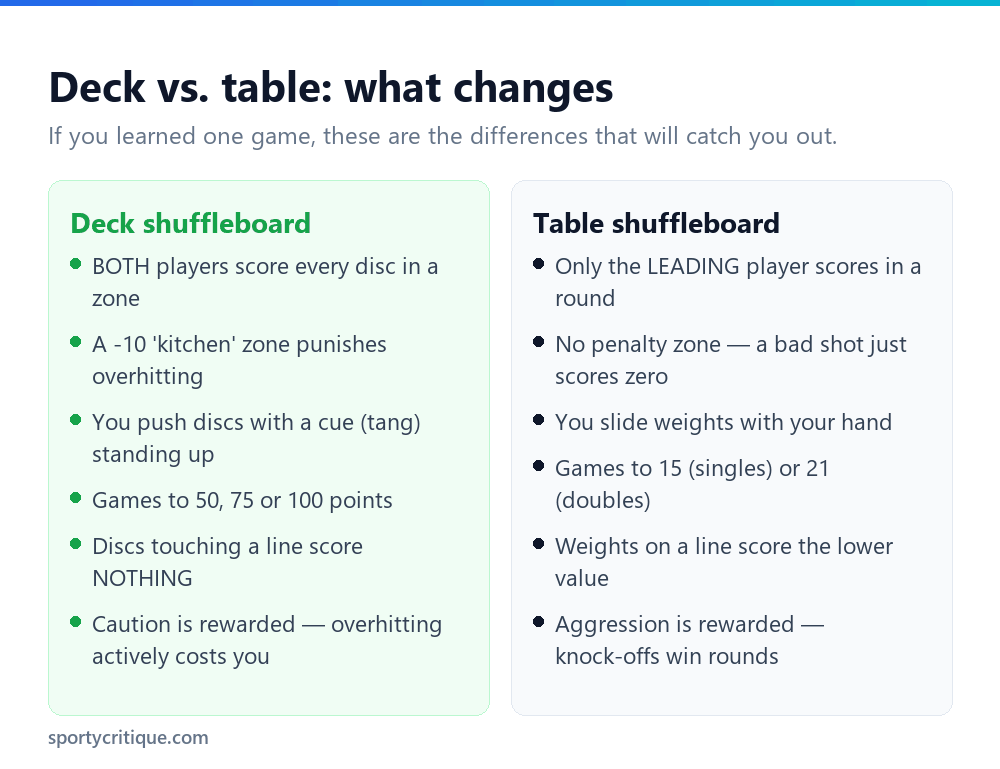
- →Unlike table shuffleboard, BOTH players score all their discs in scoring zones.
- →A disc touching any line scores nothing at all — it must be fully inside.
- →Games go to 50, 75, or 100. Yellow shoots first in the opening frame.
- →Overhitting is punished, so this is a game of restraint rather than power.
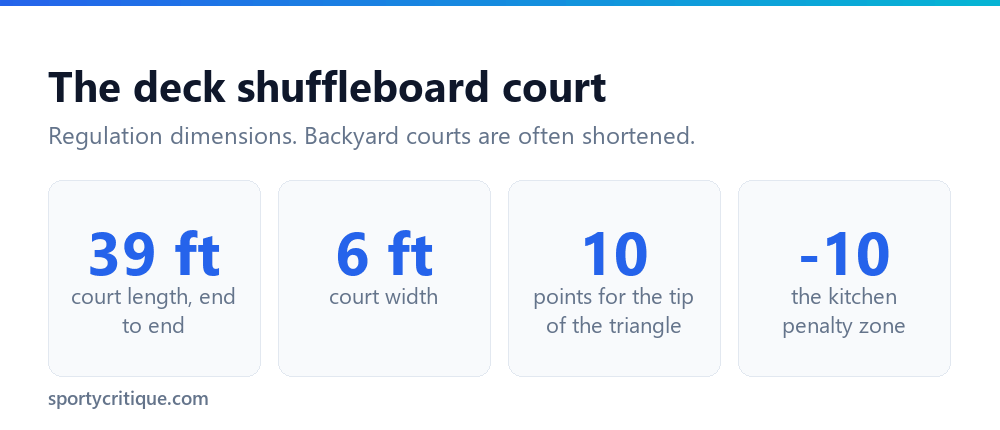
Table of Contents
The court and the scoring diagram
A regulation court is 39 feet long and 6 feet wide, usually painted onto concrete or a composite surface. At each end sits a triangular scoring diagram, and understanding its layout is most of the game.
The triangle points back toward the shooter. Its tip — the deepest, hardest-to-reach section — is worth 10. Behind that are two zones worth 8 each, then two worth 7. And directly behind the whole triangle, at the very far end, is a rectangle marked −10: the kitchen.
The kitchen is what makes deck shuffleboard interesting. In table shuffleboard, a shot that’s too hard simply falls off the end and scores nothing — annoying but neutral. Here, a shot that’s slightly too strong sails past the 10 and lands in a zone that subtracts ten points from your score. The difference between the best possible shot and a ten-point disaster is a few inches of extra force.
⚠️ Watch out: That last row catches out every table shuffleboard player. On a table, a weight touching a line scores the lower value. On a court, a disc touching a line scores zero. It’s the single most common scoring dispute in casual play — settle it before the first frame.
How a game is played
Two players (singles) or four (doubles) use eight discs total, four yellow and four black. Yellow shoots first in the opening frame. Players alternate shots until all eight discs are played — that completes a frame, sometimes called a round or an end.
Then you score. Every disc lying fully inside a scoring zone counts for its owner, and both players score in the same frame — a significant departure from the table game, where only the leader scores. Add the positives, subtract any kitchens, and record the frame.
For the next frame, players move to the other end of the court and shoot back the way they came, and the player who scored lower in the previous frame shoots first — a small catch-up mechanism that keeps games competitive. Play continues until someone reaches the agreed target: 50 for a short game, 75 for standard, 100 for a long one.
In doubles, partners stand at opposite ends of the court, which means you each shoot every other frame and spend the alternate frame scoring and returning discs. It also means you can’t confer mid-frame about what to do — your partner is 39 feet away, playing the shot you’d have played differently.
Cue technique: push, don’t hit
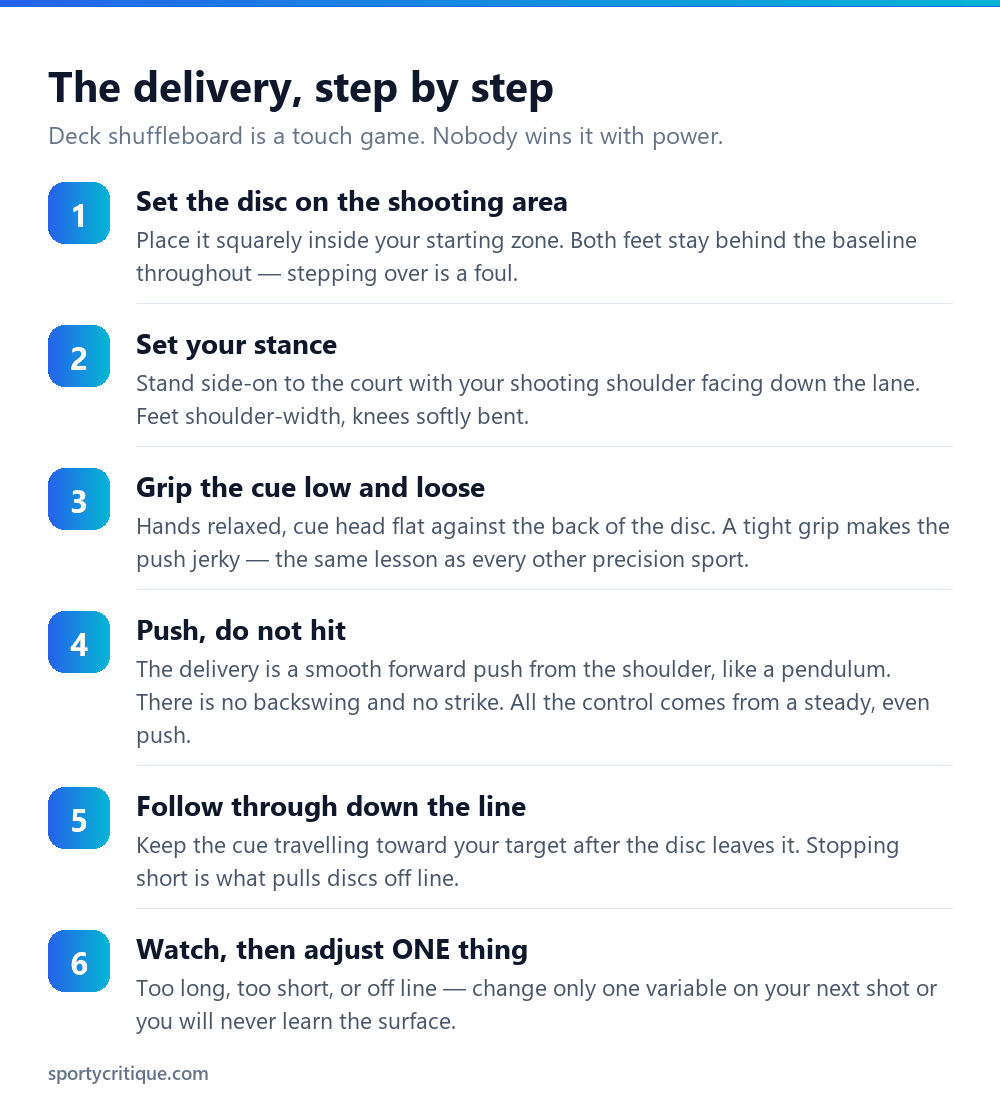
The technical heart of the game is that this is a push, not a strike. There’s no backswing. You place the cue head against the back edge of the disc and push it forward in one smooth, accelerating motion, following through toward your target.
Almost every beginner error traces to treating it like a shot. Jabbing at the disc produces wild variation in distance, because a short sharp impulse is far harder to reproduce than a long smooth push. If your distances are scattered, the fix is nearly always a slower, longer delivery rather than a more careful aim.
Aim is the easier half. Because you’re pushing along a line, the cue itself shows you your direction — line the cue up down the lane and keep it travelling there through the follow-through. Discs that drift off line usually come from a delivery that stopped at the disc rather than continuing past it.
💡 Pro tip: Before a game, take five practice pushes aiming to stop discs just inside the 7 zone — the safest, shallowest target. This calibrates you to the day’s surface, which matters more outdoors than anywhere else: a damp court plays slow, a hot dry one plays fast, and yesterday’s calibration is worthless.
Strategy: the kitchen changes everything
Because overhitting carries a ten-point penalty, deck shuffleboard rewards a fundamentally conservative approach that table players find counterintuitive. Some principles that follow from that:
Our shuffleboard strategy guide covers shot selection in more depth, and much of it transfers between the two versions of the game.
Fouls and penalties
Casual games ignore most of these, but they’re worth knowing before you play anyone who takes it seriously — and a few of them come up naturally even in friendly play.
The one that trips people up in ordinary play is the baseline. It’s a natural instinct to step forward as you push — it feels like it adds control — and it’s a foul in every ruleset. If you find your discs consistently going long, check whether you’re creeping over the line and adding unintended momentum.
Playing outdoors: the variables nobody warns you about
Deck shuffleboard is affected by conditions far more than the indoor game, and knowing this is the difference between adapting and getting frustrated.
Surface speed changes daily. Courts are dusted with shuffleboard sand or beads — tiny silicone spheres that reduce friction. Fresh beads make a court fast; a court that hasn’t been swept in a week plays slow and unpredictably. Humidity, morning dew, and heat all shift it too. Always take practice pushes.
Courts are rarely perfectly level. Outdoor concrete settles and slopes slightly for drainage. Watch a few discs and you’ll often notice a consistent drift to one side — that’s the court, not you. Once you spot it, aim off to compensate rather than fighting it.
Debris ruins shots. A single leaf, twig, or patch of grit will stop a disc dead or deflect it. Sweep before you play; most permanent courts keep a broom for exactly this reason, and using it is considered normal courtesy rather than fussiness.
📊 Note: If you’re building your own, a backyard court doesn’t have to be regulation. Shortened courts of 25 to 30 feet play perfectly well and fit far more gardens — the scoring triangle keeps its proportions, the game just needs less push. Our guide to making a shuffleboard court covers the concrete, marking, and finishing.
Frequently asked questions
What is the kitchen in shuffleboard?
The −10 penalty zone behind the scoring triangle on a deck shuffleboard court. Land a disc fully inside it and you subtract ten points from your score. It exists to punish overhitting, and it’s the feature that makes deck shuffleboard a game of restraint. Table shuffleboard has no equivalent.
How many points do you play to in outdoor shuffleboard?
Commonly 50, 75, or 100 depending on how long you want to play — 75 is the usual tournament standard. Agree it before you start. A game to 100 between two cautious players can take well over an hour, which is either the appeal or the problem depending on the afternoon.
Do both players score in deck shuffleboard?
Yes — and this is the biggest rules difference from table shuffleboard. Every disc lying fully within a scoring zone counts for its owner, so both sides usually score in every frame. In table shuffleboard, only the player with the leading weight scores at all. Coming from the table game, this catches people out constantly.
What’s the difference between shuffleboard and bocce or curling?
All three involve placing objects near a target and blocking opponents, but the mechanics differ completely: bocce uses thrown balls on grass or gravel, curling uses 40-pound stones on ice with sweeping, and deck shuffleboard uses cue-pushed discs on a painted court. Shuffleboard is the most precise of the three, and by far the easiest on the body.
Can you play deck shuffleboard indoors?
Yes — many community centres have indoor courts, and the game is identical. Indoors removes wind, dew, and debris, so the surface is far more consistent and scores tend to run higher. The name ‘deck’ just reflects where it became popular, not a requirement.
What do you call the stick used in shuffleboard?
A tang, or more casually a cue or a shuffleboard stick. It’s typically around six feet long with a forked head that cradles the back of the disc. The fork shape is what keeps the push square — it’s not just a stick with a notch, and a well-made one makes a noticeable difference to consistency.
- →How to play shuffleboard — both games compared
- →Table shuffleboard rules — the indoor bar game
- →Shuffleboard scoring — zones and scoring in both versions
- →Strategy and how to win — blocking, knock-offs, and shot selection
- →Build a shuffleboard court — DIY dimensions and surface