What Does a Libero Do in Volleyball?


So what does a libero do in volleyball that no other position does? Play under a different set of rules entirely: a dedicated back-row defender who passes, digs, and organizes the defense, wearing a jersey built to flag those exceptions on sight.
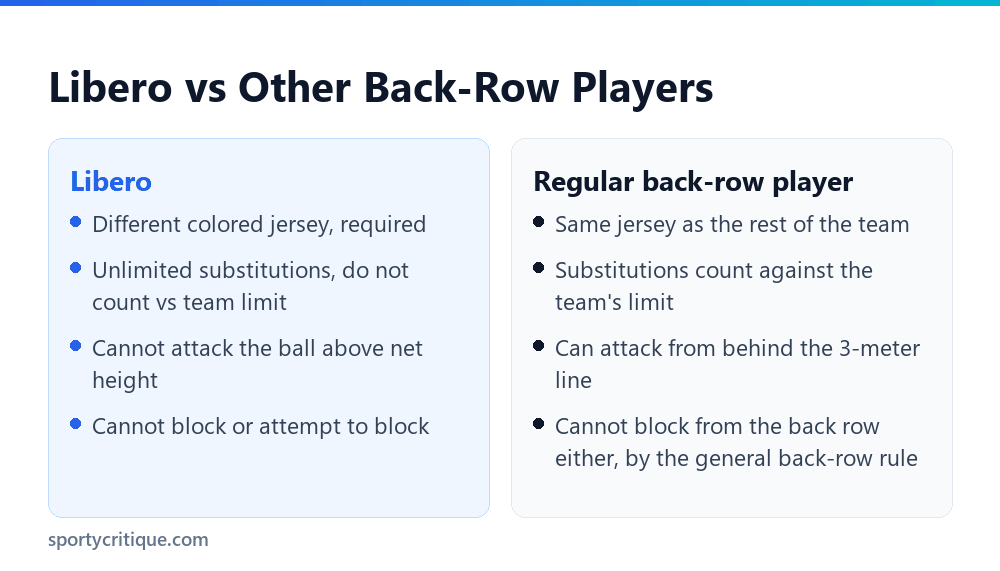
A libero is a back-row defensive specialist whose job is passing serves, digging attacks, and organizing the back-court defense. Liberos wear a different colored jersey, can be substituted in and out without counting against the team’s substitution limit, and cannot attack the ball above net height, block, or attempt to block. Under FIVB international rules the libero never serves; under NCAA, NFHS, and USAV rules in the United States, the libero can serve, but only from one locked rotation spot per set. The position exists specifically to put a team’s best ball-control player on the court as much as the rules allow, without forcing a front-row-caliber attacker to play a purely defensive role.
The libero, from the Italian word for “free,” is the most rule-bound position in volleyball, and also one of the most misunderstood by people new to the sport. It is not a lesser role or a bench-adjacent job; on most competitive teams, the libero is the most technically skilled passer on the roster, and the position’s restrictions exist because that skill set is valuable enough that the rules had to be written specifically to accommodate it.
- →A libero is a back-row-only defensive specialist focused on passing and digging
- →Liberos wear a visually distinct jersey so referees and players can track the position’s rule exceptions in real time
- →Substituting a libero in or out does not count against a team’s regular substitution limit, which is why liberos rotate on and off constantly
- →Liberos cannot attack the ball above net height, block, or attempt to block, regardless of where they are standing on the court
- →Serving rules differ by level: FIVB prohibits it entirely, while NCAA, NFHS, and USAV allow it from one fixed rotation spot per set
Table of Contents
The core job: passing, digging, and directing the defense
A libero’s primary responsibility is serve receive, taking the other team’s serve and delivering a clean, accurate pass to the setter. That single skill, arguably more than any other in volleyball, determines whether an offense can run its full set of plays or gets stuck with a predictable, defense-friendly attack. A team with a strong libero is a team that can run a real offense on nearly every rally; a team without one is constantly scrambling.
Beyond serve receive, the libero is the primary digger against opposing attacks, reading hitters and getting a platform under the ball before it hits the floor. Communication is part of the job description in practice even though it is not written into the rulebook: liberos typically call out coverage, call the other team’s tendencies, and organize where teammates should be positioned on defense, since they have the clearest read on the back court from where they stand.
The jersey rule and why it exists
A libero has to wear a jersey in a color that contrasts clearly with the rest of the team, a rule written specifically so referees can instantly identify who is subject to the position’s restrictions without checking a lineup card mid-rally. It is a small rule with an outsized practical effect: because the color is so visible, it is also how fans and broadcasters usually spot the libero within seconds of watching a match for the first time.
Substitution rules: the freedom that defines the position
Ordinary substitutions in volleyball are limited, most competitive rule sets cap a team at somewhere around 15 per set, and once a starter comes out for a substitute, getting that exact starter back in usually costs another substitution. Libero substitutions do not follow that math. A libero can swap in and out for the same back-row player repeatedly through a set, every single rotation if a coach wants, without touching the team’s regular substitution count at all.
That freedom is the entire reason the position exists in its current form. Before the libero rule was introduced internationally in the late 1990s, a team’s best defensive player either played all six rotations, including front row where their height or attacking limitations became a liability, or sat out entirely. The libero rule lets a team run its best passer through every single back-row rotation without burning a normal substitution to do it.
What a libero cannot do
The restrictions are where most of the confusion for new fans comes from, so it is worth being specific. A libero cannot attack the ball if, at the moment of contact, the entire ball is above the height of the net. That means a libero can still tip or redirect a ball below net height, but a full-power attack on a ball above the tape is not allowed regardless of where on the court the libero is standing, including the back row, where a regular player would be allowed to attack from behind the 3-meter attack line.
A libero also cannot block or attempt to block, which includes jumping with arms raised near the net in a blocking motion even if no contact is made. And a libero cannot set a teammate for an attack using an overhand finger action while standing in front of the attack line if that set happens above net height; the ball would then be dead if a teammate attacked it above the net off that set. A libero can still set with a forearm pass, or set overhand from behind the attack line, without that restriction applying.
⚠️ Watch out: That front-zone overhand-set restriction is the rule most casual fans have never heard of and the one that catches new liberos off guard in practice. It only applies to overhand finger sets taken in front of the attack line; a forearm pass from the same spot has no such restriction.
Can a libero serve? It depends on the rule set
Under FIVB rules, which govern most international and Olympic play, the libero never serves at all. Under NCAA rules, and generally under NFHS and USAV rules that govern most American high school and club play, the libero is allowed to serve, but the rule locks them into a single rotation spot: the first time the libero serves in a set, that specific rotation position becomes their only serving spot for the remainder of that set. Because rule sets genuinely differ here, and some house or recreational leagues follow their own variations, check your specific league’s current rulebook rather than assuming one version applies everywhere.
What makes a good libero
Ball control is the foundational skill: a clean, consistent passing platform that gets the ball to the setter’s target zone under pressure, not just technically in bounds. Reading ability matters nearly as much, recognizing an opposing hitter’s approach and arm swing early enough to get into digging position before contact, since reaction time alone is not fast enough against a hard-driven attack at a high level.
Communication and court awareness round out the role. Because the libero has the clearest view of the back court and is on the floor for nearly every rally, the position often functions as the defense’s on-court organizer, calling out where teammates should shift and flagging patterns in the other team’s attack as a set goes on. A talented passer who cannot communicate under pressure is a less complete libero than one with slightly less raw skill who directs the defense well.
Libero vs defensive specialist: a related but different role
A defensive specialist, often shortened to DS, is a back-row substitute who plays under normal substitution rules rather than the libero’s unlimited swap privilege. Some teams use a DS in addition to a libero, typically to replace a specific hitter in the back row for defensive purposes, while the libero continues to replace the middle blockers specifically, which is the most common pattern at higher levels since middles are usually the weakest back-row passers on a roster relative to their front-row value.
💡 Pro tip: If you are watching a match and trying to identify the libero’s tactical pattern quickly, watch who comes off the court when the middle blockers rotate to the back row. In most systems, that substitution is the libero coming in for exactly that reason.
Gear: what a libero typically wears beyond the jersey
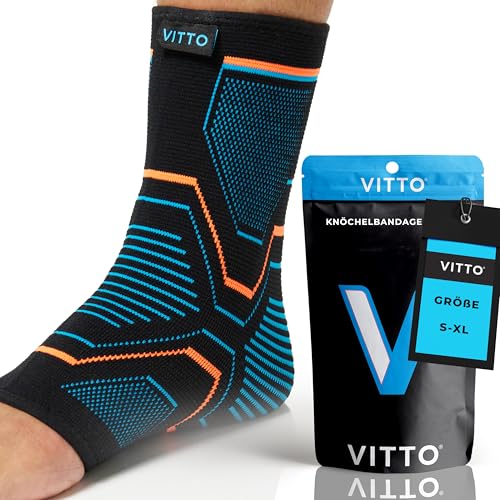
Beyond the required contrasting jersey, liberos spend more time on the floor diving and sliding for digs than almost any other position, which is why knee protection tends to matter more for this role than for a front-row hitter. A low-profile pad like the Mizuno LR6 Volleyball Kneepad is a common choice specifically because it stays out of the way during quick footwork while still cushioning a hard floor contact. Amazon’s listing did not return a live price for this specific model when we checked, so confirm current pricing and size availability on the product page.
How a libero trains differently from other positions
A libero’s training load looks different from a hitter’s or a setter’s from the first week of practice. Where an attacker spends significant time on approach footwork and arm swing mechanics, a libero’s practice time is weighted heavily toward passing platform repetition, reading drills against live hitters, and floor movement, specifically the low, controlled dive and roll technique that lets a player get to a ball without taking the kind of hard fall that ends a session early.
Platform consistency is drilled far more repetitively than most other skills in the sport, because a libero’s passing target is not “anywhere in bounds,” it is a specific zone near the setter that keeps the offense running at full speed. Coaches often track passing accuracy on a numeric scale during practice specifically for liberos and other primary passers, since small platform angle errors that would not matter on a casual pass compound into real offensive limitations at a competitive level.
📊 Note: Reading a hitter’s approach early is a trainable skill, not just reaction speed. Watching film of an opponent’s hitters before a match, specifically their approach angle and arm swing tendencies, is standard preparation at higher levels precisely because it buys a libero the extra fraction of a second that raw reflexes cannot.
A brief note on how the position came to exist
The libero rule was introduced into international volleyball in 1998 and adopted in NCAA play in 2002, created specifically to speed up rallies and raise the level of back-row defense without requiring every team to find a player who could both attack at a competitive level and pass at an elite one. Before the rule existed, a team with a great passer but limited attacking ability had few good options for using that player’s strengths without exposing a weakness elsewhere on the court.
What does a libero do in volleyball, in one sentence?
A libero is a back-row defensive specialist who passes serves, digs attacks, and organizes back-court defense, wearing a contrasting jersey and substituting freely without counting against the team’s normal substitution limit.
Can a libero serve in volleyball?
It depends on the rule set. FIVB international rules prohibit it entirely. NCAA, and generally NFHS and USAV rules in the United States, allow the libero to serve, but only from one locked rotation position per set.
Why does a libero wear a different colored jersey?
So referees, teammates, and opponents can instantly identify who is subject to the position’s rule restrictions, since those restrictions apply in real time during fast-moving rallies.
Can a libero ever attack or block the ball?
A libero can still contact and redirect the ball below net height, including a tip. What is prohibited is attacking a ball that is entirely above net height, and blocking or attempting to block in any situation.
Is a libero a weaker player than other positions?
No. The restrictions are positional rules, not a reflection of skill. Liberos are often a team’s most technically skilled ball-control players, and the position exists to make full use of that specific skill set.
As an Amazon Associate, we earn from qualifying purchases through links on this page.