How to Become a Competitive Foosball Player (An Honest Guide)

Competitive foosball is real and well-organised — the ITSF governs internationally, national associations run ranked tournaments, and there are world championships. The path is: practise daily on the table brand your region uses, join a local league, enter amateur divisions, build ranking points, and find a doubles partner. The honest caveat is that very few players make a living from it; even top-ranked competitors usually keep day jobs, and prize money mostly offsets travel.
“Professional foosball player” sounds like a joke job title, and it isn’t — there’s an international federation, world championships, national rankings, and players who have trained specific shots for a decade.
But it’s also not what most people picture when they hear “professional.” So this guide covers both: the genuine, well-structured competitive route that’s more accessible than almost any other sport, and a straight answer about the money at the end of it.
- →The ITSF governs internationally; national associations run ranked events.
- →Tournaments use tiered divisions, so beginners genuinely can enter.
- →Table brand matters enormously — practise on what your region competes on.
- →One shot at 80% under pressure beats five shots at 50%.
- →Doubles is the premier format and partnerships take years to build.
- →Almost nobody makes a full-time living. Plan around that, not against it.
Table of Contents
The sport is real, and unusually accessible
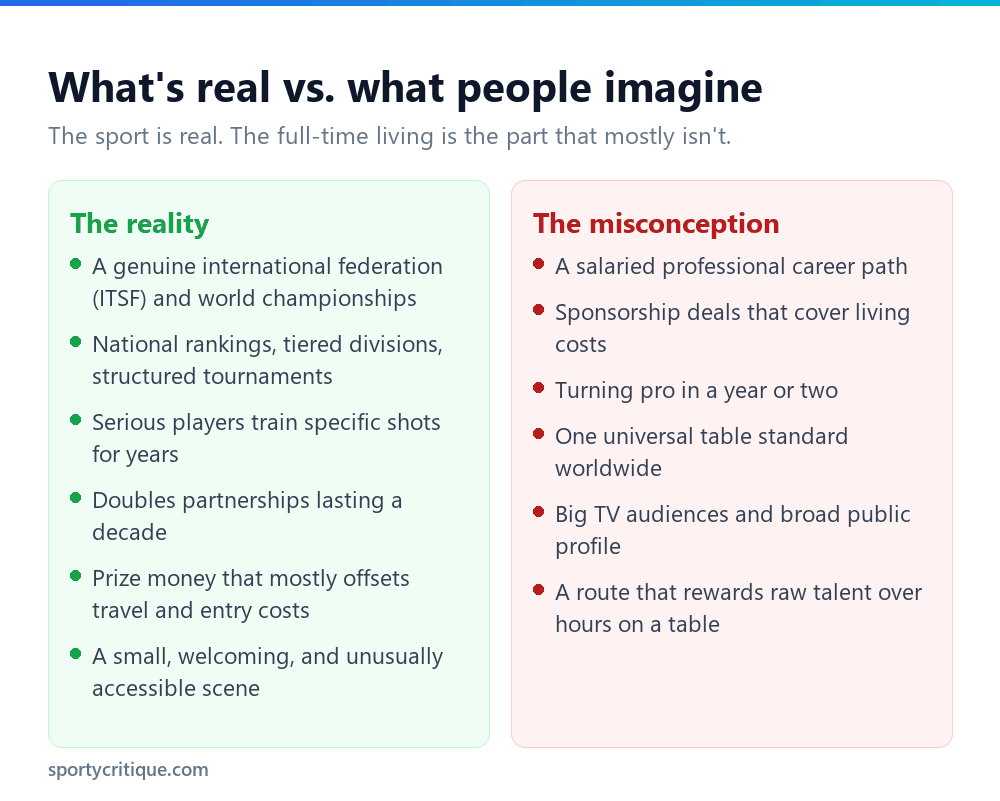
Competitive foosball has a proper structure. The International Table Soccer Federation (ITSF) sits at the top, national associations run domestic circuits and rankings, and there are world championship events drawing players from across Europe, North America, and beyond. Matches are refereed, rules are codified, and — as our rules guide covers — spinning is banned without exception.
What makes it unusual among sports is how short the distance is between the bottom and the top. There’s no youth academy system, no selection pathway you had to enter at eight years old, and no physical prerequisite that rules people out. A determined adult beginner can enter a sanctioned tournament within months, and will find themselves in the same venue as the best players in the country.
The scene is also small and famously welcoming. Top players routinely coach beginners between matches, and the barrier to asking is low. If you’re serious, this is the single biggest advantage available to you — in most sports, access to elite players is the hardest thing to obtain; here, it mostly requires turning up.
In most sports, access to the best players is the hardest thing to get. In foosball it mostly requires turning up to the right tournament and asking.
The path
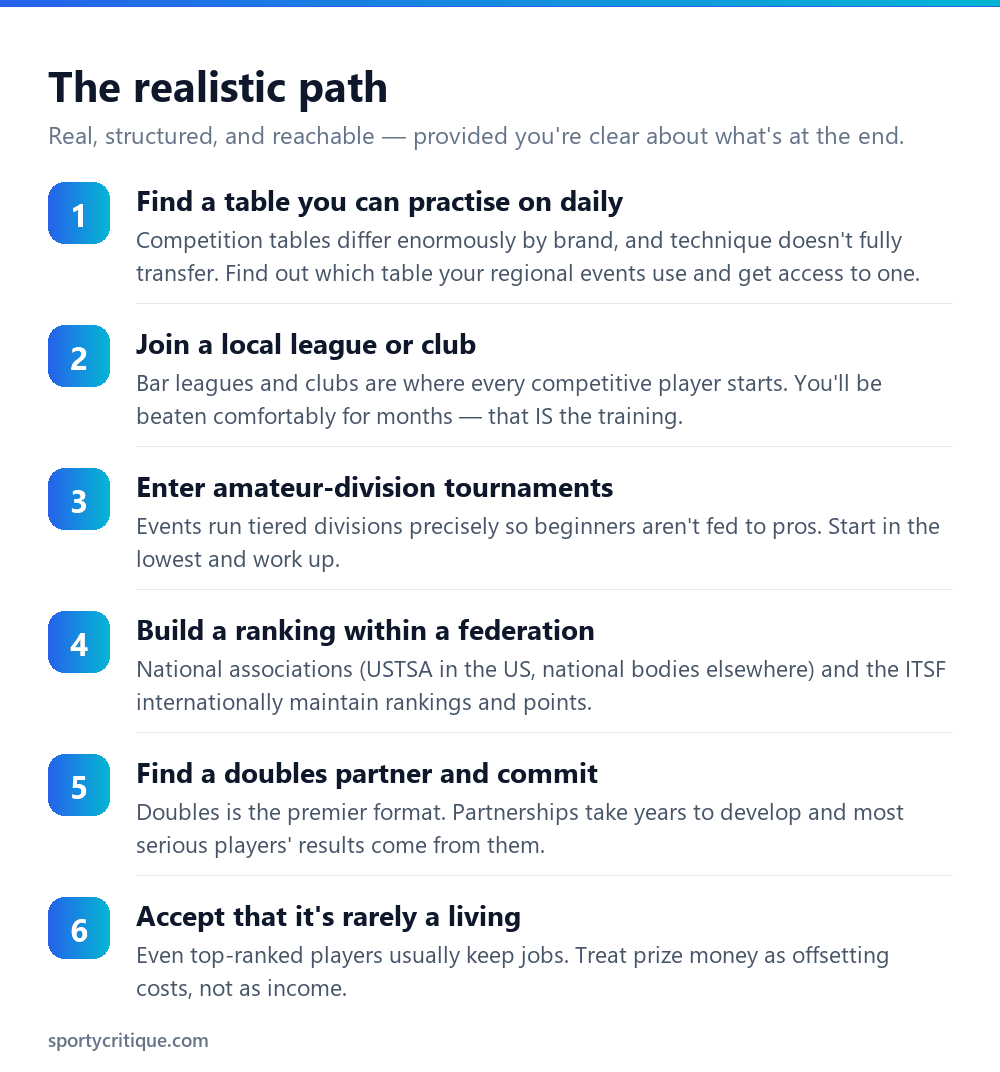
The table brand question comes first, and it’s the step people skip. As covered in our guide to playing foosball, tables differ so much between manufacturers that technique doesn’t fully transfer — a snake shot developed on a Tornado may be impossible on a Bonzini, whose rounded figures and cork ball don’t allow the same pin.
So before investing hundreds of hours, find out what your regional and national events actually use. In the US that’s typically Tornado; in France, Bonzini; in Italy and much of Europe, Garlando or Roberto Sport. Practising on the wrong brand for two years is the most expensive mistake available in this sport, and it’s entirely avoidable with one email to a local organiser.
Then find people better than you. League play against stronger opponents is worth more than any amount of solo drilling, because the gap between a good recreational player and a ranked one is largely about executing under pressure — and pressure can’t be simulated alone. Expect to lose consistently for months. That period is the training, not a sign you shouldn’t be there.
Enter tournaments early. Events run tiered divisions — typically beginner, amateur, semi-pro, and pro — precisely so that new players aren’t thrown against ranked ones. Entering the lowest division at your first event is normal and expected, and a tournament day teaches you more about your weaknesses than a month of practice.
What actually separates competitive players
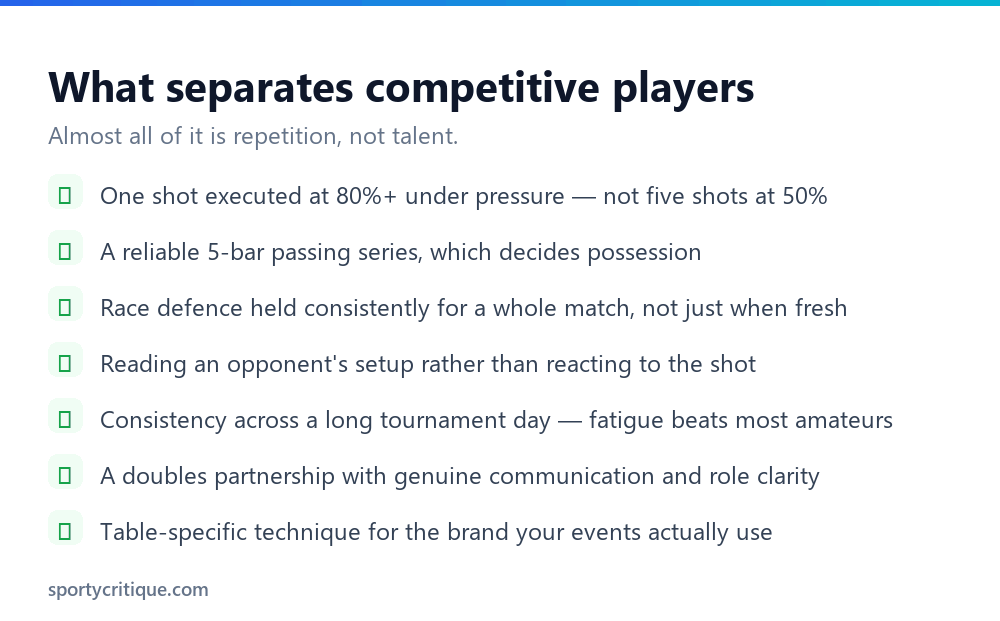
The gap between a strong bar player and a ranked competitor is less about flair than most people assume. Three things account for most of it.
One shot, executed reliably. Serious players typically have a single primary shot — a snake, a pull, a pin — that they’ve drilled for years and can execute at a high percentage under pressure. Recreational players tend to have several shots they can hit sometimes. One shot at eighty percent beats five at fifty, because a defence can only be beaten by something you can produce on demand.
The 5-bar. As our defending guide explains, midfield possession decides matches. Competitive play involves lengthy 5-bar battles that casual players don’t even recognise as a phase of the game — passing series, lane manipulation, and the reading required to intercept. A player without a reliable passing series simply doesn’t get the ball to their attack against good opposition.
Consistency across a day. Tournaments are long, and the fifth match matters as much as the first. Fatigue degrades exactly the things competitive play depends on — grip relaxation, reading, defensive discipline — and amateurs typically fall apart in the late rounds. This is trainable, and mostly it means playing long sessions deliberately rather than only playing when fresh.
How to train
Our general improvement guide covers the foundations underneath all of this — trapping, passing, and the skill ladder. Competitive training assumes those are already solid; if they aren’t, hours spent on advanced shots are wasted.
On equipment: if you’re committing seriously, owning the right table matters more than owning an expensive one. A second-hand competition-brand table is a far better investment than a new premium table of a brand nobody in your region competes on — our buying guide makes the case for buying used at length.
How tournaments actually run
Knowing the format before your first event removes most of the intimidation, because the structure is more forgiving than people expect.
Draw-your-partner deserves singling out as the best possible entry point. Because partners are assigned randomly, a complete newcomer can end up playing alongside a highly ranked player — who will typically spend the match quietly coaching. It’s the fastest way to understand what the level above you actually looks like, and it costs the same as any other event.
The other thing to know is that double elimination means your first loss isn’t the end of the day. New players often assume they’ll be knocked out in ten minutes and go home; in practice you’re guaranteed at least two matches, and usually get a long day of foosball for your entry fee.
The money, honestly
This deserves a plain answer, because plenty of pages on this topic are vague about it.
Competitive foosball has prize money, and at the largest international events it can be substantial for the winners. What it does not have, for the overwhelming majority of ranked players, is enough money to live on. Most top competitors hold regular jobs and treat foosball as a serious, expensive hobby that occasionally pays for itself.
The costs run the other way too: tournament entry fees, travel, accommodation for multi-day events, and equipment. A realistic view is that a successful competitive season offsets a good portion of its own costs, and a very successful one turns a modest profit. Sponsorship exists but is typically equipment-based rather than salaried.
None of that is a reason not to pursue it. It’s a reason to pursue it for the right motives — the competition, the craft, and a scene that’s genuinely enjoyable to belong to — rather than as a career plan. Players who go in expecting a living tend to burn out; players who go in wanting to be good at something difficult tend to stay for decades.
📊 Note: If you want a sense of the standard before committing, watch footage of ITSF or national championship matches. The gap between that and bar foosball is roughly the gap between a driveway hoop and professional basketball — and seeing it clearly is useful for setting expectations early.
Frequently asked questions
Is professional foosball a real thing?
Yes. The ITSF governs internationally, national associations run ranked circuits, and world championships are held annually with players from across Europe and North America. What’s rare is making a full-time living from it — most ranked players hold day jobs and treat prize money as offsetting costs.
How long does it take to become competitive at foosball?
With daily practice and regular league play, most people can compete respectably in amateur divisions within a year or two. Reaching the top national tier typically takes many years of dedicated work on a specific table brand. The scene’s accessibility means you can enter sanctioned events long before you’re good — and should.
Do I need a specific brand of table to compete?
Effectively yes, and it’s the most-skipped step. Tables differ so much that shots developed on one brand may be impossible on another. Find out what your regional and national events use — Tornado in much of the US, Bonzini in France, Garlando and Roberto Sport elsewhere in Europe — and practise on that.
Can I enter a foosball tournament as a beginner?
Yes. Events run tiered divisions specifically so beginners aren’t matched against ranked players, and entering the lowest division at your first event is completely normal. A tournament day will teach you more about your weaknesses than a month of practice, and the scene is unusually welcoming to newcomers.
What’s the most important skill for competitive foosball?
A reliable 5-bar passing series, closely followed by one primary shot you can execute at a high percentage under pressure. Possession decides matches, and a player who can’t move the ball from midfield to attack against a real defence won’t get to use their shot at all.
Is singles or doubles more important?
Doubles is generally the premier format at major events, and most serious players’ best results come from a long-term partnership. Partnerships take years to develop genuine communication and role clarity, which is why players tend to stick with one partner rather than rotating.
- →How to get better at foosball — the foundations underneath all of this
- →How to defend in foosball — race defence and reading shots
- →How to play foosball — the real rules, including the spinning ban
- →Choosing a foosball table — buying the brand you compete on