How to Block in Volleyball (Timing, Footwork & Hand Position)

To block in volleyball, get into ready position at the net with knees bent and hands near shoulder height, read the setter to identify which hitter to prepare for, move into position with a shuffle or crossover step, and time your jump to the hitter’s arm swing rather than the ball itself — jumping slightly after the hitter, not with them. Reach over the net with spread fingers and thumbs up, since penetrating the net plane matters more than jump height alone.
Table of Contents
The mechanics of a real block
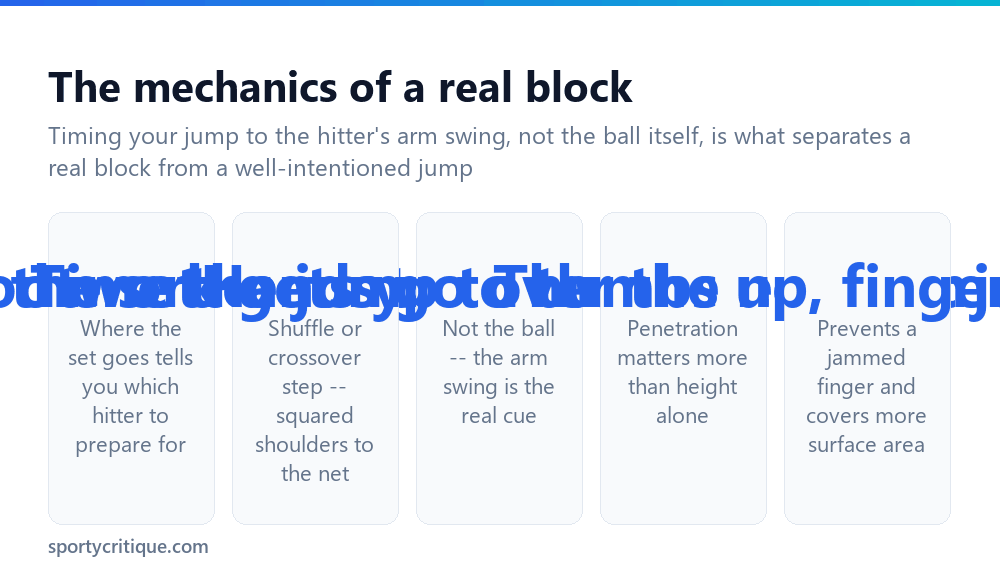
Read the setter first — where the set actually goes tells you which hitter to prepare for, and reading this early gives you the time to actually get into position rather than reacting to the hit itself.
Footwork gets you square — a shuffle step works for short lateral distances, while a crossover step covers ground faster for longer moves along the net, with shoulders staying squared to the net throughout.
Time the jump to the hitter’s arm, not the ball — the ball’s flight is too fast to react to directly, but the hitter’s arm swing gives a visible, trackable cue that lets you time your jump accurately.
Hands go over the net, not just up — genuine net penetration, reaching your hands onto the opponent’s side of the net plane, matters more for an effective block than raw vertical jump height alone.
Thumbs up, fingers spread — this hand position prevents a jammed finger on contact and covers meaningfully more surface area than a closed or poorly-angled hand.
Timing your jump to the hitter’s arm swing, not the ball, is what actually separates a real block from a well-intentioned jump that arrives too early or too late to matter.
Executing a block
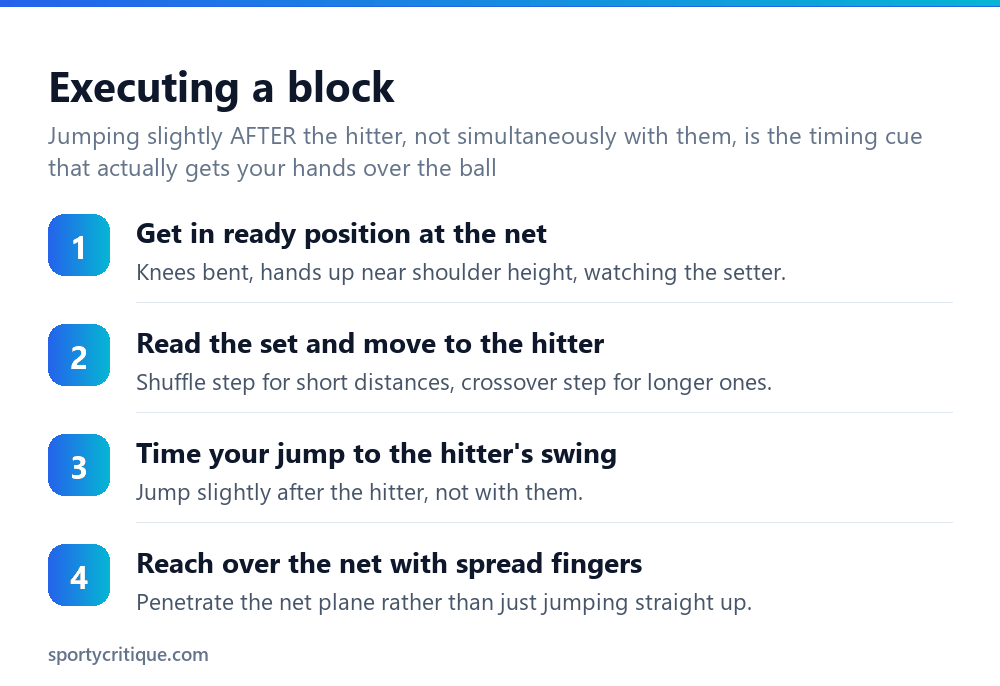
Get in ready position at the net — knees bent, hands up near shoulder height, actively watching the setter rather than standing flat-footed and reactive.
Read the set and move to the hitter — using a shuffle step for short distances or a crossover step for longer ones, keeping shoulders squared to the net the entire time.
Time your jump to the hitter’s swing — jumping slightly after the hitter begins their approach, not simultaneously with them, which is the timing adjustment that actually gets your hands over the ball rather than under it.
Reach over the net with spread fingers — genuinely penetrating the net plane rather than simply jumping straight up and hoping for contact.
Single vs. double blocking
A single block is one player closing on a hitter alone, generally used against a quick, well-covered attack where there’s no time to bring a second blocker over. A double block brings two players together to seal a larger portion of the net, typically used against a team’s primary outside hitter where the extra coverage is worth the coordination it requires. Communication between blockers — calling out who’s taking the outside hand position versus the inside — is what actually makes a double block effective rather than two players jumping independently and leaving gaps between them.
Protecting your joints while blocking
Repeated blocking, especially on a hard indoor court, puts real cumulative strain on knees and ankles from the frequent jumping and landing involved — landing with knees bent to absorb impact matters, and many serious players also use a supportive knee brace built for volleyball-specific lateral movement and repeated jumping specifically for the joint support that a full season of blocking reps demands.
As an Amazon Associate, we earn from qualifying purchases through links on this page.
A worked example: fixing a blocker who keeps getting tooled
Say a middle blocker is consistently getting scored on with off-speed shots and tips just over their outstretched hands — what players call getting “tooled” — despite genuinely good jump height and reasonable timing on hard-driven attacks.
The actual issue here usually isn’t athleticism at all — it’s that the blocker is committing fully to blocking every hard-driven swing and leaving their hands rigid and locked once they’re in the air, with no ability to react if the hitter tips or rolls a shot off their fingers instead of swinging through it. The fix is training “soft hands” for exactly this scenario: staying square and ready through the jump rather than lunging aggressively at the anticipated swing, which keeps the blocker in a position to actually redirect a tip rather than just fully committing to stop a hard hit that may not even come.
A simple drill for this: a partner alternates unpredictably between hard swings and soft tips during blocking reps, forcing the blocker to genuinely read the hit in the moment rather than pre-committing to one response before the hitter even makes contact. Over repeated reps, this builds the actual in-air reaction most blockers who get “tooled” repeatedly are missing.
Blocking against a quick or deceptive attack
A genuinely fast-tempo offense — quick sets, a hitter approaching before the block is fully set — changes the blocking calculus considerably from blocking a slower, high-arcing set. Against tempo, a blocker often has to commit to a position earlier and with less certainty about exactly where the set will end up, trading some precision for simply getting a hand up in time at all.
Against a genuinely deceptive hitter — one who disguises a tip or off-speed shot behind an identical approach and arm swing to their hard attack — the read shifts from the arm swing itself to watching the hitter’s contact point and wrist snap in the final instant before contact, a subtler cue that takes real repetition to pick up reliably.
Blocking as a shorter player
Height genuinely helps blocking, but it isn’t the whole story — timing precision matters more for a shorter blocker specifically, since there’s less margin for a mistimed jump to still result in a contact block. A shorter player who reads the hitter’s arm swing accurately and penetrates the net cleanly on a well-timed jump can still block effectively against a taller hitter, while a taller player with sloppy timing frequently doesn’t.
Approach jump technique also matters proportionally more for a shorter blocker — a strong, quick approach jump (rather than a flat-footed standing jump) can add real inches of effective reach, meaningfully closing the gap against taller hitters when technique is genuinely dialed in and practiced consistently over time.
Some shorter blockers also find success specifically targeting the block toward a hitter’s cross-court angle rather than trying to take away the whole net, since committing fully to one realistic angle is more achievable than attempting to cover every possible shot a taller blocker might contest more completely across the width of the net during a single point.
None of these adjustments replace fundamentals — they’re refinements that matter once the core timing and hand-position mechanics above are already solid.
Block breaking down?
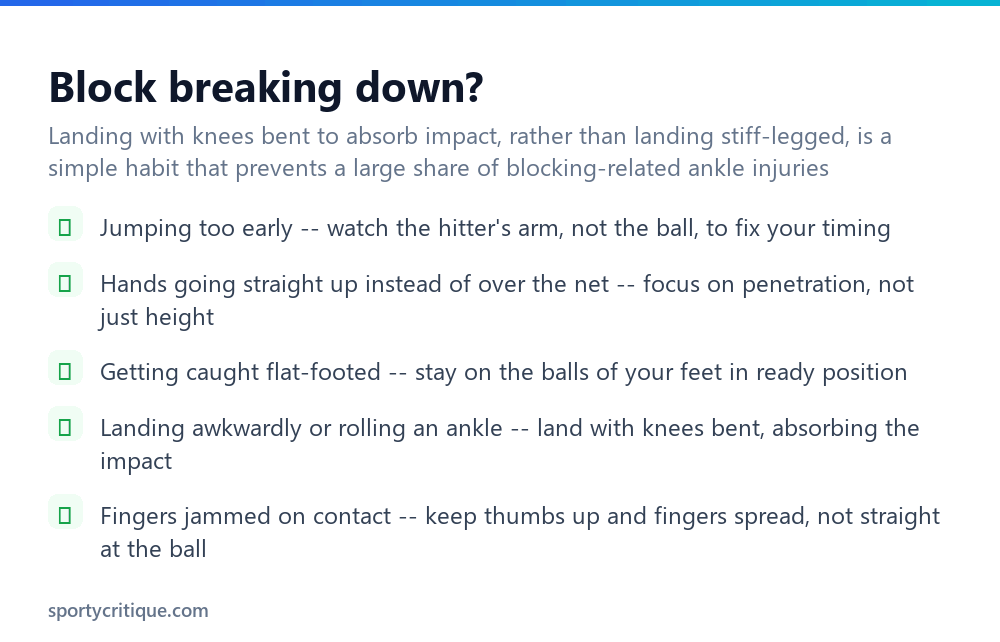
Jumping too early — watch the hitter’s arm swing specifically, not the ball, to correct your timing.
Hands going straight up instead of over the net — focus specifically on penetration over the net plane, not just maximizing jump height.
Getting caught flat-footed — stay on the balls of your feet in ready position rather than standing flat and reactive.
Landing awkwardly or rolling an ankle — land with knees bent, actively absorbing the impact rather than landing stiff-legged.
Fingers getting jammed on contact — keep thumbs up and fingers genuinely spread, rather than pointing straight and rigid at the ball.
- ✓Read the setter early to identify which hitter you’re actually blocking
- ✓Time your jump to the hitter’s arm swing, not the ball itself
- ✓Reach over the net with spread fingers rather than just jumping straight up
- ✓Communicate clearly with a partner on any double block attempt
- ✓Land with knees bent to absorb impact and protect your joints
- ✕Watching the ball instead of the hitter’s arm for your jump timing
- ✕Jumping straight up without genuinely penetrating the net plane
- ✕Standing flat-footed in ready position instead of staying on the balls of your feet
- ✕Attempting a double block with no communication about hand positioning
- ✕Landing stiff-legged repeatedly, building cumulative joint strain over a season
Frequently asked questions
How do I block in volleyball?
Get in ready position at the net, read the setter, move with a shuffle or crossover step, time your jump to the hitter’s arm swing, and reach over the net with spread fingers.
Should I time my block to the ball or the hitter?
The hitter’s arm swing. The ball moves too fast to react to directly, but the arm swing gives a trackable cue for accurate jump timing.
What’s the difference between a single and double block?
A single block is one player alone; a double block brings two players together to seal more of the net, requiring clear communication to avoid gaps.
Why do my blocking attempts jump too early?
You’re likely watching the ball instead of the hitter’s arm swing. Shift your focus to the arm to correct your timing.
How do I avoid jamming my fingers while blocking?
Keep your thumbs up and fingers spread on contact, rather than pointing them straight and rigid at the ball.
How can I protect my knees from repeated blocking?
Land with knees bent to absorb impact on every jump, and consider a volleyball-specific knee brace for added support over a full season.
- →Learn the attack this skill defends against: how to spike a volleyball
- →Understand the full rules and rotation: how to play volleyball
- →Protect your knees during dives too: best knee brace for volleyball