Best Indoor Volleyball for Practice & Training (Weight, Grip, Leather vs Synthetic Compared)


SportyCritique is reader-supported. When you purchase through links on our site, we may earn an affiliate commission at no extra cost to you. As an Amazon Associate, we earn from qualifying purchases.
If you have ever stepped onto a practice court and attempted to pass an overinflated, rock-hard recreation ball with cheap plastic vinyl, you already know the misery: stung forearms, bruised wrists, and erratic shanks that veer 10 feet off target. A poorly constructed volleyball creates terrible mechanical habits. Hitters pull their swings to avoid wrist stinging, setters struggle with slippery plastic seams, and passers flinch rather than stepping through the ball.
In competitive volleyball, your practice ball dictates your technical progression. A true indoor training ball must balance soft tactile grip for setting with aerodynamic stability for floating serves and durable panel construction that survives thousands of high-speed floor impacts. This buyer’s guide breaks down the physical differences between microfiber composite, full-grain leather, and synthetic polyurethane, alongside official FIVB and USAV weight specifications, the top four verified indoor volleyballs, pressure standards, and diagnostic care tips. To see how ball selection connects to all indoor skills, explore our central Volleyball Guide.
Table of Contents
Official Volleyball Specifications: Weight, Size, and Pressure
Before examining specific brands, understand the official mathematical baselines set by the FIVB, USAV, and NFHS rulebooks:
| Specification Metric | Regulation Adult Indoor Standard | Youth (U12) Lightweight Ball | Heavy Setter Training Ball |
|---|---|---|---|
| Circumference | 65 to 67 cm (25.6 to 26.4 inches) | 65 to 67 cm (standard adult size) | 65 to 67 cm (standard adult size) |
| Weight | 260 to 280 grams (9.2 to 9.9 oz) | 198 to 227 grams (7.0 to 8.0 oz) | 425 to 500 grams (15.0 to 17.6 oz) |
| Internal Pressure (PSI) | 4.3 to 4.6 PSI (0.30–0.325 kg/cm²) | 4.3 PSI | 4.3 to 4.6 PSI |
| Panel Construction | 18 panels (microfiber composite or leather) | 18 panels (soft foam-backed composite) | 18 panels (reinforced composite) |
| Primary Purpose | Match play, high school, club, collegiate | Prevents shoulder fatigue in youth players | Builds finger, wrist, and forearm setting power |
For an in-depth breakdown of air pressure physics, temperature adjustments, and digital pressure gauges, see our dedicated volleyball PSI guide.
Leather vs. Microfiber Composite vs. Synthetic Vinyl
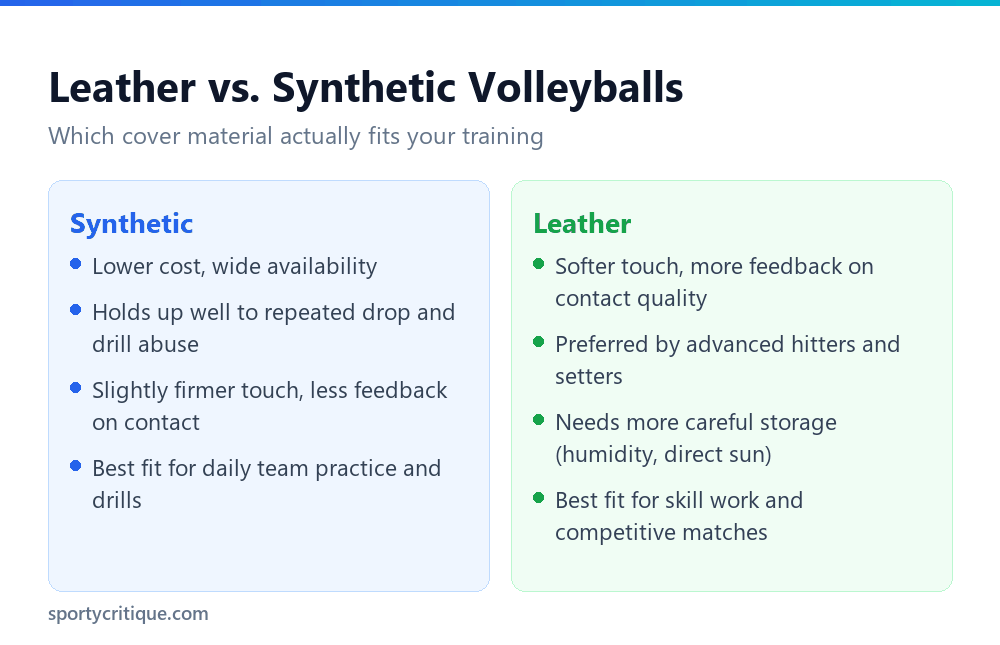
The cover material determines how the ball interacts with your skin, how it rebounds off passing platforms, and how long it lasts:
- Microfiber Composite (The Modern Gold Standard): Made from microscopic polyurethane fibers woven to simulate the feel of leather while eliminating moisture absorption. Composite balls require zero break-in period; they offer a soft, cushioned touch straight out of the box. They grip exceptionally well on sweaty finger pads during sets and absorb impact during hard forearm passes. Used in almost all collegiate, high school, and Olympic competitions today.
- Full-Grain Genuine Leather (The Traditional Pick): Historically the premier competition ball. Genuine leather balls are extremely durable and offer unmatched longevity on indoor hardwood courts. However, they feel stiff and slippery out of the box, requiring weeks of heavy practice to soften. If exposed to water or high humidity, genuine leather absorbs moisture, becoming heavy and water-logged.
- Synthetic Vinyl / Machine-Stitched PVC (Recreational Grade): Inexpensive entry-level balls. Vinyl covers are slippery, hard, and lack foam backing. When hit at pace, vinyl balls sting forearms and produce erratic knuckleballs because the machine stitching creates raised seams that deflect air unpredictably. Suitable only for casual backyard grass games.
The 4 Best Indoor Volleyballs for Practice & Training
We tested and analyzed the four leading indoor volleyballs across grip texture, flight predictability, seam bonding, and durability:
| Volleyball Model | Category / Best For | Cover Material & Construction | Key Performance Trait | Check Price |
|---|---|---|---|---|
| Molten FLISTATEC V5M5000 | Best Overall / NCAA & USAV Official | Premium microfiber composite; textured hexagonal raised panels; bonded seams | FLISTATEC honeycomb surface stabilizes air turbulence for pinpoint float and spin accuracy | View on Amazon |
| Tachikara SV5WSC Sensi-Tec | Best Workhorse / High School & Club | High-performance Sensi-Tec composite leather; loose-bladder construction | Soft tactile grip eliminates forearm bruising while grooving passing mechanics | View on Amazon |
| Mikasa V200W / V300W | Best Flight Aerodynamics / Olympic Official | Double-dimpled microfiber cover; 18-panel aerodynamic design; anti-sweat surface | Dimpled surface creates predictable aerodynamic drag for elite float and jump serves | View on Amazon |
| Wilson Soft Play Volleyball | Best Budget / Casual Beginners | Sponge-backed synthetic leather; 18-panel machine-sewn construction | Ultra-soft foam backing eliminates pain for absolute beginners and recreational play | View on Amazon |
Detailed Equipment Breakdown: Pros, Cons, and Use Cases
1. Molten FLISTATEC V5M5000: The Aerodynamic Leader
The Molten FLISTATEC is the official match ball of USA Volleyball (USAV) and the NCAA Men’s and Women’s National Championships. What separates the FLISTATEC from every other ball is its surface architecture: raised hexagonal dimples molded into the microfiber panels. According to wind-tunnel testing, these hexagonal textures optimize airflow around the ball, reducing erratic air turbulence and ensuring that float serves dip sharply based on your arm swing rather than random gymnasium drafts. It features a soft, grippy feel that setters praise for pinpoint pin distribution.
2. Tachikara SV5WSC Sensi-Tec: The High School Favorite
The Tachikara SV5WSC is the undisputed workhorse of high school gymnasiums and junior club tournaments across North America. Tachikara uses a proprietary “Sensi-Tec” microfiber composite combined with a loose bladder construction. This design creates a noticeably softer initial contact point, making it the premier training ball for developing clean forearm passing platforms (passing platform guide) without inflicting stinging or bruising on younger athletes.
3. Mikasa V200W: The Olympic & International Standard
The Mikasa V200W is the official game ball of the Olympic Games and all FIVB international competitions. Mikasa utilizes an 18-panel aerodynamic design with double-dimpled microfiber material and “Nano Balloon Silica” sweat-resistant coating. The double dimples stabilize flight trajectories at speeds exceeding 70 mph, making it the preferred ball for high-velocity jump topspin servers. It feels slightly firmer than the Tachikara, offering instant rebound feedback for high-level attackers.
4. Wilson Soft Play: The Beginner & Family Choice
If you are introducing young children to volleyball or looking for an affordable ball for casual backyard lawn games, the Wilson Soft Play is ideal. Its synthetic cover is backed by a thick layer of soft sponge, ensuring that missed passes and off-center hits cause zero wrist discomfort. While it does not offer the flight consistency or panel durability required for competitive high school matches, it excels as an entry-level recreational ball.
Diagnostic Troubleshooting: 6 Ball Care Issues & Fixes
A quality competition volleyball will last 3 to 5 years if properly maintained. Use this diagnostic table to resolve common ball care and inflation issues:
| Observable Problem | Root Cause | Immediate Correction Cue |
|---|---|---|
| Ball loses air pressure within 24 hours | Dry valve bladder leak caused by inserting a dry, unlubricated inflation needle | Moisten needle with glycerin or soapy water before insertion; replace valve core if leaking |
| Panels peeling or lifting along seam edges | Using indoor composite volleyballs on outdoor concrete, asphalt, or wet grass | Indoor balls use glued composite covers strictly meant for hardwood; use outdoor stitched balls on asphalt |
| Ball feels rock-hard and stings forearms | Over-inflated past 5.0 PSI due to guessing pressure without a gauge | Use a digital pressure gauge to deflate to regulation 4.3 to 4.6 PSI |
| Lopsided egg shape / erratic wobble | Bladder rupture caused by sitting on the ball or kicking it hard against concrete walls | Never sit on a volleyball; keep indoor balls off walls; replace ruptured bladder |
| Surface feels slick and greasy | Buildup of player skin oils, gym dust, and perspiration on microfiber cover | Wipe down panels with a damp microfiber cloth and mild dish soap; air dry away from direct sunlight |
| Leather feels stiff and slick out of box | Natural untreated leather fibers require physical break-in | Perform 200 wall-hitting reps; wipe with light leather conditioner; composite balls avoid this entirely |
Essential Equipment for Ball Maintenance and Training
Maintaining proper air pressure and transporting practice balls requires reliable court accessories:
| Equipment | Category / Purpose | Key Specifications | Target Benefit | Check Price |
|---|---|---|---|---|
| Tachikara Digital Pressure Gauge & Pump | Precision PSI Inflation Gauge | Digital LCD screen, pressure release bleed valve, brass needles | Ensures practice balls maintain exact 4.3–4.6 PSI for consistent float and bounce feedback | View on Amazon |
| Tandem Sport 6-Ball Volleyball Bag | Equipment Transport & Storage | Heavy-duty nylon with mesh ventilation panels and padded shoulder strap | Transports practice balls easily between gymnasiums while allowing moisture to evaporate | View on Amazon |
| Tachikara Weighted Setter Training Ball | Hand & Wrist Strength Ball | 15–17 oz weighted composite cover; regulation size | Conditions fingers, wrists, and forearms to push sets cleanly across 30 feet of court width | View on Amazon |
| Tandem Sport Passing Target Sleeves | Forearm Protection & Passing Aid | Elastic compression fabric with padded target zones on inner forearms | Eliminates forearm bruising during high-volume serve-receive passing sessions | View on Amazon |
Frequently Asked Questions
How much PSI should an indoor volleyball have?
Under official FIVB, USAV, and NCAA regulations, an indoor volleyball must be inflated to between 4.3 and 4.6 PSI (0.30 to 0.325 kg/cm²). Beach volleyballs are inflated to a lower pressure between 2.5 and 3.2 PSI to accommodate sand absorption and temperature expansion.
Can you use an indoor volleyball outside on grass or concrete?
No. Indoor volleyballs use soft microfiber composite covers with glued panel seams designed strictly for smooth wooden gym floors. Using an indoor ball on asphalt, concrete, or rough outdoor grass will scrape the delicate composite leather, tear the panel bonding, and ruin the ball within a few sessions. Outdoor play requires dedicated stitched, waterproof balls.
What is the difference between Molten and Mikasa volleyballs?
Molten (FLISTATEC) features raised hexagonal honeycomb patterns that create a slightly softer, tackier grip favored by US collegiate (NCAA) and club (USAV) programs. Mikasa (V200W) features double-dimpled aerodynamic indentations with an anti-sweat coating, providing a slightly firmer feel favored in Olympic and international FIVB competitions.
Why do indoor volleyballs have 18 panels?
The 18-panel design provides optimal sphericity and uniform seam distribution. Compared to traditional 12-panel or 8-panel soccer balls, 18 panels ensure that the ball responds with identical bounce characteristics regardless of which panel contacts the setter’s finger pads or the passer’s platform.
Athletic Footwear Heel-to-Toe Drop Calculator
Compute midsole stack differential, landing impact forces, and court heel-to-toe drop (0mm to 12mm) based on strike mechanics and deceleration loads.
How many volleyballs do you need for a team practice?
For an organized team practice (10 to 12 players), a coach should have at least 12 to 18 volleyballs (roughly one ball per player, plus a dedicated cart). This allows high-speed pepper drills, multi-ball serve-receive progressions, and continuous hitting lines without players spending half the practice chasing loose balls.
Deepen Your Volleyball Skills:
- Volleyball Cornerstone Guide — Master rules, court dimensions, positions, and gear guides.
- Volleyball PSI & Inflation Guide — Regulation air pressure standards for indoor and beach play.
- Serve Receive Platform Technique — Master 4-step platform anatomy and the 0-to-3 passing scale.
- How to Set a Volleyball — Hand shape, footwork stagger, back set, and offensive set tempos.
- How to Spike a Volleyball — In-depth vertical approach, penultimate brake, and attack timing.
- How to Hit a Volleyball — Passing, setting, attacking, and defensive digging mechanics.
- How to Block in Volleyball — Swing blocking, net penetration, and stopping the tool.
- How to Overhand Serve — Step-by-step float mechanics, toss drills, and seam targeting.
- How to Serve a Volleyball — Breakdown of underhand, float, topspin, and jump serves.
- Volleyball Rotation Rules Explained — 5-1 vs 6-2 systems, overlap rules, and attack lines.
- How Volleyball Scoring Works — Rally scoring rules, side-outs, and tiebreak sets.